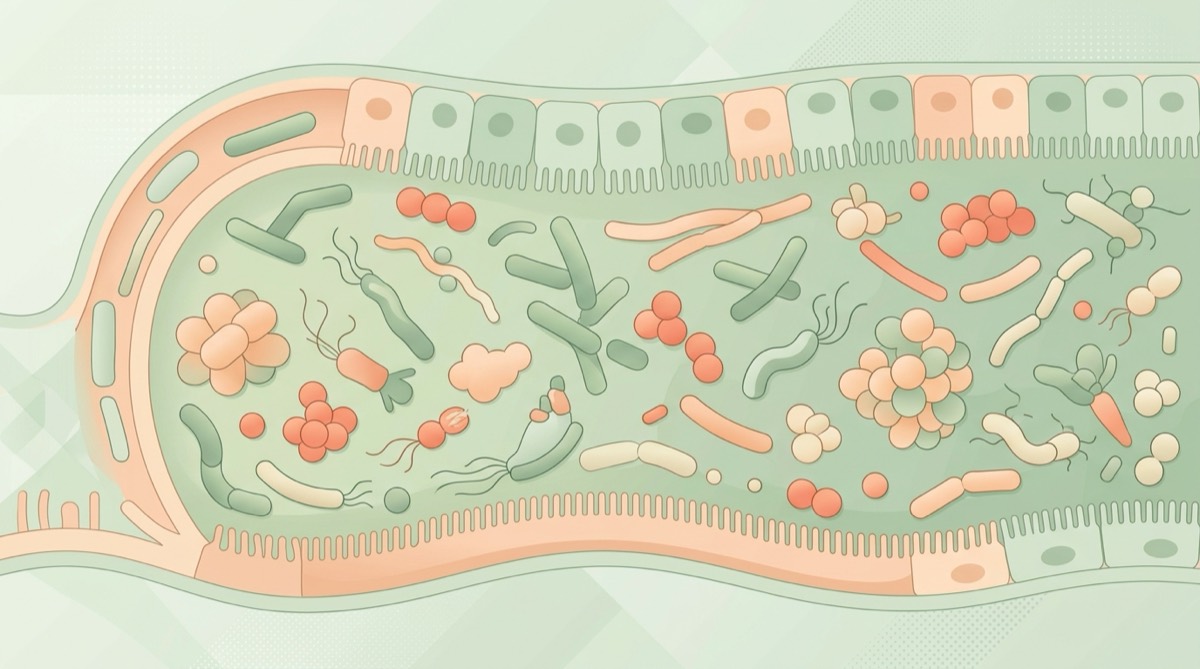
Brain fog is geen enkele diagnose. Soms draagt de darm bij; soms domineren slaap of glucose.
Wat eerst telt
Definieer uw patroon: na de maaltijd, ochtend, einde van de dag of constant. Test daarna een digestieve variabele tegelijk.
- Ontsteking en microbiota kunnen signalen naar het brein veranderen
- Nachtelijke reflux en gefragmenteerde slaap bootsen darm-fog na
- Zware of histamine-rijke maaltijden verergeren het bij sommigen
Details die echt helpen
Hoe testen
Vereenvoudig maaltijden 2 weken, bescherm slaap, verminder alcohol en log helderheid. Geen signaal: bredere evaluatie.
Het kader van twee weken
-
Wel: fog + maaltijden loggen
-
Wel: een variabele per week
-
Wel: 7 uur slaap beschermen
-
Wel: medicatie met clinicus nalopen
-
Niet: altijd alleen de darm de schuld geven
-
Niet: nootropica zonder basis stapelen
-
Niet: apneu negeren
-
Niet: eeuwige eliminatiedieten
Waarschuwingssignalen — zoek hulp bij:
- onverklaarbaar gewichtsverlies
- zwarte ontlasting
- aanhoudend braken
- flauwvallen
- hevige nachtpijn
- bloed in de ontlasting
Veelgestelde vragen
Hoe weet ik of het intestinaal is?
Als stabiliseren van eten, timing en slaap helpt, is de darm plausibel. Bij constante fog met neuro rode vlaggen: eerst kliniek.
Bronnen
-
Ford AC, et al. American College of Gastroenterology monograph on the management of irritable bowel syndrome. Am J Gastroenterol. 2024;119(S1):S2-S31.
-
Vasant DH, et al. British Society of Gastroenterology guidelines for the management of irritable bowel syndrome. Gut. 2024;73(7):1027-1058.
-
Mayer EA. Gut Feelings: The Connection Between the Brain and the Digestive System. Penguin Random House. 2024.
-
Camilleri M. Functional gastrointestinal disorders: advances in understanding and management. Lancet. 2024;403(10425):368-382.
-
Giloteaux L, et al. Reduced diversity and altered composition of the gut microbiome in individuals with myalgic encephalomyelitis/chronic fatigue syndrome. Microbiome. 2016;4(1):30.
-
Institute of Medicine. Beyond Myalgic Encephalomyelitis/Chronic Fatigue Syndrome: Redefining an Illness. National Academies Press. 2024.
-
Lomer MCE, et al. Review article: the aetiology, investigation and management of fatigue in inflammatory bowel disease. Aliment Pharmacol Ther. 2023;58(3):269-283.
-
Black CJ, Ford AC. Global burden of irritable bowel syndrome: trends, predictions, and risk factors. Nat Rev Gastroenterol Hepatol. 2024;21(5):323-336.
-
Harvard Health. The gut-brain connection. 2023. https://www.health.harvard.edu/diseases-and-conditions/the-gut-brain-connection
-
NIDDK. Digestive Diseases and Symptoms. 2024. https://www.niddk.nih.gov/
-
CDC. ME/CFS Information for Healthcare Providers. 2024. https://www.cdc.gov/me-cfs/
-
NIH PMC. Gut microbiome and human health review. 2024. https://pmc.ncbi.nlm.nih.gov/articles/PMC10384867/
-
Cleveland Clinic. Brain-Gut Connection. 2024. https://my.clevelandclinic.org/
-
ISAPP. International Scientific Association for Probiotics and Prebiotics Consensus Statement. 2024. https://isappscience.org/
-
Chey WD, et al. ACG Clinical Guideline: Management of Celiac Disease. Am J Gastroenterol. 2024;119(2):203-222.
-
Rezaie A, et al. Hydrogen and Methane-Based Breath Testing in Gastrointestinal Disorders: The North American Consensus. Am J Gastroenterol. 2024;119(5):775-792.