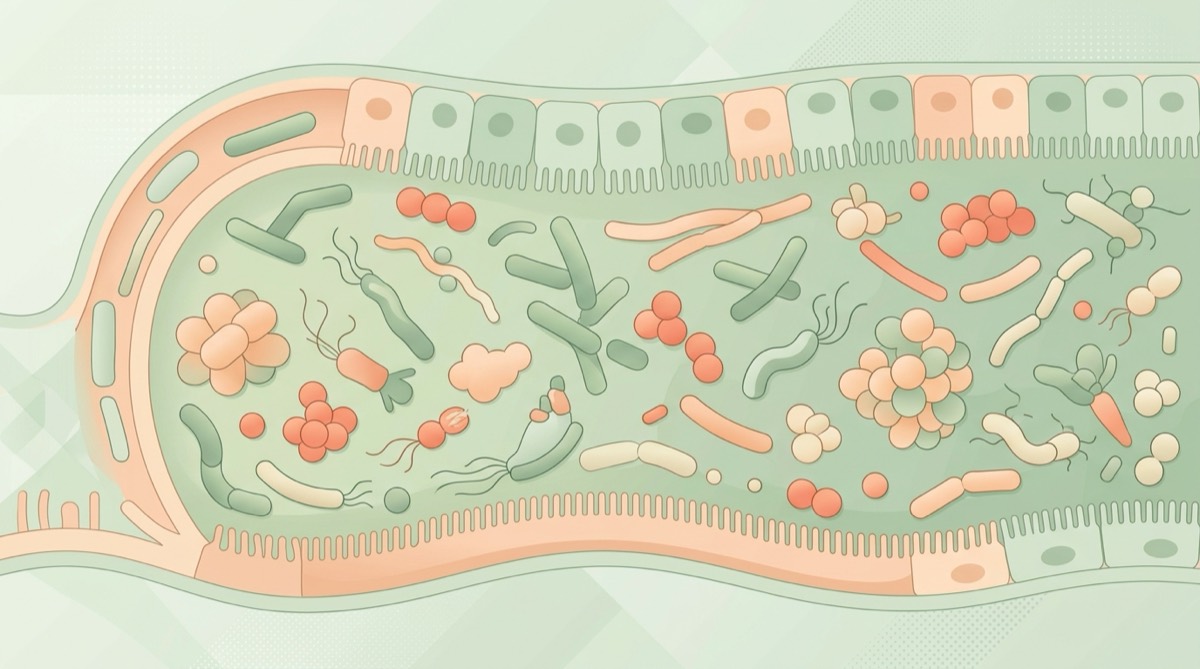
Brain Fog ist keine einzelne Diagnose. Manchmal traegt der Darm bei; manchmal dominieren Schlaf oder Glucose.
Was zuerst zählt
Definieren Sie Ihr Muster: postprandial, morgens, tagesende oder konstant. Dann eine Verdauungsvariable zugleich testen.
- Entzuendung und Mikrobiom koennen Hirnsignale veraendern
- Naechtlicher Reflux und fragmentierter Schlaf imitieren Darm-Fog
- Schwere oder histaminreiche Mahlzeiten verschaerfen es bei manchen
Details, die wirklich helfen
Wie testen
Mahlzeiten 2 Wochen vereinfachen, Schlaf schuetzen, Alkohol senken und Klarheit loggen. Ohne Signal: breitere Abklaerung.
Der Zwei-Wochen-Rahmen
-
Ja: Fog plus Essen loggen
-
Ja: eine Variable pro Woche
-
Ja: 7 Stunden Schlaf schuetzen
-
Ja: Medikamente mit Klinik pruefen
-
Nein: immer nur den Darm beschuldigen
-
Nein: Nootropika ohne Basis stapeln
-
Nein: Apnoe ignorieren
-
Nein: ewige Eliminationsdiaeten
Warnsignale — ärztliche Hilfe bei:
- unerklärlicher Gewichtsverlust
- schwarzer Stuhl
- anhaltendes Erbrechen
- Ohnmacht
- starke Nachtschmerzen
- Blut im Stuhl
Häufige Fragen
Woran erkenne ich Darm-Fog?
Wenn Stabilisieren von Essen, Timing und Schlaf hilft, ist Darm plausibel. Bei konstantem Fog mit neuro Red Flags zuerst Klinik.
Quellen
-
Ford AC, et al. American College of Gastroenterology monograph on the management of irritable bowel syndrome. Am J Gastroenterol. 2024;119(S1):S2-S31.
-
Vasant DH, et al. British Society of Gastroenterology guidelines for the management of irritable bowel syndrome. Gut. 2024;73(7):1027-1058.
-
Mayer EA. Gut Feelings: The Connection Between the Brain and the Digestive System. Penguin Random House. 2024.
-
Camilleri M. Functional gastrointestinal disorders: advances in understanding and management. Lancet. 2024;403(10425):368-382.
-
Giloteaux L, et al. Reduced diversity and altered composition of the gut microbiome in individuals with myalgic encephalomyelitis/chronic fatigue syndrome. Microbiome. 2016;4(1):30.
-
Institute of Medicine. Beyond Myalgic Encephalomyelitis/Chronic Fatigue Syndrome: Redefining an Illness. National Academies Press. 2024.
-
Lomer MCE, et al. Review article: the aetiology, investigation and management of fatigue in inflammatory bowel disease. Aliment Pharmacol Ther. 2023;58(3):269-283.
-
Black CJ, Ford AC. Global burden of irritable bowel syndrome: trends, predictions, and risk factors. Nat Rev Gastroenterol Hepatol. 2024;21(5):323-336.
-
Harvard Health. The gut-brain connection. 2023. https://www.health.harvard.edu/diseases-and-conditions/the-gut-brain-connection
-
NIDDK. Digestive Diseases and Symptoms. 2024. https://www.niddk.nih.gov/
-
CDC. ME/CFS Information for Healthcare Providers. 2024. https://www.cdc.gov/me-cfs/
-
NIH PMC. Gut microbiome and human health review. 2024. https://pmc.ncbi.nlm.nih.gov/articles/PMC10384867/
-
Cleveland Clinic. Brain-Gut Connection. 2024. https://my.clevelandclinic.org/
-
ISAPP. International Scientific Association for Probiotics and Prebiotics Consensus Statement. 2024. https://isappscience.org/
-
Chey WD, et al. ACG Clinical Guideline: Management of Celiac Disease. Am J Gastroenterol. 2024;119(2):203-222.
-
Rezaie A, et al. Hydrogen and Methane-Based Breath Testing in Gastrointestinal Disorders: The North American Consensus. Am J Gastroenterol. 2024;119(5):775-792.