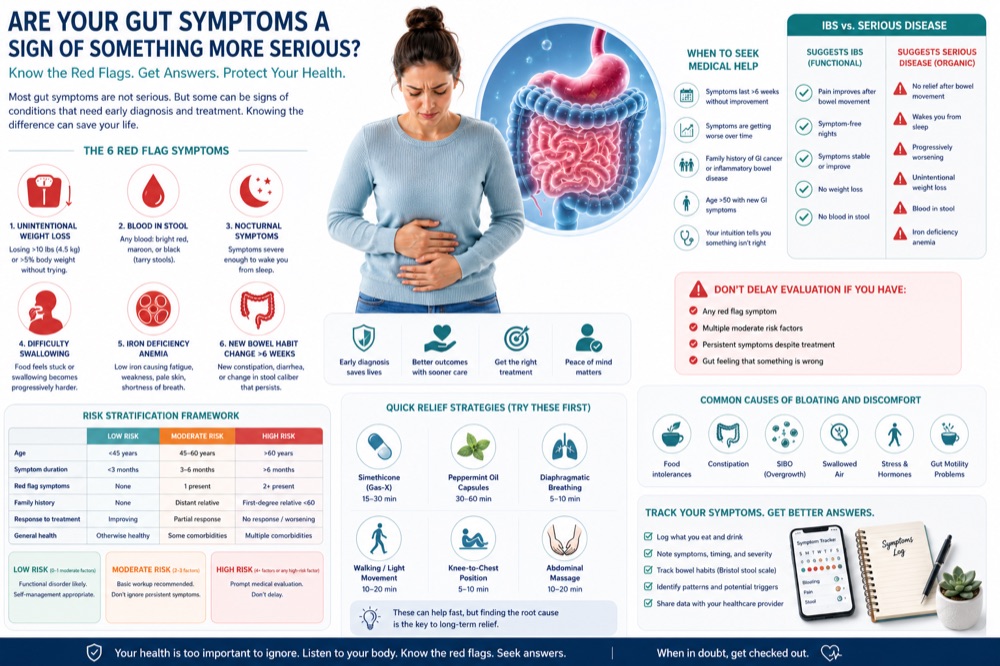
Niet elke bloating is gas. Organische distensie vraagt een ander pad dan typische PDS.
Wat eerst telt
Scheid functioneel van organisch: gewichtsverlies, bloed, braken, koorts, nachtsymptomen of start na 50 verandert de drempel.
- Typische PDS-bloating stijgt overdag en zakt ‘s nachts
- Ascites, obstructie of bekkenmassa verdwijnen niet met pepermunt thee
- Leeftijd, geslacht en alarmen sturen beeldvorming en lab, geen huisdetox
Details die echt helpen
Wat het plan verandert
Evalueer bij alarmen. Echo, bloedonderzoek en zo nodig endoscopie of CT. Geen remedies stapelen bij rode vlaggen.
Het kader van twee weken
-
Wel: timing, maaltijden en buikomvang noteren
-
Wel: alarmen voor het consult opsommen
-
Wel: medicatie checken die lediging remt
-
Wel: spoed zoeken bij braken en hevige pijn
-
Niet: elk bloed aan aambeien toeschrijven
-
Niet: evaluatie uitstellen uit angst voor tests
-
Niet: extreme vasten om te ontzwellen
-
Niet: nieuwe start na 50 negeren
Waarschuwingssignalen — zoek hulp bij:
- onverklaarbaar gewichtsverlies
- zwarte ontlasting
- aanhoudend braken
- flauwvallen
- hevige nachtpijn
- bloed in de ontlasting
Veelgestelde vragen
Wanneer is bloating spoed?
Aanhoudend braken, hevige pijn, koorts, harde buik of geen winden: spoedeisende hulp, niet wachten.
Bronnen
- American Cancer Society. Cancer Facts & Figures 2024. Atlanta: American Cancer Society; 2024.
- Ford AC, et al. American College of Gastroenterology monograph on the management of irritable bowel syndrome. Am J Gastroenterol. 2024;119(S1):S2-S31.
- Vasant DH, et al. British Society of Gastroenterology guidelines for the management of irritable bowel syndrome. Gut. 2024;73(7):1027-1058.
- Lacy BE, et al. Rome Foundation Updated Guidelines for Functional Gastrointestinal Disorders. Gastroenterology. 2024;166(1):38-57.
- National Institute for Health and Care Excellence (NICE). Suspected cancer: recognition and referral. NG12. 2024.
- American College of Obstetricians and Gynecologists. Evaluation and Management of Adnexal Masses. ACOG Practice Bulletin No. 174. 2024.
- Runyon BA. Introduction to the revised American Association for the Study of Liver Diseases Practice Guideline on the management of ascites due to cirrhosis. Hepatology. 2024;79(1):1-3.
- Ten Broeck RPG, et al. Adhesive small bowel obstruction: epidemiology, biology, prevention, and treatment. World J Surg. 2024;48(2):275-285.
- Chey WD, et al. ACG Clinical Guideline: Management of Celiac Disease. Am J Gastroenterol. 2024;119(2):203-222.
- Conlon KC. Pancreatic Cancer. In: DeVita VT, Lawrence TS, Rosenberg SA, eds. Cancer: Principles & Practice of Oncology. 12th ed. 2024.
- Camilleri M. Functional gastrointestinal disorders: advances in understanding and management. Lancet. 2024;403(10425):368-382.
- Black CJ, Ford AC. Global burden of irritable bowel syndrome: trends, predictions, and risk factors. Nat Rev Gastroenterol Hepatol. 2024;21(5):323-336.
- NIDDK. Symptoms & Causes of IBS. 2024. https://www.niddk.nih.gov/
- American Gastroenterological Association. AGA Institute Medical Position Statement on Evaluation of Abdominal Bloating and Distention. 2024.
- World Gastroenterology Organisation. WGO Global Guidelines: Irritable Bowel Syndrome. 2024.
- Cleveland Clinic. Abdominal bloating. 2024. https://my.clevelandclinic.org/health/symptoms/21740-abdominal-bloating