Here’s the statistic that should change how you think about bloating: women with ovarian cancer report an average of 5.2 healthcare visits over 6 months before receiving correct diagnosis. Their symptom? Persistent bloating. Initially dismissed as IBS, food intolerance, or stress.
But here’s the equally important statistic: functional bloating (IBS, food intolerance, functional distension) accounts for 85-90% of chronic bloating presentations. The vast majority of bloating is NOT caused by life-threatening conditions.
The challenge: Distinguishing the 10% that requires urgent intervention from the 90% that benefits from dietary and behavioral management.
This article provides an evidence-based framework for identifying when bloating signals serious pathology—without fueling unnecessary health anxiety.
What you’ll learn:
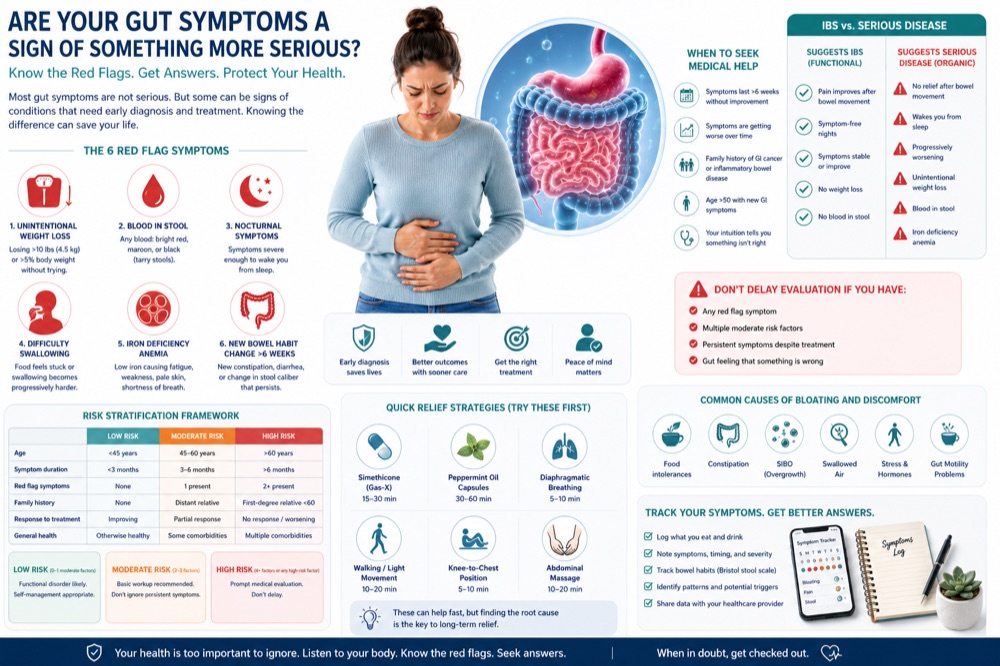
- The 6 red flag symptoms that require immediate medical evaluation
- Serious organic causes of bloating (ovarian cancer, ascites, obstruction, IBD)
- Risk stratification: when bloating is likely functional vs. when it warrants investigation
- Diagnostic pathways for persistent bloating
- Age-specific considerations (pediatric, adult, geriatric)
- What to expect during medical evaluation
The Critical Distinction: Functional vs. Organic Bloating
Functional bloating: No structural abnormality detectable on standard testing. Caused by altered gut-brain interaction, visceral hypersensitivity, abnormal gas handling, or abdomino-phrenic dyssynergia.
Organic bloating: Identifiable structural, biochemical, or pathological cause (tumor, inflammation, obstruction, fluid accumulation).
Table 1: Functional vs. Organic Bloating Comparison
| Feature | Functional Bloating | Organic Bloating |
|---|---|---|
| Onset | Gradual, often years | Sudden or progressive over weeks-months |
| Pattern | Fluctuating, relates to meals | Constant or progressively worsening |
| Overnight change | Often improves overnight | May persist or worsen |
| Red flag symptoms | Absent | Often present |
| Age at onset | Typically <50 years | Any age, but >50 raises concern |
| Weight change | Stable | Often unintentional weight loss |
| Lab abnormalities | Normal | May show anemia, inflammation, organ dysfunction |
| Response to diet | Often improves | Little or no improvement |
Key principle: Functional bloating is a diagnosis of exclusion. Red flags must be ruled out before attributing symptoms to functional causes.
The 6 Red Flag Symptoms: When to Seek Immediate Evaluation
The following symptoms, when accompanying bloating, require prompt medical assessment.
Red Flag #1: Unintentional Weight Loss
Definition: Loss of >5% body weight over 6-12 months without deliberate dieting or exercise changes.
Why it matters: Weight loss accompanying bloating suggests:
- Malignancy (ovarian, gastric, pancreatic, colorectal cancer)
- Malabsorption (celiac disease, pancreatic insufficiency, Crohn’s disease)
- Chronic infection (tuberculosis, parasitic infection)
- Hypermetabolic state (thyrotoxicosis, though this typically causes diarrhea)
Evidence: In patients >50 years with new bloating and weight loss, malignancy risk is 15-25%.
Action: Medical evaluation within 1-2 weeks. Urgent if weight loss >10% or rapid progression.
Red Flag #2: Blood in Stool
Types:
- Hematochezia: Bright red blood (typically lower GI: colon, rectum, anus)
- Melena: Black, tarry stools (typically upper GI: stomach, small intestine)
Why it matters: GI bleeding with bloating suggests:
- Colorectal cancer or polyps
- Inflammatory bowel disease (Crohn’s, ulcerative colitis)
- Diverticular bleeding
- Ischemic colitis (especially in elderly)
- Peptic ulcer disease (if melena)
Evidence: Rectal bleeding increases colorectal cancer risk 3-5 fold, especially when combined with bloating and change in bowel habits.
Action: Medical evaluation within 1 week. Emergency department if heavy bleeding, dizziness, or signs of shock.
Red Flag #3: Persistent Vomiting
Definition: Vomiting occurring daily or near-daily for >1 week, or inability to keep down food/fluids for >24 hours.
Why it matters: Vomiting with bloating suggests:
- Gastric outlet obstruction: Pyloric stenosis, gastric cancer, pancreatic cancer compressing duodenum
- Small bowel obstruction: Adhesions, hernia, tumor, volvulus
- Gastroparesis: Diabetes, post-viral, medication-induced, idiopathic
- Increased intracranial pressure: Brain tumor (typically with morning headaches)
- Ovarian cancer: Mass effect on GI tract
Evidence: Persistent vomiting with abdominal distension has 30-40% positive finding rate for structural pathology on imaging.
Action: Medical evaluation within 24-48 hours. Emergency department if signs of dehydration, severe pain, or inability to tolerate fluids.
Red Flag #4: Fever
Definition: Temperature >38°C (100.4°F) accompanying bloating.
Why it matters: Fever with bloating suggests:
- Intra-abdominal infection: Abscess, peritonitis, infected ascites
- Inflammatory bowel disease flare
- Diverticulitis
- Cholecystitis or cholangitis
- Appendicitis (typically with right lower quadrant pain)
- Tuberculous peritonitis (in endemic areas or immunocompromised)
Evidence: Fever with abdominal symptoms has 40-60% positive finding rate for infectious/inflammatory pathology.
Action: Medical evaluation within 24 hours. Emergency department if high fever (>39°C/102°F), rigors, or signs of sepsis.
Red Flag #5: Nocturnal Symptoms
Definition: Bloating or abdominal pain severe enough to wake you from sleep.
Why it matters: Functional GI disorders rarely wake patients from sleep. Nocturnal symptoms suggest:
- Inflammatory bowel disease
- Peptic ulcer disease
- GERD with nighttime reflux
- Malignancy
- Infectious processes
Evidence: Nocturnal GI symptoms have 70-80% specificity for organic pathology vs. functional disorders.
Action: Medical evaluation within 1-2 weeks.
Red Flag #6: New Onset After Age 50
Definition: Bloating that begins for the first time after age 50 without clear trigger.
Why it matters: Incidence of GI malignancies increases significantly after age 50:
- Colorectal cancer: 90% of cases occur in people >50
- Ovarian cancer: Median age at diagnosis is 63
- Gastric cancer: Risk increases after 50
- Pancreatic cancer: Median age at diagnosis is 71
Evidence: New-onset functional bloating after age 50 is uncommon. When present, requires thorough evaluation to exclude malignancy.
Action: Medical evaluation within 2-4 weeks. Lower threshold for advanced testing (colonoscopy, CT imaging).
Table 2: Red Flag Summary and Urgency
| Red Flag | Urgency | Initial Tests | Specialist Referral |
|---|---|---|---|
| Weight loss >5% | 1-2 weeks | CBC, CMP, TSH, ESR/CRP, celiac serology | Gastroenterology |
| Blood in stool | 1 week | CBC, fecal occult blood, colonoscopy | Gastroenterology |
| Persistent vomiting | 24-48 hours | CBC, CMP, lipase, abdominal X-ray/CT | Gastroenterology or Emergency |
| Fever >38°C | 24 hours | CBC, blood cultures, imaging based on symptoms | Emergency if severe |
| Nocturnal symptoms | 1-2 weeks | CBC, ESR/CRP, fecal calprotectin | Gastroenterology |
| New onset >50 | 2-4 weeks | Age-appropriate cancer screening, consider imaging | Gastroenterology |
Serious Organic Causes of Bloating
Ovarian Cancer
Why it’s missed: Symptoms are nonspecific and mimic IBS. Average time to diagnosis is 6-9 months from symptom onset.
Key statistics:
- 5th leading cause of cancer death in women
- 70% present at Stage III or IV (advanced)
- 5-year survival: 92% if caught at Stage I, 29% at Stage IV
Symptom pattern:
- Bloating: Persistent, progressive, doesn’t fluctuate with meals
- Pelvic/abdominal pain: Dull, constant
- Early satiety: Difficulty eating, feeling full quickly
- Urinary symptoms: Frequency, urgency
Risk factors:
- Age >50
- Family history (BRCA1/2 mutations, Lynch syndrome)
- Nulliparity
- Endometriosis
- Obesity
Diagnostic pathway:
- Transvaginal ultrasound
- CA-125 blood test (elevated in 80% of epithelial ovarian cancers)
- CT abdomen/pelvis if suspicious findings
- Referral to gynecologic oncologist
When to suspect: Women >50 with new, persistent bloating (>12 days/month) plus pelvic pain, early satiety, or urinary symptoms.
Ascites
Definition: Abnormal fluid accumulation in the peritoneal cavity.
Key statistics:
- 75-80% caused by cirrhosis
- 10% caused by malignancy (peritoneal carcinomatosis)
- 5% caused by heart failure
- 5% other causes (tuberculosis, pancreatic disease, nephrotic syndrome)
Symptom pattern:
- Progressive abdominal distension: Often mistaken for weight gain
- Early satiety: From pressure on stomach
- Shortness of breath: From diaphragmatic pressure
- Ankle swelling: If related to heart failure or hypoalbuminemia
- Jaundice: If cirrhosis-related
Physical findings:
- Shifting dullness on percussion
- Fluid wave
- Umbilical hernia (with chronic ascites)
Diagnostic pathway:
- Abdominal ultrasound (confirms fluid)
- Diagnostic paracentesis (fluid analysis)
- Serum-ascites albumin gradient (SAAG) to determine cause
- Additional workup based on suspected etiology
When to suspect: Progressive distension out of proportion to weight gain, especially with risk factors for liver disease or known malignancy.
Bowel Obstruction
Definition: Mechanical blockage preventing normal intestinal content passage.
Key statistics:
- Small bowel obstruction: 60-75% from adhesions (post-surgical), 15% from hernia, 10-15% from tumor
- Large bowel obstruction: 60% from colorectal cancer, 20% from diverticulitis, 10% from volvulus
Symptom pattern:
- Colicky abdominal pain: Waves of severe pain
- Progressive distension: Worsens over hours-days
- Vomiting: Early in proximal obstruction, later in distal
- Obstipation: Inability to pass gas or stool (complete obstruction)
- High-pitched bowel sounds: Early; absent sounds late
Diagnostic pathway:
- Abdominal X-ray (dilated loops, air-fluid levels)
- CT abdomen/pelvis with contrast (gold standard)
- Surgical consultation
When to suspect: Acute onset of cramping pain, distension, vomiting, and obstipation—especially with history of abdominal surgery.
Urgency: Surgical emergency. Requires immediate evaluation.
Inflammatory Bowel Disease (Crohn’s Disease, Ulcerative Colitis)
Key statistics:
- Peak onset: 15-35 years, second peak 50-70 years
- Affects 1.6 million Americans
- 30% of Crohn’s patients present with obstructive symptoms
Symptom pattern:
- Chronic diarrhea: >4 weeks duration
- Abdominal pain: Often right lower quadrant (Crohn’s)
- Bloating: From inflammation, stricture, or bacterial overgrowth
- Blood in stool: More common in ulcerative colitis
- Weight loss: From malabsorption or food avoidance
- Fatigue: From anemia, inflammation
Extra-intestinal manifestations:
- Joint pain (arthralgia, arthritis)
- Skin lesions (erythema nodosum, pyoderma gangrenosum)
- Eye inflammation (uveitis, episcleritis)
- Liver disease (primary sclerosing cholangitis)
Diagnostic pathway:
- Fecal calprotectin (elevated in IBD, normal in IBS)
- Colonoscopy with biopsy
- CT or MR enterography (for small bowel Crohn’s)
- Blood tests: CBC, ESR, CRP, albumin
When to suspect: Chronic bloating with diarrhea, weight loss, blood in stool, or family history of IBD.
Celiac Disease
Key statistics:
- Affects 1% of population
- 83% undiagnosed or misdiagnosed as IBS
- Average time to diagnosis: 6-10 years from symptom onset
Symptom pattern:
- Bloating: After gluten-containing meals
- Chronic diarrhea: Steatorrhea (fatty, foul-smelling stools)
- Weight loss or gain: Variable
- Fatigue: From iron deficiency anemia
- Dermatitis herpetiformis: Itchy blistering rash (10% of patients)
Complications if untreated:
- Osteoporosis
- Infertility
- Intestinal lymphoma (rare)
- Other autoimmune diseases
Diagnostic pathway:
- Celiac serology (tTG-IgA, total IgA) while consuming gluten
- Upper endoscopy with duodenal biopsy if serology positive
- Genetic testing (HLA-DQ2/DQ8) if serology equivocal
Critical: Do NOT start gluten-free diet before testing. Serology and biopsy require ongoing gluten consumption.
When to suspect: Chronic bloating with diarrhea, iron deficiency anemia, or family history of celiac disease.
Pancreatic Cancer
Why it’s dangerous: Often asymptomatic until advanced. 5-year survival is 11% overall.
Key statistics:
- 4th leading cause of cancer death
- Median age at diagnosis: 71 years
- 80-85% present with unresectable disease
Symptom pattern:
- Vague abdominal discomfort: Early, nonspecific
- Painless jaundice: If tumor in pancreatic head
- New-onset diabetes: In 25% of patients
- Unexplained weight loss: Common
- Bloating: From mass effect or pancreatic insufficiency
- Back pain: From retroperitoneal invasion
Risk factors:
- Age >60
- Smoking
- Chronic pancreatitis
- Diabetes
- Family history
- Obesity
Diagnostic pathway:
- CT abdomen/pelvis with pancreatic protocol
- MRCP (MRI of pancreatic/biliary ducts)
- Endoscopic ultrasound with biopsy
- CA 19-9 tumor marker (for monitoring, not screening)
When to suspect: Adults >60 with new bloating plus weight loss, jaundice, or new-onset diabetes.
Small Intestinal Bacterial Overgrowth (SIBO)
Key statistics:
- Prevalence unclear (test limitations)
- Associated with: IBS (40-50% of IBS patients may have SIBO), diabetes, scleroderma, prior bowel surgery, chronic PPI use
Symptom pattern:
- Bloating: Worsens after carbohydrate intake
- Excessive gas: Belching, flatulence
- Diarrhea: Or constipation (methane-predominant)
- Nutrient deficiencies: B12, iron, fat-soluble vitamins
Diagnostic pathway:
- Glucose or lactulose breath test
- Consider small bowel aspirate (gold standard but invasive)
- Trial of antibiotics if high clinical suspicion
When to suspect: Chronic bloating with risk factors, especially if symptoms worsen after high-carbohydrate meals.
Table 3: Organic Causes by Age Group
| Age Group | Most Likely Serious Causes | Key Considerations |
|---|---|---|
| Pediatric (<18) | Hirschsprung disease, celiac disease, IBD, intestinal malrotation | Failure to thrive is red flag; congenital causes more common |
| Young Adult (18-40) | IBD, ovarian pathology, celiac disease, SIBO | Pregnancy must be ruled out in women; lower cancer risk |
| Middle Age (40-60) | Ovarian cancer, colorectal cancer, celiac disease, IBD, cirrhosis | Cancer risk increases; screening colonoscopy indicated |
| Older Adult (>60) | Colorectal cancer, ovarian cancer, pancreatic cancer, ascites, obstruction | Lower threshold for imaging; functional causes less likely |
Diagnostic Pathway for Persistent Bloating
Step 1: Initial Evaluation (Primary Care)
History:
- Duration and pattern of bloating
- Associated symptoms (pain, diarrhea, constipation, weight change)
- Red flag symptoms
- Family history (GI cancer, IBD, celiac disease)
- Medication review (opioids, anticholinergics, iron, PPIs)
- Surgical history (adhesions, bowel resection)
Physical examination:
- Abdominal inspection (distension, surgical scars, hernias)
- Palpation (masses, tenderness, organomegaly)
- Percussion (shifting dullness for ascites)
- Auscultation (bowel sounds)
- Pelvic examination (women with pelvic symptoms)
Initial tests:
- Complete blood count (anemia, infection)
- Comprehensive metabolic panel (liver/kidney function, electrolytes)
- Celiac serology (tTG-IgA, total IgA)
- ESR or CRP (inflammation)
- Fecal calprotectin (if IBD suspected)
- Fecal occult blood test
- Pregnancy test (women of childbearing age)
Step 2: Secondary Evaluation (Based on Findings)
If anemia or positive FOBT:
- Colonoscopy
- Upper endoscopy if iron deficiency without lower GI source
If elevated inflammatory markers or fecal calprotectin:
- Colonoscopy with ileoscopy
- CT or MR enterography
If suspected ovarian pathology:
- Transvaginal ultrasound
- CA-125
- CT abdomen/pelvis if concerning findings
If suspected pancreatic/biliary pathology:
- CT abdomen with pancreatic protocol
- MRCP
- Endoscopic ultrasound
If suspected obstruction:
- Abdominal X-ray (initial)
- CT abdomen/pelvis with contrast
If suspected ascites:
- Abdominal ultrasound
- Diagnostic paracentesis
Step 3: Specialized Testing (If Initial Workup Negative)
For persistent functional symptoms:
- Gastric emptying study (if early satiety, nausea)
- Anorectal manometry (if constipation predominant)
- Breath testing for SIBO
- Video capsule endoscopy (if obscure GI bleeding)
When Functional Bloating is Likely
After appropriate evaluation excludes organic causes, functional bloating is diagnosed using Rome IV criteria:
Rome IV Criteria for Functional Bloating/Distension:
- Recurrent bloating/distension at least 1 day per week in last 3 months
- Symptom onset at least 6 months before diagnosis
- Insufficient evidence for structural disease (normal examination, basic labs, age-appropriate cancer screening)
- Does not meet criteria for IBS (no predominant pain)
Supportive features favoring functional diagnosis:
- Long duration (>6 months without progression)
- Fluctuating pattern (relates to meals, menstrual cycle)
- Improves overnight
- No red flag symptoms
- Normal basic laboratory evaluation
- Age <50 at onset
Prognosis: Functional bloating is chronic but benign. It does not progress to serious disease, does not cause structural damage, and does not reduce life expectancy.
The Over-Investigation Problem
The reality: Most patients with bloating do NOT need extensive workup.
Appropriate initial workup for typical functional bloating:
- History and physical examination
- CBC, CMP
- Celiac serology
- Age-appropriate cancer screening
What’s usually NOT needed initially:
- CT scans (radiation exposure, incidental findings)
- Extensive tumor marker panels (low specificity, anxiety)
- Comprehensive stool testing (expensive, low yield)
- Food IgG testing (not validated, leads to unnecessary restriction)
Exception: Lower threshold for advanced testing with red flags, age >50, or family history.
FAQs
I’ve had bloating for years with no other symptoms. Should I worry?
If bloating has been stable for years without red flags (weight loss, blood, fever, nocturnal symptoms), serious causes are unlikely. However, if you’re >50 or have family history of GI cancer, discuss appropriate screening with your doctor.
Can anxiety cause severe bloating?
Yes. Anxiety activates the gut-brain axis, altering motility and increasing visceral sensitivity. However, anxiety should not be assumed to be the cause without appropriate evaluation for organic causes.
My bloating started after a stomach virus. Is this serious?
Post-infectious IBS is well-documented. Symptoms often begin after gastroenteritis and can persist for months-years. While distressing, this is not dangerous. Evaluation should still exclude other causes if symptoms persist >4 weeks.
Should I get a CT scan for chronic bloating?
Not routinely. CT scans have radiation exposure and often find incidental abnormalities that lead to more testing without improving outcomes. Reserve CT for cases with red flags or abnormal initial workup.
Is ovarian cancer screening recommended for all women with bloating?
No. There is no effective population screening for ovarian cancer. Testing (ultrasound, CA-125) is indicated when symptoms are persistent (>12 days/month), progressive, and accompanied by pelvic pain or early satiety—especially in women >50.
Can colonoscopy miss causes of bloating?
Colonoscopy evaluates the colon for cancer, polyps, and IBD. It does not evaluate the small intestine (except terminal ileum) or other organs. If colonoscopy is normal but symptoms persist, additional testing may be needed based on clinical suspicion.
What if all my tests are normal but I’m still bloated?
This is common and supports a functional diagnosis. Treatment focuses on symptom management: dietary modification (low FODMAP, fiber adjustment), stress reduction, gut-directed behavioral therapy, and medications targeting specific symptoms.
Sources
-
American Cancer Society. Cancer Facts & Figures 2024. Atlanta: American Cancer Society; 2024.
-
Ford AC, et al. American College of Gastroenterology monograph on the management of irritable bowel syndrome. Am J Gastroenterol. 2024;119(S1):S2-S31.
-
Vasant DH, et al. British Society of Gastroenterology guidelines for the management of irritable bowel syndrome. Gut. 2024;73(7):1027-1058.
-
Lacy BE, et al. Rome Foundation Updated Guidelines for Functional Gastrointestinal Disorders. Gastroenterology. 2024;166(1):38-57.
-
National Institute for Health and Care Excellence (NICE). Suspected cancer: recognition and referral. NG12. 2024.
-
American College of Obstetricians and Gynecologists. Evaluation and Management of Adnexal Masses. ACOG Practice Bulletin No. 174. 2024.
-
Runyon BA. Introduction to the revised American Association for the Study of Liver Diseases Practice Guideline on the management of ascites due to cirrhosis. Hepatology. 2024;79(1):1-3.
-
Ten Broeck RPG, et al. Adhesive small bowel obstruction: epidemiology, biology, prevention, and treatment. World J Surg. 2024;48(2):275-285.
-
Chey WD, et al. ACG Clinical Guideline: Management of Celiac Disease. Am J Gastroenterol. 2024;119(2):203-222.
-
Conlon KC. Pancreatic Cancer. In: DeVita VT, Lawrence TS, Rosenberg SA, eds. Cancer: Principles & Practice of Oncology. 12th ed. 2024.
-
Camilleri M. Functional gastrointestinal disorders: advances in understanding and management. Lancet. 2024;403(10425):368-382.
-
Black CJ, Ford AC. Global burden of irritable bowel syndrome: trends, predictions, and risk factors. Nat Rev Gastroenterol Hepatol. 2024;21(5):323-336.
-
NIDDK. Symptoms & Causes of IBS. 2024. https://www.niddk.nih.gov/
-
American Gastroenterological Association. AGA Institute Medical Position Statement on Evaluation of Abdominal Bloating and Distention. 2024.
-
World Gastroenterology Organisation. WGO Global Guidelines: Irritable Bowel Syndrome. 2024.
-
Cleveland Clinic. Abdominal bloating. 2024. https://my.clevelandclinic.org/health/symptoms/21740-abdominal-bloating