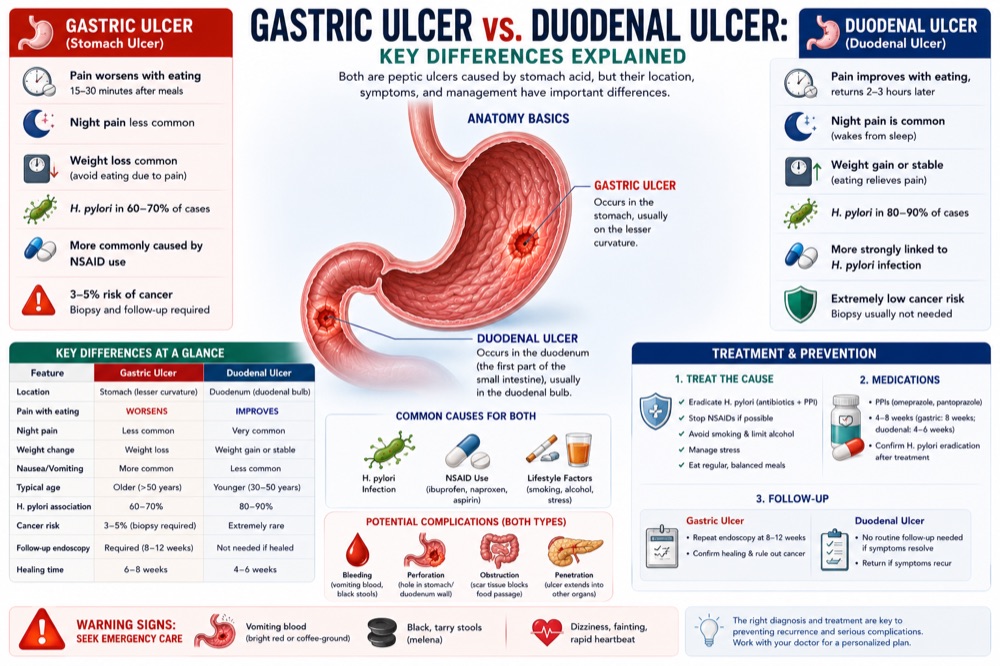
Both gastric ulcers and duodenal ulcers are “peptic ulcers”—but they differ in important ways that affect diagnosis, treatment, and cancer risk. Understanding these differences helps you know what to expect and why your doctor recommends specific tests.
While both types share similar causes (H. pylori and NSAIDs) and treatments, the location matters. Gastric ulcers occur in the stomach; duodenal ulcers occur in the first part of the small intestine. This seemingly simple distinction has significant clinical implications.
Key Takeaways:
- Location differs: Gastric = stomach; Duodenal = first part of small intestine (duodenum)
- Pain timing opposite: Gastric hurts WITH eating; Duodenal hurts when EMPTY (relieved by eating)
- Cancer risk: Gastric ulcers can be malignant (need biopsy); Duodenal ulcers almost always benign
- H. pylori rates: Higher in duodenal (80-90%) vs. gastric (60-70%)
- Age pattern: Gastric more common in older adults; Duodenal peaks earlier (30s-50s)
- Treatment similar: Both need acid suppression; H. pylori needs antibiotics regardless of location
What Are Peptic Ulcers?
Peptic ulcers are open sores that develop in the lining of the stomach or upper small intestine. The term “peptic” refers to the fact that these ulcers are caused by the action of stomach acid (peptic acid) on the lining.
Anatomy Basics
The Three Types of Peptic Ulcers
| Type | Location | Prevalence |
|---|---|---|
| Gastric ulcer | Stomach (usually lesser curvature) | ~40% of peptic ulcers |
| Duodenal ulcer | Duodenum (first part of small intestine, usually the bulb) | ~60% of peptic ulcers |
| Esophageal ulcer | Lower esophagus | Less common; usually from severe GERD |
Note: This article focuses on gastric vs. duodenal ulcers (the two main types).
Why the Distinction Matters
You might wonder: “If both are caused by acid and treated similarly, why does it matter which type I have?”
Clinical Reasons the Difference Is Important
1. Cancer Risk
- Gastric ulcers: Can be caused by stomach cancer (3-5% of gastric ulcers are malignant)
- Duodenal ulcers: Almost never cancerous (malignancy extremely rare)
- Implication: All gastric ulcers require biopsy to rule out cancer
2. Follow-Up Requirements
- Gastric ulcers: Need repeat endoscopy after 8-12 weeks to confirm healing
- Duodenal ulcers: No routine follow-up endoscopy needed if symptoms resolve
3. Symptom Pattern
- Gastric ulcers: Pain worsens with eating
- Duodenal ulcers: Pain improves with eating, returns 2-3 hours later
- Implication: Helps doctors identify likely location before endoscopy
4. H. pylori Prevalence
- Gastric ulcers: 60-70% associated with H. pylori
- Duodenal ulcers: 80-90% associated with H. pylori
- Implication: Testing is essential for both, but slightly more likely to be positive in duodenal
5. NSAID Association
- Gastric ulcers: More commonly associated with NSAID use
- Duodenal ulcers: More strongly linked to H. pylori alone
- Implication: Medication history may point toward one type
Key Differences at a Glance
| Feature | Gastric Ulcer | Duodenal Ulcer |
|---|---|---|
| Location | Stomach (usually lesser curvature) | Duodenum (first part, usually the bulb) |
| Pain with eating | WORSENS (15-30 min after meals) | IMPROVES (returns 2-3 hours later) |
| Night pain | Less common | Very common (wakes from sleep) |
| Weight change | Weight loss (avoid food due to pain) | Weight gain (eating relieves pain) |
| Nausea/vomiting | More common | Less common |
| Typical age | Older (50+ years) | Younger (30-50 years) |
| H. pylori rate | 60-70% | 80-90% |
| NSAID association | Strong | Moderate |
| Cancer risk | 3-5% malignant | Extremely rare (<0.1%) |
| Biopsy needed | YES (multiple, to rule out cancer) | Usually not (unless atypical appearance) |
| Follow-up endoscopy | Required (confirm healing) | Not needed if symptoms resolve |
| Recurrence rate | Higher if H. pylori not treated | Higher if H. pylori not treated |
| Acid production | Normal to low | Normal to high |
Detailed Comparison
1. Location and Appearance
Gastric Ulcers:
- Location: Usually on the lesser curvature of the stomach (the inner curve)
- Can also occur: Anywhere in the stomach (antrum, body, cardia)
- Appearance: Round or oval crater with smooth or irregular margins
- Size: Variable (few millimeters to several centimeters)
- Number: Usually single; can be multiple
Duodenal Ulcers:
- Location: Duodenal bulb (first part of duodenum) most common
- Can also occur: Second part of duodenum (post-bulbar)
- Appearance: Round or oval crater, usually smaller than gastric ulcers
- Size: Typically smaller than gastric ulcers
- Number: Can be single or multiple
Important: Large gastric ulcers (>2-3 cm) are more likely to be malignant and require careful biopsy and follow-up.
2. Pain Pattern: The Most Reliable Clinical Difference
Gastric Ulcer Pain:
Why: Eating stimulates stomach acid production. With the protective mucus layer damaged, acid contacts the ulcer directly, causing pain.
Duodenal Ulcer Pain:
Why: Food temporarily buffers stomach acid, providing relief. Once the stomach empties (2-3 hours), unbuffered acid enters the duodenum and contacts the ulcer.
Clinical Pearl: This pattern is reliable enough that experienced clinicians can often predict the ulcer location based on history alone (though endoscopy is still required for confirmation).
3. Associated Symptoms
Gastric Ulcer:
| Symptom | Frequency |
|---|---|
| Epigastric pain (burning, gnawing) | 70-80% |
| Nausea | 30-40% |
| Vomiting | 10-20% |
| Loss of appetite | 20-30% |
| Weight loss | 30-40% |
| Bloating | 20-30% |
| Belching | 15-25% |
| Early satiety | 20-30% |
Duodenal Ulcer:
| Symptom | Frequency |
|---|---|
| Epigastric pain (burning, gnawing) | 70-80% |
| Nausea | 15-25% |
| Vomiting | 5-10% |
| Loss of appetite | 10-15% |
| Weight gain | 20-30% |
| Bloating | 15-25% |
| Belching | 15-25% |
| Night pain | 50-60% |
Note: Many people have overlapping symptoms. Pattern recognition (especially pain timing relative to meals) is more useful than individual symptoms.
4. Causes and Risk Factors
Both Types Share These Causes:
| Cause | Gastric Ulcer | Duodenal Ulcer |
|---|---|---|
| H. pylori infection | 60-70% | 80-90% |
| NSAID use | 30-40% | 20-30% |
| Both H. pylori + NSAID | 10-20% | 5-10% |
| Unknown (idiopathic) | 5-10% | 5-10% |
Risk Factors More Common in Gastric Ulcers:
- Older age (>60)
- Heavy NSAID use
- Smoking
- Heavy alcohol use
- Prior gastric surgery
- Radiation therapy to abdomen
Risk Factors More Common in Duodenal Ulcers:
- Blood type O (2x increased risk)
- Family history of duodenal ulcers
- High acid production
- Younger to middle age (30-50)
5. Diagnostic Approach
Both Types Require:
- Medical history and physical exam
- H. pylori testing (breath, stool, or biopsy)
- Blood tests (CBC to check for anemia)
Gastric Ulcer-Specific:
- Endoscopy with biopsy (MANDATORY)
- Multiple biopsies from ulcer edge and base
- Rule out cancer (adenocarcinoma, lymphoma)
- Test for H. pylori
- Follow-up endoscopy at 8-12 weeks
- Confirm complete healing
- Repeat biopsy if not fully healed
Duodenal Ulcer-Specific:
- Endoscopy (usually recommended but biopsies less critical)
- Biopsy if appearance atypical
- Test for H. pylori
- Follow-up: No routine endoscopy needed if symptoms resolve
6. Complications
Both types can cause the same complications, but rates differ:
| Complication | Gastric Ulcer | Duodenal Ulcer |
|---|---|---|
| Bleeding | 15-20% | 15-20% |
| Perforation | 5-10% | 5-7% |
| Obstruction | 5-10% (from scarring/swelling) | 3-5% |
| Penetration | 5% (into pancreas, liver) | 5% (into pancreas most common) |
Bleeding: Most common complication for both types. Presents as black stools or vomiting blood.
Perforation: Hole burns through the wall. Surgical emergency. Sudden severe pain.
Obstruction: Scarring or swelling blocks food passage. More common with gastric ulcers near the pylorus.
Penetration: Ulcer extends into adjacent organ (pancreas, liver, colon). Causes pain radiating to back.
7. Treatment
Similarities:
- Acid suppression (PPIs) for 4-8 weeks
- H. pylori eradication if positive (antibiotics + PPI)
- Stop NSAIDs if possible
- Lifestyle modifications
Differences:
| Aspect | Gastric Ulcer | Duodenal Ulcer |
|---|---|---|
| PPI duration | 8 weeks (slower healing) | 4-6 weeks (faster healing) |
| Follow-up | Repeat endoscopy required | Not needed if symptoms resolve |
| Biopsy | Multiple biopsies mandatory | Only if atypical appearance |
| Healing rate | 80-90% at 8 weeks | 80-90% at 4-6 weeks |
H. pylori Treatment: Same for both types
- 14 days of antibiotics (quadruple or triple therapy)
- Confirm eradication 4+ weeks after treatment
NSAID Ulcer Treatment: Same for both types
- Stop NSAID if possible
- PPI for 8 weeks
- If NSAID must continue: PPI indefinitely
8. Healing and Prognosis
Gastric Ulcers:
- Healing time: 6-8 weeks with PPI therapy
- Healing rate: 80-90% with proper treatment
- Recurrence: <10% if H. pylori eradicated; 60-90% if not treated
- Cancer follow-up: Essential (repeat endoscopy confirms healing and rules out malignancy)
Duodenal Ulcers:
- Healing time: 4-6 weeks with PPI therapy
- Healing rate: 80-95% with proper treatment
- Recurrence: <10% if H. pylori eradicated; 60-90% if not treated
- Cancer follow-up: Not needed (extremely low cancer risk)
Common Questions About Ulcer Types
Can a Person Have Both Gastric and Duodenal Ulcers?
Yes, though it’s less common. Some people have:
- Multiple ulcers in the same location
- Ulcers in both locations simultaneously (gastroduodenal ulcers)
- Sequential ulcers (gastric heals, then duodenal develops)
When multiple ulcers are present, doctors consider:
- Severe H. pylori infection
- Heavy NSAID use
- Zollinger-Ellison syndrome (gastrinoma causing excessive acid)
- Other rare causes
Why Do Gastric Ulcers Have Cancer Risk but Duodenal Don’t?
Gastric ulcers can be caused by stomach cancer (adenocarcinoma) or lymphoma (MALT lymphoma). Cancer can ulcerate the stomach lining, mimicking a benign ulcer.
Duodenal ulcers are almost always benign because:
- Primary cancer of the duodenum is extremely rare
- H. pylori causes duodenal ulcers through acid mechanisms, not cancer
- The duodenal environment is less prone to malignant transformation
Important: This is why ALL gastric ulcers require biopsy and follow-up endoscopy, while duodenal ulcers typically don’t.
Which Type Is More Serious?
Neither is inherently “more serious”—both can cause life-threatening complications (bleeding, perforation).
However:
- Gastric ulcers require more intensive follow-up due to cancer risk
- Duodenal ulcers are more likely to cause night pain and sleep disruption
- Complication rates are similar for both types
- Treatment success is similar for both types
The key to preventing serious complications is prompt diagnosis and proper treatment, regardless of location.
Can You Tell Which Type You Have Without Endoscopy?
Not definitively. However, certain clues suggest one type vs. the other:
Suggests Gastric Ulcer:
- Pain WORSENS with eating
- Weight loss
- Older age (>60)
- Heavy NSAID use
Suggests Duodenal Ulcer:
- Pain IMPROVES with eating, returns 2-3 hours later
- Night pain (wakes from sleep)
- Weight gain or stable weight
- Younger age (30-50)
Bottom line: Endoscopy is the only way to definitively diagnose ulcer type and location.
Does Location Affect Treatment Choice?
Minimally. The core treatment is the same:
- Acid suppression (PPIs)
- H. pylori eradication if positive
- Stop NSAIDs if possible
Differences:
- Duration may be longer for gastric ulcers (8 vs. 4-6 weeks)
- Gastric ulcers need follow-up endoscopy
- Gastric ulcers need biopsy to rule out cancer
When to See a Doctor
Seek immediate medical attention if you have:
- Vomiting blood (bright red or coffee-ground material)
- Black, tarry stools
- Sudden, severe, persistent abdominal pain
- Dizziness, fainting, rapid heartbeat (signs of bleeding)
- Persistent vomiting
- Difficulty swallowing
Make an appointment if you have:
- Burning stomach pain lasting more than 1 week
- Pain that regularly wakes you from sleep
- Need for daily antacids for more than 2 weeks
- Unintentional weight loss
- New digestive symptoms after age 55
Diagnosis: What to Expect
Endoscopy Procedure
Before:
- Fast for 6-8 hours beforehand
- Review medications with doctor (some may need to be stopped)
- Arrange transportation (sedation used)
During:
- Sedation given (you’ll be relaxed/sleeping)
- Thin, flexible tube with camera passed through mouth
- Stomach and duodenum examined
- Biopsies taken if needed (painless)
- Procedure takes 10-20 minutes
After:
- Recover from sedation (30-60 minutes)
- Go home same day
- Mild sore throat possible
- Results available in a few days (biopsy takes longer)
H. pylori Testing
Non-Invasive:
- Urea breath test: Drink solution, blow into bag (95-98% accurate)
- Stool antigen test: Test stool sample (90-95% accurate)
- Blood antibody test: NOT recommended (can’t distinguish active vs. past infection)
Invasive (during endoscopy):
- Biopsy for rapid urease test: Results in hours
- Biopsy for histology: Results in a few days
- Biopsy for culture: Results in a week (tests antibiotic sensitivity)
Treatment Overview
Medications
Proton Pump Inhibitors (PPIs):
- Omeprazole, esomeprazole, pantoprazole, lansoprazole
- Take 30-60 minutes before breakfast
- Duration: 4-8 weeks depending on ulcer type
H. pylori Treatment (if positive):
- 14 days of combination antibiotics
- Usually: PPI + bismuth + 2 antibiotics (quadruple therapy)
- OR: PPI + 3 antibiotics (concomitant therapy)
- Confirm eradication 4+ weeks after finishing
If NSAID-Induced:
- Stop NSAID if possible
- Continue PPI for 8 weeks
- If NSAID must continue: PPI indefinitely
Follow-Up
Gastric Ulcer:
- Repeat endoscopy at 8-12 weeks
- Confirm healing
- Repeat biopsy if not healed
Duodenal Ulcer:
- No routine follow-up endoscopy
- Return if symptoms persist or recur
- Test to confirm H. pylori eradication
Prevention
Prevent Both Types By:
- Testing for and treating H. pylori
- Avoiding unnecessary NSAIDs
- Using lowest effective NSAID dose if needed
- Taking PPI protection with long-term NSAIDs
- Not smoking
- Limiting alcohol
- Managing stress (supports overall health)
Frequently Asked Questions
Are gastric ulcers or duodenal ulcers more common?
Duodenal ulcers are more common, accounting for about 60% of peptic ulcers. Gastric ulcers account for about 40%. However, the ratio varies by region, age, and H. pylori prevalence.
Can duodenal ulcers become cancerous?
Extremely rarely. Duodenal ulcers are almost always benign. The duodenal environment is not prone to malignant transformation. This is why duodenal ulcers don’t require routine follow-up endoscopy or multiple biopsies like gastric ulcers do.
Why does my doctor want to repeat my endoscopy?
If you have a gastric ulcer, repeat endoscopy is essential to:
- Confirm the ulcer has healed
- Ensure it wasn’t cancer (which may not be apparent on initial biopsy)
- Rule out other serious conditions
If you have a duodenal ulcer, routine repeat endoscopy is usually NOT needed if symptoms resolve.
Can stress cause one type more than the other?
Everyday psychological stress doesn’t directly cause either type of ulcer. However, severe PHYSIOLOGICAL stress (critical illness, major burns, head trauma) can cause “stress ulcers” which can be gastric or duodenal.
Which type heals faster?
Duodenal ulcers typically heal faster (4-6 weeks) compared to gastric ulcers (6-8 weeks). This is likely due to differences in the tissue environment and blood supply.
Do I need different medications for gastric vs. duodenal ulcers?
The same medications are used for both types:
- PPIs for acid suppression
- Antibiotics for H. pylori
- Stopping NSAIDs if they’re the cause
The main difference is duration (gastric may need longer treatment) and follow-up (gastric needs repeat endoscopy).
Can I tell which type I have based on my symptoms?
Symptoms provide clues but aren’t definitive:
- Pain worsening with eating suggests gastric ulcer
- Pain improving with eating, night pain suggests duodenal ulcer
However, only endoscopy can definitively diagnose the ulcer type and location.
Is one type harder to treat?
Both types respond well to treatment when the underlying cause is addressed:
- H. pylori eradication: >85% success for both types
- PPI healing: 80-90% success for both types
Gastric ulcers may take slightly longer to heal and require more follow-up, but treatment success rates are similar.
Conclusion
While gastric and duodenal ulcers share similar causes and treatments, the differences matter for diagnosis, follow-up, and cancer screening. Gastric ulcers occur in the stomach, worsen with eating, and require biopsy and follow-up due to cancer risk. Duodenal ulcers occur in the small intestine, improve with eating, cause night pain, and are almost always benign.
Key Points:
- Pain timing is the most reliable clinical difference
- Gastric ulcers require biopsy and follow-up (cancer risk)
- Duodenal ulcers heal faster and don’t need routine follow-up
- H. pylori testing is essential for both types
- Treatment is similar but duration may differ
- Both types heal well with proper treatment (80-90% success)
If you have ulcer symptoms, see a healthcare provider for proper diagnosis. Endoscopy is the only way to definitively determine ulcer type and guide appropriate management.
Related Articles:
- Peptic Ulcer Symptoms: Recognizing the Warning Signs
- Peptic Ulcer Causes: H. pylori, NSAIDs, and More
- Peptic Ulcer Treatment: Medications, Diet, and Lifestyle
- Bleeding Ulcer: Warning Signs and Emergency Treatment
- H. pylori Infection: Complete Guide to Symptoms and Treatment
Sources
- NIDDK - Peptic Ulcers (Stomach Ulcers) - National Institute of Diabetes and Digestive and Kidney Diseases - 2020 - https://www.niddk.nih.gov/health-information/digestive-diseases/peptic-ulcers-stomach-ulcers
- Mayo Clinic - Peptic Ulcer - 2025 - https://www.mayoclinic.org/diseases-conditions/peptic-ulcer/symptoms-causes/syc-20354223
- NHS - Stomach ulcer - 2023 - https://www.nhs.uk/conditions/stomach-ulcer/
- American College of Gastroenterology - ACG Clinical Guideline: Treatment of Helicobacter pylori Infection - 2024 - https://gi.org/topics/irritable-bowel-syndrome/journals-publications/ebgi/schoenfeld_sep2024/
- Lanza FL, et al. - Guidelines for prevention of NSAID-related ulcer complications - American Journal of Gastroenterology - 2023 - https://journals.lww.com/ajg/Fulltext/2023/03000/Guidelines_for_Prevention_of_NSAID_Related_Ulcer.15.aspx
- UpToDate - Clinical manifestations and diagnosis of peptic ulcer disease - 2025 - https://www.uptodate.com/contents/clinical-manifestations-and-diagnosis-of-peptic-ulcer-disease
- Systematic Review - Gastric vs. duodenal ulcers: comparative analysis - Gastrointestinal Endoscopy - 2023 - https://www.giejournal.org/article/S0016-5107(23)00123-4/fulltext
- Malfertheiner P, et al. - Management of Helicobacter pylori infection: the Maastricht VI/Florence consensus report - Gut - 2022 - https://gut.bmj.com/content/71/9/1724