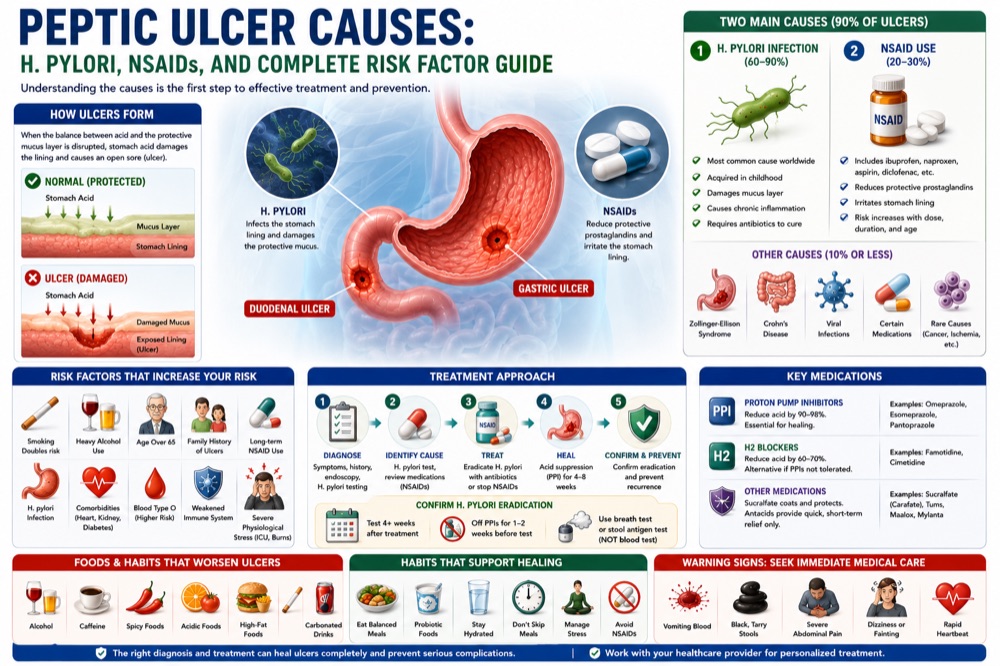
Peptic ulcer treatment has come a long way. Where patients once faced months of bland diets and frequent recurrences, modern medicine offers cure rates exceeding 90% with targeted treatments. The key is identifying the cause—H. pylori infection or NSAID use—and applying the right combination of medications.
This comprehensive guide covers everything you need to know about peptic ulcer treatment: antibiotic regimens for H. pylori, acid-suppressing medications, healing timelines, lifestyle modifications, and strategies to prevent recurrence.
Key Takeaways:
- H. pylori requires antibiotics: 10-14 days of combination therapy (usually 2 antibiotics + PPI)
- NSAID ulcers need medication changes: Stop NSAID if possible; add acid suppression
- PPIs are cornerstone treatment: Omeprazole, esomeprazole, pantoprazole heal 80-95% of ulcers in 4-8 weeks
- Treatment completion is critical: Stopping antibiotics early leads to treatment failure and resistance
- Follow-up testing confirms cure: Repeat H. pylori testing 4+ weeks after treatment
- Recurrence is preventable: Eradicating H. pylori reduces recurrence from 60-90% to <10%
Treatment Approach by Cause
Effective treatment starts with identifying the cause. Your treatment plan will differ significantly based on whether H. pylori, NSAIDs, or another factor is responsible.
Treatment Algorithm
H. pylori Treatment: Eradication Therapy
If H. pylori is present, antibiotics are essential. Acid-suppressing medications alone will heal the ulcer temporarily, but without eradicating the bacteria, recurrence rates exceed 60-90%.
First-Line Treatment: Bismuth Quadruple Therapy
Current guidelines recommend bismuth quadruple therapy as first-line treatment due to increasing antibiotic resistance.
**Regimen **(10-14 days)
| Medication | Dose | Frequency | Purpose |
|---|---|---|---|
| PPI (omeprazole, etc.) | 20-40 mg | Twice daily | Acid suppression |
| Bismuth subsalicylate | 524 mg | 4 times daily | Bactericidal, protective |
| Metronidazole | 500 mg | 3-4 times daily | Antibiotic |
| Tetracycline | 500 mg | 4 times daily | Antibiotic |
Alternative: Pylera (single capsule containing bismuth, metronidazole, tetracycline) + PPI
Eradication Rates: 85-90% with good compliance
Important Considerations:
- Take with food to reduce nausea
- Avoid alcohol with metronidazole (causes severe reaction)
- Tetracycline causes sun sensitivity (use sunscreen)
- May cause dark stools (from bismuth—harmless)
- Complete full course even if symptoms improve
Alternative First-Line: Concomitant Therapy
**Regimen **(10-14 days)
| Medication | Dose | Frequency |
|---|---|---|
| PPI | Standard dose | Twice daily |
| Amoxicillin | 1000 mg | Twice daily |
| Clarithromycin | 500 mg | Twice daily |
| Metronidazole | 500 mg | Twice daily |
Eradication Rates: 85-90%
Advantages: Simpler dosing than quadruple therapy
Disadvantages: Higher antibiotic resistance risk
Second-Line: Levofloxacin-Based Therapy
Used if first-line treatment fails or for penicillin-allergic patients.
**Regimen **(10-14 days)
| Medication | Dose | Frequency |
|---|---|---|
| PPI | Standard dose | Twice daily |
| Levofloxacin | 500 mg | Once daily (or 250 mg twice daily) |
| Amoxicillin | 1000 mg | Twice daily |
| Clarithromycin | 500 mg | Twice daily |
Note: Often given as single capsule (Talbicia) for convenience
Eradication Rates: 80-85%
Penicillin-Allergic Patients
Bismuth Quadruple Therapy (described above) is preferred.
Alternative:
| Medication | Dose | Frequency |
|---|---|---|
| PPI | Standard dose | Twice daily |
| Clarithromycin | 500 mg | Twice daily |
| Metronidazole | 500 mg | Twice daily |
Eradication Rates: 70-80% (lower than quadruple therapy)
Treatment Duration: 10 vs. 14 Days
14-day therapy consistently shows higher eradication rates:
- 10 days: 75-85% eradication
- 14 days: 85-90% eradication
Guideline recommendation: 14 days is preferred, especially with increasing resistance.
Maximizing Treatment Success
Before Starting:
- Confirm H. pylori diagnosis (breath test, stool test, or biopsy)
- Review allergies (especially penicillin)
- Review current medications (drug interactions)
- Discuss importance of compliance
During Treatment:
- Take ALL medications as prescribed
- Don’t skip doses
- Complete full course (even if feeling better)
- Take PPI 30 minutes before meals
- Take antibiotics with food (reduces nausea)
- Avoid alcohol (especially with metronidazole)
- Report severe side effects to doctor
Common Side Effects:
- Nausea (30-50%)
- Diarrhea (20-30%)
- Metallic taste (10-20%)
- Dark stools (bismuth—harmless)
- Sun sensitivity (tetracycline)
Managing Side Effects:
- Take with food
- Stay hydrated
- Probiotics may reduce diarrhea (take 2-3 hours apart from antibiotics)
- Don’t stop treatment without consulting doctor
Confirming Eradication
Testing is essential to confirm H. pylori has been eliminated:
When to Test:
- 4 weeks minimum after completing antibiotics
- Off PPIs for 1-2 weeks before testing (can cause false negative)
Which Test:
- Urea breath test (preferred)
- Stool antigen test
- NOT blood antibody test (stays positive after successful treatment)
If Still Positive:
- Second-line therapy with different antibiotics
- Consider culture/sensitivity testing if multiple failures
- Refer to gastroenterologist
NSAID-Induced Ulcer Treatment
If NSAIDs caused the ulcer, treatment focuses on stopping the offending medication and promoting healing.
Step 1: Stop or Reduce NSAID
Ideal: Discontinue NSAID completely
If NSAID is essential (e.g., cardiovascular protection with aspirin):
- Use lowest effective dose
- Consider switching to COX-2 selective inhibitor (celecoxib)
- Add protective medication (PPI)
- Test for and treat H. pylori if present
Step 2: Acid Suppression
PPIs are first-line for NSAID ulcer healing:
| PPI | Standard Dose | Healing Duration |
|---|---|---|
| Omeprazole | 20-40 mg daily | 4-8 weeks |
| Esomeprazole | 20-40 mg daily | 4-8 weeks |
| Lansoprazole | 30 mg daily | 4-8 weeks |
| Pantoprazole | 40 mg daily | 4-8 weeks |
| Rabeprazole | 20 mg daily | 4-8 weeks |
Healing Rates: 80-95% at 8 weeks
H2 Blockers (alternative if PPI not tolerated):
- Famotidine 20 mg twice daily
- Less effective than PPIs for ulcer healing
- May be sufficient for low-risk patients
Step 3: Prevention of Recurrence
If NSAID must continue:
- Continue PPI long-term (at reduced dose)
- OR use misoprostol 200 mcg 4 times daily
- Test for and eradicate H. pylori
Misoprostol:
- Synthetic prostaglandin
- Replaces prostaglandins depleted by NSAIDs
- Side effects: Diarrhea (30%), abdominal cramping
- Contraindicated in pregnancy (causes uterine contractions)
Acid-Suppressing Medications
Whether treating H. pylori or NSAID ulcers, acid suppression is essential for healing.
Proton Pump Inhibitors (PPIs)
Mechanism: Irreversibly blocks the proton pump (H+/K+ ATPase) in stomach parietal cells, reducing acid production by 90-98%.
PPIs Available:
| PPI | Generic Available | OTC or Rx | Typical Ulcer Dose |
|---|---|---|---|
| Omeprazole | Yes | Both | 20-40 mg daily |
| Esomeprazole | Yes | Both | 20-40 mg daily |
| Lansoprazole | Yes | Both | 30 mg daily |
| Pantoprazole | Yes | Rx only | 40 mg daily |
| Rabeprazole | Yes | Rx only | 20 mg daily |
| Dexlansoprazole | Yes | Rx only | 60 mg daily |
How to Take PPIs:
- Take 30-60 minutes before breakfast (on empty stomach)
- If twice daily, take before breakfast AND dinner
- Don’t crush or chew (enteric-coated)
- Consistent timing is important
Duration of Treatment:
- Duodenal ulcers: 4 weeks (80-90% heal)
- Gastric ulcers: 8 weeks (80-90% heal)
- Complicated ulcers (bleeding): 8 weeks minimum
- H. pylori treatment: Continue 4-8 weeks after antibiotics
Side Effects (generally well-tolerated):
- Headache (5-10%)
- Diarrhea or constipation (2-5%)
- Nausea (2-5%)
- Abdominal pain (2-5%)
Long-Term Safety Concerns (mostly from observational studies):
- Increased fracture risk (hip, wrist, spine)
- Vitamin B12 deficiency
- Magnesium deficiency
- Increased infection risk (C. diff, pneumonia)
- Kidney disease
- Dementia (controversial)
Important: These risks are small and mostly associated with high-dose, long-term use (>1 year). For ulcer treatment (4-8 weeks), benefits far outweigh risks.
H2 Receptor Antagonists (H2 Blockers)
Mechanism: Blocks histamine H2 receptors on parietal cells, reducing acid production by 60-70%.
H2 Blockers Available:
| H2 Blocker | Dose for Ulcer | Frequency |
|---|---|---|
| Famotidine | 20-40 mg | Twice daily |
| Cimetidine | 800 mg | Twice daily or 400 mg 4x daily |
| Nizatidine | 150 mg | Twice daily |
Note: Ranitidine (Zantac) was withdrawn from market in 2020 due to NDMA impurity.
Healing Rates:
- Duodenal ulcers: 70-80% at 4 weeks
- Gastric ulcers: 60-70% at 8 weeks
- Less effective than PPIs
When to Use:
- Mild ulcers
- Patients who can’t tolerate PPIs
- Step-down therapy after initial PPI treatment
- Nighttime acid breakthrough (take at bedtime)
Side Effects:
- Generally well-tolerated
- Headache (2-5%)
- Dizziness (1-3%)
- Constipation or diarrhea (1-3%)
- Cimetidine: Drug interactions, gynecomastia (rare)
Other Medications
Sucralfate (Carafate):
- Coats ulcer crater with protective barrier
- Doesn’t reduce acid
- Dose: 1 gram 4 times daily (1 hour before meals and at bedtime)
- Side effects: Constipation, drug interactions (binds other medications)
- Use: Adjunct to PPI, not monotherapy
Antacids (Tums, Rolaids, Maalox, Mylanta):
- Neutralize existing acid
- Short-acting (30 minutes to 2 hours)
- Use: Symptom relief only, not ulcer healing
- Don’t rely on antacids alone for ulcer treatment
Healing Timeline: What to Expect
Understanding the healing process helps set realistic expectations.
Symptom Improvement
| Time | What to Expect |
|---|---|
| Days 1-3 | Some symptom relief possible, but pain may persist |
| Week 1 | Noticeable improvement in 50-70% of patients |
| Week 2 | Significant improvement in 70-80% of patients |
| Week 4 | 80-90% of duodenal ulcers healed |
| Week 8 | 80-90% of gastric ulcers healed |
Important: Symptom improvement doesn’t mean ulcer is healed. Continue medication for full prescribed duration.
Factors That Affect Healing
Faster Healing:
- H. pylori eradication
- Stopping NSAIDs
- PPI therapy (vs. H2 blocker)
- Good medication compliance
- Not smoking
- Younger age
Slower Healing:
- Continued NSAID use
- Ongoing H. pylori infection
- Smoking
- Large ulcers (>2 cm)
- Gastric ulcers (vs. duodenal)
- Older age
- Comorbidities (diabetes, vascular disease)
When Ulcers Don’t Heal
Refractory Ulcer: Ulcer that doesn’t heal after 8-12 weeks of appropriate treatment
Causes:
- Non-compliance (not taking medication as prescribed)
- Persistent H. pylori (treatment failure, reinfection)
- Continued NSAID use
- Smoking
- Zollinger-Ellison syndrome (gastrinoma)
- Cancer (mimics ulcer)
- Other rare causes (Crohn’s, viral infections, ischemia)
Evaluation:
- Repeat endoscopy with biopsy
- Confirm H. pylori status
- Review medication compliance
- Review NSAID use
- Check gastrin level (rule out Zollinger-Ellison)
- Multiple biopsies to rule out cancer
Lifestyle Modifications for Healing
While medications do the heavy lifting, certain lifestyle changes support healing and prevent recurrence.
Dietary Recommendations
During Active Ulcer:
- Eat regular, balanced meals
- Avoid foods that worsen YOUR symptoms (individual variation)
- Common triggers: spicy foods, acidic foods, caffeine, alcohol
- Don’t skip meals (especially important for duodenal ulcers)
- Small, frequent meals may help some people
After Healing:
- No restrictions for most people
- Resume normal, healthy diet
- Continue to avoid personal triggers
Myth Busting:
- ❌ Milk does NOT heal ulcers (temporarily buffers acid, then stimulates more)
- ❌ Bland diet is NOT necessary
- ❌ Spicy food does NOT cause ulcers (may irritate existing ones)
Alcohol
Recommendation: Avoid or minimize during active healing
Why:
- Irritates stomach lining
- Increases acid production
- May interfere with medications (especially metronidazole)
- Impairs healing
After Healing: Moderate consumption (1-2 drinks/day) is generally acceptable
Smoking
Recommendation: QUIT smoking
Why:
- Doubles ulcer recurrence risk
- Impairs healing
- Reduces effectiveness of H. pylori treatment
- Increases complication risk (bleeding, perforation)
Good News: Quitting smoking improves healing rates to match non-smokers
Stress Management
While stress doesn’t cause ulcers, managing stress supports overall health:
- Adequate sleep (7-9 hours)
- Regular exercise
- Relaxation techniques (meditation, deep breathing)
- Work-life balance
NSAID Use
If you need pain relief:
- Acetaminophen (Tylenol) is safer for stomach (not an NSAID)
- Topical NSAIDs (diclofenac gel) have lower systemic absorption
- If oral NSAID is essential:
- Use lowest effective dose
- Take with PPI protection
- Consider COX-2 selective inhibitor (celecoxib)
Follow-Up and Monitoring
Proper follow-up ensures ulcers heal and H. pylori is eradicated.
After H. pylori Treatment
Confirm Eradication:
- Test 4+ weeks after completing antibiotics
- Off PPIs for 1-2 weeks before testing
- Use breath test or stool antigen test (NOT blood test)
If Eradication Confirmed:
- Continue PPI to complete ulcer healing (4-8 weeks total)
- No further H. pylori testing needed (unless symptoms recur)
If H. pylori Persists:
- Second-line therapy with different antibiotics
- Consider culture/sensitivity testing
- Refer to gastroenterologist if multiple failures
After NSAID Ulcer
If NSAID Stopped:
- Complete 4-8 weeks of PPI
- No routine follow-up endoscopy needed if symptoms resolve
- Avoid NSAIDs in future (or use with protection)
If NSAID Continued:
- Continue PPI long-term
- Regular monitoring for complications
- Consider switching to COX-2 inhibitor
After Gastric Ulcer (vs. Duodenal Ulcer)
Gastric ulcers require follow-up endoscopy:
- Repeat endoscopy at 8-12 weeks
- Confirm healing
- Repeat biopsies (rule out cancer)
- Duodenal ulcers don’t require follow-up endoscopy if symptoms resolve
Preventing Recurrence
Once healed, preventing recurrence is the goal.
H. pylori Ulcers
After successful eradication:
- Recurrence rate: <10% (vs. 60-90% without eradication)
- Reinfection rate: <1% per year in developed countries
- No ongoing medication needed (unless other risk factors)
NSAID Ulcers
If NSAID must continue:
- Continue PPI indefinitely
- OR use misoprostol 200 mcg 4 times daily
- Test for and eradicate H. pylori
- Use lowest effective NSAID dose
- Consider COX-2 selective inhibitor
General Prevention
- Don’t smoke
- Limit alcohol
- Avoid unnecessary NSAIDs
- If on long-term PPI, use lowest effective dose
- Maintain healthy diet and lifestyle
Treatment During Pregnancy
Special considerations:
Safe Medications:
- PPIs (omeprazole, pantoprazole)—Category B/C (generally considered safe)
- H2 blockers (famotidine)—Category B
- Sucralfate—Category B
- Amoxicillin—Category B (for H. pylori)
Avoid:
- Tetracycline (affects fetal bone/teeth development)
- Bismuth subsalicylate (salicylate component)
- Clarithromycin (Category C—use only if clearly needed)
- Metronidazole (controversial; avoid in first trimester)
- Misoprostol (Category X—causes uterine contractions)
H. pylori Treatment in Pregnancy:
- Usually deferred until after delivery (unless severe complications)
- Symptomatic treatment with PPIs/H2 blockers
- If treatment necessary: PPI + amoxicillin (avoid clarithromycin, metronidazole, tetracycline)
Consultation: Always coordinate with OB/GYN before starting any ulcer medication during pregnancy.
Complications and Emergency Treatment
Some ulcers present with or develop complications requiring urgent intervention.
Bleeding Ulcer
Signs:
- Black, tarry stools
- Vomiting blood or coffee-ground material
- Dizziness, fainting
- Rapid heartbeat
Treatment:
- Emergency endoscopy (within 24 hours)
- Endoscopic therapy (injection, cautery, clips)
- High-dose IV PPI (80 mg bolus, then 8 mg/hour infusion for 72 hours)
- Blood transfusion if needed
- Oral PPI for 8 weeks after
Perforated Ulcer
Signs:
- Sudden, severe, persistent abdominal pain
- Rigid, tender abdomen
- Fever
- Rapid heart rate
Treatment:
- Emergency surgery (laparoscopic or open repair)
- IV antibiotics
- IV PPI
- NPO (nothing by mouth)
- Nasogastric tube
Obstruction
Signs:
- Persistent vomiting
- Early satiety
- Bloating
- Weight loss
Treatment:
- Endoscopic balloon dilation (if scarring)
- Surgery (if severe)
- IV fluids, nutritional support
- PPI therapy
Frequently Asked Questions
How long does it take for an ulcer to heal?
Most ulcers heal with proper treatment:
- Duodenal ulcers: 4-6 weeks (80-90% healing rate)
- Gastric ulcers: 6-8 weeks (80-90% healing rate)
- Symptom improvement: Often within 1-2 weeks
Continue medication for the full prescribed duration even if you feel better.
Can ulcers come back after treatment?
Yes, but recurrence depends on the cause:
- H. pylori eradicated: <10% recurrence rate
- H. pylori NOT treated: 60-90% recurrence within 1 year
- NSAID stopped: Low recurrence
- NSAID continued: 30-50% recurrence without PPI protection
Do I need to follow a special diet?
No special diet is required. Recommendations:
- Eat regular, balanced meals
- Avoid YOUR personal trigger foods (varies by person)
- Don’t skip meals
- Limit alcohol during healing
- Milk does NOT heal ulcers
Can I take antacids with my ulcer medication?
Yes, but with timing considerations:
- Antacids can be taken for breakthrough symptoms
- Separate from PPI by at least 2 hours
- Don’t rely on antacids alone for ulcer treatment
- Avoid antacids containing aspirin
What if my H. pylori treatment doesn’t work?
Treatment failure occurs in 10-20% of cases:
- Second-line therapy with different antibiotics
- Consider culture/sensitivity testing
- Review compliance (taking all medications as prescribed)
- Check for antibiotic resistance
- May need referral to gastroenterologist
Can I drink alcohol while treating an ulcer?
Best to avoid or minimize during active treatment:
- Alcohol irritates the stomach lining
- Increases acid production
- May interfere with healing
- Dangerous interaction with metronidazole (severe nausea/vomiting)
Are PPIs safe for long-term use?
For ulcer treatment (4-8 weeks), PPIs are very safe. Long-term use (>1 year) has been associated with small increased risks:
- Bone fractures
- Vitamin B12 deficiency
- Magnesium deficiency
- Infections (C. diff, pneumonia)
- Kidney disease
These risks are small. If you need long-term PPI, use the lowest effective dose and discuss monitoring with your doctor.
Can I exercise with an ulcer?
Yes, exercise is generally safe and beneficial:
- Doesn’t interfere with healing
- May help reduce stress
- Avoid strenuous exercise if you have pain or complications
- Stop if exercise worsens symptoms
When can I go back to work?
Most people can work normally with an ulcer:
- No restrictions for uncomplicated ulcers
- May need time off for endoscopy procedure
- Take medications on schedule even at work
- If symptoms are severe, discuss with doctor
Conclusion
Peptic ulcer treatment is highly effective when the cause is properly identified and addressed. H. pylori infection requires combination antibiotic therapy plus acid suppression. NSAID-induced ulcers need medication changes and acid suppression. With modern treatment, most ulcers heal completely within 4-8 weeks, and recurrence is preventable.
Keys to Successful Treatment:
- Get tested for H. pylori (if positive, eradication is essential)
- Take ALL medications as prescribed (don’t skip doses or stop early)
- Complete the full course (10-14 days of antibiotics, 4-8 weeks of PPI)
- Confirm H. pylori eradication (4+ weeks after treatment)
- Follow up as recommended (especially for gastric ulcers)
- Address lifestyle factors (quit smoking, avoid unnecessary NSAIDs)
- Know warning signs (bleeding, severe pain—seek help immediately)
Don’t ignore ulcer symptoms or try to self-treat long-term. With proper diagnosis and treatment, peptic ulcers are curable, and most people never experience recurrence.
Related Articles:
- Peptic Ulcer Symptoms: Recognizing the Warning Signs
- Peptic Ulcer Causes: H. pylori, NSAIDs, and More
- Peptic Ulcer Diet: Foods to Eat and Avoid for Healing
- H. pylori Infection: Complete Guide to Symptoms and Treatment
- NSAIDs and Digestive Health: Protecting Your Stomach
Medical Disclaimer: This article is for educational purposes only and does not constitute medical advice. Peptic ulcers require proper medical diagnosis and treatment. If you have symptoms of an ulcer, consult a healthcare provider. If you have signs of bleeding (black stools, vomiting blood) or severe pain, seek emergency medical attention.
Sources
- NIDDK - Peptic Ulcers (Stomach Ulcers) - Treatment - 2020 - https://www.niddk.nih.gov/health-information/digestive-diseases/peptic-ulcers-stomach-ulcers/treatment
- American College of Gastroenterology - ACG Clinical Guideline: Treatment of Helicobacter pylori Infection - 2024 - https://gi.org/topics/irritable-bowel-syndrome/journals-publications/ebgi/schoenfeld_sep2024/
- Chey WD, et al. - ACG Clinical Guideline: Diagnosis and Treatment of Helicobacter pylori Infection - American Journal of Gastroenterology - 2024 - https://journals.lww.com/ajg/Fulltext/2024/02000/ACG_Clinical_Guideline__Diagnosis_and_Treatment.12.aspx
- Lanza FL, et al. - Guidelines for prevention of NSAID-related ulcer complications - American Journal of Gastroenterology - 2023 - https://journals.lww.com/ajg/Fulltext/2023/03000/Guidelines_for_Prevention_of_NSAID_Related_Ulcer.15.aspx
- Mayo Clinic - Peptic Ulcer - Diagnosis & Treatment - 2025 - https://www.mayoclinic.org/diseases-conditions/peptic-ulcer/diagnosis-treatment/drc-20354229
- NHS - Stomach ulcer - Treatment - 2023 - https://www.nhs.uk/conditions/stomach-ulcer/treatment/
- UpToDate - Treatment of Helicobacter pylori infection in adults - 2025 - https://www.uptodate.com/contents/treatment-of-helicobacter-pylori-infection-in-adults
- World Gastroenterology Organisation - WGO Global Guideline: Helicobacter pylori - 2024 - https://www.worldgastroenterology.org/guidelines/helicobacter-pylori
- FDA - Pylera (bismuth subgallate, metronidazole, tetracycline) prescribing information - 2024 - https://www.accessdata.fda.gov/drugsatfda_docs/label/2024/021596s000lbl.pdf
- Malfertheiner P, et al. - Management of Helicobacter pylori infection: the Maastricht VI/Florence consensus report - Gut - 2022 - https://gut.bmj.com/content/71/9/1724