
Celiac Disease Symptoms: 15 Signs of Gluten Intolerance You Shouldn’t Ignore
What matters first
Most articles on celiac disease symptoms make the same mistake. They jump straight to fixes before they explain the mechanism. That leaves readers trying interventions without knowing what success should actually look like.
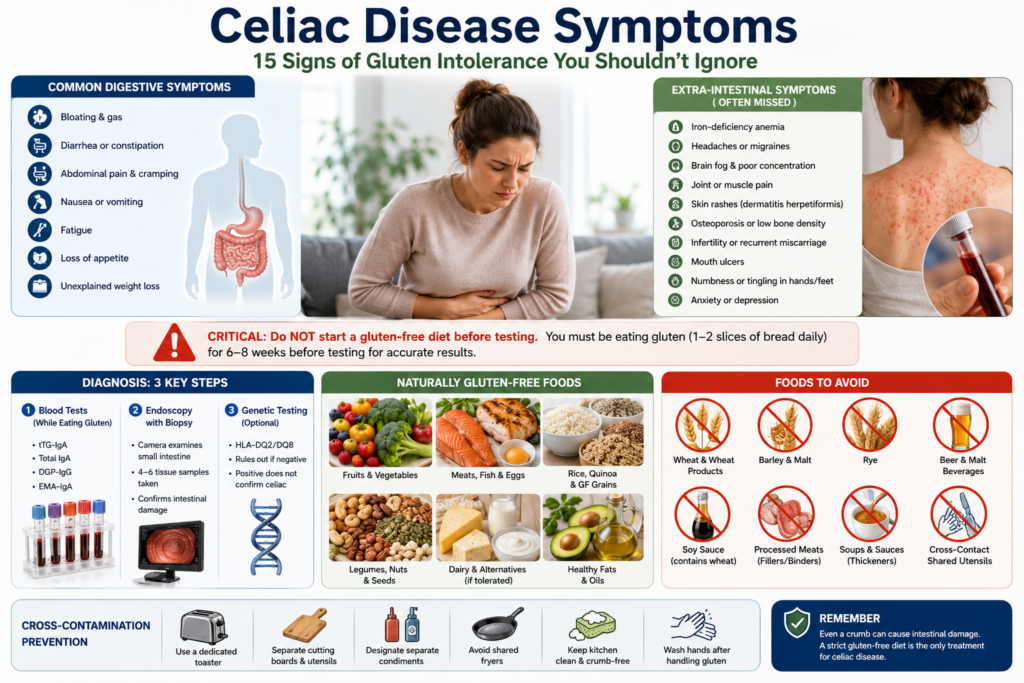
CRITICAL: Do NOT start a gluten-free diet before testing. Going gluten-free before antibody testing and biopsy can lead to false-negative results. You need to be eating gluten (at least 1-2 slices of bread daily) for 6-8 weeks before testing for accurate results.
A better starting point is this: Key tools are antibody testing before diet change, label reading, and a strict cross-contact plan.
Patterns that show up repeatedly in digestive health work include:
- People often start gluten-free too early and accidentally weaken the diagnostic process.
- Shared toasters and condiment jars cause more trouble than restaurant pasta in some households.
- Fatigue is one of the most ignored symptoms because it does not feel ‘digestive’.
That is why timing, portion size, stool pattern, sleep, and stress belong in the conversation even when the title sounds like it is only about one food, one test, or one symptom.
How Celiac Disease Symptoms Present: Digestive and Beyond
Digestive Symptoms (Classic Presentation)
| Symptom | Frequency in Celiac Patients | Notes |
|---|---|---|
| Chronic diarrhea | 50-70% | Often pale, foul-smelling, floating (steatorrhea) |
| Bloating and gas | 60-80% | Often worse after gluten-containing meals |
| Abdominal pain | 40-60% | Can range from mild cramping to severe pain |
| Constipation | 15-25% | Less common than diarrhea but well-documented |
| Nausea/vomiting | 20-30% | More common in children |
| Loss of appetite | 30-40% | Often due to chronic discomfort |
| Weight loss | 20-40% | From malabsorption |
| Pale, fatty stools | 40-50% | Steatorrhea from fat malabsorption |
Extra-Intestinal Symptoms (Often Missed)
Many people with celiac disease have NO digestive symptoms. These extra-intestinal signs are often the only clues:
| System | Symptom | Frequency | Notes |
|---|---|---|---|
| Neurological | Headaches/migraines | 20-30% | Often improve on gluten-free diet |
| Neurological | Peripheral neuropathy | 10-20% | Numbness, tingling in extremities |
| Neurological | Brain fog | 30-40% | Difficulty concentrating |
| Dermatological | Dermatitis herpetiformis | 10-15% | Itchy, blistering rash (elbows, knees, buttocks) |
| Dermatological | Eczema-like rash | 15-20% | Often misdiagnosed |
| Hematological | Iron-deficiency anemia | 40-60% | Most common extra-intestinal sign |
| Hematological | Easy bruising | 20-30% | From vitamin K deficiency |
| Bone/Joint | Joint pain | 25-35% | Often mistaken for arthritis |
| Bone/Joint | Osteoporosis/osteopenia | 40-60% | From calcium/vitamin D malabsorption |
| Reproductive | Infertility (unexplained) | 10-15% | Improves with gluten-free diet |
| Reproductive | Recurrent miscarriages | 10-20% | Associated with untreated celiac |
| Reproductive | Delayed menstruation | 10-15% | More common in adolescents |
| Dental | Enamel defects | 40-60% | In permanent teeth only |
| Dental | Mouth ulcers | 20-30% | Recurrent canker sores |
| Psychiatric | Depression | 30-40% | Often improves on gluten-free diet |
| Psychiatric | Anxiety | 25-35% | Common in newly diagnosed |
Symptoms by Age Group
| Age Group | Most Common Symptoms |
|---|---|
| Infants/Toddlers | Failure to thrive, chronic diarrhea, vomiting, irritability |
| Children (4-12) | Abdominal pain, bloating, constipation, delayed growth |
| Adolescents | Delayed puberty, iron deficiency, short stature, dental defects |
| Adults | Fatigue, anemia, joint pain, infertility, osteoporosis |
| Older Adults | Neuropathy, cognitive decline, bone density loss |
What Can Mimic Celiac Disease
| Condition | Overlapping Symptoms | How to Differentiate |
|---|---|---|
| Non-Celiac Gluten Sensitivity | Bloating, fatigue, brain fog | Negative celiac antibodies and biopsy |
| IBS (Irritable Bowel Syndrome) | Diarrhea, bloating, pain | No antibodies; no intestinal damage |
| Inflammatory Bowel Disease | Diarrhea, weight loss, pain | Different antibodies; colonoscopy findings |
| Wheat Allergy | GI symptoms, hives, breathing issues | IgE-mediated; immediate reaction |
| SIBO | Bloating, gas, diarrhea | Positive breath test; no celiac antibodies |
| Pancreatic Insufficiency | Fatty stools, weight loss | Low fecal elastase; no celiac antibodies |
| Lactose Intolerance | Bloating, diarrhea after dairy | Hydrogen breath test positive |
Red Flags That Change the Plan
Seek immediate medical attention if you experience:
| Red Flag | Why It’s Concerning |
|---|---|
| Unintentional weight loss >10 lbs | Possible malabsorption or malignancy |
| Severe dehydration | From chronic diarrhea |
| Blood in stool | Not typical of celiac; suggests other conditions |
| Severe anemia symptoms | Extreme fatigue, shortness of breath, chest pain |
| Bone fractures from minor trauma | Advanced bone density loss |
| Neurological symptoms | Severe numbness, weakness, coordination problems |
| Growth failure in children | Falling off growth curve |
| Persistent vomiting | Risk of dehydration and electrolyte imbalance |
Getting Diagnosed: The Celiac Disease Testing Process
Step 1: Blood Tests (While Still Eating Gluten)
CRITICAL: You must be consuming gluten (1-2 slices of bread daily) for 6-8 weeks before testing for accurate results.
| Test | What It Measures | Accuracy |
|---|---|---|
| tTG-IgA (Tissue Transglutaminase) | Primary screening test | 95-98% sensitive |
| Total IgA | Checks for IgA deficiency | Rules out false negatives |
| DGP-IgG (Deamidated Gliadin Peptide) | Alternative if IgA deficient | 90-95% sensitive |
| EMA-IgA (Endomysial Antibody) | Confirmatory test | 98-100% specific |
Step 2: Endoscopy with Biopsy
If blood tests are positive, an upper endoscopy confirms diagnosis:
| Procedure | What Happens | What They’re Looking For |
|---|---|---|
| Upper endoscopy | Camera examines small intestine | Visible damage (scalloping, grooves) |
| Duodenal biopsy | 4-6 tissue samples taken | Villous atrophy (damage to intestinal lining) |
| Marsh classification | Damage graded 0-3 | Marsh 3 = celiac disease confirmed |
Step 3: Genetic Testing (Optional)
| Test | What It Tells You | When It’s Used |
|---|---|---|
| HLA-DQ2/DQ8 | Genetic risk markers | Rules OUT celiac if negative |
| Negative result | 99% rules out celiac | Useful when diagnosis is unclear |
| Positive result | Does NOT confirm celiac | 30-40% of population has genes; most don’t develop celiac |
Diagnosing Dermatitis Herpetiformis
If you have the characteristic rash:
| Test | Purpose |
|---|---|
| Skin biopsy | Taken from unaffected skin near rash |
| Direct immunofluorescence | Looks for IgA deposits (confirms DH) |
| Celiac blood tests | Often positive but may be negative |
| Treatment | Gluten-free diet + dapsone (medication) |
Living with Celiac Disease: Essential Do’s and Don’ts
Do’s for Celiac Disease Management
| Do This | Why It Matters |
|---|---|
| Work with a celiac-knowledge dietitian | Specialized guidance prevents mistakes |
| Read every label, every time | Formulas change; gluten hides everywhere |
| Use separate condiments | Shared jars get crumbs from knives |
| Get a dedicated toaster | Crumbs in shared toasters cause reactions |
| Use separate cutting boards | Wood retains gluten particles |
| Check medications and supplements | Gluten used as filler in some medications |
| Join a celiac support group | Learn from experienced patients |
| Get regular nutrient monitoring | Check iron, B12, folate, vitamin D annually |
| Screen family members | 10% of first-degree relatives also have celiac |
| Wear medical ID | Important for emergency situations |
Don’ts for Celiac Disease Management
| Don’t Do This | Why It’s Dangerous |
|---|---|
| Don’t trust “wheat-free” labels | May still contain barley or rye |
| Don’t share fryers | Cross-contact from breaded foods |
| Don’t eat regular soy sauce | Contains wheat; use tamari instead |
| Don’t assume oats are safe | Only certified gluten-free oats are safe |
| Don’t use wooden utensils | Porous wood traps gluten |
| Don’t skip follow-up testing | Need to monitor healing and nutrient levels |
| Don’t ignore cross-contact at home | Family members should rinse hands after handling gluten |
| Don’t eat buffet food | High cross-contact risk from shared utensils |
| Don’t trust verbal assurances alone | Always verify with manager or written info |
Hidden Sources of Gluten
| Product | Why It Contains Gluten | Safe Alternative |
|---|---|---|
| Soy sauce | Made with wheat | Tamari (gluten-free) |
| Beer | Made from barley | Gluten-free beer, wine, spirits |
| Malt vinegar | Made from barley | White vinegar, apple cider vinegar |
| Seitan | Pure wheat gluten | Tofu, tempeh, legumes |
| Some processed meats | Gluten as binder | Plain, unprocessed meats |
| Gravy mixes | Wheat flour as thickener | Cornstarch-based gravies |
| Some salad dressings | Gluten as stabilizer | Check labels; many are GF |
| Licorice candy | Wheat flour as filler | Check labels carefully |
| Some medications | Gluten as filler | Ask pharmacist for GF options |
| Communion wafers | Made from wheat | Low-gluten wafers available |
A composite case study
Consider a composite example: Ella, 27, went gluten-light instead of gluten-free and kept having iron deficiency. The fix was not a new supplement. It was replacing shared butter tubs, checking sauces, and cleaning up cross contact. Her ferritin improved over the next three months as repeat exposure fell.
That kind of progress rarely looks dramatic on day two. It often looks like less evening bloating, one fewer bathroom sprint, better stool form, or one meal that stops feeling like a gamble.
Those are not small wins. They are the early signs that the mechanism and the plan are finally aligned.
When to get medical help
Most digestive symptoms are not emergencies. Some are. The hard part is that people get used to feeling unwell and start negotiating with symptoms they should not be negotiating with.
- weight loss
- severe diarrhea
- signs of malnutrition
- growth issues in children
- black stool
- fainting
- persistent vomiting
- unexplained weight loss
If those are in the picture, the right move is medical assessment, not a stricter diet or another supplement order.
Related reading
- Celiac Disease Diet: A Comprehensive Guide to Gluten-Free Living
- Diagnosing Celiac Disease: Tests, Biopsies, and What Comes Next
- Living Gluten-Free: Tips and Tricks for Celiac Disease Management
- Celiac Disease vs. Gluten Sensitivity: Understanding the Key Differences
- Cross-Contamination in Celiac Disease: How to Stay Safe
- Celiac Disease in Children: Symptoms, Diagnosis, and Management
A brief note on tracking
Tracking only helps if the data is readable. You do not need perfection. You need a short log with enough structure to show cause and effect.
- What you ate and roughly how much
- When symptoms started and how intense they were
- Stool frequency and Bristol stool form when relevant
- Sleep, stress, hydration, and medication changes
If you already use GutFeel AI, use it as a pattern-capture tool. Log meals, symptoms, and timing. Then review weekly trends instead of reacting to one bad afternoon.
Not medical advice: This article is educational and does not replace care from a licensed clinician.
FAQs
What are the first signs of celiac disease?
In children: chronic diarrhea, failure to thrive, irritability, bloating. In adults: fatigue, iron-deficiency anemia, bloating, joint pain, or unexplained infertility. Many adults have no digestive symptoms at all.
Can celiac disease develop at any age?
Yes. Celiac can develop at any age after gluten is introduced to the diet. Many people are diagnosed in their 40s, 50s, or later. Having negative tests in the past doesn’t mean you can’t develop it later.
How long does it take for symptoms to improve on a gluten-free diet?
Digestive symptoms often improve within 2-4 weeks. Fatigue and brain fog may take 3-6 months. Nutrient deficiencies (like iron) can take 6-12 months to correct. Full intestinal healing takes 1-2 years in adults.
What’s the difference between celiac disease and gluten sensitivity?
Celiac disease is an autoimmune condition with intestinal damage and positive antibodies. Non-celiac gluten sensitivity causes similar symptoms but no intestinal damage or positive antibodies. Both require gluten avoidance, but celiac requires stricter cross-contact prevention.
Do I need to get tested before going gluten-free?
YES. Going gluten-free before testing can cause false-negative results. You need to eat gluten (1-2 slices of bread daily) for 6-8 weeks before blood tests and biopsy for accurate diagnosis.
Can celiac disease cause weight gain?
Yes. While weight loss is more common, some people gain weight after diagnosis because their intestines heal and absorb nutrients more efficiently. Some also gain weight by eating more processed gluten-free foods.
Is celiac disease hereditary?
Yes. Having a first-degree relative (parent, sibling, child) with celiac disease gives you about a 10% risk of developing it. Genetic testing (HLA-DQ2/DQ8) can rule out celiac if negative.
Can children outgrow celiac disease?
No. Celiac disease is lifelong. Once diagnosed, a strict gluten-free diet is required for life. However, early diagnosis and treatment allow children to grow and develop normally.
What happens if I accidentally eat gluten?
One-time exposure causes symptoms but doesn’t cause permanent damage. Symptoms typically last 2-7 days. Focus on hydration, rest, and symptom management. Contact your doctor if symptoms are severe or persistent.
Do I need regular follow-up appointments after diagnosis?
Yes. Follow-up typically includes: repeat celiac antibodies at 6-12 months, then annually; nutrient level monitoring (iron, B12, vitamin D); bone density scan if osteoporosis risk; ongoing dietitian support.
Can I drink alcohol with celiac disease?
Yes, but choose carefully. Wine and distilled spirits (vodka, whiskey, gin) are gluten-free. Beer contains gluten unless labeled gluten-free. Some ciders and malt beverages contain gluten.
Is dermatitis herpetiformis the same as celiac disease?
Dermatitis herpetiformis is the skin manifestation of celiac disease. About 10-15% of celiac patients develop DH. Treatment is a strict gluten-free diet plus dapsone medication for symptom control.
Can celiac disease cause infertility?
Yes. Untreated celiac disease is associated with unexplained infertility, recurrent miscarriages, and delayed puberty. Many women conceive successfully after starting a gluten-free diet.
What nutrients should I monitor with celiac disease?
Common deficiencies include: iron (anemia), vitamin D, calcium, B12, folate, and zinc. Get these checked at diagnosis and annually thereafter. Supplementation may be needed during healing.
Sources
- NIDDK – Definition & Facts for Celiac Disease – NIDDK – 2020 – https://www.niddk.nih.gov/health-information/digestive-diseases/celiac-disease/definition-facts
- NIDDK – Symptoms & Causes of Celiac Disease – NIDDK – 2020 – https://www.niddk.nih.gov/health-information/digestive-diseases/celiac-disease/symptoms-causes
- NHS – Coeliac disease – NHS – 2023 – https://www.nhs.uk/conditions/coeliac-disease/
- Mayo Clinic – Celiac disease diagnosis and treatment – Mayo Clinic – 2025 – https://www.mayoclinic.org/diseases-conditions/celiac-disease/diagnosis-treatment/drc-20352225
- Celiac Disease Foundation – Sources of Gluten and Cross Contact – Celiac Disease Foundation – 2025 – https://celiac.org/gluten-free-living/what-is-gluten/sources-of-gluten/
- Nature Reviews Gastroenterology & Hepatology – Coeliac disease complications and comorbidities – Nature Reviews Gastroenterology & Hepatology – 2025 – https://www.nature.com/articles/s41575-024-01032-w