Your child has been diagnosed with celiac disease. Or maybe you suspect they might have it. Either way, you’re facing a mountain of questions.
How will they adjust to a gluten-free diet? What about school lunches? Birthday parties? Sleepovers? Will they grow normally? Can they still play sports?
As a parent, you want to protect your child from every hardship. With celiac disease, that means becoming an expert in gluten-free living—and teaching your child to do the same.
Here’s the good news: Children with celiac disease can—and do—thrive. They play sports, attend parties, go to college, and live full, healthy lives. With proper diagnosis, treatment, and family support, most children heal completely and experience normal growth and development.
This comprehensive guide covers everything you need to know: recognizing symptoms in children of different ages, navigating the diagnostic process, managing the gluten-free transition, handling school and social situations, and ensuring your child gets all the nutrients they need to grow strong.
Understanding Celiac Disease in Children
What Is Celiac Disease?
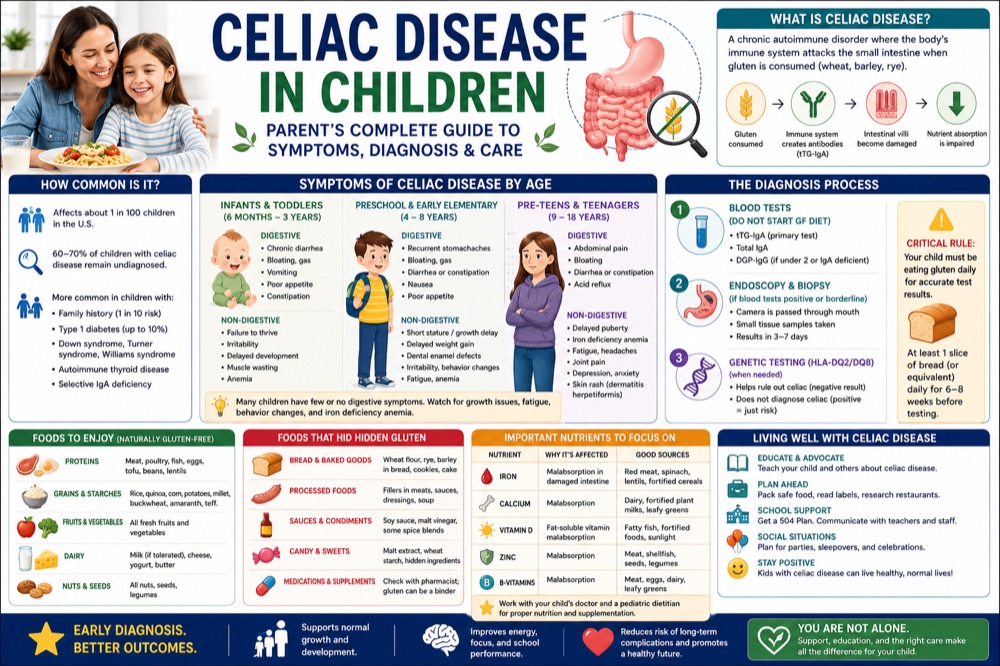
Celiac disease is a chronic autoimmune disorder where the body’s immune system mistakenly attacks the small intestine when gluten is consumed. Gluten is a protein found in wheat, barley, and rye.
When a child with celiac disease eats gluten:
- The immune system produces antibodies (tTG-IgA)
- These antibodies attack the tissue transglutaminase enzyme
- The villi (finger-like projections in the small intestine) become damaged
- Nutrient absorption is impaired
- Growth and development can be affected
How Common Is Celiac Disease in Children?
- Affects approximately 1 in 100 children in the United States
- About 60-70% of children with celiac disease remain undiagnosed
- Can develop at any age—once teeth come in and gluten is introduced
- More common in children with:
- Family history of celiac disease (1 in 10 risk for first-degree relatives)
- Type 1 diabetes (up to 10% have celiac disease)
- Down syndrome, Turner syndrome, or Williams syndrome
- Autoimmune thyroid disease
- Selective IgA deficiency
Why Early Diagnosis Matters
Untreated celiac disease in children can lead to:
| Complication | Impact | Reversibility |
|---|---|---|
| Growth failure | Short stature, delayed growth spurts | Usually reversible with treatment |
| Delayed puberty | Late onset of puberty | Reversible with early treatment |
| Iron deficiency anemia | Fatigue, weakness, poor concentration | Reversible |
| Calcium/vitamin D deficiency | Poor bone density, fracture risk | Partially reversible |
| Dental enamel defects | Permanent tooth discoloration | Not reversible |
| Learning difficulties | Brain fog, school struggles | Reversible |
| Mood changes | Irritability, anxiety, depression | Reversible |
Symptoms of Celiac Disease in Children: Age-by-Age Guide
Children don’t always present with the “classic” digestive symptoms. In fact, many children have few or no digestive complaints at all.
Infants and Toddlers (6 months - 3 years)
Symptoms typically appear after gluten is introduced to the diet (usually 6-12 months)
Digestive Symptoms:
- Chronic diarrhea (often pale, foul-smelling stools)
- Abdominal bloating and distension
- Excessive gas
- Vomiting
- Poor appetite or refusal to eat
- Constipation (less common but possible)
Non-Digestive Symptoms:
- Failure to thrive (poor weight gain)
- Irritability and fussiness
- Delayed development
- Muscle wasting (especially in buttocks and thighs)
- Anemia (pale skin, fatigue)
What Parents Notice:
“My toddler’s belly was always bloated, like a little pot belly. She stopped gaining weight and seemed unhappy all the time.”
Preschool and Early Elementary (4-8 years)
Digestive Symptoms:
- Recurrent stomachaches
- Bloating and gas
- Diarrhea or constipation
- Nausea
- Poor appetite
Non-Digestive Symptoms:
- Short stature or growth delay
- Delayed weight gain
- Dental enamel defects (on permanent teeth)
- Irritability and behavioral changes
- Fatigue
- Anemia
What Parents Notice:
“My 6-year-old was the shortest in his class and always tired. The dentist noticed enamel problems on his new permanent teeth.”
Pre-Teens and Teenagers (9-18 years)
Digestive Symptoms:
- Abdominal pain (often dismissed as “growing pains”)
- Bloating
- Diarrhea or constipation
- Acid reflux
Non-Digestive Symptoms:
- Delayed puberty (no breast development by 13, no periods by 15, no testicular growth by 14)
- Short stature
- Iron deficiency anemia (especially in teenage girls)
- Fatigue
- Headaches
- Joint pain
- Depression or anxiety
- Dermatitis herpetiformis (itchy, blistering rash)
- Canker sores
- Poor school performance (brain fog)
What Parents Notice:
“My 14-year-old daughter was always exhausted, had heavy periods, and couldn’t focus in school. Turns out she had severe iron deficiency from celiac disease.”
Silent Celiac Disease
Some children have no noticeable symptoms but still have positive blood tests and intestinal damage. This is called “silent” celiac disease.
When Silent Celiac Is Found:
- Family screening (sibling or parent diagnosed)
- Screening high-risk conditions (Type 1 diabetes, Down syndrome)
- Incidental finding during other medical work
Important: Even without symptoms, silent celiac disease requires treatment. Untreated celiac disease can still cause bone density loss, growth issues, and other complications.
Diagnosing Celiac Disease in Children
When to Request Testing
Ask your pediatrician about celiac testing if your child has:
- Persistent digestive symptoms (more than 2-3 weeks)
- Unexplained growth delay or weight loss
- Iron deficiency anemia that doesn’t respond to supplements
- Dental enamel defects on permanent teeth
- Delayed puberty
- Family history of celiac disease (first-degree relative)
- Type 1 diabetes or other autoimmune condition
- Down syndrome, Turner syndrome, or Williams syndrome
- Unexplained fatigue or behavioral changes
Critical Rule: Don’t Start a Gluten-Free Diet Before Testing!
This is crucial: If you suspect celiac disease, DO NOT remove gluten from your child’s diet until testing is complete.
Why? Removing gluten before testing can cause:
- False-negative blood tests
- False-negative biopsy results
- Delayed or missed diagnosis
- Need for a gluten challenge later (reintroducing gluten for several weeks)
Your child must be eating gluten daily for accurate test results.
Step 1: Blood Tests (Celiac Serology)
The initial blood test panel should include:
| Test | Purpose | Normal Range |
|---|---|---|
| tTG-IgA (tissue transglutaminase antibody) | Primary screening test | <4 U/mL (varies by lab) |
| Total Serum IgA | Rules out IgA deficiency (which causes false negatives) | Age-dependent |
| DGP-IgG (deamidated gliadin peptide) | Used in children under 2; backup test | <20 U/mL |
Additional Tests Sometimes Ordered:
- EMA-IgA (endomysial antibody) – for confirmation
- tTG-IgG – if IgA deficient
Important for Parents:
- Children under 2 may not produce tTG-IgA reliably; DGP testing is preferred
- Your child must be eating gluten daily (at least 1 slice of bread or equivalent) for 6-8 weeks before testing
- Mild elevations can occur with infections; significant elevations (>10x normal) strongly suggest celiac disease
Step 2: Endoscopy with Biopsy
When Biopsy Is Recommended:
- Blood tests are positive or borderline
- Symptoms persist despite negative blood tests
- High clinical suspicion
When Biopsy May Be Avoided (ESPGHAN Guidelines): Children may be diagnosed without biopsy if ALL of these criteria are met:
- tTG-IgA level is >10 times the upper limit of normal
- EMA-IgA (endomysial antibody) is positive on a second blood sample
- Child is symptomatic
- HLA-DQ2 or HLA-DQ8 genes are present (genetic testing)
The Endoscopy Procedure:
| Aspect | What Parents Need to Know |
|---|---|
| Age | Safe for children of all ages |
| Sedation | Children receive anesthesia; they sleep through it |
| Duration | 10-15 minutes |
| Procedure | Small camera passed through mouth into small intestine |
| Biopsy | 4-6 tiny tissue samples taken (painless) |
| Recovery | 1-2 hours; home same day |
| Results | Available in 3-7 days |
Preparing Your Child for Endoscopy:
For Young Children (3-7 years):
- Use simple language: “The doctor will take tiny pictures of your tummy to see why you’ve been feeling sick.”
- Read children’s books about medical procedures
- Bring a comfort item (stuffed animal, blanket)
- Stay calm—your anxiety affects them
For Older Children (8-12 years):
- Explain what will happen in age-appropriate detail
- Emphasize they’ll be sleeping and won’t feel anything
- Answer questions honestly
- Discuss what to expect after (sore throat, grogginess)
For Teenagers:
- Provide full explanation of the procedure
- Discuss privacy and modesty concerns
- Allow them to ask questions directly to the doctor
- Acknowledge their feelings (anxiety is normal)
Day of Procedure:
- No food or drink for 6-8 hours before (follow doctor’s instructions)
- Wear comfortable clothing
- Bring insurance card and medical information
- Arrange for someone to drive home (sedation prevents driving)
Step 3: Genetic Testing (Sometimes)
HLA genetic testing checks for the genes HLA-DQ2 and HLA-DQ8, which are present in nearly all people with celiac disease.
When Genetic Testing Is Useful:
- To rule OUT celiac disease (negative result essentially excludes diagnosis)
- In children already on a gluten-free diet (avoids gluten challenge)
- For family screening
- When diagnosis is unclear
Understanding Results:
| Result | Meaning | Next Steps |
|---|---|---|
| Negative for DQ2 and DQ8 | Celiac disease is extremely unlikely (<1% chance) | No further celiac testing needed |
| Positive for DQ2 and/or DQ8 | Genetic susceptibility present | Does NOT diagnose celiac (30-40% of population has these genes) |
Biopsy Results: Understanding the Marsh Classification
If your child has a biopsy, the pathologist assigns a Marsh score:
| Marsh Type | Findings | Interpretation |
|---|---|---|
| Marsh 0 | Normal | No celiac disease |
| Marsh 1 | Increased lymphocytes | Possible early celiac; non-specific |
| Marsh 2 | Increased lymphocytes + crypt changes | Suggestive of celiac |
| Marsh 3a-3c | Villous atrophy (partial to total) | Diagnostic of celiac disease |
| Marsh 4 | Total villous atrophy | Advanced celiac (rare in children) |
Treatment: The Gluten-Free Diet for Children
The Foundation: Lifelong Strict Gluten-Free Diet
Currently, the only treatment for celiac disease is a strict, lifelong gluten-free diet. This means eliminating all sources of:
- Wheat (including spelt, kamut, farro, durum, semolina, einkorn)
- Barley (and malt, malt extract, malt vinegar, malt syrup)
- Rye
- Triticale (wheat-rye hybrid)
- Brewer’s yeast (unless specified gluten-free)
Foods That Are Naturally Gluten-Free (Safe!)
Proteins:
- Fresh meat, poultry, fish
- Eggs
- Tofu and tempeh
Grains & Starches:
- Rice (all varieties)
- Quinoa
- Corn
- Potatoes and sweet potatoes
- Buckwheat (despite the name!)
- Millet
- Amaranth
- Teff
- Certified gluten-free oats (see note below)
Fruits & Vegetables:
- All fresh fruits
- All fresh vegetables
Dairy:
- Milk (if tolerated—some children have temporary lactose intolerance)
- Natural cheeses
- Plain yogurt
Legumes, Nuts & Seeds:
- All dried beans and lentils
- All nuts (check flavored varieties)
- All seeds
Foods That Require Careful Label Reading
| Food Category | Hidden Gluten Sources | Safe Choices |
|---|---|---|
| Breaded/fried foods | Wheat flour in breading | Naturally GF foods, GF breadcrumbs |
| Processed meats | Fillers in hot dogs, sausages, deli meats | Plain fresh meats, GF-certified brands |
| Candy | Malt extract, wheat-based ingredients | Most chocolate, gummies (verify) |
| Ice cream | Cookie dough, brownie pieces, malt | Plain flavors, GF-certified brands |
| Chips | Seasonings, malt vinegar | Plain chips, GF-certified |
| Soy sauce | Contains wheat | Tamari, coconut aminos |
| Soup | Flour thickener, barley broth | GF-certified soups |
| Medications | Gluten as binding agent | Ask pharmacist; verify each prescription |
A Note on Oats
Oats are naturally gluten-free but are often contaminated with wheat during growing and processing.
Guidelines for Children:
- Only use certified gluten-free oats (Bob’s Red Mill GF, Bobo’s, GF Harvest)
- Introduce oats after the child is stable on a gluten-free diet (usually 3-6 months)
- Some people with celiac disease react to avenin (a protein in oats)—monitor for symptoms
- Oats are not recommended during the initial healing phase
Nutritional Considerations for Children
Children with newly diagnosed celiac disease often have nutrient deficiencies due to intestinal damage.
Common Deficiencies and Food Sources:
| Nutrient | Why It’s Affected | Food Sources | Supplementation |
|---|---|---|---|
| Iron | Malabsorption in damaged intestine | Red meat, spinach, lentils, fortified GF cereals | Often needed initially |
| Calcium | Malabsorption + possible lactose intolerance | Dairy (if tolerated), fortified plant milks, leafy greens | Usually recommended |
| Vitamin D | Fat-soluble vitamin malabsorption | Fatty fish, fortified foods, sunlight | Commonly prescribed |
| Zinc | Malabsorption | Meat, shellfish, legumes, seeds | Sometimes needed |
| B Vitamins | Malabsorption | Meat, eggs, dairy, leafy greens, fortified foods | May be needed |
Important: Work with your child’s doctor and a pediatric dietitian to determine appropriate supplementation. Many children need supplements initially but can transition to food-based nutrition as the gut heals.
Sample Meal Plans for Children
Toddler (Ages 1-3)
| Meal | Options |
|---|---|
| Breakfast | Scrambled eggs with cheese and fruit; GF oatmeal with berries |
| Snack | Cheese sticks and GF crackers; apple slices with peanut butter |
| Lunch | Turkey and cheese roll-ups with carrots; GF pasta with butter and cheese |
| Snack | Yogurt with fruit; GF muffin |
| Dinner | Baked chicken with potatoes and vegetables; tacos with corn tortillas |
Elementary Age (Ages 4-10)
| Meal | Options |
|---|---|
| Breakfast | GF waffles with fruit; smoothie with GF protein powder |
| Snack | Hummus with vegetables; string cheese and fruit |
| Lunch | GF sandwich with chips; leftover dinner |
| Snack | GF granola bar; popcorn |
| Dinner | Spaghetti with meat sauce (GF pasta); grilled fish with rice and vegetables |
Teenagers (Ages 11-18)
| Meal | Options |
|---|---|
| Breakfast | Breakfast burrito (corn tortilla); GF cereal with milk |
| Snack | Trail mix; GF protein bar |
| Lunch | Large salad with protein; GF wrap with chips |
| Snack | Fruit and cheese; GF cookies |
| Dinner | Stir-fry with tamari over rice; pizza with GF crust |
School Lunch Ideas
Packing Lunch:
- Use insulated lunchbox with ice pack
- Include variety: protein, fruit, vegetable, treat
- Label everything clearly
- Include hand wipes for before eating
GF Lunch Ideas:
- Turkey and cheese sandwich (GF bread) with fruit and vegetables
- Thermos soup (GF) with GF crackers and fruit
- Leftover pasta salad
- Chicken nuggets (GF brands: Applegate, Yummy) with sweet potato fries
- Taco salad with ground beef, cheese, lettuce, salsa
Managing Celiac Disease at School
Legal Protections
Section 504 Plan: Celiac disease qualifies as a disability under Section 504 of the Rehabilitation Act. Your child is entitled to accommodations at school.
What a 504 Plan Can Include:
- Access to gluten-free meal options in cafeteria
- Permission to bring safe snacks from home
- Gluten-free alternatives for classroom celebrations
- Safe handwashing before meals
- Education for teachers and staff about celiac disease
- No punishment if child needs to eat at a different time
- Access to nurse’s office if feeling ill
How to Request a 504 Plan:
- Submit written request to school principal or 504 coordinator
- Provide documentation from child’s doctor
- Attend 504 meeting (parents, school staff, doctor if possible)
- Develop written plan with specific accommodations
- Review and update annually
Classroom Celebrations and Parties
Potential Risks:
- Cupcakes, cookies, pizza parties
- Play-dough (contains wheat)
- Crafts using wheat-based materials
- Shared snacks without ingredient verification
Solutions:
| Situation | Strategy |
|---|---|
| Birthday celebrations | Provide teacher with GF cupcakes/treats to keep in freezer; send non-food treats |
| Class parties | Send GF version of the treat for your child AND to share |
| End-of-year pizza party | Arrange GF pizza in advance (many chains deliver to schools) |
| Crafts | Request GF play-dough alternatives (see recipe below) |
Homemade Gluten-Free Play-Dough Recipe:
- 1 cup GF flour (rice flour works well)
- 1/2 cup salt
- 2 tsp cream of tartar
- 1 tbsp oil
- 1 cup water
- Food coloring (optional)

Mix dry ingredients, add water and oil, cook over medium heat until ball forms.
Sample 504 Plan Accommodations for Celiac Disease
Talking to School Staff
Email Template for Teachers:
Dear [Teacher’s Name],
I’m writing to inform you that [Child’s Name] has celiac disease, a serious autoimmune condition. This means that even tiny amounts of gluten (a protein in wheat, barley, and rye) can cause intestinal damage and make [him/her] sick.
Key points:
- [Child’s Name] cannot eat regular cookies, cupcakes, pizza, or most processed snacks
- [He/She] needs to wash hands before eating
- Cross-contamination is a concern (shared utensils, crumbs on tables)
- We will provide gluten-free treats for celebrations, or [Child’s Name] can have a non-food reward
I’ve attached a 504 plan from our doctor. I’d love to discuss this further before school starts. Thank you for helping keep [Child’s Name] safe!
Warmly, [Your Name]
Social Situations: Birthday Parties, Sleepovers, and Events
Birthday Parties
Before the Party:
- Call the host parent: “[Child’s Name] has celiac disease, which means [he/she] can’t eat wheat, barley, or rye. I’m happy to drop off a gluten-free cupcake!”
- Offer to bring enough GF treats for all the kids (often welcomed!)
- Ask about planned food so you can prepare
At the Party:
- Arrive early with GF treats
- Label your child’s plate or designate a safe eating area
- Teach your child to check with you before eating anything
Sleepovers
For Younger Children:
- Consider hosting sleepovers at your house initially
- When child stays elsewhere, call the host parents to discuss food
- Send a bag of safe snacks and breakfast items
- Provide clear instructions about what can and can’t be eaten
For Older Children/Teens:
- Ensure they understand how to advocate for themselves
- Send safe snacks
- Provide host parents with your contact information
- Discuss what to do if they accidentally eat something unsafe
Script for Calling Host Parents:
“Hi, I’m [Name], [Child’s Name]‘s parent. [Child’s Name] has celiac disease, which is a medical condition where [he/she] can’t eat wheat, barley, or rye. I wanted to let you know and offer to drop off some safe snacks for [him/her]. Pizza is usually safe if it’s cheese or pepperoni without specialty toppings, but I’m happy to provide GF alternatives if that’s easier.”
Dining Out with Children
Restaurant Strategies:
- Research restaurants with GF options beforehand
- Use Find Me Gluten Free app (read reviews from other families)
- Call ahead during off-peak hours
- Teach children to ask questions
Kid-Friendly GF Restaurant Options:
| Restaurant | GF Options | Notes |
|---|---|---|
| Chipotle | Burrito bowls, tacos (corn tortillas) | Avoid flour tortillas |
| Five Guys | Burgers (no bun), fries | GF bun available; fries are safe |
| Chick-fil-A | Grilled chicken, waffle fries | Many GF options; allergen menu available |
| Outback Steakhouse | Steaks, sides | GF menu available |
| P.F. Chang’s | Dedicated GF menu | Separate prep area |
Sports and Activities
Team Snacks:
- Volunteer to bring team snacks so you control what’s served
- Send GF options that all kids can enjoy (fruit, cheese sticks, GF granola bars)
- Educate coaches about celiac disease
Sports Camps:
- Notify camp staff about dietary needs
- Pack safe snacks
- Ensure child knows not to share food
Emotional Support: Helping Your Child Adjust
Common Emotional Responses by Age
Young Children (3-7 years):
- Confusion about “why I can’t eat that”
- Frustration when seeing peers eat cookies, pizza, etc.
- Fear of getting sick
- How to help: Use simple explanations, focus on foods they CAN eat, normalize the diet
Elementary Age (8-12 years):
- Feeling different from peers
- Embarrassment about bringing special food
- Worry about making mistakes
- How to help: Teach self-advocacy, connect with other kids with celiac, involve them in meal planning
Teenagers (13-18 years):
- Rebellion against dietary restrictions
- Risk-taking (intentional gluten exposure)
- Social anxiety about dating, parties, eating out
- How to help: Open communication, involve in support groups, emphasize long-term health, consider counseling**
Age-Appropriate Explanations
For Young Children:
“Your tummy has trouble digesting something called gluten, which is in bread, pasta, and cookies. When you eat gluten, it makes your tummy hurt and stops your body from growing strong. So we’re going to eat different foods that make your tummy happy!”
For Elementary Age:
“You have something called celiac disease. It means your body’s defense system gets confused when you eat gluten—a protein in wheat, barley, and rye—and attacks your intestines. The good news is that when you eat gluten-free, your body can heal and you’ll feel great!”
For Teenagers:
“Celiac disease is an autoimmune condition that runs in families [if applicable]. When you eat gluten, your immune system damages your small intestine. This can cause [specific symptoms they experienced]. The only treatment is a gluten-free diet, which lets your intestine heal. I know it feels restrictive, but millions of people live gluten-free lives and do great.”
When to Seek Professional Support
Consider counseling or therapy if your child experiences:
- Persistent sadness or depression
- Severe anxiety about food
- Social withdrawal
- Disordered eating patterns
- Intentional gluten exposure (teens)
- School refusal
Resources:
- Celiac Disease Foundation support groups
- Beyond Celiac community programs
- Local children’s hospital support groups
- Therapists specializing in chronic illness (Psychology Today directory)
Monitoring Progress: What to Expect After Diagnosis
Healing Timeline
| Timeframe | What’s Happening | What Parents Notice |
|---|---|---|
| Week 1-2 | Inflammation beginning to decrease | Some symptom improvement; less bloating |
| Month 1-3 | Villi starting to regenerate | Increased energy; better appetite; mood improvement |
| Month 3-6 | Significant intestinal healing | Normal growth resumes; anemia improving |
| Month 6-12 | Near-complete healing in most children | Full symptom resolution; catch-up growth |
| Year 1-2 | Complete healing expected | Normal lab values; healthy growth pattern |
Note: Healing is typically faster in children than adults. Younger children often heal within 6 months.
Follow-Up Testing Schedule
| Timeframe | Testing | Purpose |
|---|---|---|
| 3-6 months | tTG-IgA blood test | Confirm antibody levels decreasing |
| 12 months | tTG-IgA + nutrient panel | Verify healing and address deficiencies |
| Annually | tTG-IgA + CBC + metabolic panel | Monitor ongoing compliance and health |
| As needed | Repeat endoscopy | Only if symptoms persist or diagnosis uncertain |
Signs of Healing
What Parents Should See:
- Improved energy levels
- Better appetite
- Resolution of digestive symptoms
- Improved mood and behavior
- Catch-up growth (height and weight)
- Improved school performance
- Resolution of anemia
What Labs Should Show:
- Decreasing tTG-IgA levels
- Normalizing hemoglobin and ferritin
- Improving vitamin and mineral levels
When Healing Doesn’t Happen: Persistent Symptoms
If your child continues to have symptoms after 6 months on a strict gluten-free diet, discuss these possibilities with the doctor:
Common Reasons for Persistent Symptoms
| Cause | Signs | Solution |
|---|---|---|
| Inadvertent gluten exposure | Most common cause; ongoing symptoms | Review diet with dietitian; identify hidden sources |
| Temporary lactose intolerance | Bloating, diarrhea after dairy | Reduce lactose temporarily; usually resolves as gut heals |
| SIBO (Small Intestinal Bacterial Overgrowth) | Bloating, gas, diarrhea | Breath test; antibiotics if positive |
| IBS (Irritable Bowel Syndrome) | Ongoing digestive symptoms | Low-FODMAP diet; stress management |
| Refractory celiac disease | Very rare in children | Specialist evaluation; medications |
Resources for Families
Frequently Asked Questions
Key Takeaways
- Celiac disease affects 1 in 100 children and requires lifelong management
- Symptoms vary widely—from severe digestive issues to no symptoms at all
- Don’t go gluten-free before testing—this can cause false-negative results
- Children can often be diagnosed without biopsy if blood tests are very high
- Healing is faster in children than adults—most heal within 6-12 months
- School accommodations are legally required—request a 504 plan
- Social situations require planning but are completely manageable
- Emotional support is critical—help your child understand and advocate
- Regular follow-up is essential—monitor healing and nutrient levels
- Children with celiac disease can thrive—with proper management, they live full, healthy lives
Medical Review: This content has been reviewed for accuracy against current pediatric celiac disease guidelines from the North American Society for Pediatric Gastroenterology, Hepatology and Nutrition (NASPGHAN) and European Society for Paediatric Gastroenterology Hepatology and Nutrition (ESPGHAN).
Sources:
- NASPGHAN - Pediatric Celiac Disease Guidelines - 2025
- ESPGHAN - Diagnosis of Celiac Disease in Children - 2024
- Celiac Disease Foundation - Children and Celiac Disease - 2026
- Beyond Celiac - Family Resources - 2026
- Mayo Clinic - Celiac Disease in Children - 2025
- Journal of Pediatric Gastroenterology and Nutrition - Celiac Disease Management in Children - 2025
Last Updated: March 9, 2026