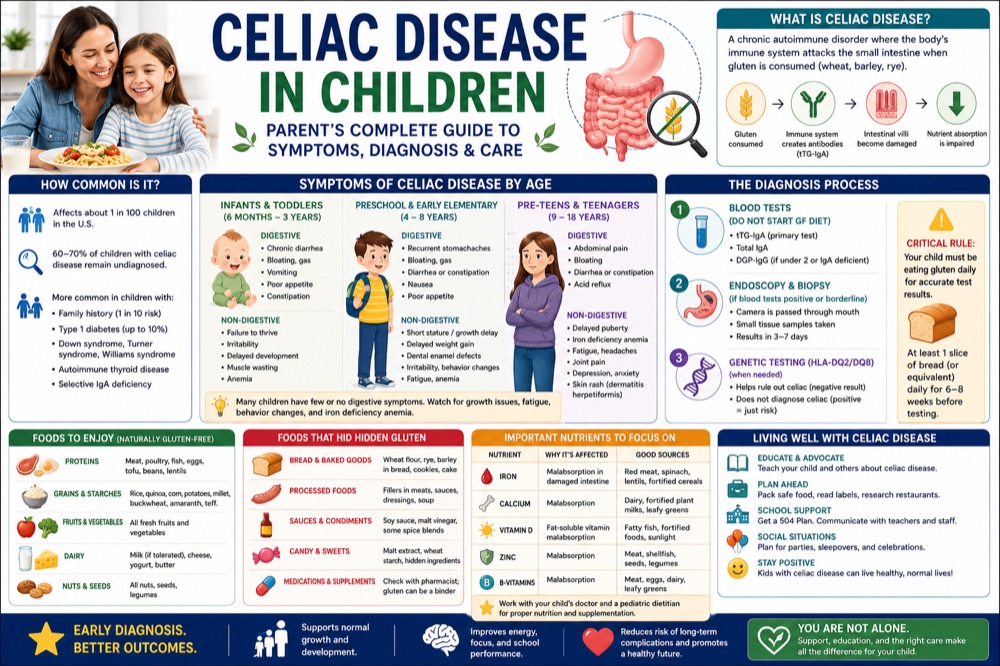
You’ve been struggling with digestive issues, unexplained fatigue, or stubborn iron deficiency. Your doctor mentioned celiac disease. Now what?
The path to a celiac disease diagnosis can feel confusing and overwhelming. There are blood tests, genetic tests, biopsies, and the critical rule about staying on a gluten-containing diet during testing. Get one thing wrong, and you could face months of uncertainty or a misdiagnosis.
This guide walks you through every step of the celiac disease diagnostic process—what each test means, how to prepare, what happens during an endoscopy, how to interpret results, and exactly what to do after diagnosis.
Critical Warning: If you suspect celiac disease, DO NOT start a gluten-free diet until testing is complete. Going gluten-free before testing can cause false-negative results and delay diagnosis for years.
Why Celiac Disease Is Often Misdiagnosed
Celiac disease affects approximately 1 in 100 people worldwide, yet about 83% remain undiagnosed or misdiagnosed. The average person waits 6-10 years for a correct diagnosis. Why?
Common Reasons for Delayed Diagnosis:
| Reason | Explanation |
|---|---|
| Symptom overlap | Symptoms mimic IBS, IBD, SIBO, and other conditions |
| Atypical presentation | Many patients have few or no digestive symptoms |
| Lack of physician awareness | Some providers still believe celiac is rare |
| Premature gluten-free diet | Patients eliminate gluten before proper testing |
| False-negative tests | Can occur if gluten intake was reduced before testing |
| Focus on single symptoms | Doctors treat anemia or fatigue without investigating root cause |
Step 1: Recognizing Symptoms That Warrant Testing
Symptoms in Children
- Failure to thrive (poor growth)
- Delayed puberty
- Irritability or behavioral changes
- Dental enamel defects
- Short stature
- Weight loss or difficulty gaining weight
When to Request Testing: If you have persistent symptoms from either category—especially if you have a family member with celiac disease or autoimmune conditions—ask your doctor about testing.
Step 2: Celiac Disease Blood Tests (Serology)
Blood tests are the first step in celiac diagnosis. They detect antibodies your immune system produces when reacting to gluten.
Primary Celiac Blood Tests
1. tTG-IgA (Tissue Transglutaminase Antibody, IgA Class)
The Gold Standard Test
| Detail | Information |
|---|---|
| What it measures | IgA antibodies against tissue transglutaminase enzyme |
| Accuracy | 95-98% sensitive in patients over age 2 |
| When it’s positive | Elevated in active celiac disease |
| False negatives | Possible if IgA deficient or low gluten intake |
Important: This test requires that you’re consuming gluten regularly (at least 1-2 slices of bread daily) for 6-8 weeks before testing.
2. Total Serum IgA
Rules Out IgA Deficiency
About 2-3% of people with celiac disease have IgA deficiency, which causes false-negative tTG-IgA results. Your doctor should order this alongside tTG-IgA.
If you’re IgA deficient, alternative tests are used:
- tTG-IgG
- DGP-IgG (Deamidated Gliadin Peptide)
3. EMA (Endomysial Antibody, IgA)
The Confirmation Test
| Detail | Information |
|---|---|
| What it measures | IgA antibodies against endomysium (connective tissue) |
| Accuracy | 99% specific (very rarely positive without celiac) |
| When used | To confirm positive tTG-IgA or in borderline cases |
| Limitation | More expensive and operator-dependent |
4. DGP (Deamidated Gliadin Peptide)
Useful in Specific Situations
| Detail | Information |
|---|---|
| What it measures | Antibodies to gliadin (gluten protein component) |
| When used | In IgA-deficient patients or young children |
| Accuracy | Good but slightly less specific than tTG-IgA |
| Types | DGP-IgA and DGP-IgG available |
Complete Celiac Blood Panel (What to Request)
A comprehensive celiac panel should include:
- tTG-IgA (primary screening)
- Total Serum IgA (to rule out deficiency)
- tTG-IgG (if IgA deficient)
- DGP-IgA and DGP-IgG (especially in children or IgA deficiency)
- EMA-IgA (for confirmation if other tests are positive or borderline)
Understanding Your Blood Test Results
| Result Type | What It Means | Next Steps |
|---|---|---|
| Strongly Positive tTG-IgA (above 10x normal) | Highly likely celiac disease | Endoscopy with biopsy typically recommended |
| Weakly Positive tTG-IgA (2-10x normal) | Possible celiac disease | Endoscopy with biopsy recommended |
| Borderline/Low Positive | Uncertain—could be early celiac, other condition, or lab variation | Repeat testing, consider endoscopy, or genetic testing |
| Negative tTG-IgA | Celiac disease unlikely (IF consuming gluten) | Consider other diagnoses; if high suspicion, check IgA levels and consider DGP testing |
Important Considerations for Blood Testing
You MUST be eating gluten for accurate results:
- Minimum: 1-2 slices of bread worth of gluten daily
- Duration: At least 6-8 weeks before blood testing
- If you’ve already gone gluten-free, discuss a “gluten challenge” with your doctor
Conditions that can cause false-positive results:
- Type 1 diabetes
- Autoimmune thyroid disease
- Autoimmune liver disease
- Rheumatoid arthritis
- psoriatic arthritis
- Certain infections
- Some medications
A positive blood test alone does NOT confirm celiac disease—it indicates the need for further testing.
Step 3: Genetic Testing (HLA Typing)
What Is HLA Genetic Testing?
Celiac disease occurs almost exclusively in people with specific genetic markers called HLA-DQ2 and HLA-DQ8. Genetic testing checks for these markers.
When Genetic Testing Is Used
| Situation | How Genetic Testing Helps |
|---|---|
| Already on gluten-free diet | Negative result rules out celiac (no gluten challenge needed) |
| Borderline blood tests | Helps determine if further testing is worthwhile |
| Family members of celiac patients | Identifies who needs regular screening |
| Unclear diagnosis | Adds information to clinical picture |
Understanding Genetic Test Results
| Result | Meaning | Implications |
|---|---|---|
| Negative for HLA-DQ2 and HLA-DQ8 | Celiac disease is extremely unlikely (99%+ ruled out) | No further celiac testing needed; look for other causes |
| Positive for HLA-DQ2 and/or HLA-DQ8 | Genetic susceptibility present | Does NOT diagnose celiac (30-40% of population has these genes) |
| Positive, but blood tests negative | Has genes but no current evidence of celiac | May develop celiac later; monitor symptoms and retest if needed |
Key Point: Genetic testing can RULE OUT celiac disease but cannot diagnose it. About 30-40% of the general population carries these genes, but only about 1-3% develop celiac disease.
Step 4: Endoscopy with Small Intestine Biopsy
When Is a Biopsy Needed?
A biopsy is recommended when:
- Blood tests are positive (tTG-IgA elevated)
- Blood tests are borderline with symptoms and genetic susceptibility
- Patient has symptoms and positive genetic testing despite negative blood work
Exception: In some pediatric cases with very high tTG-IgA levels (over 10x normal) and positive EMA, biopsy may be waived per ESPGHAN guidelines.
What Happens During an Endoscopy?
Procedure Overview:
| Aspect | Details |
|---|---|
| Duration | 10-20 minutes |
| Sedation | Conscious sedation (you’re relaxed and drowsy) |
| Procedure | Thin, flexible tube with camera passed through mouth into small intestine |
| Biopsy | 4-6 tiny tissue samples taken from duodenum (painless) |
| Recovery | 30-60 minutes; can go home same day |
| Discomfort | Minimal; mild sore throat possible |
What Pathologists Look For: Marsh Classification
Biopsy samples are examined for villous atrophy (damage to finger-like projections) and other changes. Results are classified using the Marsh-Oberhuber system:
| Marsh Type | Findings | Interpretation |
|---|---|---|
| Marsh 0 | Normal biopsy | No celiac disease |
| Marsh 1 | Increased intraepithelial lymphocytes | Possible early celiac; non-specific |
| Marsh 2 | Increased lymphocytes + crypt hyperplasia | Suggestive of celiac |
| Marsh 3a-3c | Villous atrophy (partial to total) | Diagnostic of celiac disease (with positive serology) |
| Marsh 4 | Total villous atrophy with hypoplasia | Advanced celiac disease (rare at diagnosis) |
Important: Biopsy interpretation requires an experienced pathologist. If results don’t match blood tests, consider a second opinion.
Preparing for Endoscopy
Before the Procedure:
- Fast for 6-8 hours (no food or drink)
- Arrange transportation (sedation prevents driving)
- Inform doctor of all medications (some may need temporary adjustment)
- Continue eating gluten until the procedure (critical!)
After the Procedure:
- Rest for the day
- Mild throat discomfort or bloating is normal
- Resume normal diet unless instructed otherwise
- Results typically available in 1-2 weeks
Step 5: Dermatitis Herpetiformis (DH) Diagnosis
What Is Dermatitis Herpetiformis?
DH is the skin manifestation of celiac disease—an intensely itchy, blistering rash typically appearing on elbows, knees, buttocks, and scalp.
How DH Is Diagnosed
| Method | Details |
|---|---|
| Skin biopsy | Small sample taken from skin near rash (not the blister itself) |
| Direct immunofluorescence | Detects IgA deposits in skin (diagnostic for DH) |
| Blood tests | tTG-IgA often positive but can be negative in DH |
Important: A positive skin biopsy for DH confirms celiac disease—no intestinal biopsy needed. Treatment is the same: strict gluten-free diet.
Special Situations in Celiac Diagnosis
Already Eating Gluten-Free?
If you’ve eliminated gluten before testing, you have two options:
Option 1: Gluten Challenge
- Reintroduce gluten (1-2 slices of bread daily) for 6-8 weeks
- Repeat blood tests
- Proceed to biopsy if positive
- Challenge: Can cause significant symptoms; must be medically supervised
Option 2: Genetic Testing First
- If HLA-DQ2/DQ8 negative: celiac ruled out (no challenge needed)
- If positive: discuss gluten challenge with gastroenterologist
Children and Celiac Testing
Testing approach differs slightly for children:
- Blood tests are the same
- Biopsy may be avoided if tTG-IgA is >10x normal AND EMA is positive (per ESPGHAN guidelines)
- Genetic testing useful for family screening
- Early diagnosis important for growth and development
Silent Celiac Disease
Some people have positive tests and intestinal damage but minimal or no symptoms. This is still celiac disease requiring treatment.
Seronegative Celiac Disease
Rarely, patients have:
- Negative blood tests
- Positive biopsy (villous atrophy)
- Response to gluten-free diet
This requires expert evaluation to rule out other causes of villous atrophy.
After Diagnosis: What Comes Next?
Immediate Steps (First Month)
- Meet with a registered dietitian specializing in celiac disease
- Get baseline labs to check for deficiencies:
- Complete blood count (CBC)
- Iron studies (ferritin, iron, TIBC)
- Vitamin D
- Vitamin B12
- Folate
- Calcium
- Zinc
- Liver function tests
- Thyroid function (TSH)
- Family screening—first-degree relatives should be tested
- Join a celiac support group (in-person or online)
Follow-Up Testing Schedule
| Timeframe | Testing | Purpose |
|---|---|---|
| 3-6 months | tTG-IgA repeat | Confirm antibody levels are decreasing |
| 12 months | tTG-IgA + nutrient panel | Verify healing and address deficiencies |
| Annually | tTG-IgA + comprehensive metabolic panel | Monitor ongoing compliance and health |
| 2-3 years | Consider repeat endoscopy | Confirm intestinal healing (if symptoms persist or diagnosis uncertain) |
When to See a Specialist
Consult a gastroenterologist if:
- Blood tests remain elevated after 12 months gluten-free
- Symptoms don’t improve within 6 months
- You have questions about bone density testing
- You develop new or worsening symptoms
Getting a Second Opinion
Seek a second opinion if:
- Diagnosis is unclear or tests are contradictory
- You’re not improving on a gluten-free diet
- Your doctor is unfamiliar with current celiac guidelines
- You want confirmation before committing to lifelong dietary changes
Major Celiac Disease Centers:
- Celiac Disease Foundation (find a specialist at celiac.org)
- Beyond Celiac (provider directory)
- University medical centers with gastroenterology departments
Common Diagnostic Mistakes to Avoid
| Mistake | Consequence | Prevention |
|---|---|---|
| Going gluten-free before testing | False-negative results; delayed diagnosis | Get tested BEFORE dietary changes |
| Testing only tTG-IgA without total IgA | Missed diagnosis in IgA-deficient patients | Request complete celiac panel |
| Relying on genetic testing alone | False diagnosis (genes don’t equal disease) | Use genetics as rule-out tool only |
| Skipping biopsy with positive bloods | Incomplete diagnosis; insurance issues | Follow through with full diagnostic workup |
| Not retesting after diagnosis | Missing ongoing damage from hidden gluten | Schedule regular follow-up blood work |
Frequently Asked Questions
Key Takeaways
- Stay on a gluten-containing diet until ALL testing is complete—this is critical for accurate results
- Request a complete celiac panel, not just tTG-IgA alone
- Genetic testing rules OUT celiac but doesn’t diagnose it
- Biopsy remains the gold standard for confirmation in most cases
- Even without digestive symptoms, celiac can cause serious health problems if untreated
- First-degree relatives should be screened—celiac disease runs in families
- Follow-up testing is essential to monitor healing and dietary compliance
Medical Review: This content has been reviewed for accuracy against current celiac disease diagnostic guidelines from the American College of Gastroenterology, Celiac Disease Foundation, and European Society for Paediatric Gastroenterology Hepatology and Nutrition (ESPGHAN).
Sources:
- American College of Gastroenterology - Celiac Disease Clinical Guidelines - 2025
- Celiac Disease Foundation - Diagnostic Guidelines - 2026
- Mayo Clinic - Celiac Disease Diagnosis - 2025
- NIDDK - Testing for Celiac Disease - 2025
- Beyond Celiac - Understanding Celiac Disease Testing - 2026
- Gastroenterology Journal - ESPGHAN Guidelines for Celiac Diagnosis - 2024
Last Updated: March 9, 2026