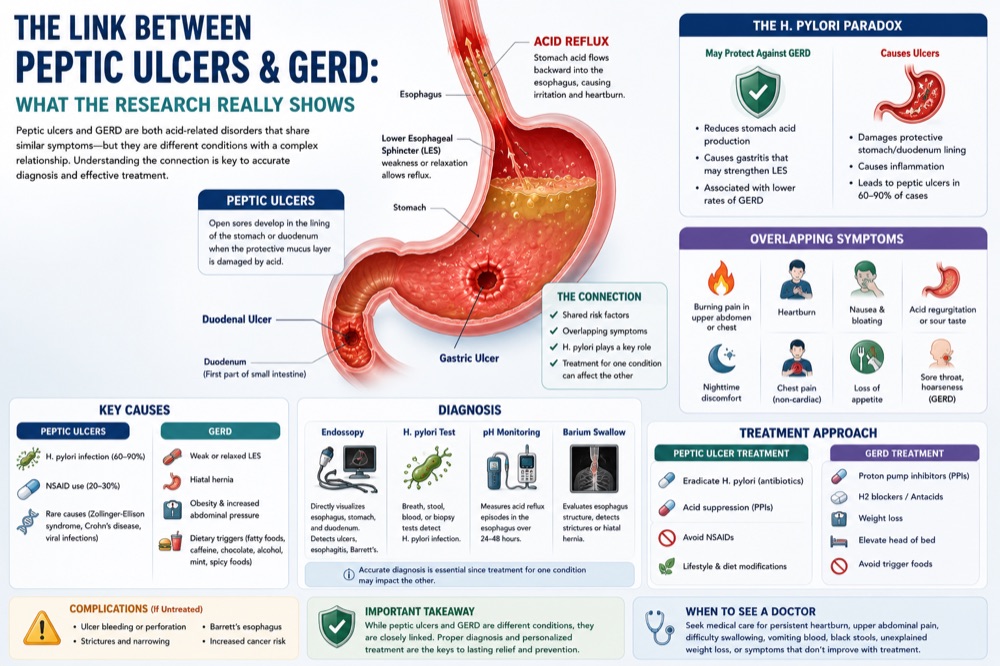
궤양과 GERD 모두 산과 관련되지만 「산이 많으면 둘 다」는 아닙니다.
독자는 범인 음식 하나, 마법 검사, 모든 걸 설명하는 보충제를 기대하기 쉽습니다. 진짜 진전은 더 조용합니다.
목표는 완벽한 루틴이 아니라 2주 반복할 수 있는 계획입니다. 증상이 계속되면 임상의와 공유할 기록을 남기세요.
먼저 중요한 것
많은 글이 메커니즘을 설명하기 전에 바로 해결책으로 뛰어가, 성공이 어떤 모습인지 모른 채 개입을 시도하게 만듭니다.
더 나은 출발점은 이렇습니다. 궤양 통증과 역류 유발 요인을 구분하고 식사·NSAIDs·야간 증상을 14일 기록하세요.
- 헬리코박터가 대부분 궤양의 주원인; 제균 후 역류가 바뀌는 경우도 있음
- NSAID 궤양과 LES 이상은 다른 대응 필요
- 증상 겹침이 약 하나로 둘 다 낫는다는 뜻은 아님
- 야간 통증·출혈·체중 감소는 먼저 진료
실제로 도움이 되는 세부사항
실무 목록
식후 쑤시는 통증과 직립 작열감을 구분. NSAIDs·커피·술도 기록.
과한 기대 금지
PPI 한 번이 적신호 검사를 대체하지 않습니다.
2주 틀
-
하기: 신뢰할 수 있는 기본으로 식사를 구성
-
하기: 수면과 수분을 지키세요. 증상 로그에 예상보다 많이 나옵니다
-
하기: 시작·끝이 분명한 작은 실험을 쓰세요
-
하기: 증상이 악화되는데 더 즉흥적으로 버티지 말고 적절한 검사를 요청하세요
-
하지 않기: 늦은 밤 과식을 기본으로 두지 마세요
-
하지 않기: 과음을 전제로 루틴을 짜고 월요일 잔잔한 장을 기대하지 마세요
-
하지 않기: 힘든 하루를 계획 전체 실패의 증거로 보지 마세요
-
하지 않기: 식단을 다섯 가지로 줄일 만큼 과도하게 제한하지 마세요
다음이 있으면 의료 도움을 받으세요:
- 혈변
- 밤에 깨는 통증
- 급격한 원인 불명 체중 감소
- 지속 구토
- 검은 변
- 실신
관련 글
자주 묻는 질문
헬리코박터 제균이 GERD를 반드시 좋게 하나요?
항상은 아닙니다. 제균 후 역류가 바뀌는 사람도 있습니다. 증상을 기록하고 의사 지시를 따르세요.
출처
-
Ford AC, Forman D, Moayyedi P, Moray M. Eradication of Helicobacter pylori and risk of peptic ulcers in patients starting long-term treatment with non-steroidal anti-inflammatory drugs: a randomised trial. Lancet. 2002;359(9300):9-13. doi:10.1016/S0140-6736(02)07278-0
-
Qian B, Ma S, Shang L, Wang J, Zhang Y. Effects of Helicobacter pylori infection on gastroesophageal reflux disease: A meta-analysis. Medicine (Baltimore). 2017;96(31):e7687. doi:10.1097/MD.0000000000007687
-
ACG Clinical Guideline: Diagnosis and Treatment of Helicobacter pylori Infection. American College of Gastroenterology. 2024. https://gi.org/guidelines/
-
Katz PO, Gerson LB, Vela MF. Guidelines for the Diagnosis and Management of Gastroesophageal Reflux Disease. American Journal of Gastroenterology. 2013;108(3):308-328. doi:10.1038/ajg.2012.444
-
Malfertheiner P, Chan FKL, McColl KEL. Peptic ulcer disease. Lancet. 2009;374(9699):1449-1461. doi:10.1016/S0140-6736(09)60938-7
-
NIDDK. Peptic Ulcers (Stomach Ulcers). National Institute of Diabetes and Digestive and Kidney Diseases. 2020. https://www.niddk.nih.gov/health-information/digestive-diseases/peptic-ulcers-stomach-ulcers
-
NIDDK. Your Digestive System & How It Works. National Institute of Diabetes and Digestive and Kidney Diseases. 2019. https://www.niddk.nih.gov/health-information/digestive-diseases/digestive-system-how-it-works
-
NHS. Stomach Ulcer. National Health Service. 2023. https://www.nhs.uk/conditions/stomach-ulcer/
-
Mayo Clinic. GERD. Mayo Clinic. 2024. https://www.mayoclinic.org/diseases-conditions/gerd/symptoms-causes/syc-20361940
-
Chey WD, Leontiadis GI, Howden CW, Moss SF. ACG Clinical Guideline: Treatment of Helicobacter pylori Infection. American Journal of Gastroenterology. 2017;112(2):212-239. doi:10.1038/ajg.2016.563
-
Lanza FL, Chan FKL, Quigley EMM. Guidelines for Prevention of NSAID-Related Ulcer Complications. American Journal of Gastroenterology. 2009;104(3):728-738. doi:10.1038/ajg.2009.70
-
European Helicobacter and Microbiota Study Group. Management of Helicobacter pylori infection: the Maastricht V/Florence Consensus Report. Gut. 2017;66(1):6-30. doi:10.1136/gutjnl-2016-312288
-
Krag M, Perner A, Wetterslev J, et al. Prevalence and outcome of gastrointestinal bleeding and use of acid suppressants in acutely ill adult intensive care patients. Intensive Care Medicine. 2015;41(5):833-845. doi:10.1007/s00134-015-3725-1
-
Vakil N, van Zanten SV, Kahrilas P, Dent J, Jones R. The Montreal Definition and Classification of Gastroesophageal Reflux Disease. American Journal of Gastroenterology. 2006;101(8):1900-1920. doi:10.1111/j.1572-0241.2006.00630.x
-
ACG Clinical Guideline: Upper Gastrointestinal and Ulcer Bleeding. American College of Gastroenterology. 2021. https://gi.org/guidelines/