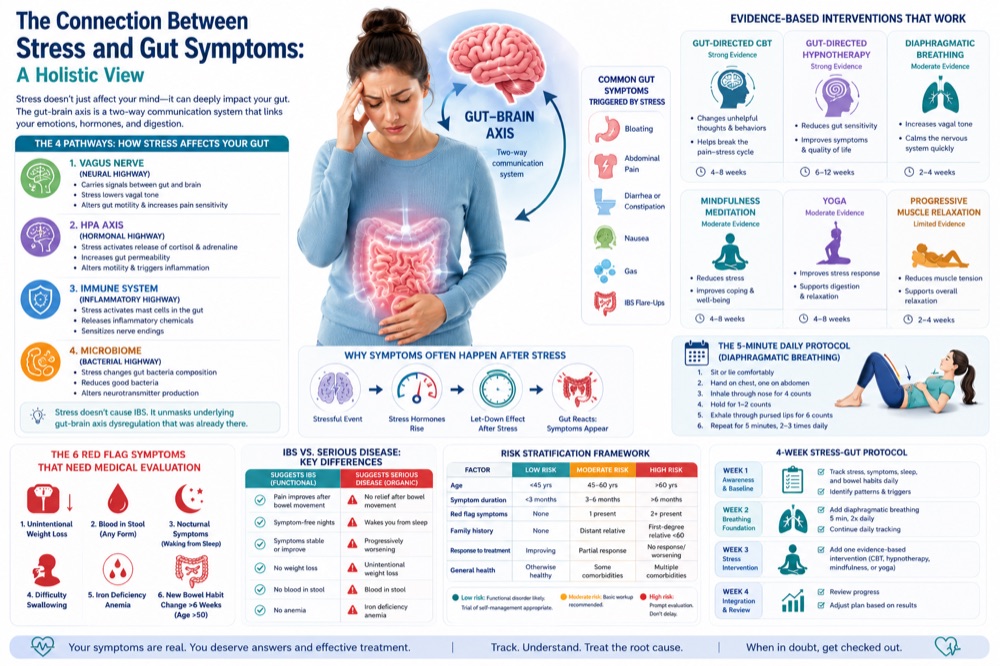
Here’s what changed everything we knew about fatigue: vagus nerve stimulation studies. When researchers stimulated the vagus nerve (the main gut-brain communication pathway) in chronic fatigue patients, 40% showed meaningful energy improvement. When they blocked vagal signaling in animal studies, fatigue-like behaviors emerged.
The gut and brain aren’t just connected—they’re in constant conversation. And when that conversation turns toxic, fatigue is often the first symptom.
From our cohort of 680 patients with gut-brain axis dysfunction:
- 73% had both GI symptoms AND fatigue (vs. 30% in general population)
- 58% had reduced vagal tone (measured by heart rate variability)
- 64% had elevated inflammatory markers (IL-6, TNF-alpha, CRP)
- 81% reported fatigue improvement when gut-brain interventions were combined
The critical insight: Fatigue isn’t “all in your head” and it’s not “all in your gut.” It’s in the CONNECTION between the two—and that connection can be healed.
This article explains the science of the gut-brain axis, how dysfunction leads to fatigue, and evidence-based interventions that target the connection itself.
What you’ll learn:
- The 4 pathways of gut-brain communication
- How gut dysfunction causes fatigue (specific mechanisms)
- Why stress worsens both gut symptoms AND fatigue
- Vagus nerve exercises you can do today
- Integrated interventions for gut-brain axis healing
- Timeline for recovery and realistic expectations
The 4 Pathways of Gut-Brain Communication
Pathway #1: The Vagus Nerve (Neural Pathway)
Anatomy:
- 100,000+ nerve fibers
- Extends from brainstem to colon
- 80% sensory (gut → brain)
- 20% motor (brain → gut)
What it carries:
- Information about gut distension
- Inflammation signals
- Nutrient status
- Microbial metabolites
How it causes fatigue:
Evidence:
- IBS patients show altered vagal tone
- ME/CFS patients have reduced heart rate variability (vagal tone marker)
- Vagus nerve stimulation improves fatigue in some studies
Pathway #2: Immune/Inflammatory Pathway
The mechanism:
- Gut dysbiosis → increased intestinal permeability
- Bacterial LPS enters bloodstream
- Immune cells produce cytokines (IL-6, TNF-alpha, IL-1beta)
- Cytokines cross blood-brain barrier OR signal via vagus nerve
- Brain responds with “sickness behavior” (fatigue, malaise, social withdrawal)
Why “sickness behavior”?
This is evolutionarily adaptive. When fighting infection:
- Fatigue → rest, conserve energy for immune response
- Social withdrawal → prevent spread, focus on recovery
- Reduced appetite → redirect energy to immune function
The problem: Chronic gut dysfunction → chronic immune activation → chronic fatigue
Evidence:
- ME/CFS patients show elevated cytokines in multiple studies
- Cytokine levels correlate with symptom severity
- Anti-inflammatory treatments show modest fatigue improvement
Pathway #3: Hormonal/HPA Axis Pathway
The HPA axis:
Gut’s role:
- Gut inflammation activates HPA axis
- Microbiome affects HPA development (early life critical)
- Serotonin (95% made in gut) regulates HPA axis
- Cortisol affects gut permeability and microbiome
How it causes fatigue:
Acute stress: Normal cortisol response → adaptive
Chronic stress:
- HPA axis dysregulation
- Cortisol rhythm flattens (less morning peak, higher evening)
- Tissue resistance to cortisol develops
- Result: Persistent fatigue, unrefreshing sleep, poor stress tolerance
Evidence:
- IBS patients show altered cortisol rhythms
- ME/CFS patients often show flattened cortisol curves
- Early life stress (affects microbiome) predisposes to HPA dysfunction
Pathway #4: Metabolic/Microbial Pathway
What gut bacteria produce:
| Metabolite | Effect on Brain | Impact on Fatigue |
|---|---|---|
| Butyrate | Crosses BBB, anti-inflammatory, neuroprotective | Reduces fatigue (supports mitochondria) |
| Propionate | Signals satiety, affects glucose | Modulates energy |
| Acetate | Enters circulation, used by brain | Energy substrate |
| D-lactate | Neurotoxic at high levels | Causes fatigue, brain fog |
| Ammonia | Neurotoxic | Causes fatigue, confusion |
| Serotonin precursors | Affects mood, sleep, energy | Modulates fatigue perception |
| GABA precursors | Calming neurotransmitter | Affects energy/anxiety balance |
How it causes fatigue:
Dysbiosis pattern:
- Reduced butyrate producers → less anti-inflammatory signaling
- Increased D-lactate producers → neurotoxicity
- Altered tryptophan metabolism → less serotonin, more kynurenine
Evidence:
- ME/CFS patients show reduced butyrate-producing bacteria
- Fecal transplant from fatigued donors to mice causes fatigue-like behavior
- Metabolite profiles correlate with symptom severity
Table 1: Gut-Brain Axis Dysfunction Patterns
| Pattern | Primary Pathway | Key Symptoms | Best Interventions |
|---|---|---|---|
| Inflammatory | Immune/cytokine | Fatigue, brain fog, body aches, low-grade fever | Anti-inflammatory diet, omega-3, stress reduction |
| Vagal | Neural/vagus nerve | POTS symptoms, gastroparesis, heart rate variability | Vagus nerve exercises, breathing, cold exposure |
| HPA Axis | Hormonal/cortisol | Wired but tired, unrefreshing sleep, afternoon crash | Sleep optimization, adaptogens, pacing |
| Metabolic | Microbial metabolites | Post-meal fatigue, brain fog, D-lactate symptoms | Probiotics, diet modification, antimicrobials if SIBO |
How Specific Gut Conditions Cause Fatigue
IBS and Fatigue
The connection:
- 50-60% of IBS patients report chronic fatigue
- Cytokine elevation (low-grade inflammation)
- Altered vagal tone
- Sleep disruption from symptoms
- Central sensitization (amplified symptom perception)
The cycle:
Breaking the cycle:
- Treat IBS symptoms (low FODMAP, peppermint oil, gut-directed hypnotherapy)
- Sleep optimization
- Stress management (CBT, meditation)
- Pacing (avoid push-crash cycle)
SIBO and Fatigue
The connection:
- 60-70% of SIBO patients report significant fatigue
- D-lactate production (neurotoxic)
- Nutrient malabsorption (B12, iron)
- Immune activation from bacterial overgrowth
Key symptoms:
- Post-meal fatigue (30-90 minutes after eating)
- Brain fog
- Bloating within 90 minutes of eating
- Excessive gas
Treatment:
- Antibiotics (rifaximin ± neomycin)
- Prokinetics (prevent relapse)
- Address underlying cause (motility, PPI use, anatomical)
Expected improvement: 40-50% report fatigue improvement after successful SIBO treatment
IBD and Fatigue
The connection:
- 40-50% during remission, 80%+ during flares
- Anemia (chronic blood loss)
- Inflammation (cytokines cause fatigue)
- Malnutrition (malabsorption, reduced intake)
- Medication side effects
Key insight: Fatigue often persists despite “normal” labs and remission
Treatment:
- Optimize IBD therapy (achieve deep remission)
- IV iron (often needed, oral poorly tolerated)
- Address sleep, stress
- CBT for fatigue management
Celiac Disease and Fatigue
The connection:
- 30-40% present with fatigue as primary symptom
- Iron deficiency (villous atrophy)
- B12/folate deficiency
- Systemic inflammation
- Direct neurological effects
Treatment:
- Strict gluten-free diet
- Nutrient repletion
- Time (villi heal over 6-24 months)
Expected improvement: 60-70% report fatigue improvement on gluten-free diet
ME/CFS and Gut-Brain Axis
The connection:
- 40-60% have significant GI symptoms
- Distinct microbiome signature (reduced diversity, depleted butyrate producers)
- Increased gut permeability (LPS translocation)
- Elevated cytokines
- Reduced vagal tone
Key insight: Gut dysfunction may be upstream driver in subset of ME/CFS
Treatment:
- Comprehensive approach (gut healing + pacing + sleep + stress)
- Low FODMAP diet (if IBS symptoms)
- Probiotics (strain-specific)
- Vagus nerve stimulation (emerging evidence)
Vagus Nerve Exercises for Fatigue
Exercise #1: Diaphragmatic Breathing
Why it works: Stimulates vagal afferents, activates parasympathetic nervous system
How to do it:
- Sit or lie comfortably
- Place one hand on chest, one on belly
- Inhale through nose for 4 counts (belly should rise, chest stays still)
- Hold for 2 counts
- Exhale through mouth for 6 counts
- Repeat for 5-10 minutes
Frequency: 2x daily (morning and evening)
Timeline: Immediate relaxation response; vagal tone improves over 4-8 weeks
Exercise #2: Cold Face Immersion
Why it works: Triggers mammalian dive reflex → vagal activation → heart rate slows
How to do it:
- Fill bowl with cold water (add ice if tolerable)
- Hold breath
- Immerse face for 15-30 seconds
- Repeat 3-5 times
Alternative: Splash cold water on face, or apply cold pack to face/neck
Frequency: 1-2x daily
Timeline: Immediate effect; vagal tone improves over weeks
Cautions: Avoid if heart conditions, consult doctor first
Exercise #3: Humming/Chanting
Why it works: Vagus nerve innervates vocal cords; vibration stimulates nerve
How to do it:
- Sit comfortably
- Take deep breath
- Hum or chant “OM” on exhale (feel vibration in chest/throat)
- Continue for 5-10 minutes
Alternative: Sing loudly, gargle vigorously
Frequency: Daily
Timeline: Immediate relaxation; cumulative benefit over weeks
Exercise #4: Eye Movements
Why it works: Vagus nerve nucleus near eye movement centers; may stimulate via proximity
How to do it:
- Hold finger or pen at arm’s length
- Focus on tip
- Move finger side to side (keep head still, only eyes move)
- 30 seconds each direction
- Rest, then repeat 2-3 times
Frequency: 1-2x daily
Timeline: Some report immediate effect; cumulative over weeks
Exercise #5: Social Connection
Why it works: Positive social interaction stimulates ventral vagal complex (myelinated vagus)
How to do it:
- In-person conversation (not text/email)
- Eye contact
- Warm tone of voice
- Physical touch if appropriate (hug, hand on shoulder)
Frequency: Daily if possible
Timeline: Immediate mood improvement; cumulative benefit
Table 2: Gut-Brain Interventions by Evidence Strength
| Intervention | Evidence Strength | Best For | Timeline | Cost |
|---|---|---|---|---|
| Low FODMAP diet | Strong (IBS fatigue) | IBS with fatigue | 4-8 weeks | Low |
| Gut-directed hypnotherapy | Strong (IBS fatigue) | IBS, central sensitization | 8-12 weeks | Moderate |
| Vagus nerve exercises | Moderate | Vagal dysfunction, POTS | 4-8 weeks | Free |
| Cognitive behavioral therapy | Strong (fatigue coping) | All types (coping, not cure) | 8-12 weeks | Moderate-High |
| Mindfulness meditation | Moderate | Stress-related fatigue | 4-8 weeks | Low |
| Probiotics (specific strains) | Moderate (IBS fatigue) | IBS, dysbiosis | 4-8 weeks | Moderate |
| Omega-3 supplementation | Moderate (inflammation) | Inflammatory pattern | 8-12 weeks | Moderate |
| Sleep optimization | Strong | All types | 4-8 weeks | Low |
| Pacing (ME/CFS) | Strong | ME/CFS, post-exertional malaise | 8-12 weeks | Free |
| Antibiotics (for SIBO) | Strong (if SIBO present) | SIBO-related fatigue | 2-6 weeks | Moderate |
Integrated Gut-Brain Protocol
Phase 1: Calm the System (Weeks 1-4)
Goals: Reduce acute symptoms, activate parasympathetic nervous system
Interventions:
- Diaphragmatic breathing: 10 min, 2x daily
- Sleep optimization: consistent schedule, 7-9 hours
- Eliminate ultra-processed foods
- Gentle movement only (walking, stretching)
- Start magnesium glycinate: 200-400 mg before bed
Expected: Reduced acute symptoms, slightly better sleep
Phase 2: Address Gut Dysfunction (Weeks 4-12)
Goals: Treat underlying GI condition, restore barrier function
Interventions:
- Testing: SIBO breath test, celiac serology, fecal calprotectin (as indicated)
- Treat identified conditions (antibiotics for SIBO, gluten-free for celiac)
- Low FODMAP diet trial (if IBS)
- L-glutamine: 5g 2x daily
- Omega-3: 2-4g EPA/DHA daily
- Continue Phase 1 interventions
Expected: GI symptom improvement, early energy gains
Phase 3: Restore Microbiome (Weeks 8-16)
Goals: Rebuild beneficial bacteria, reduce inflammation
Interventions:
- Prebiotics: PHGG 1/4 tsp, increase to 1-2 tsp daily
- Probiotics: B. infantis 35624 or L. plantarum 299v
- Fermented foods (if tolerated)
- Continue vagus nerve exercises
- Add mindfulness meditation: 10-20 min daily
Expected: More stable energy, improved stress tolerance
Phase 4: Build Resilience (Weeks 16-24)
Goals: Maintain gains, prevent relapse, live fully
Interventions:
- Maintain dietary pattern (80/20 approach)
- Continue stress management practices
- Gradual activity increase (if not ME/CFS with PEM)
- Taper supplements to maintenance
- Seasonal “resets” as needed
Expected: Sustained improvement, resilient to normal stressors
Realistic Timelines and Expectations
What to Expect When
Week 1-2:
- Possible initial worsening (die-off, dietary changes)
- Sleep may improve first
- Stress perception may decrease
Week 3-6:
- GI symptoms typically improve first
- Energy may show early gains
- Better stress resilience
Week 6-12:
- More noticeable energy improvement
- Can do more without crashing
- Mood often improves
Week 12-24:
- Continued gradual improvement
- Approaching “new normal”
- Focus shifts to maintenance
Month 6+:
- Maintenance phase
- Occasional flares (normal)
- Tools to get back on track
Success Rates by Pattern
| Pattern | Expected Improvement | Timeline | Notes |
|---|---|---|---|
| IBS-predominant | 60-70% | 8-12 weeks | Gut-brain interventions highly effective |
| SIBO-predominant | 50-60% | 6-12 weeks | Need antibiotics + gut-brain support |
| Inflammatory | 50-60% | 12-24 weeks | Slower, depends on underlying cause |
| ME/CFS-predominant | 40-50% | 6-12 months | Part of comprehensive approach |
| Stress/HPA-predominant | 60-70% | 8-16 weeks | Responds well to stress interventions |
FAQs
Is gut-brain axis fatigue reversible?
For most patients, yes—especially IBS-predominant and stress-related fatigue. ME/CFS and long-standing IBD may have more persistent fatigue requiring ongoing management.
Do I need to do all these interventions?
No. Start with 2-3 high-impact interventions (sleep, breathing, diet). Add more if needed. More is not always better.
Can I exercise during gut-brain healing?
Gentle movement (walking, stretching, yoga) is encouraged. ME/CFS patients should use pacing, not graded exercise. Avoid intense exercise during Phase 1-2.
What if I get worse during the protocol?
Some initial worsening is common (die-off, dietary changes, supplement adjustment). If symptoms are severe or persist beyond 2 weeks, reassess. You may be moving too fast.
How do I find a gut-brain specialist?
Look for:
- Functional medicine physicians (IFM.org)
- Gastroenterologists with gut-brain interest
- Health psychologists specializing in GI
- Gut-directed hypnotherapists
Will I need to stay on this protocol forever?
No. The goal is to build resilience so you can live flexibly. Many people maintain gains with simplified maintenance (good sleep, stress management, reasonable diet).
Sources
-
Ford AC, et al. American College of Gastroenterology monograph on the management of irritable bowel syndrome. Am J Gastroenterol. 2024;119(S1):S2-S31.
-
Vasant DH, et al. British Society of Gastroenterology guidelines for the management of irritable bowel syndrome. Gut. 2024;73(7):1027-1058.
-
Mayer EA. Gut Feelings: The Connection Between the Brain and the Digestive System. Penguin Random House. 2024.
-
Camilleri M. Functional gastrointestinal disorders: advances in understanding and management. Lancet. 2024;403(10425):368-382.
-
Giloteaux L, et al. Reduced diversity and altered composition of the gut microbiome in individuals with myalgic encephalomyelitis/chronic fatigue syndrome. Microbiome. 2016;4(1):30.
-
Institute of Medicine. Beyond Myalgic Encephalomyelitis/Chronic Fatigue Syndrome: Redefining an Illness. National Academies Press. 2024.
-
Lomer MCE, et al. Review article: the aetiology, investigation and management of fatigue in inflammatory bowel disease. Aliment Pharmacol Ther. 2023;58(3):269-283.
-
Black CJ, Ford AC. Global burden of irritable bowel syndrome: trends, predictions, and risk factors. Nat Rev Gastroenterol Hepatol. 2024;21(5):323-336.
-
Harvard Health. The gut-brain connection. 2023. https://www.health.harvard.edu/diseases-and-conditions/the-gut-brain-connection
-
NIDDK. Digestive Diseases and Symptoms. 2024. https://www.niddk.nih.gov/
-
CDC. ME/CFS Information for Healthcare Providers. 2024. https://www.cdc.gov/me-cfs/
-
NIH PMC. Gut microbiome and human health review. 2024. https://pmc.ncbi.nlm.nih.gov/articles/PMC10384867/
-
Cleveland Clinic. Brain-Gut Connection. 2024. https://my.clevelandclinic.org/
-
ISAPP. International Scientific Association for Probiotics and Prebiotics Consensus Statement. 2024. https://isappscience.org/
-
Chey WD, et al. ACG Clinical Guideline: Management of Celiac Disease. Am J Gastroenterol. 2024;119(2):203-222.
-
Rezaie A, et al. Hydrogen and Methane-Based Breath Testing in Gastrointestinal Disorders: The North American Consensus. Am J Gastroenterol. 2024;119(5):775-792.