Celiac disease runs in families. If your parent, sibling, or child has celiac disease, your risk isn’t just slightly higher—it’s dramatically higher.
But here’s what confuses people: You can carry the celiac genes and never develop the disease. Or you can test negative and essentially never have to worry about it. Understanding the genetic link to celiac disease isn’t just academic—it directly affects who should get tested, when testing is warranted, and how to interpret results.
Key facts you need to know:
- Celiac disease has one of the strongest genetic links of any complex disorder
- Two genes (HLA-DQ2 and HLA-DQ8) account for nearly all genetic risk
- Having the genes doesn’t mean you’ll develop celiac disease
- NOT having the genes essentially rules out celiac disease
- First-degree relatives have a 1 in 10 risk of developing celiac disease
This guide explains exactly how celiac disease is inherited, what genetic testing can (and can’t) tell you, who should get tested, and how to use genetic information to make informed health decisions.
The Genetics of Celiac Disease: The Basics
What Genes Cause Celiac Disease?
Celiac disease is strongly associated with specific genes in the HLA (human leukocyte antigen) complex, which helps the immune system distinguish between the body’s own proteins and foreign invaders.
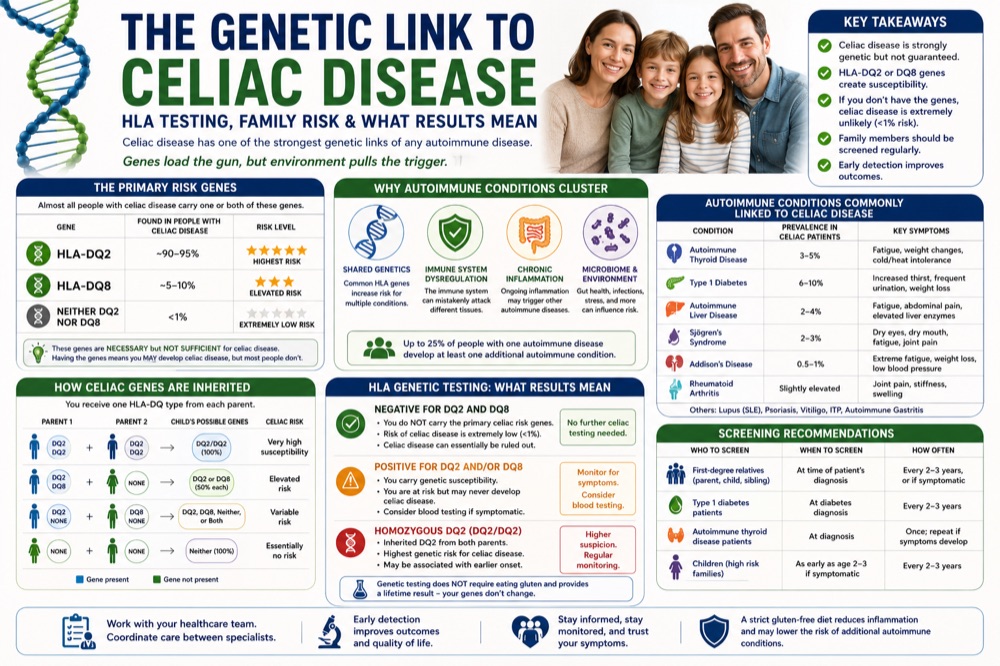
The Primary Risk Genes:
| Gene | Found In | Risk Level |
|---|---|---|
| HLA-DQ2 | ~90-95% of celiac patients | Highest risk |
| HLA-DQ8 | ~5-10% of celiac patients | Elevated risk |
| Neither DQ2 nor DQ8 | <1% of celiac patients | Extremely low risk |
Important: These genes are necessary but NOT sufficient for developing celiac disease. In other words:
- You almost certainly WON’T get celiac disease without DQ2 or DQ8
- You MIGHT get celiac disease WITH DQ2 or DQ8 (but most people don’t)
How Strong Is the Genetic Link?
Celiac disease has one of the strongest genetic components of any autoimmune disease:
- Identical twins: If one twin has celiac disease, the other has a 70-75% chance of developing it
- First-degree relatives (parent, child, sibling): 1 in 10 risk (compared to 1 in 100 in general population)
- Second-degree relatives (grandparent, aunt, uncle): 1 in 40 risk
Comparison to Other Conditions:
| Condition | Genetic Contribution |
|---|---|
| Celiac disease | ~35-40% (very strong) |
| Type 1 diabetes | ~50% |
| Crohn’s disease | ~25% |
| Rheumatoid arthritis | ~15% |
The Paradox: Why Don’t Everyone with the Genes Get Celiac Disease?
Approximately 30-40% of the general population carries HLA-DQ2 or HLA-DQ8, but only about 1-3% develop celiac disease.
This gap between genetic susceptibility and actual disease tells us something important: Genes load the gun, but environment pulls the trigger.
Factors That May Trigger Celiac Disease in Genetically Susceptible People:
| Trigger | Evidence | Theory |
|---|---|---|
| Gluten introduction in infancy | Moderate | Timing of first gluten exposure may affect immune tolerance |
| Gastrointestinal infections | Emerging | Infections may increase intestinal permeability |
| Antibiotic use | Limited | May alter gut microbiome, affecting immune development |
| Pregnancy | Anecdotal | Hormonal and immune changes may trigger onset |
| Surgery or trauma | Anecdotal | Physical stress may activate immune system |
| Significant emotional stress | Anecdotal | Stress affects immune function and gut permeability |
Inheritance Patterns: Understanding Your Family Risk
How Celiac Genes Are Inherited
HLA genes are inherited from both parents. You receive one HLA-DQ type from your mother and one from your father.
Inheritance Scenarios:
| Parent 1 | Parent 2 | Child’s Possible Genotypes | Celiac Risk |
|---|---|---|---|
| DQ2/DQ2 | DQ2/DQ2 | DQ2/DQ2 (100%) | Very high susceptibility |
| DQ2/DQ8 | Neither | DQ2 or DQ8 (50% each) | Elevated risk |
| DQ2/Neither | DQ8/Neither | DQ2, DQ8, Neither, or Both | Variable risk |
| Neither | Neither | Neither (100%) | Essentially no risk |
Risk by Family Relationship
| Relationship to Celiac Patient | Risk of Developing Celiac | Screening Recommendation |
|---|---|---|
| Identical twin | 70-75% | Regular screening essential |
| First-degree relative (parent, child, sibling) | 10% (1 in 10) | Screen at diagnosis and every 2-3 years |
| Second-degree relative (grandparent, aunt, uncle) | 2.5% (1 in 40) | Consider screening if symptomatic |
| Third-degree relative (first cousin) | Slightly elevated | Screen if symptomatic |
High-Risk Groups Beyond Family History
Certain populations and conditions carry elevated celiac disease risk:
Ethnic/Racial Groups:
- Northern European ancestry (highest prevalence)
- Mediterranean populations (Italy, Greece, Middle East)
- South Asian populations (India, Pakistan)
- Lower prevalence in East Asian and African populations (but NOT zero risk)
Medical Conditions Associated with Higher Celiac Risk:
| Condition | Celiac Prevalence | Screening Recommendation |
|---|---|---|
| Type 1 diabetes | 6-10% | Screen at diagnosis, then every 2-3 years |
| Autoimmune thyroid disease | 3-5% | Screen at diagnosis |
| Down syndrome | 5-10% | Screen in childhood; repeat if symptomatic |
| Turner syndrome | 3-5% | Screen at diagnosis |
| Williams syndrome | 3-7% | Screen at diagnosis |
| Selective IgA deficiency | 2-5% | Use IgG-based tests (not IgA) |
| Autoimmune liver disease | 3-5% | Screen at diagnosis |
Genetic Testing for Celiac Disease: What You Need to Know
What Is HLA Genetic Testing?
HLA genetic testing (also called HLA typing or HLA-DQ typing) identifies whether you carry the genes associated with celiac disease.
The Test:
- Sample type: Blood draw or cheek swab
- Genes tested: HLA-DQA1 and HLA-DQB1 (which combine to form DQ2 and DQ8)
- Turnaround time: 1-3 weeks
- Cost: $100-300 (often covered by insurance for high-risk patients)
- Availability: Ordered by doctors; some direct-to-consumer options (23andMe, AncestryDNA)
Important: Unlike celiac blood tests (tTG-IgA), genetic testing:
- Does NOT require you to be eating gluten
- Does NOT change based on diet
- Is NOT affected by medications
- Provides a lifetime result (your genes don’t change)
Understanding Your Genetic Test Results
Result: Negative for HLA-DQ2 and HLA-DQ8
What It Means:
- You do NOT carry the primary genes associated with celiac disease
- Your risk of developing celiac disease is extremely low (<1%)
- Celiac disease can essentially be ruled out
Clinical Implications:
- No further celiac testing needed (even if symptomatic)
- If already on gluten-free diet, no gluten challenge required
- Symptoms likely due to other causes (IBS, NCGS, SIBO, etc.)
What to Tell Patients:
“Your genetic test is negative for the celiac disease risk genes. This is excellent news—it means you have less than 1% chance of developing celiac disease in your lifetime. We should look for other explanations for your symptoms.”
Result: Positive for HLA-DQ2 and/or HLA-DQ8
What It Means:
- You carry genetic susceptibility to celiac disease
- You are AT RISK but do NOT necessarily have or will develop celiac disease
- Approximately 30-40% of the population has these genes; most never develop celiac
Clinical Implications:
- If symptomatic: Proceed with celiac blood testing (tTG-IgA)
- If asymptomatic but high-risk (family member): Consider baseline blood testing
- If already gluten-free: Genetic test helps avoid need for gluten challenge
What to Tell Patients:
“You carry the genes that predispose to celiac disease. This doesn’t mean you have celiac disease—most people with these genes never develop it. However, it does mean you’re at higher risk, and we should monitor for symptoms and consider periodic blood testing.”
Result: Homozygous DQ2 (DQ2/DQ2)
What It Means:
- You inherited DQ2 from BOTH parents
- This confers the HIGHEST genetic risk for celiac disease
- Associated with earlier onset and potentially more severe disease
Clinical Implications:
- Higher index of suspicion for symptoms
- Lower threshold for biopsy if blood tests borderline
- Family members should be aware of elevated risk
When Is Genetic Testing Useful?
| Clinical Scenario | Utility of Genetic Testing |
|---|---|
| Already on gluten-free diet | HIGH – Negative result rules out celiac without gluten challenge |
| Borderline/unclear blood tests | MODERATE – Helps determine if further workup warranted |
| Family member of celiac patient | HIGH – Identifies who needs ongoing screening |
| Symptomatic but negative blood tests | MODERATE – Helps decide if gluten challenge worth considering |
| Routine screening in general population | LOW – Not cost-effective; too many false positives |
| Confirming diagnosis | LOW – Positive result doesn’t diagnose celiac |
Limitations of Genetic Testing
What Genetic Testing CANNOT Do:
- Diagnose celiac disease (positive result doesn’t mean you have it)
- Predict who WILL develop celiac disease
- Determine disease severity
- Replace blood testing or biopsy for diagnosis
- Identify rare non-HLA genetic variants (emerging research area)
What Genetic Testing CAN Do:
- Rule OUT celiac disease with high confidence (negative predictive value ~99%)
- Identify people at elevated risk
- Guide screening decisions in families
- Avoid unnecessary gluten challenges
Screening Recommendations for Families
Who Should Get Screened?
Universal Screening NOT Recommended:
- General population screening is not currently recommended
- Too many false positives; cost not justified
Targeted Screening IS Recommended for:
| Group | When to Screen | How Often |
|---|---|---|
| First-degree relatives | At time of patient’s diagnosis | Every 2-3 years, or if symptomatic |
| Type 1 diabetics | At diabetes diagnosis | Every 2-3 years |
| Down syndrome | In childhood | Once in childhood; repeat if symptomatic |
| Autoimmune thyroid disease | At diagnosis | Once; repeat if symptomatic |
| Symptomatic individuals | When symptoms develop | As clinically indicated |
Screening Protocol for Family Members
Step 1: Genetic Testing (Optional but Helpful)
- Test for HLA-DQ2 and HLA-DQ8
- If negative: No further screening needed
- If positive: Proceed to Step 2
Step 2: Celiac Blood Panel (Must Be Eating Gluten)
- tTG-IgA (tissue transglutaminase antibody)
- Total Serum IgA (to rule out IgA deficiency)
- If IgA deficient: tTG-IgG or DGP-IgG
Step 3: Further Evaluation (If Blood Tests Positive)
- Gastroenterology referral
- Endoscopy with biopsy (in most cases)
- Diagnosis confirmation
Screening Children in Celiac Families
When to Start Screening:
- Children should be eating gluten regularly before testing
- Screening can begin as early as age 2-3 if symptomatic
- Some experts recommend screening around age 3-5 for high-risk children
- Earlier screening if symptoms develop (growth failure, chronic diarrhea, anemia)
Approach for Asymptomatic Children:
- Consider genetic testing first (avoids repeated blood draws if negative)
- If genes positive: Baseline blood testing
- Repeat blood testing every 2-3 years or if symptoms develop
- Maintain high index of suspicion for growth issues, anemia, dental defects
What Parents Should Watch For:
- Poor growth or weight gain
- Chronic diarrhea or constipation
- Abdominal bloating
- Iron deficiency anemia
- Dental enamel defects
- Behavioral changes (irritability, fatigue)
- Delayed puberty (in teenagers)
The Future of Celiac Genetics
Beyond HLA-DQ2/DQ8: Emerging Research
While HLA-DQ2 and HLA-DQ8 account for most genetic risk, researchers have identified 40+ additional genetic variants that contribute to celiac disease susceptibility.
Non-HLA Genetic Variants:
- IL2/IL21 region (chromosome 4q27)
- SH2B3 gene (chromosome 12q24)
- TAGAP gene (chromosome 6q25)
- Multiple other loci identified through genome-wide association studies (GWAS)
Clinical Relevance:
- Currently NOT used in routine clinical testing
- May improve risk prediction in the future
- Could help identify which gene-positive individuals will develop disease
- Research ongoing into polygenic risk scores
Pharmacogenomics: Will Genetics Guide Treatment?
Future research may reveal genetic markers that predict:
- Response to gluten-free diet
- Risk of complications
- Potential response to emerging therapies (currently in clinical trials)
Frequently Asked Questions
Key Takeaways
- Celiac disease has a strong genetic link—first-degree relatives have 1 in 10 risk
- Two genes (HLA-DQ2 and HLA-DQ8) account for nearly all genetic risk
- Having the genes doesn’t mean you’ll develop celiac disease (30-40% have genes; only 1-3% develop disease)
- NOT having the genes essentially rules out celiac disease (<1% risk)
- Genetic testing is useful for ruling out celiac, screening family members, and avoiding gluten challenges
- First-degree relatives should be screened at diagnosis and every 2-3 years
- Certain conditions (Type 1 diabetes, Down syndrome) warrant screening regardless of family history
- Genetic testing doesn’t require eating gluten and provides lifetime information
- Children with family history should be monitored for symptoms and growth issues
- Emerging research continues to identify additional genetic risk factors beyond HLA-DQ2/DQ8
Medical Review: This content has been reviewed for accuracy against current guidelines from the American College of Gastroenterology, Celiac Disease Foundation, and American College of Medical Genetics.
Sources:
- American College of Gastroenterology - Celiac Disease Clinical Guidelines - 2025
- Celiac Disease Foundation - Genetics of Celiac Disease - 2026
- Nature Reviews Disease Primers - Coeliac Disease - 2025
- Gastroenterology Journal - HLA Typing in Celiac Disease Diagnosis - 2024
- Beyond Celiac - Family Testing and Genetics - 2026
- Journal of Medical Genetics - Non-HLA Genetics in Celiac Disease - 2025
Last Updated: March 9, 2026