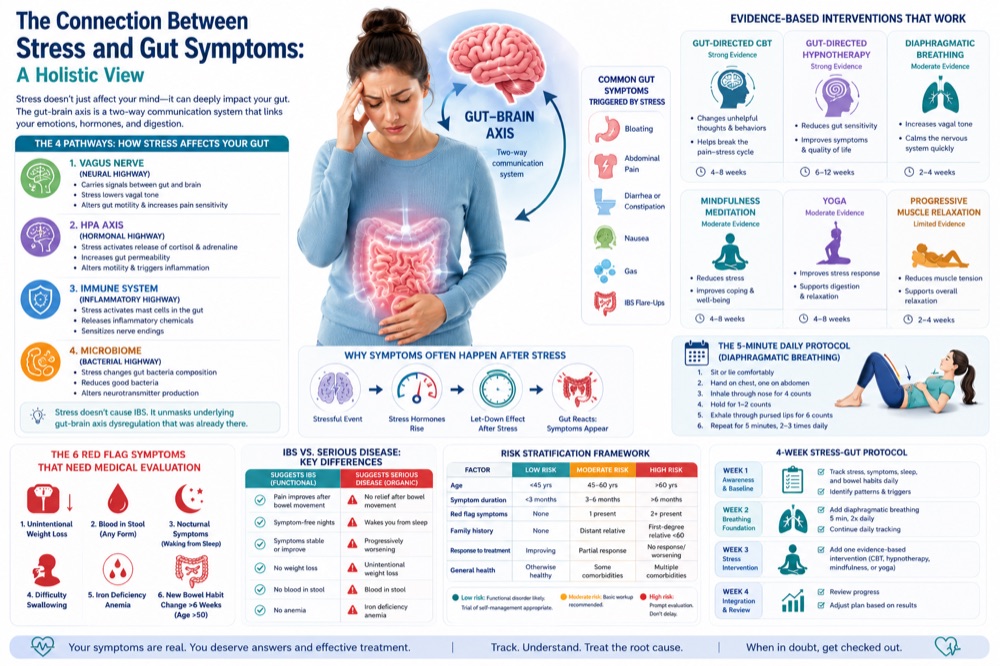
Stress does not create every gut disorder, but it can turn the symptom volume up fast. That is especially true with stress, sleep, and your gut. Readers often expect one villain food, one magic test, or one supplement to explain everything. Real progress is usually quieter than that.
Stress acts like a dimmer switch wired backward. The more life speeds up, the brighter the gut signal can feel. When you look at stress, sleep, and your gut through that lens, the topic stops feeling random. You can sort what is normal adaptation, what deserves caution, and what is simply bad advice dressed up as confidence.
The contrarian point is worth saying early: If stress matters, the symptoms must be psychological. No. The biology is real. The goal here is not a perfect gut routine. It is a workable plan you can repeat for two weeks, learn from, and discuss intelligently with your clinician if symptoms keep pushing back.
What matters first
Most articles on stress, sleep, and your gut make the same mistake. They jump straight to fixes before they explain the mechanism. That leaves readers trying interventions without knowing what success should actually look like.
A better starting point is this: Useful frameworks include gut-directed CBT, 4-6 breathing, brief mindfulness checks, and symptom journaling around stressful events.
- Symptoms often peak on the commute home, not during the stressful event itself.
- People say they are fine under pressure, then their stool pattern says otherwise.
- The fastest wins usually come from short repeatable practices, not hour-long wellness rituals.
Specifics that actually help
The practical list
Useful building blocks in this area include steady meals, less caffeine on empty stomach, hydration, protein at breakfast, light dinners when stress is high. The most common problems are not exotic. They are usually portion creep, poor timing, dehydration, and trying to troubleshoot six variables at once.
- Use steady meals in measured, repeatable portions
- Use less caffeine on empty stomach in measured, repeatable portions
- Use hydration in measured, repeatable portions
- Use protein at breakfast in measured, repeatable portions
- Use light dinners when stress is high in measured, repeatable portions
The two-week framework
-
Do build meals around reliable staples such as steady meals, less caffeine on empty stomach, hydration, protein at breakfast
-
Do protect sleep and hydration because both show up in symptom logs more than readers expect
-
Do use small experiments with clear start and stop points
-
Do ask for proper testing when symptoms are escalating instead of improvising harder
-
Do not let caffeine overload become your default
-
Do not build your routine around skipping meals under pressure and expect a calm Monday gut
-
Do not interpret one rough day as proof that the whole plan failed
-
Do not self-restrict until your diet collapses to five foods
-
bleeding
-
weight loss
-
fever
-
nighttime symptoms
-
black stool
-
fainting
-
persistent vomiting
-
unexplained weight loss
Related reading
- The Connection Between Stress and Gut Symptoms: A Holistic View
- Stress Management for Gut Health: The Gut-Brain Connection
- How Stress Impacts Your Digestive System: A Deep Dive
- Mindfulness for Gut Health: Reducing Stress for Better Digestion
- Yoga for Gut Health: Poses to Relieve Digestive Discomfort
- Meditation for a Healthy Gut: Calming Your Digestive System
FAQs
Sources
- Harvard Health - The gut-brain connection - Harvard Health - 2023 - https://www.health.harvard.edu/diseases-and-conditions/the-gut-brain-connection
- NCCIH - Meditation and mindfulness - NCCIH - 2024 - https://www.nccih.nih.gov/health/meditation-and-mindfulness-what-you-need-to-know
- NCCIH - Yoga - NCCIH - 2024 - https://www.nccih.nih.gov/health/yoga-what-you-need-to-know
- NHS - Stress management tips - NHS - 2024 - https://www.nhs.uk/every-mind-matters/mental-health-issues/stress/
- ACG - IBS management guideline - American Journal of Gastroenterology - 2021 - https://journals.lww.com/ajg/Fulltext/2021/01000/ACG_Clinical_Guideline__Management_of_Irritable.11.aspx
- NIDDK - IBS overview - NIDDK - 2020 - https://www.niddk.nih.gov/health-information/digestive-diseases/irritable-bowel-syndrome