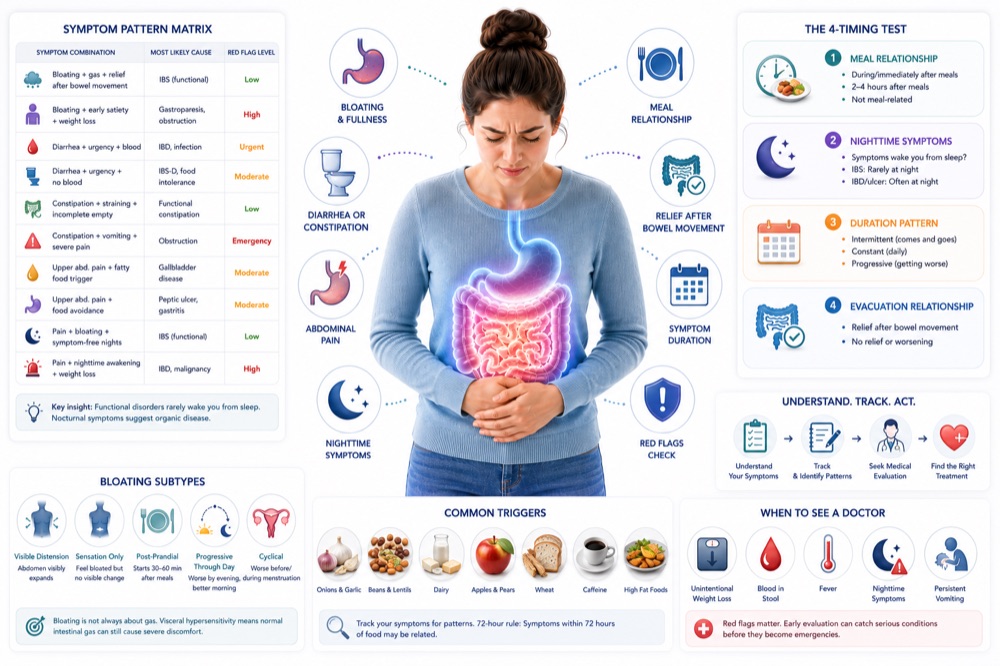
Do you have constant bloating that worsens throughout the day? Gas that embarrasses you? Bowel changes that come and go without explanation? You might be wondering if it’s SIBO—Small Intestinal Bacterial Overgrowth.
SIBO occurs when bacteria from the colon migrate upward into the small intestine, where they don’t belong. These bacteria ferment food prematurely, producing gas and toxins that cause a cascade of symptoms.
This guide provides a comprehensive SIBO symptoms checklist, explains the different symptom patterns based on SIBO type, helps you distinguish SIBO from IBS, and tells you when testing makes sense.
Quick Self-Assessment: Do You Have SIBO Symptoms?
Primary SIBO Symptoms
Check any that apply to you:
| Symptom | Frequency | Notes |
|---|---|---|
| ☐ Bloating | Daily or nearly daily | Often worse as day progresses |
| ☐ Abdominal distension | Visible swelling of abdomen | Belt feels tighter by evening |
| ☐ Excessive gas | Multiple times daily | Burping, flatulence, or both |
| ☐ Abdominal pain or discomfort | Recurrent | Can be crampy or aching |
| ☐ Diarrhea | Loose stools 3+ times/day | May be urgent |
| ☐ Constipation | Hard stools, difficulty passing | May alternate with diarrhea |
| ☐ Nausea | Occasional to frequent | Especially after eating |
| ☐ Early satiety | Feeling full quickly | Can’t finish normal meals |
If you checked 3 or more: SIBO is a possibility worth investigating.
If you checked 5 or more: SIBO is more likely; discuss testing with your doctor.
Secondary SIBO Symptoms
These symptoms occur due to nutrient malabsorption and systemic effects of bacterial overgrowth:
| Symptom | Why It Happens |
|---|---|
| ☐ Fatigue | Bacteria consume nutrients; inflammation causes exhaustion |
| ☐ Brain fog | Bacterial toxins affect cognitive function |
| ☐ Unintentional weight loss | Malabsorption of calories and nutrients |
| ☐ Nutrient deficiencies (B12, iron, fat-soluble vitamins) | Bacteria consume nutrients before you absorb them |
| ☐ Food intolerances (especially carbohydrates) | Bacteria ferment carbs, producing gas |
| ☐ Joint pain | Systemic inflammation from gut |
| ☐ Skin issues (acne, rosacea, eczema) | Gut-skin axis; inflammation |
| ☐ Mood changes (anxiety, depression) | Gut-brain axis disruption |
| ☐ Headaches | Bacterial toxins, inflammation, histamine |
If you have primary symptoms PLUS secondary symptoms: SIBO likelihood increases.
The Complete SIBO Symptoms Checklist
Most Common Symptoms (By Frequency)
Based on clinical studies of SIBO patients:
| Symptom | % of SIBO Patients | Severity (1-10) |
|---|---|---|
| Bloating | 80-90% | 7-9/10 |
| Abdominal discomfort/pain | 70-85% | 5-8/10 |
| Excessive gas/flatulence | 65-80% | 6-8/10 |
| Diarrhea | 50-70% | 5-7/10 |
| Constipation | 30-50% | 5-7/10 |
| Nausea | 30-40% | 3-6/10 |
| Vomiting (severe cases) | 10-20% | 7-9/10 |
| Weight loss | 20-30% | Variable |
Symptom Patterns That Suggest SIBO
It’s not just WHAT symptoms you have—it’s HOW they present.
| Pattern | What It Looks Like | Why It Suggests SIBO |
|---|---|---|
| Progressive daily bloating | Flat in morning, progressively distended by evening | Bacteria accumulate and ferment throughout the day |
| Symptoms after eating | Worsen 30-90 minutes after meals | Food triggers bacterial fermentation |
| Carbohydrate sensitivity | Worse after bread, pasta, sugar, fruits, beans | Carbs are what bacteria ferment |
| Symptom fluctuation | Good days and bad days without obvious trigger | Bacterial populations fluctuate |
| Refractory to standard IBS treatment | IBS medications don’t help much | Wrong target (motility vs. bacteria) |
| Relapse after antibiotics | Feel better on antibiotics, then symptoms return | Bacteria reduced but not eliminated; underlying cause not addressed |
SIBO Type Matters: Different Symptoms for Different Gases
SIBO isn’t one condition. The type of bacteria overgrowth determines which gases they produce—and which symptoms you experience.
Hydrogen-Dominant SIBO
What happens: Hydrogen-producing bacteria overgrow in the small intestine.
Characteristic symptoms:
| Symptom | Typical Pattern |
|---|---|
| Diarrhea | Loose, watery stools; urgency; 3+ times daily |
| Bloating | Moderate to severe; worse after eating |
| Gas | Frequent flatulence; often odorless |
| Abdominal pain | Crampy; may improve after bowel movement |
| Food intolerance | Especially to fruits, sweeteners, high-fiber foods |
Why diarrhea: Hydrogen gas speeds up intestinal transit, causing food to move through too quickly.
Methane-Dominant SIBO (now called Intestinal Methanogen Overgrowth - IMO)
What happens: Archaea (ancient microorganisms, not bacteria) called Methanobrevibacter smithii produce methane gas.
Characteristic symptoms:
| Symptom | Typical Pattern |
|---|---|
| Constipation | Hard, infrequent stools; straining; feeling of incomplete evacuation |
| Bloating | Often severe; visible distension |
| Gas | Less frequent than hydrogen SIBO, but still present |
| Abdominal pain | Can be severe; often relieved by bowel movement |
| Nausea | More common than in hydrogen SIBO |
| Weight gain | Some patients report difficulty losing weight |
Why constipation: Methane gas slows intestinal transit, allowing more water absorption and harder stools.
Important: Methane SIBO is now officially called Intestinal Methanogen Overgrowth (IMO) because archaea are not technically bacteria.
Hydrogen Sulfide SIBO
What happens: Sulfate-reducing bacteria produce hydrogen sulfide gas.
Characteristic symptoms:
| Symptom | Typical Pattern |
|---|---|
| Diarrhea | Often predominant; can be urgent |
| Bloating | Present but may be less severe than other types |
| Gas with odor | Rotten egg smell (hydrogen sulfide) |
| Abdominal pain | Burning sensation possible |
| Food sensitivity | Especially to sulfur-containing foods (eggs, cruciferous vegetables, red meat) |
| Neurological symptoms | Brain fog, fatigue more prominent |
Testing challenge: Hydrogen sulfide SIBO doesn’t show up on standard breath tests. Newer tests are becoming available.
Mixed SIBO
Some people have combinations:
- Hydrogen + Methane: Alternating diarrhea and constipation
- Hydrogen + Hydrogen Sulfide: More severe diarrhea
- All three types: Complex, fluctuating symptoms
SIBO vs. IBS: How to Tell the Difference
SIBO and IBS share many symptoms, which causes confusion. Here’s how to distinguish them:
Symptom Comparison
| Symptom | IBS | SIBO |
|---|---|---|
| Bloating | Common | More severe; visible distension |
| Abdominal pain | Common; relieved by bowel movement | Common; may not improve with bowel movement |
| Diarrhea | Common in IBS-D | Common in hydrogen SIBO |
| Constipation | Common in IBS-C | Common in methane SIBO/IMO |
| Gas | Common | More severe; frequent |
| Nausea | Sometimes | More common |
| Food intolerances | Common | More severe; especially to carbs |
| Nutrient deficiencies | Rare | Common (B12, iron, fat-soluble vitamins) |
| Weight loss | Unusual | Can occur in severe cases |
| Symptoms after antibiotics | No change or worse | Often improves (temporarily) |
| Response to low FODMAP | Often good | May help but symptoms often persist |
| Symptom pattern | Related to stress, hormones | Related to meals, timing |
Key Differentiator
IBS: Symptoms often triggered by stress, hormones, certain foods. Gut structure is normal.
SIBO: Symptoms often tied to bacterial fermentation (worse after eating carbs). Underlying cause often involves motility issues or anatomical problems.
Important: Up to 80% of people diagnosed with IBS may actually have SIBO. Many people have BOTH conditions.
Symptom Timing: When SIBO Symptoms Occur
Understanding WHEN symptoms occur helps identify SIBO:
Daily Pattern
| Time | Typical Experience |
|---|---|
| Morning (fasting) | Relatively flat; minimal symptoms |
| 30-90 min after breakfast | Bloating begins; gas starts |
| Mid-morning | Symptoms may plateau or improve slightly |
| After lunch | Symptoms worsen; distension visible |
| Afternoon | Continued bloating; fatigue may increase |
| After dinner | Worst symptoms; belt feels tight |
| Evening/bedtime | Distension may persist; discomfort affects sleep |
Why this pattern: Bacteria accumulate throughout the day. Each meal provides more fuel for fermentation.
Meal-Related Timing
| Time After Eating | What’s Happening |
|---|---|
| 0-30 minutes | Food enters small intestine |
| 30-90 minutes | Bacteria begin fermenting carbohydrates |
| 1-3 hours | Gas production peaks; symptoms noticeable |
| 3-6 hours | Food moves to colon; symptoms may improve |
| Between meals | Migrating Motor Complex (MMC) should clear bacteria |
Key insight: If symptoms consistently occur 30-90 minutes after eating, SIBO is more likely than other conditions.
Extra-Intestinal Symptoms: Beyond the Gut
SIBO affects more than just digestion. Here’s why:
Nutrient Deficiency Symptoms
Bacteria in the small intestine consume nutrients before you can absorb them:
| Deficiency | Symptoms |
|---|---|
| Vitamin B12 | Fatigue, weakness, brain fog, tingling in hands/feet, mood changes |
| Iron | Fatigue, pale skin, shortness of breath, brittle nails, restless leg syndrome |
| Vitamin D | Bone pain, muscle weakness, frequent infections, mood changes |
| Vitamin A | Night blindness, dry skin, frequent infections |
| Vitamin E | Muscle weakness, vision problems, impaired immune function |
| Vitamin K | Easy bruising, prolonged bleeding |
Lab findings: Unexplained anemia (low B12 or iron) with normal diet suggests malabsorption from SIBO.
Inflammatory Symptoms
Bacterial overgrowth triggers systemic inflammation:
| Symptom | Description |
|---|---|
| Joint pain | Achy joints; may mimic arthritis |
| Muscle pain | Generalized aching; fibromyalgia-like |
| Skin issues | Acne, rosacea, eczema, rashes |
| Fatigue | Persistent exhaustion not relieved by sleep |
| Brain fog | Difficulty concentrating; memory issues |
| Mood changes | Anxiety, depression, irritability |
| Headaches | Tension headaches or migraines |
Histamine-Related Symptoms
Some SIBO bacteria produce histamine:
| Symptom | Description |
|---|---|
| Flushing | Red face, neck, or chest after eating |
| Hives or itching | Skin reactions without obvious trigger |
| Runny nose | After meals, especially histamine-rich foods |
| Headaches | After wine, aged cheese, fermented foods |
| Rapid heart rate | After eating |
| Anxiety | Particularly after meals |
High-histamine foods to note: Aged cheese, wine, fermented foods, processed meats, spinach, tomatoes, avocado.
Risk Factors: Who Gets SIBO?
Having symptoms is one thing. Having risk factors makes SIBO more likely.
Anatomical/Structural Risk Factors
| Risk Factor | Why It Increases SIBO Risk |
|---|---|
| Previous abdominal surgery | Adhesions can create blind loops where bacteria accumulate |
| Diverticulosis | Pouches in colon can harbor bacteria that migrate upward |
| Bowel strictures | Narrowing slows transit, allowing bacterial growth |
| Fistulas | Abnormal connections between bowel segments |
| Tumors or masses | Can obstruct normal flow |
| Ileocecal valve dysfunction | Valve between small/large intestine doesn’t close properly; colonic bacteria migrate up |
Motility Disorders
| Risk Factor | Why It Increases SIBO Risk |
|---|---|
| Gastroparesis | Stomach doesn’t empty properly; food sits and ferments |
| Intestinal pseudo-obstruction | Bowel doesn’t move content effectively |
| Scleroderma | Affects intestinal muscle function |
| Diabetes | Can damage vagus nerve, slowing gut motility |
| Hypothyroidism | Slows overall metabolism including gut motility |
| Opioid use | Slows intestinal transit significantly |
Reduced Stomach Acid
| Risk Factor | Why It Increases SIBO Risk |
|---|---|
| Proton Pump Inhibitors (PPIs) | Acid normally kills bacteria; less acid = more survive |
| H2 blockers | Same mechanism as PPIs, though less potent |
| Atrophic gastritis | Stomach lining thins; produces less acid |
| H. pylori infection | Can reduce stomach acid production |
Note: Don’t stop acid-reducing medications without consulting your doctor.
Immune System Issues
| Risk Factor | Why It Increases SIBO Risk |
|---|---|
| Immunodeficiency disorders | Body can’t control bacterial overgrowth |
| Chronic pancreatitis | Reduced digestive enzymes allow bacterial growth |
| Crohn’s disease | Inflammation and structural changes increase risk |
| Celiac disease | Intestinal damage affects motility and immunity |
Lifestyle Factors
| Factor | Why It May Increase Risk |
|---|---|
| Chronic stress | Affects gut motility and immune function |
| Poor diet | High sugar/processed foods feed bacteria |
| Excessive alcohol | Damages intestinal lining; affects motility |
| Frequent antibiotic use | Disrupts normal bacterial balance |
When to See a Doctor About SIBO Symptoms
Symptoms That Warrant Testing
Consider SIBO testing if you have:
| Criteria | Details |
|---|---|
| Chronic bloating | Present most days for 3+ months |
| Multiple symptoms | 3+ primary symptoms from checklist |
| Refractory to standard treatment | IBS medications, diet changes haven’t helped |
| Nutrient deficiencies | Unexplained low B12, iron, or fat-soluble vitamins |
| Risk factors present | PPI use, prior surgery, motility issues, etc. |
| Symptom pattern fits | Worse after eating; progressive through day |
Red Flag Symptoms (Seek Care Immediately)
These symptoms suggest something more serious than SIBO:
| Red Flag | Possible Concern |
|---|---|
| Unintentional weight loss (>10 lbs without trying) | Cancer, malabsorption, severe disease |
| Blood in stool (bright red or black/tarry) | Bleeding, IBD, cancer |
| Severe, persistent diarrhea (>10 times/day) | Infection, IBD, malabsorption |
| Fever with GI symptoms | Infection, IBD, abscess |
| Severe abdominal pain | Obstruction, perforation, emergency |
| Persistent vomiting | Obstruction, gastroparesis |
| Difficulty swallowing | Esophageal stricture, tumor |
| Family history of GI cancer | Increased cancer risk |
| New symptoms after age 50 | Cancer risk increases with age |
| Anemia (low hemoglobin) | Bleeding, malabsorption, cancer |
SIBO Testing Overview
Gold Standard Test: Lactulose or Glucose Breath Test
How it works:
- Drink sugar solution (lactulose or glucose)
- Blow into tubes every 15-20 minutes for 2-3 hours
- Lab measures hydrogen and methane at each interval
- Rising levels indicate bacterial fermentation in small intestine
What the test shows:
| Result | Interpretation |
|---|---|
| Hydrogen rise >20 ppm by 90 minutes | Positive for hydrogen SIBO |
| Methane ≥10 ppm at any point | Positive for methane SIBO/IMO |
| Both elevated | Mixed SIBO |
| Neither elevated | Negative (but false negatives occur) |
Test Preparation (Critical for Accurate Results)
2-4 weeks before test:
- Stop antibiotics (can cause false negative)
- Stop probiotics (can affect results)
- Stop colonoscopy prep (resets bacteria)
24-48 hours before test:
- Eat only low-fiber, low-fermentable foods
- Avoid: beans, whole grains, high-fiber vegetables, fruits
- Eat: white rice, eggs, fish, plain chicken
12 hours before test:
- Fast after 8 PM (water only)
- No gum, mints, or smoking
Day of test:
- No eating, drinking (except water), smoking, or exercise
- Brush teeth before test (no toothpaste after)
- Arrive with clean mouth (no food particles)
Medications to discuss with doctor:
- PPIs (may need to continue or pause)
- Prokinetics (affect motility)
- Laxatives (affect transit time)
Other Tests (Less Common or Experimental)
| Test | What It Measures | Limitations |
|---|---|---|
| Small intestine aspirate | Direct bacterial count from small intestine | Invasive; expensive; risk of contamination |
| Urine organic acids test | Bacterial metabolites in urine | Not well validated for SIBO |
| Stool test | Gut bacteria in stool | Doesn’t reflect small intestine bacteria |
| Blood test | Antibodies or markers | Experimental; not widely accepted |
What If Your Test Is Negative But You Still Have Symptoms?
A negative test doesn’t always rule out SIBO:
| Reason for False Negative | What It Means |
|---|---|
| Recent antibiotic use | Bacteria temporarily suppressed |
| Bacteria in distal small intestine | Beyond reach of breath test measurement |
| Hydrogen sulfide SIBO | Standard tests don’t measure hydrogen sulfide |
| Low bacterial load | Below detection threshold but still symptomatic |
| Rapid transit | Sugar moves through too quickly for bacteria to ferment |
| Intermittent SIBO | Bacteria fluctuate; test on a “low” day |
Options if test is negative but suspicion remains high:
- Repeat test (different preparation or substrate)
- Empiric treatment trial (antibiotics or herbs)
- Investigate other conditions (IBS, SIFO, bile acid malabsorption)
- Address underlying motility issues regardless of test result
The GutFeel Approach
Tracking symptoms helps you:
- Identify patterns (when symptoms occur, what triggers them)
- Prepare for testing (know your baseline)
- Monitor treatment response (are interventions working?)
- Communicate with your doctor (concrete data, not vague descriptions)
GutFeel AI helps you log:
- Daily symptoms (bloating, pain, gas, bowel movements)
- Meal timing and content
- Symptom severity throughout the day
- Medication and supplement use
- Stress levels and sleep quality
This data helps your healthcare provider make more informed diagnostic and treatment decisions.
FAQs
Can I diagnose SIBO based on symptoms alone?
No. Symptoms suggest SIBO but aren’t diagnostic. Many conditions cause similar symptoms (IBS, SIFO, bile acid malabsorption, pancreatic insufficiency). Breath testing or other diagnostic methods are needed for confirmation.
How long do SIBO symptoms take to develop?
Symptoms typically develop gradually over weeks to months as bacterial populations increase. Some people report sudden onset after food poisoning or gastroenteritis (which can damage the migrating motor complex).
Do SIBO symptoms come and go?
Yes, many people experience fluctuating symptoms—better days and worse days. This can make diagnosis challenging. Symptoms often worsen with high-carb meals and improve with fasting or low-carb eating.
Can SIBO cause weight gain?
Methane SIBO (IMO) is sometimes associated with weight gain or difficulty losing weight, though weight loss is more common in severe SIBO. The relationship is complex and not fully understood.
Can SIBO cause anxiety and depression?
Yes. The gut-brain axis is bidirectional. Bacterial toxins, inflammation, and nutrient deficiencies from SIBO can affect neurotransmitter production and brain function.
How do I know if it’s SIBO or IBS?
Symptom patterns overlap significantly. Key differentiators: SIBO often has more severe bloating, nutrient deficiencies, and may improve temporarily with antibiotics. Testing is the best way to distinguish them.
Can SIBO symptoms be worse in the morning?
Typically SIBO symptoms are WORSE later in the day as bacteria accumulate. Morning worsening might suggest other conditions (bile acid malabsorption, gastritis) or severe SIBO with overnight fermentation.
What does SIBO bloating feel like?
Patients describe it as: feeling “pregnant” by evening, belt not fitting, tight pressure, visible distension. It’s often worse after eating and improves somewhat overnight.
Key Takeaways
- Bloating is the hallmark SIBO symptom—especially if it worsens throughout the day
- SIBO type determines symptoms: Hydrogen = diarrhea; Methane = constipation; Hydrogen Sulfide = diarrhea + rotten gas
- Up to 80% of IBS patients may actually have SIBO—testing is important
- Nutrient deficiencies (B12, iron) suggest SIBO over IBS
- Symptom timing matters—SIBO symptoms typically occur 30-90 minutes after eating
- Risk factors increase likelihood—PPIs, prior surgery, motility issues, diabetes
- Breath test is gold standard—but requires proper preparation for accuracy
- Negative test doesn’t rule out SIBO—false negatives occur
- Red flags need immediate evaluation—weight loss, bleeding, fever, severe pain
- Track your symptoms—patterns help with diagnosis and treatment monitoring
Sources
- ACG Clinical Guideline: Small Intestinal Bacterial Overgrowth. American Journal of Gastroenterology. 2020.
- Pimentel M, et al. “Development of a Standardized Lactulose Breath Test for SIBO.” American Journal of Gastroenterology. 2020.
- Cleveland Clinic. “Small Intestinal Bacterial Overgrowth (SIBO).” 2024.
- Mayo Clinic. “Small Intestinal Bacterial Overgrowth (SIBO).” 2024.
- Rezaie A, et al. “Hydrogen and Methane-Based Breath Testing in Gastrointestinal Disorders.” American Journal of Gastroenterology. 2017.
- Ghoshal UC. “How to Interpret Hydrogen Breath Tests.” Journal of Neurogastroenterology and Motility. 2011.
- IBD and SIBO Research Consortium. “SIBO in Inflammatory Bowel Disease.” 2021.
- NIDDK. “Symptoms & Causes of IBS.” 2023.
- Monash University. “FODMAPs and SIBO.” 2024.
- Siebecker A. “SIBO Symptoms and Diagnosis.” SIBO Info. 2023.