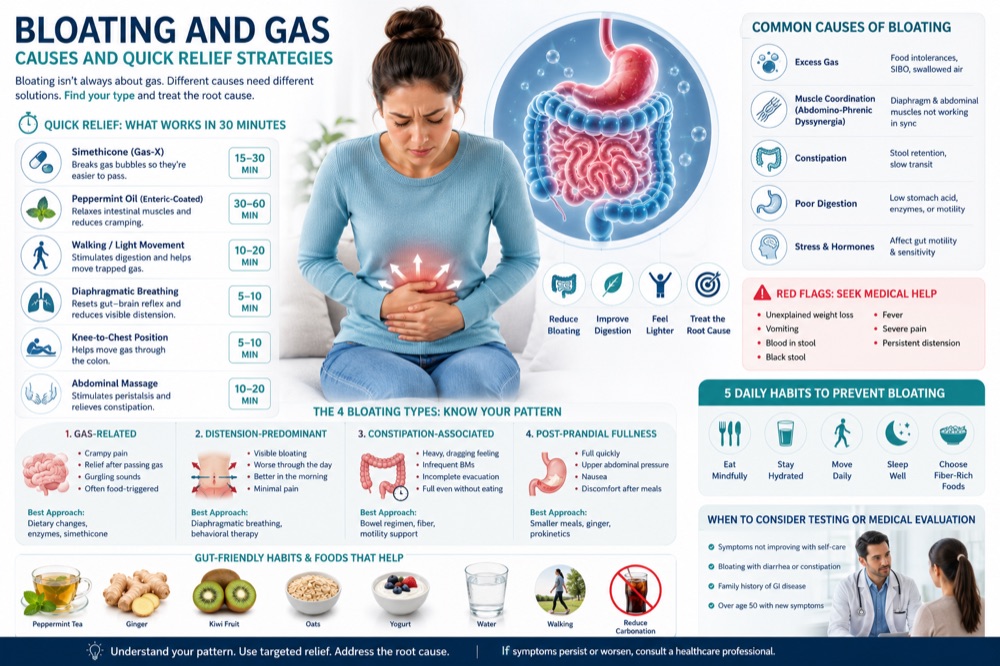
Your stomach looks like you’re six months pregnant by the end of the day. You wake up flat, but by evening, your belly is so distended you need to loosen your belt by two notches.
You’re not imagining it. And you’re not alone.
Bloating is the #1 symptom of SIBO, reported by 80-90% of patients. It’s often the most distressing symptom — more than pain, more than bowel changes.
Here’s what’s happening: Bacteria in your small intestine are fermenting food and producing massive amounts of gas. That gas has nowhere to go, so it stretches your intestine, pushing your abdomen outward.
This guide explains exactly why SIBO causes bloating, what your bloating pattern reveals about your SIBO type, and — most importantly — how to get relief while you treat the root cause.
The Science: Why SIBO Causes Bloating
What’s Actually Happening in Your Small Intestine
The Fermentation Problem
| Process | Normal Digestion | SIBO |
|---|---|---|
| Bacteria location | Mostly in large intestine (colon) | Overgrown in small intestine |
| When fermentation occurs | 4-6 hours after eating (in colon) | 30-90 minutes after eating (in small intestine) |
| Gas production | Gradual, released as flatulence | Rapid, trapped in small intestine |
| Symptoms | Minimal | Severe bloating, pain, pressure |
The Three Gases That Cause Bloating
| Gas | Produced By | Bloating Pattern | Associated Symptoms |
|---|---|---|---|
| Hydrogen | Bacteria fermenting carbohydrates | Upper abdominal bloating, worse after carbs | Diarrhea, urgency, excessive gas |
| Methane | Archaea (Methanobrevibacter smithii) | Lower abdominal bloating, firm/hard belly | Constipation, infrequent BMs |
| Hydrogen sulfide | Sulfate-reducing bacteria | Generalized bloating with cramping | Diarrhea, rotten egg gas, pain |
Key insight: The type of gas matters. Hydrogen and methane require different treatment approaches.
Bloating Patterns: What Your Symptoms Reveal
Hydrogen SIBO Bloating
| Characteristic | Details |
|---|---|
| Location | Upper abdomen, under ribs |
| Timing | 30-60 minutes after eating |
| Triggers | Carbohydrates, sugars, high-FODMAP foods |
| Feel | Gassy, urgent, pressure |
| Associated with | Diarrhea, frequent gas release |
| Breath test pattern | Hydrogen rise ≥20 ppm by 90 minutes |
Methane SIBO (IMO) Bloating
| Characteristic | Details |
|---|---|
| Location | Lower abdomen, below belly button |
| Timing | 1-3 hours after eating, persistent |
| Triggers | Fiber, beans, whole grains |
| Feel | Hard, firm, “pregnant belly” appearance |
| Associated with | Constipation, infrequent BMs |
| Breath test pattern | Methane ≥10 ppm at any timepoint |
Why methane bloating feels different: Methane slows gut motility, so gas and stool sit longer, causing firm, persistent distension.
Hydrogen Sulfide SIBO Bloating
| Characteristic | Details |
|---|---|
| Location | Generalized, throughout abdomen |
| Timing | Variable, often after protein |
| Triggers | Sulfur-containing foods (eggs, cruciferous vegetables) |
| Feel | Crampy, painful, gassy |
| Associated with | Diarrhea, rotten egg-smelling gas |
| Breath test pattern | Hydrogen sulfide ≥3 ppm (triple-gas test required) |
Bloating Timeline: What’s Normal During Treatment
| Phase | Bloating Pattern |
|---|---|
| Week 1-2 of treatment | May worsen (die-off); gas, cramping common |
| Week 3-4 of treatment | Starts improving; less severe, shorter duration |
| Week 4-6 post-treatment | Significant improvement for most patients |
| Month 2-3 post-treatment | Continued healing; occasional bloating with triggers |
| Month 4-6 post-treatment | Near-normal for most; some food sensitivities may persist |
Immediate Bloating Relief: What Works
Quick Relief Strategies (Work Within 30-60 Minutes)
| Strategy | How It Works | How to Use |
|---|---|---|
| Simethicone (Gas-X) | Breaks up gas bubbles | 80-125 mg after meals |
| Peppermint oil (enteric-coated) | Relaxes intestinal muscles | 180-225 mg between meals |
| Ginger tea | Stimulates gastric emptying | Fresh ginger, steeped 10 min |
| Walking | Mechanically moves gas through intestine | 10-15 minutes after eating |
| Knee-to-chest position | Helps release trapped gas | Lie on back, pull knees to chest for 2-3 min |
| Abdominal massage | Physically moves gas along | Clockwise circles around belly button |
Positional Relief Techniques
1. Knee-to-Chest Pose
- Lie on your back
- Pull both knees toward your chest
- Hold for 2-3 minutes
- Breathe deeply
2. Child’s Pose (Yoga)
- Kneel on floor, sit back on heels
- Fold forward, arms extended
- Rest forehead on floor
- Hold for 1-2 minutes
3. Left Side Lying
- Lie on your left side
- Pull knees slightly toward chest
- Helps gas move through colon
- Stay for 5-10 minutes
Binding Agents (Reduce Gas Production)
| Binder | Dosage | Timing | Notes |
|---|---|---|---|
| Activated charcoal | 500-1000 mg | 2 hours away from meds/supplements | Short-term use only |
| Bentonite clay | 1 tsp in water | 2 hours away from meds/supplements | Mix well; drink immediately |
| Bismuth subsalicylate | 262-524 mg | With meals | Especially helpful for hydrogen sulfide |
Important: Binders can reduce absorption of medications and supplements. Take 2 hours apart from everything else.
Dietary Strategies for Bloating Relief
During Treatment: Reduce Fermentation
| Strategy | Details |
|---|---|
| Low-FODMAP diet | Eliminates fermentable carbohydrates that feed bacteria |
| Smaller portions | Less substrate = less gas production |
| Chew thoroughly | Mechanical digestion reduces burden on small intestine |
| Avoid carbonated beverages | Introduces additional gas |
| Limit high-fat meals | Fat slows gastric emptying, worsening bloating |
Foods Less Likely to Cause Bloating
| Category | Low-Bloating Options |
|---|---|
| Proteins | Eggs, fish, chicken, turkey, firm tofu |
| Carbohydrates | White rice, quinoa, potatoes (peeled) |
| Vegetables | Carrots, zucchini, spinach, green beans (cooked) |
| Fruits | Blueberries, strawberries, cantaloupe (small portions) |
| Fats | Olive oil, coconut oil (small amounts) |
Foods Most Likely to Cause Bloating (Limit During Treatment)
| Category | High-Bloating Foods |
|---|---|
| High-FODMAP vegetables | Onion, garlic, cauliflower, mushrooms |
| Legumes | Beans, lentils, chickpeas |
| High-fructose fruits | Apples, pears, mango, watermelon |
| Wheat products | Bread, pasta, crackers |
| Dairy (if sensitive) | Milk, soft cheeses, ice cream |
| Sugar alcohols | Sorbitol, xylitol, mannitol |
| Carbonated drinks | Soda, seltzer, sparkling water |
The Bloating-Food Timing Connection
| Timing Issue | Impact on Bloating | Fix |
|---|---|---|
| Eating too fast | Swallows air; poor digestion | Chew 20-30 times per bite |
| Drinking during meals | Dilutes stomach acid | Drink 30 min before or after meals |
| Late-night eating | Poor digestion during sleep | Finish dinner 3-4 hours before bed |
| Constant snacking | No MMC activation | 4-5 hours between meals |
Treatment: The Only Way to Fix SIBO Bloating Long-Term
Antibiotic Treatment
| Protocol | For | Duration | Bloating Improvement Timeline |
|---|---|---|---|
| Rifaximin | Hydrogen SIBO | 14 days | Weeks 3-6 post-treatment |
| Rifaximin + Neomycin | Methane SIBO | 14 days | Weeks 4-8 post-treatment |
| Ciprofloxacin | Alternative | 14 days | Weeks 3-6 post-treatment |
What to expect: Bloating may worsen during week 1-2 (die-off), then gradually improve.
Herbal Treatment
| Protocol | For | Duration | Bloating Improvement Timeline |
|---|---|---|---|
| Berberine + Oregano | Hydrogen SIBO | 4-6 weeks | Weeks 4-8 |
| Allicin + Berberine | Methane SIBO | 4-6 weeks | Weeks 5-10 |
| Neem + Berberine | Hydrogen SIBO | 4-6 weeks | Weeks 4-8 |
What to expect: Slower improvement than antibiotics, but fewer side effects for many patients.
Prokinetics: Prevent Bloating from Returning
| Prokinetic | Dosage | Why It Helps Bloating |
|---|---|---|
| Ginger extract | 250-500 mg before bed | Stimulates MMC, prevents bacterial regrowth |
| Iberogast | 20 drops 3x daily | Multi-herb prokinetic; reduces bloating |
| Prucalopride | 0.5-2 mg daily | Treats constipation; improves motility |
Critical: Without a prokinetic, SIBO (and bloating) often returns within months.
Special Considerations
Why Bloating May Persist After Treatment
| Reason | Explanation | Solution |
|---|---|---|
| Incomplete eradication | Bacteria not fully cleared | May need second treatment round |
| Visceral hypersensitivity | Nerves remain sensitized | Gut-directed hypnotherapy; neuromodulators |
| Dysbiosis | Imbalanced colon bacteria | Careful probiotic introduction; diet |
| Continued poor motility | MMC still impaired | Prokinetic essential; meal spacing |
| Food reintroduction too fast | Gut not ready for variety | Slow down reintroduction; go step-by-step |
| Constipation unresolved | Stool backup causes bloating | Aggressive constipation management |
Bloating vs. Distension: Are They Different?
| Symptom | Definition | What It Means |
|---|---|---|
| Bloating | Subjective feeling of fullness/pressure | May or may not have visible change |
| Distension | Objective increase in abdominal girth | Measurable; belt notch changes |
In SIBO: Both are common. You may feel bloated without visible distension, or have visible distension with minimal discomfort, or both.
When Bloating Isn’t (Just) SIBO
| Condition | Overlapping Symptoms | How to Differentiate |
|---|---|---|
| IBS without SIBO | Bloating, gas, pain | Normal breath test |
| SIFO (fungal overgrowth) | Bloating, brain fog | May not respond to SIBO treatment |
| Gastroparesis | Early fullness, bloating, nausea | Gastric emptying study |
| Pancreatic insufficiency | Bloating, greasy stools, weight loss | Low fecal elastase |
| Celiac disease | Bloating, diarrhea, fatigue | Positive celiac antibodies |
| Ovarian cancer | Persistent bloating, pelvic pain | Pelvic exam; ultrasound |
| Ascites (liver disease) | Progressive abdominal distension | Fluid wave on exam; ultrasound |
Red flag: Bloating with weight loss, fever, or blood in stool needs immediate medical evaluation.
The GutFeel Approach
Tracking your bloating helps you:
- Identify triggers - Which foods, timing, and stress levels affect bloating
- Track treatment response - Is bloating improving week-to-week?
- Spot patterns - Morning vs. evening, upper vs. lower abdomen
- Share with your practitioner - Objective data for treatment decisions
What to track daily:
| Metric | How to Measure |
|---|---|
| Morning bloating | 1-10 scale (right after waking) |
| Evening bloating | 1-10 scale (before bed) |
| Visible distension | Yes/No; belt notch change |
| Food triggers | Which meals caused worst bloating |
| Bowel movements | Frequency and stool form |
| Gas frequency | Approximate number per day |
GutFeel AI helps you organize this information systematically, so you can see patterns that aren’t obvious day-to-day.
FAQs
How long does SIBO bloating last?
During treatment: Bloating may worsen week 1-2 (die-off), then improve weeks 3-6. Full resolution can take 2-3 months post-treatment as the gut heals.
Why is my bloating worse in the evening?
This is classic SIBO pattern. Bacteria ferment food throughout the day, and gas accumulates. Morning bloating that improves during the day suggests different causes.
Can probiotics help SIBO bloating?
Controversial. Some patients improve; others worsen (adding bacteria to an overgrowth). Saccharomyces boulardii is generally safe. Discuss with your practitioner.
Does the type of SIBO affect bloating?
Yes. Hydrogen SIBO causes upper abdominal, gassy bloating. Methane SIBO causes lower abdominal, firm/hard distension with constipation.
Will I ever be able to eat normally again?
Most patients can expand their diet significantly after treatment. Some may have ongoing sensitivities that improve over months.
Why do I bloat after drinking water?
Possible causes: drinking too fast (swallowing air), cold water slowing digestion, or underlying motility issues. Try room-temperature water, sipped slowly.
Can stress make SIBO bloating worse?
Yes. Stress impairs the vagus nerve, which controls gut motility. This slows digestion and worsens bloating.
Is it normal to look pregnant with SIBO?
Yes. “SIBO belly” or “endo belly” appearance is common, especially with methane SIBO. The distension is from gas stretching the intestine.
What’s the fastest way to reduce SIBO bloating?
Simethicone (Gas-X) provides quickest relief (30-60 min). Peppermint oil, walking, and positional techniques also help within an hour.
Can SIBO bloating cause back pain?
Yes. Severe bloating can refer pain to the back, especially upper back (gas under diaphragm) or lower back (pelvic pressure).
Key Takeaways
- Bloating is the #1 SIBO symptom - 80-90% of patients experience it
- Gas from fermentation causes bloating - Bacteria produce hydrogen, methane, or hydrogen sulfide
- Bloating pattern reveals SIBO type - Hydrogen = upper, gassy; Methane = lower, firm
- Immediate relief is possible - Simethicone, peppermint oil, walking, positional techniques
- Diet reduces symptoms during treatment - Low-FODMAP limits bacterial food sources
- Treatment is the only cure - Antibiotics or herbs eradicate the overgrowth
- Bloating may worsen before improving - Die-off is normal in week 1-2
- Prokinetics prevent return - Essential for long-term relief
- Persistent bloating has causes - Incomplete treatment, visceral hypersensitivity, dysbiosis, constipation
- Most patients improve significantly - With proper treatment, bloating resolves in weeks to months
Sources
- Pimentel M, et al. “Eradication of Small Intestinal Bacterial Overgrowth Reduces Symptoms of Irritable Bowel Syndrome.” American Journal of Gastroenterology. 2000.
- Rezaie A, et al. “Hydrogen and Methane-Based Breath Testing in Gastrointestinal Disorders: The North American Consensus.” American Journal of Gastroenterology. 2017.
- ACG Clinical Guideline: Small Intestinal Bacterial Overgrowth. American Journal of Gastroenterology. 2020.
- Ford AC, et al. “Efficacy of 5-HT3 Antagonists and 5-HT4 Agonists in Irritable Bowel Syndrome.” American Journal of Gastroenterology. 2018.
- Mayo Clinic. “Small Intestinal Bacterial Overgrowth (SIBO).” 2024.
- Cleveland Clinic. “SIBO: Symptoms and Causes.” 2024.
- NIDDK. “Bloating.” 2023.
- Monash University. “FODMAPs and Bloating.” 2024.
- Siebecker A. “SIBO Symptoms and Treatment Protocols.” SIBO Info. 2023.
- Rome Foundation. “Rome IV Criteria for Functional GI Disorders.” 2016.