You’re in an important meeting. Your stomach starts churning. You feel gurgling, urgency, maybe even pain. You’ve felt this before — during presentations, difficult conversations, or stressful deadlines.
Or maybe it’s the opposite: after days of digestive chaos, you finally feel calm on vacation. Your gut settles. You sleep better. Symptoms you’ve battled for years suddenly seem manageable.
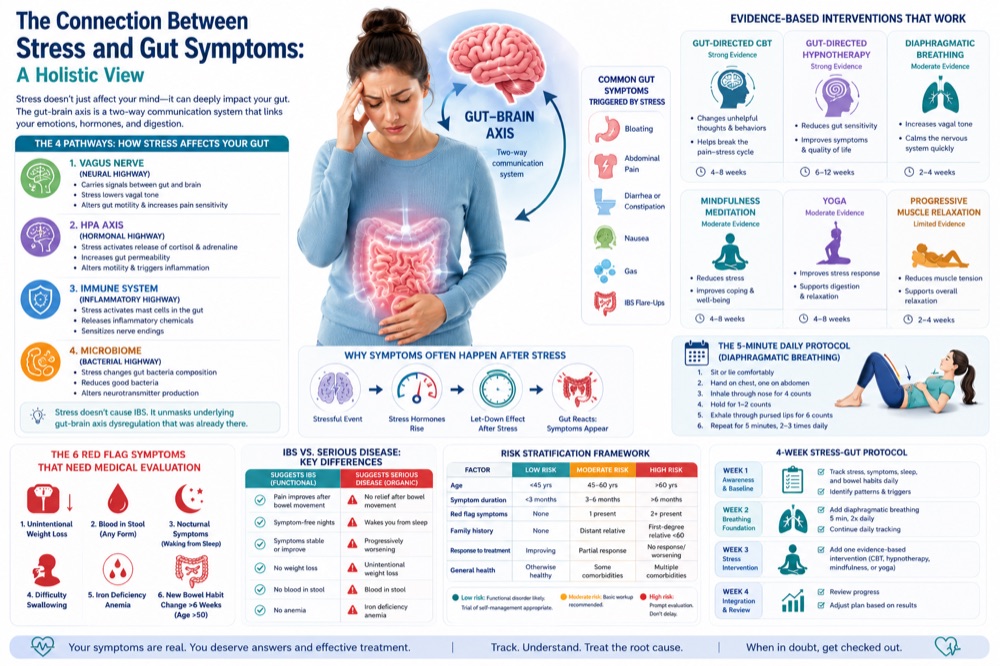
This isn’t coincidence. Your gut and brain are in constant communication — a two-way street called the gut-brain axis. When your brain is stressed, your gut feels it. When your gut is inflamed, your brain feels it too.
Understanding this connection doesn’t just explain why you get “nervous stomach” before big events. It opens up entirely new treatment approaches — strategies that calm your nervous system to calm your gut.
This guide explains the science behind the gut-brain axis and gives you 10 evidence-based strategies to break the stress-symptom cycle.
The Gut-Brain Axis: Your Body’s Information Highway
What Is the Gut-Brain Axis?
The gut-brain axis is a bidirectional communication network connecting your:
- Central nervous system (brain and spinal cord)
- Enteric nervous system (the “brain in your gut”)
- Autonomic nervous system (fight-or-flight and rest-digest responses)
- Immune system
- Endocrine (hormone) system
- Gut microbiome
Key insight: This isn’t a one-way street where your brain tells your gut what to do. Your gut sends signals TO your brain that affect mood, cognition, and behavior.
The Communication Pathways
| Pathway | How It Works | Impact on Gut |
|---|---|---|
| Vagus nerve | Direct nerve connection from brainstem to intestines | Carries stress signals directly to gut |
| Stress hormones | Cortisol, adrenaline released during stress | Alter gut motility, increase permeability |
| Immune signaling | Inflammatory cytokines travel through blood | Gut inflammation affects brain function |
| Neurotransmitters | Serotonin, GABA, dopamine produced in gut | Affect both gut function and mood |
| Microbiome signals | Bacteria produce compounds that signal the brain | Can influence anxiety, depression, stress response |
The Vagus Nerve: Your Gut’s Direct Line to the Brain
Important facts:
- 80-90% of vagus nerve fibers carry signals FROM gut TO brain (not the other way)
- This is why gut sensations affect your emotions and thoughts
- “Gut feelings” are literally real — your gut is sending information to your brain
How Stress Triggers Gut Symptoms
The Stress Response Cascade
| Stage | What Happens | Gut Effect |
|---|---|---|
| 1. Stressor detected | Brain perceives threat (real or imagined) | — |
| 2. HPA axis activated | Hypothalamus → Pituitary → Adrenal glands | — |
| 3. Cortisol released | Stress hormone enters bloodstream | Increases gut permeability |
| 4. Adrenaline released | Fight-or-flight activation | Redirects blood flow away from gut |
| 5. Digestion slows | Energy diverted to muscles | Motility changes (diarrhea or constipation) |
| 6. Inflammation increases | Immune system activated | Gut lining becomes more sensitive |
Why Stress Affects Some People More Than Others
| Factor | Why It Matters |
|---|---|
| Genetics | Some people have more sensitive stress response systems |
| Early life stress | Childhood adversity can program lifelong stress sensitivity |
| Previous gut trauma | Food poisoning, infections can “prime” gut nerves |
| Microbiome composition | Some bacterial profiles increase stress reactivity |
| Baseline anxiety | Higher trait anxiety = stronger gut response to stress |
| Coping strategies | Poor stress management amplifies physical symptoms |
The Post-Infectious IBS Connection
What happens:
- You get food poisoning (gastroenteritis)
- Infection clears, but gut nerves remain sensitized
- Stress now triggers exaggerated gut responses
- IBS symptoms develop and persist
Statistics:
- 6-17% of people who get food poisoning develop post-infectious IBS
- This is one of the clearest examples of gut-brain axis dysfunction
How Your Gut Affects Your Mood
Serotonin: The “Happy Chemical” Is Mostly in Your Gut
| Location | Serotonin Production | Function |
|---|---|---|
| Brain | ~5% of total | Mood regulation, sleep, appetite |
| Gut (enteric nervous system) | ~90-95% of total | Gut motility, secretion, sensation |
Key insight: Gut serotonin doesn’t cross the blood-brain barrier, but gut health still influences brain serotonin production through other pathways.
The Microbiome-Mood Connection
| Bacteria Type | Effect on Mood |
|---|---|
| Lactobacillus | Produces GABA (calming neurotransmitter) |
| Bifidobacterium | Produces butyrate (anti-inflammatory) |
| Bacteroides | Associated with lower anxiety in studies |
| Prevotella | Mixed effects; may increase inflammation |
Research finding: People with depression and anxiety often have different gut bacteria compositions compared to mentally healthy controls.
Inflammation and Mental Health
This is why: Treating gut inflammation often improves mood symptoms — and vice versa.
The Stress-Symptom Cycle (And How to Break It)
Understanding the Vicious Cycle
Breaking the cycle requires addressing BOTH:
- The physical gut symptoms
- The stress and anxiety response
Common Thought Patterns That Worsen Symptoms
| Thought | Why It Makes Symptoms Worse |
|---|---|
| “What if I can’t find a bathroom?” | Activates fight-or-flight response |
| “I can’t eat anything without getting sick” | Creates food anxiety, restricts life |
| “My gut is broken” | Increases catastrophizing, helplessness |
| “This will never get better” | Chronic stress worsens gut function |
| “Everyone notices my bloating” | Social anxiety amplifies discomfort |
10 Evidence-Based Strategies to Calm Your Gut-Brain Axis
Strategy 1: Diaphragmatic Breathing (Daily)
Why it works: Deep breathing activates the vagus nerve, switching your body from fight-or-flight to rest-and-digest.
The protocol:
- Sit or lie comfortably
- Place one hand on chest, one on belly
- Inhale through nose for 4 counts (belly rises, chest stays still)
- Hold for 2 counts
- Exhale through mouth for 6 counts
- Repeat for 5-10 minutes
When: Morning (to start calm), before meals (to activate digestion), during symptom flares
Research: Studies show diaphragmatic breathing reduces IBS symptom severity by 30-50% in 8-12 weeks.
Strategy 2: Gut-Directed Hypnotherapy
What it is: Guided hypnosis specifically designed to calm gut function and reduce symptom-focused anxiety.
How it works:
- Induces deep relaxation
- Uses imagery to normalize gut function
- Reduces visceral hypersensitivity (overly sensitive gut nerves)
Delivery options:
| Option | Details | Cost |
|---|---|---|
| In-person therapist | 6-12 sessions with trained hypnotherapist | $150-300/session |
| Nerva app | 6-week digital program | ~$100 total |
| Zoom sessions | Remote hypnotherapy | $100-200/session |
| Self-hypnosis recordings | Guided audio programs | $20-50 |
Research: 70-80% of IBS patients improve with gut-directed hypnotherapy — similar efficacy to low-FODMAP diet.
Strategy 3: Cognitive Behavioral Therapy (CBT) for IBS
What it is: Structured therapy that changes thought patterns and behaviors related to gut symptoms.
Targets:
- Catastrophic thinking about symptoms
- Avoidance behaviors (not leaving home, restricting foods unnecessarily)
- Hypervigilance (constantly monitoring gut sensations)
Delivery options:
| Option | Duration | Effectiveness |
|---|---|---|
| Standard CBT (in-person) | 8-12 sessions | High |
| Internet-based CBT | 6-10 weeks online | Moderate-High |
| Minimal-contact CBT | 4 sessions + workbook | Moderate |
Research: CBT produces significant symptom improvement in 50-70% of IBS patients, with benefits lasting 1-2 years.
Strategy 4: Mindfulness Meditation
Why it works: Reduces stress reactivity, changes relationship to symptoms, decreases visceral hypersensitivity.
The protocol:
| Duration | Practice |
|---|---|
| Daily | 10-20 minutes seated meditation |
| Before meals | 2 minutes of mindful breathing |
| During symptoms | Body scan to observe without reacting |
Apps to try:
- Headspace (has specific “Pain Management” and “Stress” courses)
- Calm (sleep and anxiety focus)
- Insight Timer (free, large library)
- Balance (personalized programs)
Research: 8-week mindfulness programs reduce IBS symptom severity by 30-40% on average.
Strategy 5: Gentle Movement (Not Intense Exercise)
Why gentle? Intense exercise can stress the body further. Gentle movement activates parasympathetic (rest-digest) nervous system.
Best options:
| Activity | Duration | Frequency |
|---|---|---|
| Walking | 20-30 minutes | Daily |
| Yoga (gentle/restorative) | 20-45 minutes | 3-5x/week |
| Tai chi | 30 minutes | 3-5x/week |
| Stretching | 10-15 minutes | Daily |
Avoid during flares: HIIT, long-distance running, intense cycling (can worsen symptoms)
Strategy 6: Sleep Optimization
Why it matters: Poor sleep increases stress hormones, worsens pain perception, and disrupts the microbiome.
The sleep-gut connection:
Sleep optimization protocol:
| Habit | Action |
|---|---|
| Consistent schedule | Same bedtime and wake time daily |
| Wind-down routine | 30-60 min without screens before bed |
| Cool, dark room | 65-68°F, blackout curtains |
| No late eating | Finish dinner 3-4 hours before bed |
| Limit caffeine | None after 2 PM |
| Magnesium before bed | 200-400 mg glycinate or citrate |
Strategy 7: Progressive Muscle Relaxation
What it is: Systematically tensing and relaxing muscle groups to release physical stress.
The protocol (15 minutes):
- Find a quiet space, lie down or sit comfortably
- Starting with your feet, tense muscles for 5 seconds
- Release and notice the relaxation for 10 seconds
- Move up: calves, thighs, buttocks, abdomen, hands, arms, shoulders, neck, face
- End with 2-3 minutes of deep breathing
When: Before bed, during symptom flares, before stressful events
Research: Regular practice reduces IBS symptom severity and anxiety scores.
Strategy 8: Social Connection
Why it matters: Loneliness and isolation increase stress hormones. Social connection activates the vagus nerve and reduces inflammation.
The protocol:
| Action | Frequency |
|---|---|
| Meaningful conversation | At least 1-2x/week |
| Shared meals | With family/friends when possible |
| Support groups | IBS/gut health groups (online or in-person) |
| Physical touch | Hugs, handshakes (releases oxytocin) |
Important: If social anxiety about symptoms is isolating you, this is itself a treatment target (see CBT above).
Strategy 9: Psychobiotics (Mood-Supporting Probiotics)
What they are: Probiotic strains that specifically affect the gut-brain axis.
Best-studied strains:
| Strain | Studied Benefits | Typical Dose |
|---|---|---|
| Lactobacillus helveticus R0052 | Reduces cortisol, improves mood | 3 billion CFU daily |
| Bifidobacterium longum R0175 | Reduces anxiety, improves memory | 3 billion CFU daily |
| Lactobacillus plantarum 299v | Reduces IBS symptoms, may improve mood | 10 billion CFU daily |
| Bifidobacterium infantis 35624 | Gold standard for IBS | 1 billion CFU daily |
Note: Effects are strain-specific. Generic “probiotics” may not have the same benefits.
Strategy 10: Journaling for Emotional Processing
Why it works: Writing about stressors reduces their physiological impact. Unprocessed emotions can manifest as physical symptoms.
The protocol:
| Type | How To | Frequency |
|---|---|---|
| Expressive writing | Write about feelings for 15-20 min | 3-4x/week |
| Gratitude journaling | List 3 things you’re grateful for | Daily |
| Symptom + mood log | Track both together to see patterns | Daily |
Prompt ideas:
- “What am I carrying that I need to let go of?”
- “What emotions am I feeling in my body right now?”
- “What would my gut say if it could talk?”
Tracking Mood and Gut Symptoms Together
What to Track
| Category | Metrics |
|---|---|
| Mood | Anxiety (1-10), depression (1-10), irritability, stress level |
| Gut symptoms | Bloating, pain, urgency, stool form, nausea |
| Sleep | Hours, quality (1-10), waking symptoms |
| Stressors | Major events, conflicts, deadlines |
| Coping practices | Meditation, breathing, exercise, therapy |
The Mood-Gut Pattern Log
Example entry:
| Time | Event/Food | Mood (1-10) | Stress (1-10) | Gut Symptoms | Notes |
|---|---|---|---|---|---|
| 8 AM | Woke up | Anxiety 4/10 | Stress 3/10 | Bloating 2/10 | Slept 7 hours |
| 10 AM | Work meeting | Anxiety 7/10 | Stress 7/10 | Bloating 5/10, urgency | Presentation stress |
| 1 PM | Lunch (rice, chicken) | Anxiety 4/10 | Stress 4/10 | Bloating 4/10 | Ate at desk |
| 4 PM | Afternoon | Anxiety 3/10 | Stress 3/10 | Bloating 3/10 | Took walk |
| 8 PM | Evening | Anxiety 2/10 | Stress 2/10 | Bloating 2/10 | Did breathing exercise |
Pattern visible: Meeting stress correlated with symptom spike, even though food was “safe.”
Using GutFeel AI for Mood-Gut Tracking
Features that help:
| Feature | Benefit |
|---|---|
| Mood logging | Track anxiety, stress, mood alongside symptoms |
| Correlation detection | AI identifies mood-symptom patterns |
| Weekly reports | See which days had best/worst mood AND gut scores |
| Trigger alerts | Notifications when stress predicts flares |
When to Seek Professional Help
Signs You Need More Support
| Sign | What It Means |
|---|---|
| Symptoms persist despite self-care | May need medication or specialized therapy |
| Anxiety is severe or disabling | Consider therapy, possibly medication |
| Depression symptoms | Low mood, loss of interest, hopelessness |
| Panic attacks | Sudden intense anxiety with physical symptoms |
| Avoiding life due to symptoms | Not leaving home, missing work/events |
| Thoughts of self-harm | Urgent mental health support needed |
Types of Professionals to Consider
| Professional | What They Do | When to See |
|---|---|---|
| Gastroenterologist | Medical evaluation, rules out serious conditions | Persistent symptoms |
| Gut psychologist | CBT, hypnotherapy for IBS | Stress-symptom cycle |
| Registered dietitian | Dietary strategies, FODMAP guidance | Food-related symptoms |
| Psychiatrist | Medication for anxiety/depression | Severe mood symptoms |
| Therapist/counselor | General mental health support | Life stressors, coping |
Medications That Affect the Gut-Brain Axis
Low-Dose Antidepressants for IBS
| Type | How It Helps Gut | Typical Dose |
|---|---|---|
| TCAs (amitriptyline, nortriptyline) | Slows gut motility, reduces pain signaling | 10-50 mg at bedtime |
| SSRIs (fluoxetine, sertraline) | May help constipation, treats anxiety/depression | 20-100 mg daily |
| SNRIs (duloxetine, venlafaxine) | Pain modulation, anxiety/depression | 30-120 mg daily |
Important: These are used at LOWER doses for IBS than for depression. The gut effects are separate from mood effects.
Anti-Anxiety Medications
| Medication | Role in Gut-Brain Treatment |
|---|---|
| Buspirone | May help functional dyspepsia; non-addictive |
| Benzodiazepines | Generally avoided (dependency risk) |
| Hydroxyzine | Short-term anxiety relief; antihistamine |
Special Considerations
IBS and Anxiety: Which Came First?
The reality: It’s often impossible to tell — and it doesn’t matter for treatment.
| Scenario | Approach |
|---|---|
| Anxiety first, then IBS | Treat anxiety; gut often improves |
| IBS first, then anxiety | Treat gut; anxiety often improves |
| Both developed together | Treat both simultaneously |
The Eating Disorder Question
Important distinction:
| Concerning Sign | What It Might Mean |
|---|---|
| Restricting due to fear (not intolerance) | Possible disordered eating |
| Significant weight loss from restriction | Needs evaluation |
| Social isolation around food | May need mental health support |
If this resonates: Work with a dietitian AND therapist who specialize in both GI issues and eating disorders.
Trauma and Gut Health
The connection: Past trauma (especially childhood) is associated with higher rates of IBS and functional GI disorders.
Why: Trauma can “program” the stress response system to be chronically overactive.
Treatment approach: Trauma-informed therapy (EMDR, somatic experiencing, trauma-focused CBT) may be necessary alongside gut treatment.
FAQs
Can anxiety cause digestive problems?
Yes. Anxiety activates the fight-or-flight response, which directly affects gut motility (causing diarrhea or constipation), increases gut sensitivity, and can trigger inflammation.
Can gut problems cause anxiety?
Also yes. Gut inflammation, dysbiosis (imbalanced bacteria), and increased permeability (“leaky gut”) can all contribute to anxiety through the gut-brain axis.
How long does it take to calm the gut-brain axis?
Some strategies work immediately (breathing exercises). Others take 4-8 weeks of consistent practice (meditation, CBT). Most people notice improvement within 2-4 weeks of starting multiple strategies.
Do I need medication for gut-brain axis issues?
Not necessarily. Many people improve with behavioral strategies alone. Medication may help if anxiety/depression is severe or if other approaches haven’t worked.
Can probiotics really affect my mood?
Some strains (psychobiotics) have shown promise in studies for reducing anxiety and improving mood. Effects are modest but real. Strain matters — not all probiotics have these benefits.
Is gut-directed hypnotherapy “real”?
Yes. Multiple randomized controlled trials show it’s as effective as the low-FODMAP diet for IBS, with benefits lasting years. It’s recommended in major gastroenterology guidelines.
Why do I get diarrhea when I’m nervous?
Stress hormones (especially CRH) directly stimulate colonic contractions. This is the same mechanism that causes “nervous poops” before big events.
Can childhood stress cause adult gut problems?
Yes. Early life stress can program the stress response system to be chronically overactive, increasing risk of IBS and other functional disorders in adulthood.
Should I see a therapist for IBS?
If stress clearly triggers your symptoms, or if you’re struggling with anxiety about your symptoms, a therapist (especially one trained in CBT for IBS or gut-directed hypnotherapy) can be very helpful.
Is it “all in my head”?
Absolutely not. The gut-brain axis is real biology — real nerve pathways, real hormones, real immune signals. Your symptoms are physical, even though stress affects them.
Key Takeaways
- The gut-brain axis is bidirectional — Your brain affects your gut, AND your gut affects your brain
- 90% of serotonin is made in your gut — Gut health directly influences mood regulation
- The vagus nerve is the main highway — 80-90% of fibers carry gut-to-brain signals
- Stress triggers real physical symptoms — Not “imagined” — actual changes in motility, sensitivity, inflammation
- The stress-symptom cycle can be broken — Requires addressing both gut AND stress
- Diaphragmatic breathing is foundational — Activates vagus nerve, switches to rest-digest mode
- Gut-directed hypnotherapy works — 70-80% improvement rate, similar to low-FODMAP diet
- CBT for IBS is evidence-based — Changes thought patterns that amplify symptoms
- Sleep matters enormously — Poor sleep worsens both gut and mental health
- You’re not crazy — Gut-brain symptoms are real, common, and treatable
Sources
- Mayer EA, et al. “Gut/Brain Axis and the Microbiota.” Journal of Clinical Investigation. 2015.
- American College of Gastroenterology. “ACG Clinical Guideline: Irritable Bowel Syndrome.” 2021.
- Ford AC, et al. “Efficacy of Psychological Therapies for IBS: Systematic Review and Meta-Analysis.” American Journal of Gastroenterology. 2022.
- Peters SL, et al. “Randomised Clinical Trial: Gut-Directed Hypnotherapy Is Effective in IBS.” Alimentary Pharmacology & Therapeutics. 2015.
- Cryan JF, Dinan TG. “Mind-Altering Microorganisms: The Impact of the Gut Microbiota on Brain and Behaviour.” Nature Reviews Neuroscience. 2012.
- Harvard Medical School. “Understanding the Gut-Brain Connection.” 2024.
- NIDDK. “Stress and Digestive Diseases.” 2023.
- Monash University. “Gut-Brain Axis and IBS.” 2024.
- International Foundation for Gastrointestinal Disorders. “Psychological Treatments for IBS.” 2024.
- Nature Digital Medicine. “Digital Therapeutics for Gut-Brain Disorders.” 2023.