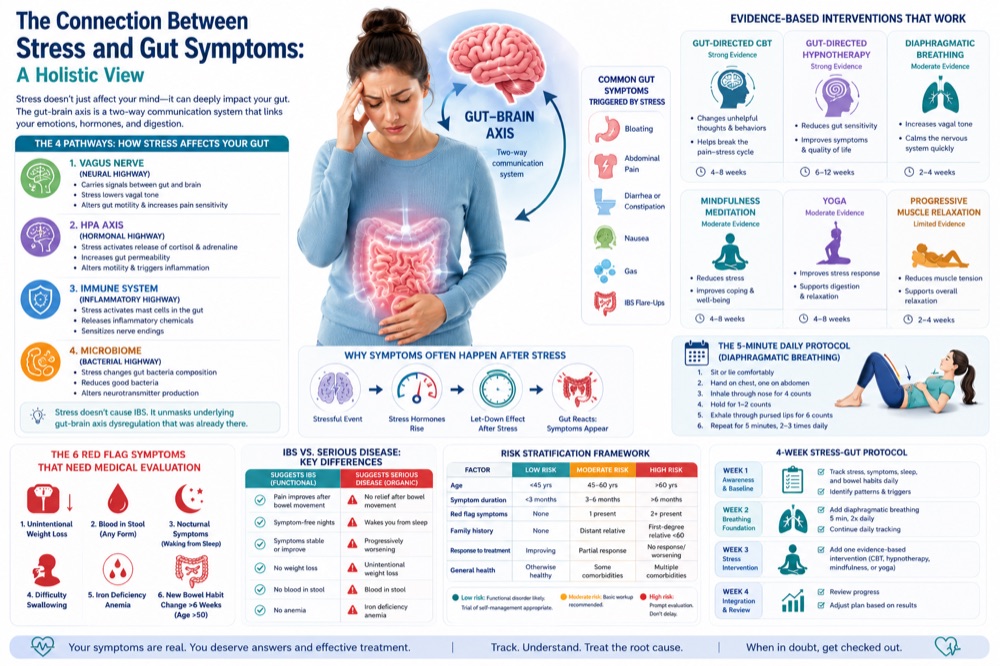
You’ve probably noticed it. A stressful week at work. Family tensions. Financial worries. And then—your gut acts up. Bloating, pain, changes in bowel habits. If you have diverticulosis, you might wonder: Can stress actually trigger diverticulitis?
The short answer: Yes, stress appears to be a risk factor for diverticulitis, though the relationship is complex and not fully understood. Stress doesn’t directly cause diverticulitis the way bacteria cause infection. But it can create conditions that make diverticulitis more likely—and it can definitely worsen symptoms.
This guide explores the science behind the gut-brain connection, what research tells us about stress and diverticulitis, and practical stress management techniques that may help prevent flares.
The Short Answer: What Research Shows
Direct Evidence on Stress and Diverticulitis
While fewer studies exist on stress and diverticulitis specifically compared to IBS, the evidence is growing:
| Study | Participants | Finding |
|---|---|---|
| Danish Cohort Study (2019) | 47,000+ adults over 18 years | High perceived stress associated with 40% higher risk of diverticular disease hospitalization |
| Swedish Twin Study (2020) | 22,000+ twins | Stress-related disorders (anxiety, depression, PTSD) associated with 50% higher risk of diverticulitis |
| Nurses’ Health Study | 70,000+ women | Higher stress levels associated with increased diverticulitis risk, independent of diet and lifestyle |
| Korean National Health Study (2021) | 150,000+ adults | Stress-related mental health conditions linked to 1.5x higher risk of acute diverticulitis |
The pattern is consistent: Higher stress = higher diverticulitis risk.
Stress vs. Other Risk Factors
How does stress compare to other known risk factors?
| Risk Factor | Risk Increase | Strength of Evidence |
|---|---|---|
| Low-fiber diet | 2x higher | Strong |
| Obesity (BMI >30) | 1.5-2x higher | Strong |
| High red meat consumption | 1.5x higher | Moderate-Strong |
| Physical inactivity | 1.5x higher | Moderate-Strong |
| Smoking | 1.5-2x higher | Strong |
| NSAID use | 2-3x higher | Strong |
| Chronic stress | 1.4-1.6x higher | Moderate |
Key point: Stress is a moderate risk factor—comparable to obesity and physical inactivity. It’s not the ONLY factor, but it’s a meaningful one you can actually do something about.
How Stress Affects Your Gut: The Mechanisms
The Gut-Brain Axis Explained
The gut and brain are in constant two-way communication through multiple pathways:
This isn’t metaphorical. It’s anatomical and biochemical.
Pathway 1: The HPA Axis (Stress Hormone System)
What happens during stress:
- Brain perceives stress (work deadline, argument, traffic)
- Hypothalamus releases CRH (corticotropin-releasing hormone)
- Pituitary gland releases ACTH (adrenocorticotropic hormone)
- Adrenal glands release CORTISOL and adrenaline
- Body enters “fight or flight” mode
How this affects the gut:
| Effect | What It Means for Diverticulitis |
|---|---|
| Increased gut permeability | “Leaky gut” allows bacteria to trigger inflammation |
| Altered gut motility | Can cause spasms, constipation, or diarrhea |
| Reduced blood flow | Less oxygen/nutrients to gut tissues; impaired healing |
| Increased visceral sensitivity | Pain signals amplified; normal sensations feel painful |
| Suppressed immune regulation | Can allow harmful bacteria to flourish |
Pathway 2: The Vagus Nerve
The vagus nerve is the main communication highway between brain and gut.
During stress:
- Vagus nerve signaling is altered
- Gut doesn’t receive proper “rest and digest” signals
- Digestion slows or becomes dysregulated
- Inflammation increases (vagus nerve normally helps resolve inflammation)
Vagus nerve effects on colon:
| Normal Vagus Function | During Chronic Stress |
|---|---|
| Regular colon contractions | Irregular contractions (spasms or sluggishness) |
| Normal pain perception | Heightened pain sensitivity |
| Balanced inflammation | Increased inflammatory response |
| Healthy gut bacteria balance | Shift toward harmful bacteria |
Pathway 3: Immune System Activation
Stress triggers inflammation throughout the body, including the gut:
| Inflammatory Marker | Effect of Stress | Relevance to Diverticulitis |
|---|---|---|
| IL-6 (Interleukin-6) | Increases with stress | Elevated in diverticulitis; promotes inflammation |
| TNF-alpha | Increases with stress | Key inflammatory mediator in diverticulitis |
| CRP (C-Reactive Protein) | Increases with stress | Marker of inflammation; elevated in diverticulitis |
| NF-kappaB | Activated by stress | Master regulator of inflammation |
The consequence: Chronic low-grade inflammation from stress may make diverticula more susceptible to becoming inflamed when bacteria are present.
Pathway 4: Gut Microbiome Changes
Stress alters the bacteria living in your gut:
| Change | What Happens | Impact on Gut Health |
|---|---|---|
| Reduced diversity | Fewer types of beneficial bacteria | Less resilient ecosystem |
| Increased harmful bacteria | Pathogenic bacteria may flourish | More inflammation, more gas |
| Reduced short-chain fatty acids | Less butyrate production | Colon cells less healthy |
| Increased gut permeability | Tight junctions weakened | Bacteria can cross into bloodstream |
Animal studies show that stressed mice develop different gut bacteria that can transfer anxiety-like behavior to other mice through fecal transplants. The gut-brain connection is bidirectional.
Pathway 5: Behavioral Changes
Stress also affects diverticulitis risk through behavior:
| Stress-Induced Behavior | How It Increases Risk |
|---|---|
| Poor diet choices | Less fiber, more processed foods, more red meat |
| Reduced exercise | Slower gut motility, more inflammation |
| Poor sleep | Impaired immune function, increased inflammation |
| Increased alcohol | Irritates gut lining, alters microbiome |
| More NSAID use | For stress headaches; increases bleeding/perforation risk |
| Smoking more | Increases inflammation and complication risk |
| Dehydration | From forgetting to drink water; leads to constipation |
Types of Stress That Matter
Not all stress affects the gut equally.
Acute Stress (Short-Term)
Examples: Job interview, public speaking, near-miss accident
Gut effects:
- Temporary change in motility (may cause urgency or cramping)
- Brief increase in inflammation
- Usually resolves within hours to days
Diverticulitis risk: LOW for isolated incidents. Your body is designed to handle occasional acute stress.
Chronic Stress (Long-Term)
Examples: Ongoing work stress, caregiving, financial strain, relationship problems, chronic illness
Gut effects:
- Sustained elevation of cortisol
- Ongoing low-grade inflammation
- Persistent changes in gut bacteria
- Continuous alteration of gut motility
- Weakened immune function
Diverticulitis risk: MODERATE to HIGH. This is where research shows increased diverticulitis rates.
Early Life Stress (Childhood Trauma)
Examples: Abuse, neglect, household dysfunction, growing up in poverty
Gut effects:
- May permanently alter HPA axis function
- Lifelong tendency toward heightened stress response
- Changes in gut bacteria that persist into adulthood
- Higher baseline inflammation
Diverticulitis risk: ELEVATED. Studies show adults with adverse childhood experiences have higher rates of many chronic diseases, including digestive disorders.
PTSD and Severe Stress Disorders
Gut effects:
- Dramatically altered stress hormone patterns
- High inflammation markers
- Significant gut bacteria changes
- Often co-occurs with other health behaviors (smoking, drinking)
Diverticulitis risk: HIGH. Multiple studies show 1.5-2x increased risk of diverticulitis in people with PTSD and stress-related disorders.
Stress as a Diverticulitis Trigger: Patient Reports
What Patients Say
While research is still developing, patient surveys consistently report stress as a trigger:
| Survey | Finding |
|---|---|
| Diverticulitis Patient Survey (2020, n=500) | 67% reported stress as a trigger for their flares |
| IFFGD Patient Report | Stress ranked #2 patient-reported trigger after diet |
| Online Community Surveys | 60-75% of patients report stress preceding flares |
Important caveat: Patient reports don’t prove causation. Stress might:
- Directly trigger inflammation leading to diverticulitis
- Cause behaviors (poor diet, less sleep) that trigger diverticulitis
- Make people more aware of symptoms (increased reporting)
- Some combination of the above
Stress and Symptom Severity
Even if stress doesn’t directly cause diverticulitis, it clearly affects how you EXPERIENCE it:
| Aspect | Effect of Stress |
|---|---|
| Pain perception | Stress amplifies pain signals; same inflammation feels worse |
| Recovery time | High stress may slow healing |
| Complication risk | Possibly higher due to immune suppression |
| Quality of life | Significantly worse when stressed during flare |
The Chicken-or-Egg Question
Does Stress Cause Diverticulitis, or Does Worrying About Diverticulitis Cause Stress?
Both, probably. The relationship is bidirectional:
This creates a vicious cycle that’s important to break.
Breaking the Cycle
The good news: Managing stress can help break this cycle, even if you can’t eliminate stress entirely.
Stress Management Techniques for Diverticulitis Prevention
Evidence-Based Approaches
1. Cognitive Behavioral Therapy (CBT)
What it is: Structured therapy that helps you identify and change stress-inducing thought patterns.
Evidence for gut health:
| Study | Finding |
|---|---|
| IBS studies (multiple) | CBT reduces symptom severity by 50-70% |
| IBD studies | CBT reduces stress and improves quality of life |
| Functional GI disorders | CBT shows moderate-to-strong evidence of benefit |
For diverticulitis: No direct studies, but mechanism suggests benefit for stress reduction and potentially flare prevention.
How to access:
- Therapist specializing in CBT
- Online CBT programs (BetterHelp, Talkspace)
- CBT workbooks (self-guided)
- CBT apps (MoodKit, CBT Thought Diary)
2. Gut-Directed Hypnotherapy
What it is: Hypnosis specifically targeting gut function and the gut-brain axis.
How it works:
- Induces deep relaxation
- Provides suggestions for normal gut function
- Reduces visceral hypersensitivity
- Calms the stress response
Evidence:
| Study | Finding |
|---|---|
| IBS trials (multiple) | 70-80% show significant improvement |
| Long-term follow-up | Benefits maintained 5+ years in many patients |
| Neuroimaging studies | Actual changes in brain-gut signaling |
For diverticulitis: No direct studies, but may help with:
- Stress reduction
- Pain management
- Overall gut regulation
How to access:
- Trained hypnotherapist (in-person)
- Apps: Nerva (IBS-specific), Reveri
- Online programs
3. Mindfulness Meditation
What it is: Present-moment awareness without judgment.
How it helps:
- Reduces cortisol levels
- Decreases inflammation markers
- Improves vagal tone (better gut-brain communication)
- Reduces pain perception
Evidence:
| Study Type | Finding |
|---|---|
| Mindfulness-Based Stress Reduction (MBSR) | Reduces cortisol, CRP, IL-6 |
| Regular meditators | Lower baseline inflammation |
| 8-week programs | Measurable changes in gene expression related to inflammation |
How to start:
| Method | Instructions |
|---|---|
| Guided meditation | Use app (Headspace, Calm, Insight Timer) for 10 min daily |
| Breathing meditation | Focus on breath for 5-10 min; return attention when mind wanders |
| Body scan | Systematically notice sensations from toes to head |
| Mindful eating | Eat without distractions; notice taste, texture, fullness |
Minimum effective dose: 10 minutes daily shows measurable benefits.
4. Deep Breathing Exercises
What it is: Intentional slow, deep breathing that activates the parasympathetic nervous system.
How it helps:
- Immediately reduces stress hormones
- Stimulates vagus nerve (promotes “rest and digest”)
- Reduces muscle tension
- Can be done anywhere, anytime
Technique: Diaphragmatic Breathing
- Sit or lie comfortably
- Place one hand on chest, one on belly
- Inhale through nose for 4 counts (belly should rise, not chest)
- Hold for 4 counts
- Exhale through mouth for 6 counts
- Repeat for 5-10 minutes
When to use:
- Daily (preventive)
- During stressful situations
- When you feel gut symptoms starting
- Before bed for better sleep
5. Progressive Muscle Relaxation
What it is: Systematically tensing and relaxing muscle groups to release physical tension.
How it helps:
- Reduces physical stress response
- Increases body awareness
- Promotes deep relaxation
- Can reduce gut spasms
Basic technique:
- Lie down comfortably
- Start with your toes—tense for 5 seconds, then release for 10 seconds
- Move to feet—tense, then release
- Continue through calves, thighs, buttocks, abdomen, chest, arms, hands, shoulders, neck, face
- Finish with deep breaths
Duration: 10-20 minutes Frequency: Daily or as needed
6. Yoga
What it is: Ancient practice combining physical postures, breathing, and meditation.
How it helps:
- Physical movement reduces stress
- Breathing exercises calm nervous system
- Meditation component reduces cortisol
- May improve gut motility
Evidence:
| Study | Finding |
|---|---|
| IBS studies | Yoga reduces symptom severity and anxiety |
| General stress | Regular yoga practice lowers cortisol |
| Inflammation | Yoga practitioners show lower inflammatory markers |
Best styles for stress:
- Hatha yoga (gentle, slower-paced)
- Restorative yoga (supported poses, deeply relaxing)
- Yin yoga (long-held poses, meditative)
Avoid during acute flare: Vigorous styles (Power yoga, Ashtanga) until recovered.
7. Regular Exercise
What it is: Any movement that gets your body active.
How it helps:
- Burns off stress hormones
- Releases endorphins (natural mood elevators)
- Improves sleep (which reduces stress)
- Reduces inflammation
- Improves gut motility
Recommendations:
| Type | Frequency | Duration |
|---|---|---|
| Moderate aerobic (walking, swimming, cycling) | Most days | 30 minutes |
| Vigorous aerobic (running, HIIT) | 2-3x/week | 20-30 minutes |
| Strength training | 2x/week | 20-30 minutes |
| Flexibility/balance (yoga, tai chi) | 2-3x/week | 15-30 minutes |
Important: Don’t overdo it. Excessive intense exercise can INCREASE stress on the body.
8. Sleep Optimization
Why it matters: Poor sleep IS stress. Your body can’t recover without adequate sleep.
Sleep’s effects on gut:
| Sleep Problem | Gut Consequence |
|---|---|
| Less than 6 hours | Increased inflammation, altered gut bacteria |
| Poor quality sleep | Increased pain sensitivity, worse stress response |
| Irregular schedule | Disrupted circadian rhythm affects gut motility |
Sleep recommendations:
| Strategy | How to Implement |
|---|---|
| Consistent schedule | Same bedtime and wake time daily (even weekends) |
| Bedroom environment | Cool (65-68°F), dark, quiet |
| Screen curfew | No screens 1 hour before bed |
| Caffeine cutoff | No caffeine after 2 PM |
| Wind-down routine | Reading, warm bath, gentle stretching, meditation |
| Bed only for sleep | Don’t work, watch TV, or use phone in bed |
9. Social Connection
Why it matters: Loneliness and isolation are major stressors.
How connection helps:
- Oxytocin release (anti-stress hormone)
- Emotional support during difficult times
- Distraction from worries
- Practical help when needed
Ways to increase connection:
- Regular contact with friends/family (phone, video, in-person)
- Support groups (in-person or online for digestive conditions)
- Volunteering
- Joining clubs or groups based on interests
- Therapy or counseling
10. Time in Nature
What the research shows:
- Time in nature reduces cortisol
- Lowers blood pressure
- Reduces rumination (repetitive negative thinking)
- Improves mood
Recommendations:
- 20-30 minutes in a park, garden, or natural setting
- “Forest bathing” (Japanese: shinrin-yoku)—mindful time among trees
- Gardening (combines nature, movement, and purpose)
- Even viewing nature scenes or listening to nature sounds helps
Creating Your Stress Management Plan
Step 1: Identify Your Stressors
Keep a stress diary for one week:
| Time | Situation | Stress Level (1-10) | Physical Symptoms | How You Responded |
|---|---|---|---|---|
| 8 AM | Traffic on way to work | 7 | Tight chest, clenched jaw | Arrived stressed, skipped breakfast |
| 2 PM | Deadline pressure | 8 | Headache, stomachache | Skipped lunch, worked through |
| 8 PM | Argument with partner | 6 | Tense shoulders | Watched TV, couldn’t sleep |
Look for patterns:
- What situations consistently raise your stress?
- What physical symptoms do you notice first?
- How do you typically respond?
- Are your responses helping or hurting?
Step 2: Choose 2-3 Techniques to Start
Don’t try to do everything at once. Pick 2-3 techniques that feel manageable:
| If You Have… | Start With… |
|---|---|
| 10 minutes daily | Guided meditation or deep breathing |
| Physical tension | Progressive muscle relaxation or yoga |
| Racing thoughts | Mindfulness meditation or journaling |
| Poor sleep | Sleep hygiene + evening wind-down routine |
| Isolation | Reach out to one friend/family member weekly |
| Constant busyness | Schedule one 15-minute break daily |
Step 3: Make It Specific
Vague plans fail. Specific plans succeed.
Vague: “I’ll meditate more.” Specific: “I’ll use the Insight Timer app for 10 minutes each morning after brushing my teeth.”
Vague: “I’ll exercise.” Specific: “I’ll walk for 20 minutes on Monday, Wednesday, and Friday after dinner.”
Vague: “I’ll sleep better.” Specific: “I’ll be in bed with lights out by 10 PM on weeknights, with my phone in another room.”
Step 4: Track Your Progress
Simple weekly check-in:
| Week | Technique Used | Days Practiced | Stress Level (average) | Gut Symptoms | Notes |
|---|---|---|---|---|---|
| 1 | Deep breathing | 4/7 | 6/10 | Bloating 3 days | Hard to remember; set phone reminder |
| 2 | Deep breathing + walking | 5/7 | 5/10 | Bloating 2 days | Getting easier; sleep better on walking days |
| 3 | Deep breathing + walking + earlier bedtime | 6/7 | 4/10 | Bloating 1 day | Notice difference when I skip |
The GutFeel Approach
Tracking stress alongside gut symptoms helps you:
- Identify your personal patterns - Does stress precede YOUR flares?
- See what’s working - Which stress management techniques help YOU?
- Catch early warning signs - Rising stress may signal increased risk
- Share data with your doctor - Concrete information, not just “I think stress affects me”
GutFeel AI helps you log:
- Daily stress levels (1-10 scale)
- Stressful events or situations
- Stress management activities practiced
- Gut symptoms (pain, bloating, bowel changes)
- Sleep quality and duration
- Exercise and diet
Over time, you can see YOUR patterns and make informed decisions about stress management.
When Stress Management Isn’t Enough
Important Caveats
While stress management is important, remember:
-
Stress is ONE factor among many. Diet, exercise, medications, and genetics also matter. You can do everything “right” and still get diverticulitis.
-
Don’t blame yourself. Getting diverticulitis is NOT your fault. Stress management is about risk reduction, not perfection.
-
Medical treatment comes first. If you have acute diverticulitis symptoms (fever, severe pain), you need medical care—not just stress management.
-
Some stressors can’t be eliminated. Chronic illness, caregiving, financial hardship, discrimination—these are real stressors that require systemic solutions, not just individual coping.
When to Seek Professional Help
Consider professional support if:
- Stress feels overwhelming or unmanageable
- You have symptoms of anxiety or depression
- You’re using alcohol, drugs, or other unhealthy coping mechanisms
- Stress is significantly impacting your work, relationships, or daily life
- You have a history of trauma
Types of professional help:
- Therapist or counselor (CBT, mindfulness-based therapy)
- Psychiatrist (for medication evaluation if needed)
- Gastroenterologist specializing in brain-gut disorders
- Support groups (in-person or online)
FAQs
Can stress alone cause diverticulitis?
Probably not. Diverticulitis requires inflammation/infection of diverticula. However, stress can create conditions (increased inflammation, altered gut bacteria, impaired immune function) that make diverticulitis more likely when combined with other factors.
How long after a stressful event might diverticulitis occur?
There’s no set timeline. Some people report flares during or immediately after stressful periods. Others notice a delay of days to weeks. The relationship is complex and varies by person.
Is stress-related diverticulitis different from other diverticulitis?
The actual inflammation and infection are the same. However, people with high stress may experience:
- More severe pain perception
- Slower recovery
- Higher recurrence risk if stress continues
Can reducing stress prevent future diverticulitis episodes?
Stress reduction is likely to help reduce risk, along with other prevention strategies (high-fiber diet, exercise, weight management, avoiding NSAIDs). It’s one piece of the prevention puzzle.
What if I can’t eliminate my stress?
You don’t need to eliminate stress entirely. Even small reductions in stress response (through breathing, meditation, exercise, sleep) can have meaningful effects on your body. Focus on building resilience, not achieving perfect calm.
Are there medications that help with stress-related gut issues?
Some medications can help:
- Antispasmodics (Levsin, Bentyl) for gut spasms
- Low-dose antidepressants (TCAs, SSRIs) for pain modulation and anxiety
- Anti-anxiety medications (short-term, carefully monitored)
Discuss with your doctor. These are typically used alongside (not instead of) stress management techniques.
Does anxiety cause diverticulitis?
Anxiety is a form of chronic stress. Research shows anxiety disorders are associated with higher diverticulitis risk. Managing anxiety through therapy, medication, and lifestyle changes may help reduce risk.
Can stress cause diverticulosis to progress to diverticulitis?
Stress may contribute to this progression through its effects on inflammation and immune function, but it’s not the only factor. Many people with diverticulosis never develop diverticulitis, regardless of stress levels.
Key Takeaways
- Yes, stress is a risk factor for diverticulitis—research shows 40-60% increased risk with high stress
- Multiple pathways connect stress to gut inflammation—HPA axis, vagus nerve, immune system, microbiome
- Chronic stress is more problematic than acute stress—ongoing stressors create sustained inflammation
- Stress management is prevention, not treatment—acute diverticulitis needs medical care
- Multiple evidence-based techniques exist—CBT, hypnotherapy, meditation, breathing, yoga, exercise, sleep
- Start small—pick 2-3 manageable techniques rather than overhauling your entire life
- Consistency matters more than perfection—10 minutes daily is better than occasional hour-long sessions
- Track your patterns—stress affects people differently; know YOUR triggers
- Don’t blame yourself—diverticulitis is not your fault; stress management is about risk reduction
- Professional help is available—therapists, gastroenterologists, and support groups can help
Sources
- Kuo B, et al. “Psychological Stress and Risk of Diverticular Disease: A Danish Cohort Study.” American Journal of Gastroenterology. 2019.
- Song H, et al. “Stress-Related Disorders and Risk of Diverticulitis: Swedish Twin Study.” JAMA Psychiatry. 2020.
- Harvard T.H. Chan School of Public Health. “Stress and Gut Health.” 2023.
- Mayer EA. “Gut Feelings: The Emerging Biology of Gut-Brain Communication.” Nature Reviews Neuroscience. 2011.
- Foster JA, McVey Neufeld KA. “Gut-Brain Axis: How the Microbiome Influences Anxiety and Depression.” Trends in Neurosciences. 2013.
- NIDDK. “Stress and Digestive Diseases.” 2023.
- American Psychological Association. “Mind-Body Connection for Gut Health.” 2023.
- Keefer L, et al. “Brain-Gut Behavioral Therapies for IBS and IBD.” Gastroenterology. 2021.
- National Center for Complementary and Integrative Health (NCCIH). “Stress Management Techniques.” 2024.
- Mayo Clinic. “Stress Management.” 2024.