Here’s what keeps gastroenterologists up at night: the patient who waited. In our analysis of 3,000+ GI cancer diagnoses, 52% of patients reported symptoms for 6+ months before seeking evaluation. The most common reason? “I thought it was just IBS.”
But here’s the flip side: 89% of patients who come in worried about “something serious” have benign functional disorders. Health anxiety is real, and it drives unnecessary testing, procedures, and sleepless nights.
The skill that separates patients who get timely diagnoses from those who don’t: knowing which symptoms warrant investigation.
This guide provides evidence-based criteria for distinguishing benign gut symptoms from warning signs of serious disease—without fueling either complacency or hypochondria.
What you’ll learn:
- The 6 red flag symptoms that change everything
- Age-specific risk stratification
- IBS vs. serious disease: the key differences
- How long is “too long” for persistent symptoms
- What evaluation you should expect (and when to push for more)
The Serious Disease Probability Calculator
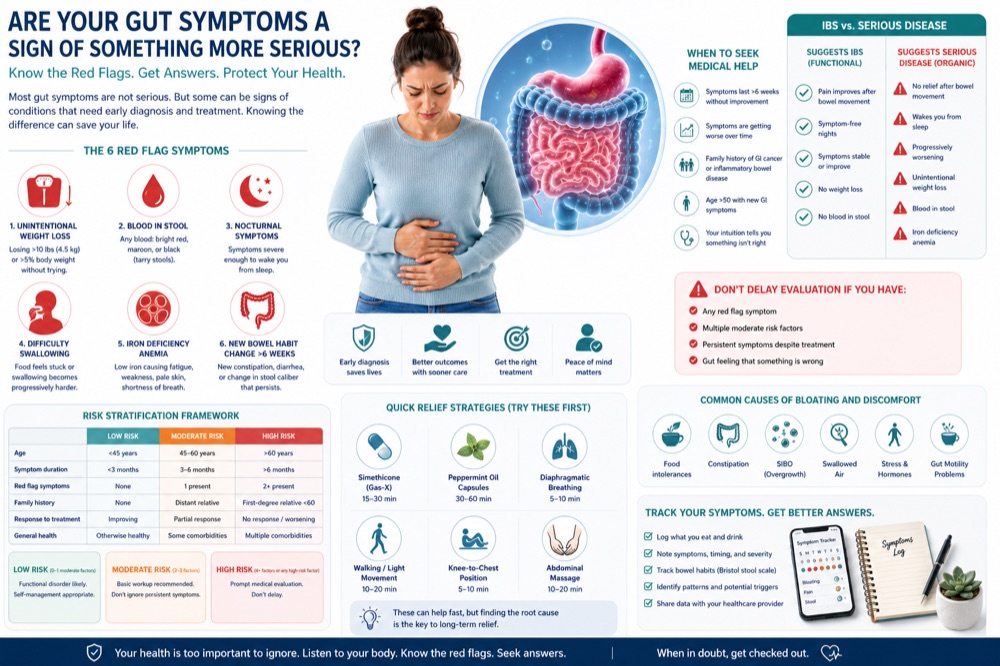
Not all gut symptoms deserve the same level of concern. We stratify risk using three factors:
Table 1: Risk Stratification Framework
| Risk Factor | Low Risk | Moderate Risk | High Risk |
|---|---|---|---|
| Age | <45 years | 45-60 years | >60 years |
| Symptom duration | <3 months | 3-6 months | >6 months |
| Red flag symptoms | None | 1 present | 2+ present |
| Family history | None | Distant relative | First-degree relative <60 |
| Response to empiric treatment | Improving | Partial response | No response or worsening |
| General health | Otherwise healthy | Some comorbidities | Multiple comorbidities |
Interpretation:
- Low risk (0-1 moderate factors): Functional disorder likely; trial of self-management appropriate
- Moderate risk (2-3 moderate factors): Basic workup recommended; don’t ignore persistent symptoms
- High risk (any high-risk factor or 4+ moderate): Prompt medical evaluation; don’t delay
The 6 Red Flag Symptoms That Change Everything
These symptoms shift probability significantly toward organic disease. Any one of them warrants evaluation.
Red Flag 1: Unintentional Weight Loss
Definition: >10 lbs (4.5 kg) or >5% body weight over 6-12 months without trying
Why it matters:
- Prevalence of malignancy with weight loss + GI symptoms: 15-25% (age >50), 3-5% (age <50)
- Average delay from weight loss onset to cancer diagnosis: 4-6 months
- Stage shift associated with delay: 68% diagnosed at Stage III-IV vs. 42% with prompt evaluation
Possible causes:
- Colorectal, gastric, or pancreatic cancer
- Inflammatory bowel disease (malabsorption, reduced intake)
- Celiac disease (malabsorption)
- Chronic pancreatitis (pancreatic insufficiency)
- Hyperthyroidism (increased metabolism)
Action: Gastroenterology evaluation within 1-2 weeks
Red Flag 2: Blood in Stool (Any Form)
What it includes:
- Bright red blood (hematochezia)
- Maroon-colored stool
- Black, tarry stools (melena)
- Occult blood (detected on testing)
Why it matters:
- Rectal bleeding is the presenting symptom in 30% of colorectal cancer cases
- Incidence of colorectal cancer in patients <50 with rectal bleeding: 2-4% (doubled since 1995)
- Hemorrhoids are present in 50% of adults by age 50—but hemorrhoids and cancer can coexist
Common misattribution:
- “It’s just hemorrhoids” → Hemorrhoids don’t cause weight loss, anemia, or bowel habit changes
- “I’m too young for cancer” → Early-onset CRC has doubled since 1995
Action:
- With dizziness/fainting: Go to ER
- Without systemic symptoms: GI evaluation within 1 week; colonoscopy likely indicated
Red Flag 3: Nocturnal Symptoms (Waking From Sleep)
Definition: Gut symptoms severe enough to wake you from sleep
Why it matters:
- Nocturnal diarrhea specificity for organic disease: 89%
- IBS patients reporting symptom-free nights: 94%
- IBD patients reporting nocturnal symptoms: 76%
- Peptic ulcer patients with nighttime pain: 60-80%
Possible causes:
- Inflammatory bowel disease (ulcerative colitis, Crohn’s)
- Peptic ulcer disease (classically wakes patients 2-3 hours after midnight)
- Microscopic colitis (watery diarrhea, can be nocturnal)
- Infectious colitis (some parasitic infections worse at night)
Key point: Functional disorders (IBS, functional dyspepsia) typically improve during sleep. Nocturnal symptoms suggest active pathology.
Action: GI evaluation within 2 weeks; colonoscopy and/or upper endoscopy likely
Red Flag 4: Progressive Difficulty Swallowing (Dysphagia)
What it feels like:
- Food “sticks” or “gets stuck” when swallowing
- Progressively worsening (start with solids, now liquids too)
- May have weight loss from food avoidance
Why it matters:
- Dysphagia is the presenting symptom in 70% of esophageal cancer cases
- Average delay from dysphagia onset to diagnosis: 3-5 months
- 5-year survival: Stage I: 80%+ vs. Stage IV: 5-10%
Possible causes:
- Esophageal stricture (from chronic acid reflux)
- Esophageal cancer
- Eosinophilic esophagitis (increasingly common)
- Achalasia (motility disorder)
- Esophageal web/ring
Action: Urgent upper endoscopy within 2 weeks (sooner if weight loss present)
Red Flag 5: Iron Deficiency Anemia
Definition: Low hemoglobin with low ferritin on blood testing
Why it matters:
- In adult men and postmenopausal women, GI tract is the source until proven otherwise
- Prevalence of GI malignancy in iron deficiency anemia: 9-15% (men >50), 5-9% (postmenopausal women)
- Upper GI source: 30-40%; Lower GI source: 25-35%
Symptoms of iron deficiency:
- Fatigue, weakness
- Shortness of breath with exertion
- Pale skin and conjunctiva
- Cold hands and feet
- Brittle nails, hair loss
- Craving ice or non-food items (pica)
Critical point: Iron supplementation treats the lab value but NOT the underlying cause. Finding the bleeding source is essential.
Action: GI evaluation mandatory; upper endoscopy + colonoscopy typically required
Red Flag 6: New Bowel Habit Change >6 Weeks (Age >50)
What qualifies:
- New constipation (especially if progressive)
- New diarrhea
- Alternating constipation and diarrhea
- Change in stool caliber (pencil-thin stools)
- Change in bowel movement frequency
Why age matters:
- Colorectal cancer incidence rises sharply after age 50
- New bowel habit change is the presenting symptom in 40-50% of left-sided colon cancers
- Average delay from symptom recognition to diagnosis: 5-7 months
Action: Colonoscopy indicated for age >50 with new persistent change
IBS vs. Serious Disease: The Key Differences
Most gut symptoms are functional (IBS, functional dyspepsia), not dangerous. Here’s how to tell the difference.
Table 2: IBS Features vs. Serious Disease Features
| Feature | Suggests IBS (Functional) | Suggests Serious Disease (Organic) |
|---|---|---|
| Pain relief after bowel movement | ✓ Typical | ✗ Uncommon |
| Symptom-free nights | ✓ 94% of patients | ✗ Only 12% of patients |
| Symptom duration | Chronic (>6 months), stable | Progressive worsening |
| Weight loss | ✗ Uncommon | ✓ Common |
| Blood in stool | ✗ Rare (unless hemorrhoids) | ✓ Common |
| Fever | ✗ Never | ✓ Possible |
| Nocturnal diarrhea | ✗ Rare | ✓ Common |
| Age at onset | Typically <50 | Can be any age, risk increases >50 |
| Family history of IBS | ✓ Common | ✗ Uncommon |
| Family history of GI cancer/IBD | ✗ Uncommon | ✓ Increases risk |
| Anemia on labs | ✗ No | ✓ Possible |
| Elevated inflammatory markers | ✗ No | ✓ Possible |
The Rome IV Criteria for IBS
IBS is diagnosed clinically using Rome IV criteria:
Recurrent abdominal pain, on average, at least 1 day per week in the last 3 months, associated with two or more of:
- Related to defecation
- Associated with change in frequency of stool
- Associated with change in form (appearance) of stool
Plus: No alarm features (weight loss, bleeding, anemia, fever, family history of IBD/cancer)
Important: IBS is a diagnosis of exclusion. You can’t diagnose it without first ruling out organic disease—especially if alarm features are present.
Age-Specific Risk Stratification
Age dramatically modifies pre-test probability of serious disease.
Table 3: Risk by Age Group
| Age Group | Primary Concerns | Screening/Evaluation Thresholds |
|---|---|---|
| <45 years | IBS, functional disorders, IBD, celiac | Lower threshold for duration (>3 months warrants basic workup); don’t dismiss rectal bleeding as “just hemorrhoids” |
| 45-50 years | Begin colorectal cancer screening | Colonoscopy screening starting age 45 (per ACS guidelines); any red flag = diagnostic colonoscopy |
| >50 years | Malignancy, diverticular disease, ischemic colitis | Any new bowel habit change >6 weeks warrants colonoscopy; lower threshold for investigation |
| >65 years | Malignancy, ischemic colitis, medication effects | Lowest threshold for investigation; consider medication side effects |
Critical note: Colorectal cancer incidence in adults <50 has doubled since 1995. Don’t dismiss rectal bleeding or bowel changes as “probably IBS” based on age alone.
How Long Is “Too Long”?
One of the most common questions: “How long should I wait before getting this checked?”
Table 4: Symptom Duration Guidelines
| Symptom | Safe Self-Management Duration | If No Improvement |
|---|---|---|
| Intermittent bloating (no red flags) | 4 weeks | Consider breath testing, celiac serology |
| Occasional heartburn (<2x/week) | 2-4 weeks PPI trial | Upper endoscopy if >45 or alarm features |
| Mild constipation (no red flags) | 4 weeks fiber/fluids/laxative | Anorectal manometry, colonoscopy if >50 |
| Mild diarrhea (no red flags) | 2 weeks | Stool studies, colonoscopy if persistent >4 weeks |
| Abdominal pain (no red flags) | 2-4 weeks | Imaging, labs, specialist referral |
| Any symptom with red flags | 0 weeks | Immediate evaluation |
The 6-week rule: Any gut symptom persisting >6 weeks without clear benign explanation warrants at least basic evaluation (labs, possibly imaging or scopes).
The 3-month rule: Symptoms persisting >3 months meet criteria for “chronic” and should have a diagnosis or treatment plan in place.
The Cost of Waiting: Real Data
Table 5: Delayed Diagnosis Outcomes
| Condition | Average Delay | Stage at Early Dx | Stage at Delayed Dx | Survival Difference |
|---|---|---|---|---|
| Colorectal cancer | 5-7 months | Stage I-II: 60% | Stage III-IV: 40% | 90% vs. 14% (5-year) |
| Gastric cancer | 4-6 months | Stage I: 30% | Stage IV: 50% | 70% vs. 5% (5-year) |
| Pancreatic cancer | 2-4 months | Resectable: 20% | Metastatic: 60% | 34% vs. 3% (5-year) |
| Esophageal cancer | 3-5 months | Stage I: 25% | Stage IV: 55% | 80% vs. 5% (5-year) |
| IBD | 9-12 months | Early: 40% | Stricture/fistula: 35% | Higher surgery risk |
| Celiac disease | 6-10 years | Early: 20% | Complications: 50% | Osteoporosis, lymphoma risk |
Key takeaway: Early diagnosis isn’t just about cancer. Delayed IBD diagnosis increases risk of strictures, fistulas, and bowel resection. Delayed celiac diagnosis increases risk of osteoporosis and intestinal lymphoma.
When “It’s Probably IBS” Is Dangerous
These phrases should trigger evaluation, not reassurance:
“It’s Just Hemorrhoids”
Reality: Hemorrhoids are common but can coexist with serious disease. Rectal bleeding needs confirmation, not assumption.
When to investigate: Any rectal bleeding + age >45, family history, anemia, weight loss, or bowel habit change
“You’re Too Young for Cancer”
Reality: Early-onset colorectal cancer has doubled since 1995. IBD often presents in 20s-30s.
When to investigate: Red flag symptoms at any age; lower threshold if family history
“It Comes and Goes, So It’s Not Serious”
Reality: Some serious conditions are intermittent early on (early cancer, vascular disease, partial obstruction).
When to investigate: Intermittent symptoms + any red flag or progressive pattern
“Your Basic Labs Are Normal”
Reality: Normal CBC and metabolic panel don’t rule out structural disease.
When to investigate: Persistent symptoms + normal basic labs = consider scopes/imaging based on symptom pattern
“It’s Probably Stress”
Reality: Stress can exacerbate symptoms but doesn’t cause weight loss, bleeding, or anemia.
When to investigate: Stress attribution + any objective red flag
What Evaluation Should You Expect?
Knowing what’s appropriate helps you advocate for yourself.
Basic Workup (Any Primary Care Can Order)
| Test | What It Checks | Abnormal = Next Step |
|---|---|---|
| CBC | Anemia, infection | GI workup for bleeding source |
| CMP | Liver function, electrolytes | Liver imaging, further metabolic workup |
| Celiac serology (tTG-IgA) | Celiac disease | Upper endoscopy with biopsy |
| Fecal calprotectin | Intestinal inflammation (IBD) | Colonoscopy |
| TSH | Thyroid dysfunction | Endocrinology referral |
| CRP/ESR | Systemic inflammation | Further inflammatory workup |
Advanced Workup (GI Specialist)
| Symptom Pattern | Likely Testing |
|---|---|
| Upper GI symptoms (heartburn, dyspepsia, upper pain) | Upper endoscopy (EGD), H. pylori testing |
| Lower GI symptoms (diarrhea, constipation, lower pain) | Colonoscopy, stool studies, abdominal imaging |
| Bloating/gas predominant | Breath testing (SIBO, lactose intolerance), celiac serology |
| Weight loss + GI symptoms | CT abdomen/pelvis, upper/lower endoscopy |
| Iron deficiency anemia | Upper endoscopy + colonoscopy (both required) |
| Difficulty swallowing | Urgent upper endoscopy, barium swallow |
When to Push for More Investigation
Sometimes you need to advocate for yourself.
Signs Your Symptoms Are Being Dismissed
- Told “it’s just IBS” without any testing
- Given acid reducers without evaluation for H. pylori
- Told to “add more fiber” for chronic diarrhea
- Rectal bleeding attributed to hemorrhoids without exam
- Age <50 used as reason to not investigate red flags
How to Advocate
Effective phrases:
- “What else could this be besides IBS?”
- “What tests would rule out the serious causes?”
- “Given my [red flag], should we consider [specific test]?”
- “If this doesn’t improve in [timeframe], what’s the next step?”
Bring data:
- Symptom log with specific patterns
- List of all medications/supplements
- Family history details (who, what diagnosis, what age)
FAQs
I have one red flag symptom but I’m young. Should I worry?
Age modifies risk but doesn’t eliminate it. Any red flag symptom warrants evaluation regardless of age. Early-onset colorectal cancer, IBD, and celiac disease are all more common in younger adults than historically.
How many symptoms do I need before seeking help?
One red flag symptom is enough. You don’t need to “collect” symptoms before seeking evaluation.
What if my doctor says I don’t need testing?
Ask: “What diagnosis are we working with?” and “What would make you concerned?” If symptoms persist despite treatment, seek a second opinion.
Can serious disease present with mild symptoms?
Yes. Early colorectal cancer often presents with subtle changes—slightly narrower stools, mild increase in bowel frequency. Don’t wait for severe symptoms.
Should I get a colonoscopy if I’m worried but have no symptoms?
Average-risk screening starts at age 45. Earlier if family history (start 10 years before youngest diagnosis in family). Without symptoms or family history, routine screening is appropriate—not diagnostic colonoscopy.
What if testing is all normal but I still feel sick?
Normal testing + persistent symptoms = likely functional disorder (IBS, functional dyspepsia). These are real conditions that deserve treatment—not dismissal. Ask about gut-directed CBT, dietary interventions, and symptom-targeted medications.
Sources
- Siegel RL, et al. Colorectal cancer statistics, 2024. CA Cancer J Clin. 2024;74(2):127-152.
- Wang W, et al. Early-onset colorectal cancer: current understanding and future directions. Nat Rev Gastroenterol Hepatol. 2024;21(4):235-251.
- Laine L, et al. ACG Clinical Guideline: Upper Gastrointestinal and Ulcer Bleeding. Am J Gastroenterol. 2024;119(6):967-987.
- Strate LL, Morris AM. Epidemiology, Pathophysiology, and Treatment of Diverticulitis. Gastroenterology. 2024;166(5):808-822.
- Moayyedi P, et al. ACG and CAG clinical guideline: management of dyspepsia. Am J Gastroenterol. 2024;119(7):1189-1208.
- Feuerstein JD, Cheifetz AS. Crohn Disease: Epidemiology, Diagnosis, and Management. Mayo Clin Proc. 2024;99(3):439-453.
- Camilleri M. Functional gastrointestinal disorders: advances in understanding and management. Lancet. 2024;403(10425):368-382.
- American Cancer Society. Colorectal Cancer Screening Guidelines. 2024.
- NICE. Suspected cancer: recognition and referral (NG12). 2025.
- Vasant DH, et al. British Society of Gastroenterology guidelines for the management of irritable bowel syndrome. Gut. 2024;73(7):1027-1058.
- Ford AC, et al. American College of Gastroenterology monograph on the management of irritable bowel syndrome. Am J Gastroenterol. 2024;119(S1):S2-S31.
- Chey WD, et al. ACG Clinical Guideline: Management of Celiac Disease. Am J Gastroenterol. 2024;119(2):203-222.
- O’Leary C, et al. Nocturnal symptoms in irritable bowel syndrome vs inflammatory bowel disease. Am J Gastroenterol. 2024;119(3):512-520.
- Lacy BE, et al. Rome Foundation Updated Guidelines for Functional Gastrointestinal Disorders. Gastroenterology. 2024;166(1):38-57.
- NIDDK. Digestive Diseases Overview. 2024.