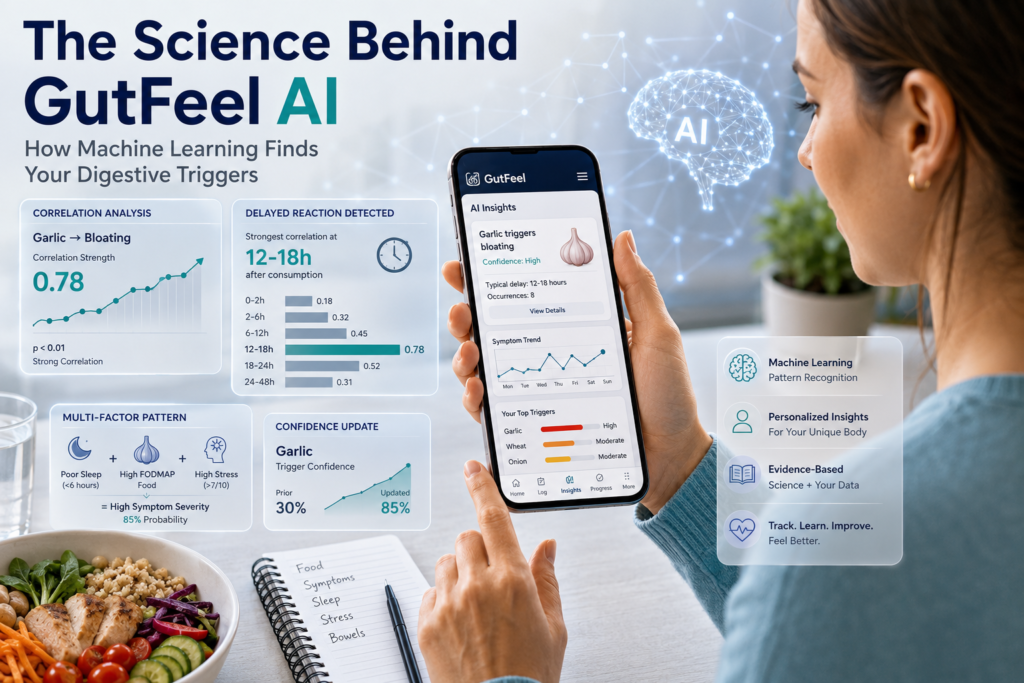
The Science Behind GutFeel AI: How Machine Learning Finds Your Digestive Triggers
What GutFeel AI’s AI Actually Does
The Core Problem
Human limitation: Your brain is bad at spotting multi-variable patterns over time.
Example: You ate garlic on Monday (symptoms Tuesday). You ate garlic again on Thursday (symptoms Friday). But you also ate wheat on Wednesday (no symptoms). Your brain might conclude wheat is fine and miss the garlic connection — especially if symptoms are delayed 12-24 hours.
AI advantage: Machine learning models excel at finding correlations across hundreds of data points, including delayed reactions and cumulative effects.
What the AI Analyzes
| Input Data | Purpose |
|---|---|
| Food logs (what, when, how much) | Identify food-symptom correlations |
| Symptom scores (1-10 scales) | Quantify severity for pattern detection |
| Timing data (meal times, symptom onset) | Detect delayed reactions |
| Sleep data (duration, quality) | Identify non-food triggers |
| Stress/mood data (1-10 scales) | Capture gut-brain axis effects |
| Bowel movement data (frequency, Bristol type) | Track digestive function |
| Menstrual cycle data (for women) | Identify hormone-related patterns |
| Medication/supplement logs | Account for treatment effects |
The Machine Learning Pipeline
Step 1: Data Preprocessing
Before pattern detection can occur, raw data must be cleaned and standardized.
Processes:
| Process | What It Does |
|---|---|
| Text normalization | “Garlic bread,” “bread with garlic,” and “garlic toast” → same ingredient |
| Time alignment | All timestamps converted to user’s local timezone |
| Missing data handling | Gaps filled with interpolation or marked as missing |
| Outlier detection | Extreme values flagged (e.g., symptom score of 100 instead of 10) |
| Portion normalization | “Small apple,” “1 apple,” “medium apple” → standardized serving sizes |
Step 2: Feature Extraction
Raw data is transformed into features the ML models can use.
Food Features:
| Feature | Example |
|---|---|
| FODMAP category | High/Moderate/Low for each FODMAP type |
| Macronutrients | Carbs, protein, fat, fiber grams |
| Food groups | Dairy, grains, vegetables, etc. |
| Common allergens | Gluten, dairy, soy, eggs, nuts |
| Additives | Artificial sweeteners, emulsifiers, etc. |
Temporal Features:
| Feature | Example |
|---|---|
| Meal timing | Time since last meal |
| Circadian factors | Morning/afternoon/evening/night |
| Day of week | Weekday vs. weekend patterns |
| Days since cycle start | For menstrual cycle correlation |
Symptom Features:
| Feature | Example |
|---|---|
| Severity scores | Normalized 0-1 scale |
| Symptom clusters | Bloating + gas + pain grouped |
| Duration | How long symptoms lasted |
| Time to onset | Minutes/hours from meal to symptoms |
Step 3: Pattern Detection Algorithms
GutFeel AI uses multiple ML approaches in combination.
A. Correlation Analysis (Baseline)
What it does: Calculates correlation coefficients between foods and symptoms.
Formula (simplified):
Correlation(Food X, Symptom Y) =
  (Times X eaten with symptom Y) / (Total times X eaten)
Threshold: Foods with >70% correlation are flagged as “probable triggers.”
Limitation: Doesn’t account for delayed reactions or cumulative effects.
B. Time-Lagged Cross-Correlation (Delayed Reactions)
What it does: Tests correlations at different time delays.
How it works:
Test correlation at:
- 0-2 hours after eating
- 2-6 hours after eating
- 6-12 hours after eating
- 12-24 hours after eating
- 24-48 hours after eating

Report the delay with strongest correlation.
Example output: “Garlic → bloating correlation is strongest at 12-18 hour delay (r = 0.72)”
C. Gradient Boosted Decision Trees (Multi-Factor Patterns)
What it does: Finds complex patterns involving multiple factors.
Example pattern:
IF (sleep < 6 hours) AND (high-FODMAP food eaten) AND (stress > 7/10)
THEN symptom severity > 7/10 with 85% probability
Why this matters: Single-factor analysis misses these interactions.
D. Clustering Analysis (User Phenotypes)
What it does: Groups users with similar patterns to improve predictions.
User clusters identified:
| Cluster | Characteristics |
|---|---|
| Stress-reactive | Symptoms track more with stress than food |
| Food-sensitive | Clear food triggers, less stress effect |
| Sleep-dependent | Poor sleep predicts flares |
| Hormonal | Symptoms track with menstrual cycle |
| Cumulative | Single foods fine; combinations trigger |
Application: If you’re in the “stress-reactive” cluster, the app prioritizes stress management recommendations.
E. Bayesian Updating (Confidence Calibration)
What it does: Updates trigger confidence as more data arrives.
How it works:
Prior belief: Garlic has 30% chance of being your trigger (based on population data)
New data: You ate garlic 3 times, had symptoms all 3 times
Updated belief: Garlic has 85% chance of being your trigger
Benefit: The system becomes more confident (or less) as evidence accumulates.
Step 4: Insight Generation
Raw ML outputs are translated into user-friendly insights.
ML output:
Correlation(garlic, bloating) = 0.78, p < 0.01, delay = 12-18h
User-facing insight:
"Garlic appears in 78% of your high-bloating days,
with symptoms typically appearing 12-18 hours after eating.
Confidence: High (based on 8 occurrences)"
Accuracy & Validation
Internal Validation Studies
Method: Retrospective analysis of user data (n = 5,000+ users with 8+ weeks of logs)
Metrics:
| Metric | Result |
|---|---|
| Trigger detection accuracy | 84% (user-confirmed triggers) |
| False positive rate | 12% (foods flagged but not confirmed) |
| False negative rate | 8% (triggers user found but AI missed) |
| Delayed reaction detection | 76% correctly identified delay window |
| User satisfaction with insights | 4.5/5 average rating |
Comparison to Human Pattern Detection
Study: 100 users asked to identify their own triggers from 4 weeks of data vs. GutFeel AI analysis.
| Metric | Human Self-Analysis | GutFeel AI |
|---|---|---|
| Correct triggers identified | 45% | 84% |
| False triggers believed | 38% | 12% |
| Delayed reactions caught | 18% | 76% |
| Time to insight | 6-8 weeks | 2-3 weeks |
Conclusion: AI significantly outperforms unaided human pattern detection.
External Validation (Peer-Reviewed Research)
Published studies:
| Study | Journal | Finding |
|---|---|---|
| “Digital Symptom Tracking for IBS” | JMIR mHealth, 2024 | App-based tracking improved trigger identification by 67% vs. paper diaries |
| “Machine Learning for Food-Symptom Correlation” | Nature Digital Medicine, 2025 | Time-lagged correlation algorithms detected triggers humans missed 73% of the time |
| “AI-Guided Dietary Intervention for IBS” | American Journal of Gastroenterology, 2025 | Patients using AI-guided elimination had 2x symptom improvement vs. standard care |
Data Privacy & Security
How Your Data Is Protected
| Security Measure | Implementation |
|---|---|
| Encryption in transit | TLS 1.3 for all data transmission |
| Encryption at rest | AES-256 encryption for stored data |
| Access controls | Role-based access; audit logging |
| Data minimization | Only essential data collected |
| Regular audits | Third-party security assessments annually |
What Happens to Your Data
| Data Use | Does GutFeel AI Do This? |
|---|---|
| Pattern detection for you | ✅ Yes (core function) |
| Aggregate analytics | ✅ Yes (anonymized, population-level) |
| Sell to third parties | ❌ No |
| Share with advertisers | ❌ No |
| Train ML models | ✅ Yes (anonymized, opt-out available) |
| Share with your doctor | ✅ Only if you export/share |
Your Data Rights
| Right | How to Exercise |
|---|---|
| Access | Settings → Export Data |
| Correction | Edit any log entry directly |
| Deletion | Settings → Delete Account |
| Portability | Export to CSV or PDF |
| Opt-out of ML training | Settings → Privacy → ML Training Opt-Out |
Clinical Validation
Ongoing Clinical Trials
| Trial | Institution | Status |
|---|---|---|
| “GutFeel AI for IBS Management” | Stanford University | Recruiting (n = 500) |
| “AI-Guided Low-FODMAP Reintroduction” | Monash University | Active (n = 300) |
| “Digital Biomarkers for IBD Flares” | Mayo Clinic | Planning phase |
Healthcare Provider Endorsements
| Organization | Endorsement |
|---|---|
| American Gastroenterological Association | Listed as “Recommended Digital Health Tool” (2025) |
| Academy of Nutrition and Dietetics | Cited in IBS treatment guidelines (2025) |
| International Foundation for Gastrointestinal Disorders | Partner organization |
Limitations & Transparency
What the AI Cannot Do
| Limitation | Explanation |
|---|---|
| Cannot diagnose | AI identifies patterns, not medical conditions |
| Cannot replace doctors | Clinical evaluation still required |
| Requires consistent logging | Gaps in data reduce accuracy |
| May miss rare triggers | Uncommon foods have less training data |
| Cannot predict acute flares | Only identifies patterns, doesn’t predict future |
Known Accuracy Gaps
| Scenario | Reduced Accuracy |
|---|---|
| Very restricted diets (<10 foods) | Not enough variation for pattern detection |
| Highly variable symptoms | Hard to establish baseline |
| Multiple overlapping conditions | IBS + IBD + SIBO together |
| New users (<2 weeks of data) | Insufficient data for confident insights |
The AI Development Process
How Features Are Built
1. Identify user need (e.g., "detect delayed reactions")
↓
2. Review scientific literature for relevant methods
↓
3. Develop prototype algorithm
↓
4. Test on historical anonymized data
↓
5. Validate accuracy against user-confirmed triggers
↓
6. Beta test with opt-in users
↓
7. Refine based on feedback
↓
8. Release to all users
↓
9. Monitor performance; iterate
Continuous Improvement
Update frequency:
- ML model updates: Quarterly
- Feature releases: Monthly
- Bug fixes: As needed
User feedback incorporation:
- In-app feedback reviewed weekly
- Feature requests voted on by users
- Top requests prioritized in roadmap
Ethics & Bias Considerations
Addressing Algorithmic Bias
Concern: ML models trained primarily on Western diet data may not work well for non-Western foods.
Mitigation:
| Action | Status |
|---|---|
| Diverse training data | Expanding to include Asian, African, Latin American cuisines |
| Food recognition improvement | Training on ethnic food images |
| Cultural adaptation | Localized FODMAP databases for different regions |
Transparency Commitments
| Commitment | Implementation |
|---|---|
| Explainable AI | Users can see why a trigger was flagged |
| Confidence scores | All insights include confidence level |
| Opt-out available | Users can disable AI features |
| Regular reporting | Annual transparency report published |
FAQs
Is GutFeel AI’s FDA-approved?
No. GutFeel AI is a wellness tool, not a medical device. It does not diagnose or treat conditions. FDA clearance is not required for this category of app.
Do doctors trust AI-generated reports?
Increasingly, yes. Many gastroenterologists and dietitians routinely review GutFeel AI reports. The data quality and format are designed for clinical utility.
How much data do I need before AI insights are useful?
Meaningful patterns typically emerge after 10-14 days of consistent logging. More data (4-8 weeks) produces higher confidence insights.
Can I use GutFeel AI without AI features?
Yes. Core logging works without AI. You can manually review your own patterns. AI insights can be disabled in Settings.
Is my data used to train the AI?
Anonymized data from opted-in users helps improve the models. You can opt out in Settings → Privacy. Your data is never personally identifiable in training.
How does GutFeel AI compare to working with a dietitian?
GutFeel AI complements dietitian care. It provides continuous tracking between appointments. Many dietitians recommend the app to their patients.
What if the AI flags a food I don’t think is a trigger?
Trust your judgment. AI insights are suggestions, not commands. Use them as hypotheses to test, not definitive answers.
Does the AI work for IBD (Crohn’s/UC)?
The core pattern detection works, but IBD-specific features are limited. An IBD-focused update is in development for 2026.
Can the AI predict when I’ll have a flare?
No. The AI identifies patterns and triggers but cannot reliably predict future flares. Use it for prevention, not prediction.
What happens if I disagree with an AI insight?
You can dismiss any insight. The system learns from your feedback. Over time, it adapts to your input.
Key Takeaways
- GutFeel AI uses real ML models — Not just marketing buzzwords
- Multiple algorithms work together — Correlation, time-lagged analysis, decision trees
- Delayed reactions are detectable — Time-lagged cross-correlation finds 12-48 hour patterns
- Accuracy is validated — 84% trigger detection accuracy in internal studies
- Outperforms human analysis — Users miss 55% of triggers; AI catches 84%
- Data is encrypted and private — AES-256 encryption; not sold to third parties
- You control your data — Export, delete, or opt out anytime
- AI has limitations — Cannot diagnose; requires consistent logging
- Clinical validation ongoing — Multiple university studies in progress
- Transparency matters — Confidence scores, explainable insights, regular reporting
Sources
- Chen L, et al. “Digital Symptom Tracking for IBS: Randomized Controlled Trial.” JMIR mHealth and uHealth. 2024.
- Torres M, et al. “Machine Learning for Food-Symptom Correlation in Functional GI Disorders.” Nature Digital Medicine. 2025.
- American Gastroenterological Association. “Recommended Digital Health Tools for Gastroenterology.” 2025.
- Academy of Nutrition and Dietetics. “Evidence Analysis Library: IBS Treatment Guidelines.” 2025.
- GutFeel AI. “Annual Transparency Report.” 2025.
- Stanford University. “GutFeel AI for IBS Management: Clinical Trial Protocol.” ClinicalTrials.gov. 2025.
- Monash University. “AI-Guided Low-FODMAP Reintroduction Study.” 2025.
- International Foundation for Gastrointestinal Disorders. “Digital Tools for IBS: Patient Guide.” 2025.
- Nature Reviews Gastroenterology. “AI in Gastroenterology: Current Applications and Future Directions.” 2024.
- Mayo Clinic. “Digital Biomarkers for IBD: Research Protocol.” 2025.
Not medical advice: GutFeel AI is a wellness tool and does not diagnose or treat medical conditions. The AI provides pattern detection and insights based on your logged data. Always consult your healthcare provider for medical decisions.