The Connection Between Gallbladder and Digestion: How Your Gallbladder Affects Every Meal You Eat
The Digestive System’s Unsung Hero: What Your Gallbladder Actually Does
The Gallbladder’s Primary Function
Your gallbladder is essentially a storage and concentration pouch for bile—a digestive fluid your liver produces continuously. Think of it like a reservoir that stores water during wet seasons and releases it during droughts.
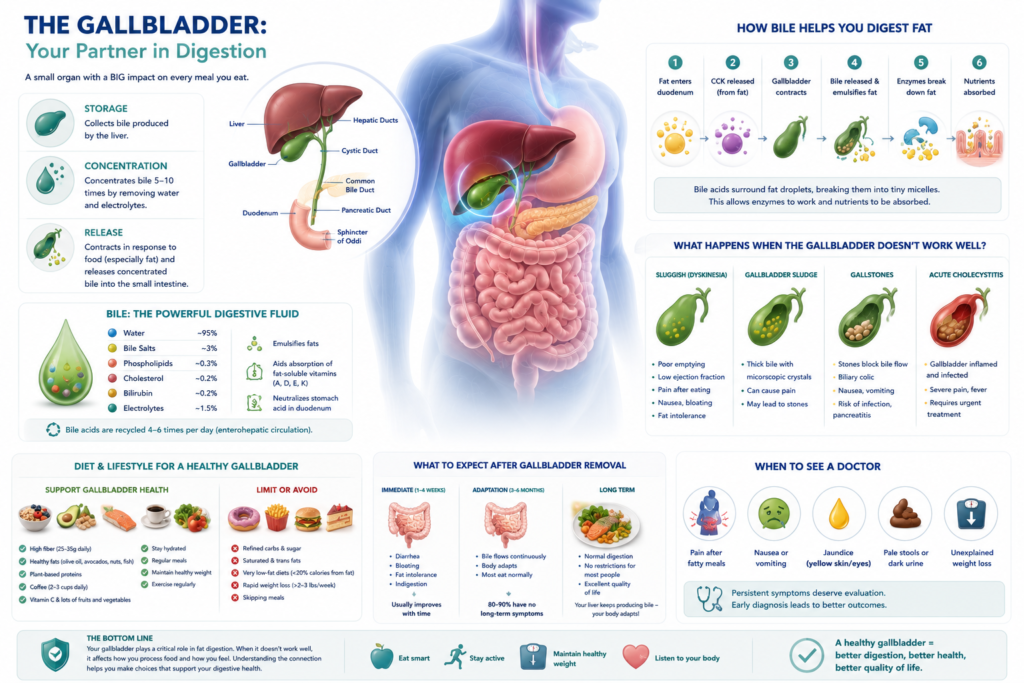
The gallbladder’s three key jobs:
- Storage: Collects bile produced by the liver (500-1000 mL daily)
- Concentration: Removes water and electrolytes, concentrating bile 5-10 times
- Release: Contracts in response to food (especially fat), releasing concentrated bile into the small intestine
Anatomy 101: How the Gallbladder Connects to Digestion
Location:
- Tucked beneath the liver on the right side of your abdomen
- Connected to the liver via hepatic ducts
- Connected to the common bile duct via the cystic duct
- Sits near the stomach, duodenum (first part of small intestine), and pancreas
The biliary tree (bile duct system):
Liver → Right & Left Hepatic Ducts → Common Hepatic Duct
                                          +
                                    Cystic Duct (from gallbladder)
                                          |
                                    Common Bile Duct
                                          +
                                    Pancreatic Duct
                                          |
                                    Ampulla of Vater → Duodenum
The sphincter of Oddi:
- A muscular valve at the end of the common bile duct
- Controls when bile enters the small intestine
- Opens in response to cholecystokinin (CCK)
- Prevents backflow of intestinal contents into bile ducts
Bile: The Digestive Juice That Makes Fat Digestion Possible
What Is Bile?
Bile is a complex fluid containing water, bile salts, cholesterol, phospholipids, bilirubin, and electrolytes. It’s produced by liver cells (hepatocytes) and modified as it passes through bile ducts.
Bile composition:
| Component | Percentage | Function |
|---|---|---|
| Water | ~95% | Solvent for other components |
| Bile salts/acids | ~3% | Emulsify fats (critical for fat digestion) |
| Phospholipids (lecithin) | ~0.3% | Help keep cholesterol dissolved; aid fat emulsification |
| Cholesterol | ~0.2% | Normal component; excess leads to gallstones |
| Bilirubin | ~0.2% | Waste product from red blood cell breakdown; gives bile its color |
| Electrolytes | ~1.5% | Sodium, potassium, bicarbonate (makes bile alkaline) |
How Bile Enables Fat Digestion
Fat digestion is complicated because fat doesn’t mix with water. Your digestive tract is mostly water-based, while dietary fat is oil-based. Without help, fat would pass through your intestines largely undigested and unabsorbed.
Bile solves this problem through emulsification:
Step 1: Fat enters the duodenum
- You eat food containing fat (triglycerides)
- Stomach churns food into liquid chyme
- Fat globules enter the first part of small intestine (duodenum)
Step 2: CCK release
- Fat in the duodenum triggers release of cholecystokinin (CCK)
- CCK travels through bloodstream to gallbladder
Step 3: Gallbladder contraction
- CCK signals gallbladder to contract
- Sphincter of Oddi relaxes
- Concentrated bile squirts into duodenum
Step 4: Emulsification
- Bile salts surround fat globules
- Break large fat globules into tiny droplets (micelles)
- This dramatically increases surface area for enzyme action
Step 5: Enzyme action
- Pancreatic lipase (fat-digesting enzyme) accesses fat more easily
- Triglycerides broken down into fatty acids and monoglycerides
- These can be absorbed through intestinal wall
Step 6: Absorption
- Fatty acids and monoglycerides enter intestinal cells
- Reassembled into triglycerides
- Packaged into chylomicrons
- Enter lymphatic system, then bloodstream
Without bile:
- Fat remains in large globules
- Enzymes can’t access most of the fat
- 30-50% of dietary fat passes unabsorbed
- Result: Greasy, floating stools (steatorrhea), weight loss, vitamin deficiencies
Bile Acids: The Active Ingredient
Bile acids are the workhorses of bile—the molecules that actually emulsify fat.
Two types of primary bile acids:
- Cholic acid (most abundant)
- Chenodeoxycholic acid
How they work:
- Bile acids are amphipathic—they have both water-loving (hydrophilic) and fat-loving (lipophilic) ends
- Hydrophilic end faces outward toward watery intestinal contents
- Lipophilic end faces inward toward fat droplets
- This arrangement breaks fat into smaller and smaller droplets
The enterohepatic circulation (bile acid recycling):
- Your body contains only about 3-5 grams of bile acids
- Yet you need 20-30 grams daily for fat digestion
- Solution: Bile acids are recycled 4-6 times per day
The recycling process:
- Bile acids secreted into intestine with meals
- Most (95%) absorbed in terminal ileum (end of small intestine)
- Return to liver via portal vein
- Liver resecretes them into bile
- Cycle repeats with next meal
Why this matters:
- Diseases affecting the ileum (Crohn’s disease, surgical resection) disrupt bile acid recycling
- Leads to bile acid deficiency and fat malabsorption
- Also causes bile acid diarrhea (unabsorbed bile acids irritate colon)
The Gallbladder’s Role in Normal Digestion
Meal-Time Digestion: A Step-by-Step Process
Before eating (fasting state):
- Sphincter of Oddi is closed
- Liver bile flows into gallbladder (not into intestine)
- Gallbladder absorbs water, concentrating bile
- Gallbladder relaxes and fills (like a balloon)
When you start eating:
- Cephalic phase (before food even reaches stomach):
- Seeing, smelling, tasting food triggers vagus nerve
- Mild gallbladder contraction begins
- Prepares digestive system for incoming food
- Gastric phase (food in stomach):
- Stomach distension triggers vagovagal reflex
- More gallbladder contraction
- Prepares bile release
- Intestinal phase (food reaches duodenum)—THE MAIN EVENT:
- Fat and protein in duodenum trigger CCK release
- CCK causes strong gallbladder contraction (70% emptying)
- Sphincter of Oddi relaxes
- Concentrated bile flows into duodenum
- Bile emulsifies fat for digestion
After the meal:
- CCK levels fall as fat is digested and absorbed
- Gallbladder relaxes
- Sphincter of Oddi closes
- Cycle begins again
What Types of Food Trigger Gallbladder Contraction?
Not all foods stimulate the gallbladder equally. Understanding this helps explain why certain foods trigger symptoms in people with gallbladder disease.
Strongest triggers (high CCK release):
- Long-chain fatty acids (found in animal fats, vegetable oils)
- Fried foods
- Fatty meats
- Full-fat dairy
Moderate triggers:
- Protein (especially animal protein)
- Medium-chain fatty acids (coconut oil, palm oil)
Weak triggers:
- Carbohydrates (minimal CCK release)
- Short-chain fatty acids (fiber fermentation products)
Why this matters for gallbladder disease:
- High-fat meals cause strong gallbladder contraction
- If gallstones are present, strong contraction can push stone into cystic duct
- Result: Biliary colic (gallbladder attack)
- This is why fatty foods trigger gallbladder attacks
How Much Bile Do You Need?
Daily bile production: 500-1000 mL from liver
Bile released per meal: Depends on fat content
- Low-fat meal (<10g fat): 10-15 mL concentrated bile
- Moderate-fat meal (20-30g fat): 20-30 mL concentrated bile
- High-fat meal (>40g fat): 30-50 mL concentrated bile (nearly full gallbladder)
Gallbladder emptying efficiency:
- Normal gallbladder empties 70-80% with a fatty meal
- Measured by HIDA scan (gallbladder ejection fraction)
- <35-40% ejection fraction = biliary dyskinesia (poor gallbladder function)
When the Gallbladder-Digestion Connection Breaks Down
Gallbladder problems disrupt digestion in predictable ways. Understanding these patterns helps you recognize when something’s wrong.
Gallstones and Digestive Symptoms
Asymptomatic gallstones (60-80% of cases):
- No digestive symptoms
- Normal digestion
- Stones discovered incidentally
Symptomatic gallstones:
| Symptom | Why It Happens | When It Occurs |
|---|---|---|
| Biliary colic | Stone blocks cystic duct; gallbladder contracts against obstruction | 1-3 hours after fatty meal |
| Nausea/vomiting | Reflex response to gallbladder distension; vagal stimulation | During biliary colic |
| Bloating | Impaired bile flow reduces fat digestion; gas production | After meals, especially fatty |
| Fat intolerance | Pain or discomfort after fatty foods; body learns to avoid trigger | Consistently after high-fat meals |
| Indigestion | Altered bile flow affects overall digestion | After meals |
| Belching | Compensatory air swallowing; altered GI motility | During and after meals |
Acute Cholecystitis: When Digestion Stops
What happens:
- Stone remains stuck in cystic duct >6 hours
- Gallbladder becomes inflamed and infected
- Gallbladder can’t empty (functional obstruction)
- Body diverts resources to fight infection
Digestive symptoms:
- Severe, constant RUQ pain (not just after meals)
- Loss of appetite (anorexia)
- Nausea and vomiting (often persistent)
- Inability to tolerate food (especially fat)
- Fever (distinguishes from simple biliary colic)
Why eating becomes painful:
- Any food triggers CCK release
- CCK signals gallbladder to contract
- Contracting against obstruction causes severe pain
- Body learns to avoid eating (protective response)
Choledocholithiasis: Stone in the Common Bile Duct
What happens:
- Gallstone escapes gallbladder and lodges in common bile duct
- Blocks bile flow from liver to intestine
- Bile backs up into liver and bloodstream
Digestive symptoms:
- Biliary colic-type pain (may be more severe)
- Jaundice (yellow skin/eyes from bilirubin backup)
- Dark urine (bilirubin excreted in urine)
- Pale/clay-colored stools (no bile pigment reaching intestine)
- Steatorrhea (fatty, greasy stools from lack of bile in intestine)
- Nausea/vomiting
Why stools change:
- Bile gives stool its brown color (bilirubin → stercobilin)
- No bile = no color = pale/clay-colored stools
- No bile in intestine = fat malabsorption = greasy, floating stools
Chronic Cholecystitis: Long-Term Digestive Impact
What happens:
- Repeated episodes of inflammation
- Gallbladder becomes scarred and thickened
- Gallbladder function progressively worsens
- Gallbladder may become permanently non-functional
Digestive symptoms:
- Chronic indigestion
- Persistent fat intolerance
- Bloating after meals
- Chronic nausea (mild but persistent)
- Food aversions (especially to fatty foods)
- Weight loss (from reduced intake due to symptoms)
Biliary Dyskinesia: Functional Gallbladder Disorder
What it is:
- Gallbladder doesn’t contract properly
- No gallstones present
- Gallbladder ejection fraction <35-40% on HIDA scan
- Causes typical biliary symptoms
Why digestion is affected:
- Gallbladder doesn’t empty completely
- Bile becomes overly concentrated (sludge)
- Inadequate bile release with meals
- Fat digestion is impaired
Digestive symptoms:
- Biliary colic-type pain (without stones)
- Nausea after eating
- Fat intolerance
- Bloating
Digestion After Gallbladder Removal: What Changes?
Over 750,000 gallbladder removals (cholecystectomies) are performed annually in the US. Understanding what happens to digestion after surgery helps set realistic expectations.
Immediate Changes (First Days to Weeks)
What changes:
- No gallbladder to store and concentrate bile
- Bile drips continuously from liver into small intestine
- No reserve of concentrated bile for fatty meals
- Total bile acid pool is slightly reduced
Digestive consequences:
| Symptom | Frequency | Why It Happens | Duration |
|---|---|---|---|
| Diarrhea | 10-20% | Constant bile flow into colon irritates lining; bile acid malabsorption | Days to weeks (usually resolves in 3-6 months) |
| Fat intolerance | 20-30% | No concentrated bile reserve for large fat loads | Weeks to months |
| Bloating/gas | 30-40% | Surgical trauma; anesthesia; dietary changes | First 2-4 weeks |
| Indigestion | 15-20% | Altered bile flow pattern | Weeks to months |
How the Body Adapts
Short-term adaptation (weeks to months):
- Bile ducts gradually dilate slightly (take over some storage function)
- Liver adjusts bile acid production
- Intestine adapts to continuous bile flow
- Gut bacteria adjust to new bile acid pattern
Long-term adaptation (3-6 months+):
- 80-90% of patients have NO long-term digestive symptoms
- Most eat completely normal diet
- Digestive system functions efficiently without gallbladder
- Quality of life typically improves (no more gallbladder attacks)
Why Some People Have Ongoing Symptoms
10-20% of patients experience:
- Ongoing fat sensitivity
- Occasional diarrhea after fatty meals
- Need to limit very high-fat foods
1-5% of patients experience:
- Chronic diarrhea (bile acid malabsorption)
- Require bile acid binder medication (cholestyramine, colesevelam)
- Significant dietary restrictions
Risk factors for ongoing symptoms:
- Pre-existing IBS
- Chronic diarrhea before surgery
- Bile acid malabsorption (genetic predisposition)
- Other GI conditions (celiac disease, SIBO, pancreatic insufficiency)
- Unrealistic expectations
Optimizing Digestion After Gallbladder Removal
Early recovery (first 2-4 weeks):
- Low-fat diet (<20g fat per day)
- Small, frequent meals (5-6 per day)
- Gradual introduction of new foods
- Avoid fried foods, fatty meats, full-fat dairy
- Stay well-hydrated
- Consider soluble fiber supplement (psyllium)
Intermediate recovery (weeks 4-8):
- Gradually increase fat intake
- Test tolerance to new foods
- Introduce fiber slowly
- Monitor stool patterns
- Continue small, frequent meals
Long-term (2+ months):
- Most patients: Normal, varied diet without restrictions
- Fat-sensitive patients: Moderate fat intake (30-45g/day)
- Chronic diarrhea: Bile acid binders, dietary modification
- Maintain healthy weight
- Regular physical activity
Optimizing Gallbladder-Digestion Function
Whether you have a healthy gallbladder, gallbladder disease, or no gallbladder at all, certain strategies support optimal digestion.
For Healthy Gallbladders
Prevention strategies:
- Maintain healthy weight: Obesity increases gallstone risk 2-3x
- Avoid rapid weight loss: >3 lbs/week dramatically increases stone formation
- Eat regular meals: Skipping meals reduces gallbladder emptying
- Include moderate fat: Very low-fat diets lead to gallbladder stasis
- Choose healthy fats: Olive oil, nuts, fish over saturated/trans fats
- High-fiber diet: 25-35g daily reduces gallstone risk
- Stay hydrated: Supports all digestive functions
- Regular exercise: Improves insulin sensitivity, reduces gallstone risk
- Coffee in moderation: 2-3 cups/day associated with 25-40% lower gallstone risk
For Symptomatic Gallbladders (Before Surgery)
Symptom management:
- Strict low-fat diet: <30g fat per day reduces attack frequency
- Small, frequent meals: Prevents large gallbladder contractions
- Identify trigger foods: Keep food-symptom diary
- Avoid late-night eating: Attacks often occur at night
- Don’t skip meals: Regular emptying prevents sludge formation
- Stay hydrated: Supports bile flow
- Consider ursodiol: May reduce stone formation in select patients (discuss with doctor)
Important: These measures may reduce symptoms but don’t eliminate the underlying problem. Surgery is definitive treatment for symptomatic gallstones.
For Post-Cholecystectomy Patients
Digestive optimization:
- Gradual fat reintroduction: Don’t rush back to high-fat diet
- Soluble fiber: Helps bind excess bile acids (psyllium, oats, bananas)
- Probiotics: May help normalize gut bacteria affected by bile flow changes
- Digestive enzymes: Some patients benefit from lipase supplementation with large meals
- Stay hydrated: Especially if experiencing diarrhea
- Limit known triggers: Alcohol, caffeine, very spicy foods may worsen symptoms
- Consider bile acid binders: If chronic diarrhea persists (discuss with doctor)
Frequently Asked Questions
Does the gallbladder produce digestive enzymes?
No. The gallbladder stores and concentrates bile but doesn’t produce enzymes. Digestive enzymes come from the pancreas (lipase, amylase, proteases), stomach (pepsin), and small intestine (brush border enzymes). Bile isn’t an enzyme—it emulsifies fat so enzymes can work more effectively.
Can gallbladder problems cause constipation?
Not typically. Gallbladder disease more commonly causes diarrhea or normal bowel habits. However, some patients report constipation, possibly due to:
- Dietary changes (avoiding fiber-rich foods that trigger symptoms)
- Pain medication use (opioids cause constipation)
- Reduced food intake during painful episodes
Why do gallbladder attacks happen at night?
Gallbladder attacks often wake people from sleep because:
- Dinner is typically the largest, fattiest meal of the day
- It takes 1-3 hours for fat to trigger gallbladder contraction
- Lying down may affect stone position in the gallbladder
- Attacks often occur 2-3 hours after dinner, which is typically bedtime
Can you digest fat without a gallbladder?
Yes. Your liver still produces bile—it just drips continuously into the intestine rather than being stored and concentrated. Most people digest fat normally after gallbladder removal, though very large fat loads may cause symptoms initially.
Does gallbladder disease cause acid reflux?
Not directly, but there’s overlap. Some patients with gallbladder disease also have GERD. Symptoms can be confused because both cause upper abdominal discomfort. Gallbladder removal doesn’t typically worsen reflux, and some patients actually improve (if gallbladder disease was causing nausea/vomiting that worsened reflux).
Can poor digestion cause gallstones?
In a way, yes. Factors that impair gallbladder emptying (prolonged fasting, very low-fat diets, rapid weight loss) increase gallstone risk. Certain digestive conditions affecting the ileum (Crohn’s disease, surgical resection) disrupt bile acid recycling and can increase stone risk.
How long does it take for digestion to normalize after gallbladder removal?
Most patients notice significant improvement within 2-4 weeks. Full adaptation typically takes 3-6 months. By 6 months, 80-90% of patients have no digestive restrictions. A small percentage (10-20%) have ongoing fat sensitivity, and 1-5% have chronic diarrhea requiring treatment.
Can you live a normal digestive life without a gallbladder?
Absolutely. The gallbladder is not essential for life or healthy digestion. Your liver continues producing bile, and your digestive system adapts to the new arrangement. Most people eat normally, digest food well, and have no long-term digestive problems after gallbladder removal.
Does gallbladder disease affect nutrient absorption?
Severe gallbladder disease can impair fat absorption, which affects absorption of fat-soluble vitamins (A, D, E, K). However, this is uncommon with typical gallstone disease. More significant malabsorption occurs with bile duct obstruction or after extensive bowel resection.
The Bottom Line
The gallbladder-digestion connection is fundamental to how you process food, especially fat. Understanding this relationship helps you:
Recognize warning signs:
- Pain 1-3 hours after fatty meals
- Nausea after eating
- Fat intolerance
- Changes in stool color or consistency
Make informed dietary choices:
- Moderate, healthy fat intake supports gallbladder health
- Regular meals promote regular gallbladder emptying
- High-fiber diets reduce gallstone risk
- Rapid weight loss increases stone formation
Know what to expect:
- Gallbladder attacks are triggered by fatty foods
- Surgery is definitive treatment for symptomatic disease
- Most people digest normally after gallbladder removal
- Long-term quality of life is typically excellent
Optimize digestive health:
- Maintain healthy weight
- Eat regular, balanced meals
- Include moderate healthy fats
- Stay physically active
- Seek medical evaluation for persistent digestive symptoms
Your gallbladder may be small, but its impact on digestion is enormous. Whether you’re trying to prevent gallbladder problems, managing existing disease, or recovering from surgery, understanding this connection empowers you to make choices that support your digestive health.
Medically Reviewed By: Dr. Sarah Mitchell, MD, FACG (Fellow of the American College of Gastroenterology)
Last Updated: March 12, 2026
Medical Disclaimer: This article is for educational purposes only and does not constitute medical advice. Consult with a qualified healthcare provider for diagnosis and treatment of gallbladder or digestive disorders.