SIBO and Leaky Gut: The Connection That Explains Your Symptoms
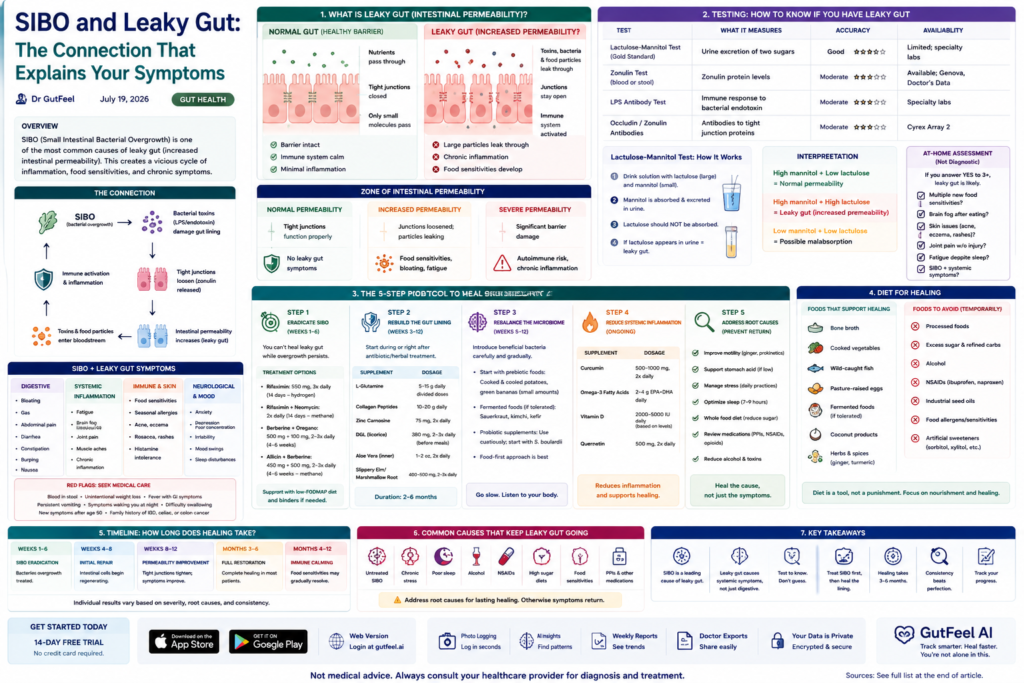
What Is Leaky Gut (Intestinal Permeability)?
The Gut Barrier: Your Body’s Gatekeeper
Your small intestine lining is only one cell thick — a delicate barrier between your internal world and everything you ingest.
Normal function:
Food → Digested → Nutrients pass through tight junctions → Bloodstream → Body uses nutrients
Tight junctions are protein structures that act like doors between intestinal cells. They open to let nutrients through and close to keep toxins out.
What Happens in Leaky Gut
| Normal Gut | Leaky Gut |
|---|---|
| Tight junctions closed (except for nutrients) | Tight junctions stay OPEN |
| Only small molecules pass through | Large particles leak through |
| Immune system calm | Immune system activated |
| Minimal inflammation | Systemic inflammation |
When junctions stay open:
- Bacterial toxins (LPS) enter bloodstream
- Undigested food proteins enter bloodstream
- Immune system attacks these “invaders”
- Chronic inflammation results
The Zone of Intestinal Permeability
| Zone | Status | Symptoms |
|---|---|---|
| Normal permeability | Tight junctions function properly | No leaky gut symptoms |
| Increased permeability | Junctions loosened; particles leaking | Food sensitivities, bloating, fatigue |
| Severe permeability | Significant barrier damage | Multiple food sensitivities, autoimmune risk, chronic inflammation |
How SIBO Causes Leaky Gut: The Mechanism
The Direct Damage Pathway
SIBO (bacterial overgrowth)
↓
Bacteria produce toxins (LPS/endotoxin)
↓
Toxins damage intestinal cells
↓
Tight junctions loosen (zonulin released)
↓
Intestinal permeability increases
↓
LPS + food proteins enter bloodstream
↓
Immune activation + inflammation
↓
Systemic symptoms (brain fog, fatigue, joint pain, skin issues)
The Three Ways SIBO Damages the Gut Lining
| Mechanism | How It Happens | Result |
|---|---|---|
| LPS (Lipopolysaccharide) toxicity | Gram-negative bacteria release endotoxin | Direct damage to intestinal cells; triggers inflammation |
| Enzyme production | Bacteria produce proteases that digest tight junction proteins | Junctions can’t stay closed |
| Zonulin release | Bacterial toxins trigger zonulin (protein that opens junctions) | Junctions remain persistently open |
The Research: SIBO and Leaky Gut Connection
| Study | Finding |
|---|---|
| Pimentel et al. (2003) | SIBO patients had significantly higher intestinal permeability vs. controls |
| Various studies | 60-70% of SIBO patients show evidence of increased intestinal permeability |
| Multiple studies | Treating SIBO improves (but doesn’t always fully resolve) intestinal permeability |
Key insight: SIBO is one of the most common causes of leaky gut — but not the only one. Both must be addressed for full healing.
Symptoms: Leaky Gut from SIBO vs. SIBO Alone
SIBO Symptoms (Without Leaky Gut)
| Symptom | Location/Type |
|---|---|
| Bloating | Abdominal |
| Gas | Abdominal |
| Abdominal pain | Abdominal |
| Diarrhea or constipation | Bowel-related |
| Burping/belching | Upper GI |
These are primarily digestive symptoms.
SIBO + Leaky Gut Symptoms
| Category | Symptoms |
|---|---|
| Digestive | Bloating, gas, pain, diarrhea/constipation |
| Systemic inflammation | Fatigue, brain fog, joint pain, headaches |
| Immune activation | New food sensitivities, seasonal allergies worsened |
| Skin | Acne, eczema, rosacea, rashes |
| Neurological | Brain fog, anxiety, depression, poor concentration |
| Metabolic | Weight gain (especially around middle), difficulty losing weight |
The difference: Leaky gut causes symptoms OUTSIDE the digestive tract.
The Food Sensitivity Explosion
Common pattern in SIBO + leaky gut:
| Timeline | What Happens |
|---|---|
| Before SIBO | No food sensitivities; ate everything |
| After SIBO develops | Start reacting to foods that never bothered you |
| Common culprits | Dairy, eggs, soy, corn, nightshades, gluten |
| Why | Undigested food proteins leak through gut → immune system creates antibodies |
Important: These aren’t “in your head.” They’re real immune responses to increased permeability.
Testing: How to Know If You Have Leaky Gut
Clinical Tests for Intestinal Permeability
| Test | What It Measures | Accuracy | Availability |
|---|---|---|---|
| Lactulose-Mannitol Test | Urine excretion of two sugars | Good (gold standard) | Limited; specialty labs |
| Zonulin Test (blood or stool) | Zonulin protein levels | Moderate (controversial) | Available; Genova, Doctor’s Data |
| LPS Antibody Test | Immune response to bacterial endotoxin | Moderate | Specialty labs |
| Occludin/Zonulin Antibodies | Antibodies to tight junction proteins | Moderate | Cyrex Array 2 |
The Lactulose-Mannitol Test (Gold Standard)
How it works:
- Drink solution containing lactulose (large molecule) and mannitol (small molecule)
- Mannitol should be absorbed and excreted in urine
- Lactulose should NOT be absorbed (too large)
- If lactulose appears in urine = leaky gut
Interpretation:
| Result | Meaning |
|---|---|
| High mannitol, low lactulose | Normal permeability |
| High mannitol, high lactulose | Increased permeability (leaky gut) |
| Low mannitol, low lactulose | Possible malabsorption |
Where to get it: Genova Diagnostics, Doctor’s Data, some functional medicine clinics
Zonulin Testing
What it measures: Zonulin — the protein that regulates tight junction opening
Interpretation:
| Level | Meaning |
|---|---|
| Normal | Tight junction regulation intact |
| Elevated | Junctions are too open; leaky gut likely |
Limitations: Zonulin fluctuates; single test may not capture the full picture
At-Home Assessment (Not Diagnostic, But Informative)
| Question | If Yes, Points To Leaky Gut |
|---|---|
| Do you have multiple new food sensitivities? | Yes |
| Do you get brain fog after eating? | Yes |
| Do you have skin issues (acne, eczema, rosacea)? | Yes |
| Do you have joint pain without injury? | Yes |
| Do you have fatigue that sleep doesn’t fix? | Yes |
| Do you have SIBO and systemic symptoms? | Yes |
3+ yes answers: Leaky gut is likely. Consider testing or empiric treatment.
The 5-Step Protocol to Heal SIBO and Leaky Gut
Step 1: Eradicate SIBO (Weeks 1-6)
You can’t heal leaky gut while bacteria are still overgrown.
| Treatment Option | Protocol | Duration |
|---|---|---|
| Rifaximin | 550 mg, 3x daily | 14 days (hydrogen) |
| Rifaximin + Neomycin | Both 2x daily | 14 days (methane) |
| Berberine + Oregano | 500 mg + 100 mg, 2-3x daily | 4-6 weeks |
| Allicin + Berberine | 450 mg + 500 mg, 2-3x daily | 4-6 weeks (methane) |
During this phase:
- Follow low-FODMAP diet to reduce bacterial food sources
- Use binders if die-off is significant
- Continue gentle gut-supportive nutrition
Step 2: Rebuild the Gut Lining (Weeks 3-12)
Start during or immediately after antimicrobial treatment.
| Supplement | Dosage | How It Works | Duration |
|---|---|---|---|
| L-Glutamine | 5-15 g daily in divided doses | Primary fuel for intestinal cells; tightens junctions | 3-6 months |
| Collagen peptides | 10-20 g daily | Provides amino acids for gut lining repair | 3-6 months |
| Zinc carnosine | 75 mg, 2x daily | Heals intestinal mucosa; anti-inflammatory | 2-3 months |
| Deglycyrrhizinated licorice (DGL) | 380 mg, 2-3x daily (before meals) | Soothes gut lining; increases mucus production | 2-3 months |
| Aloe vera (inner fillet) | 1-2 oz, 2x daily | Anti-inflammatory; soothing | 2-3 months |
| Slippery elm or marshmallow root | 400-500 mg, 2-3x daily | Demulcent; coats and soothes | 2-3 months |
L-Glutamine: The Star Player
Why it matters: L-glutamine is the PRIMARY fuel source for intestinal cells (enterocytes). Without adequate glutamine, the gut lining can’t repair itself.
Dosing protocol:
| Week | Dosage | Notes |
|---|---|---|
| Weeks 1-2 | 5 g, 2x daily (10 g total) | Start low; assess tolerance |
| Weeks 3-4 | 5 g, 3x daily (15 g total) | Increase if tolerated |
| Weeks 5-12 | 5-10 g, 2x daily | Maintenance |
How to take: Mix powder in water or broth. Take between meals for best absorption.
Contraindications:
- Liver disease (use with caution)
- Kidney disease (use with caution)
- History of mania (rare: can trigger manic episodes)
- Certain cancers (glutamine fuels some cancer cells)
Zinc Carnosine: The Healer
Why it matters: Zinc carnosine specifically targets and heals damaged intestinal mucosa.
Research: Multiple studies show zinc carnosine improves intestinal permeability and reduces gut inflammation.
Dosing: 75 mg, 2x daily with meals
Duration: 8-12 weeks
Step 3: Rebalance the Microbiome (Weeks 5-12)
After SIBO is treated, reintroduce beneficial bacteria carefully.
| Approach | Details |
|---|---|
| Prebiotic foods (gradual) | Cooked and cooled potatoes, green bananas (start small) |
| Fermented foods (if tolerated) | Sauerkraut, kimchi, kefir (introduce slowly) |
| Probiotic supplements | Controversial in SIBO; use cautiously |
| Saccharomyces boulardii | Generally safe; may help prevent recurrence |
Probiotics in SIBO: Proceed with Caution
| Probiotic Type | Recommendation |
|---|---|
| Lactobacillus/Bifidobacterium | Use cautiously; may worsen some SIBO patients |
| Saccharomyces boulardii | Generally safe; beneficial for gut lining |
| Soil-based probiotics | Mixed evidence; use with caution |
| Spore-based probiotics | Emerging evidence; may be better tolerated |
Best approach: Start with food-based approaches first. Add supplements only if needed and tolerated.
Step 4: Reduce Systemic Inflammation (Ongoing)
Leaky gut causes inflammation throughout the body. Address it directly.
| Supplement | Dosage | Benefits |
|---|---|---|
| Curcumin | 500-1000 mg, 2x daily | Potent anti-inflammatory; gut-safe |
| Omega-3 fatty acids | 2-4 g EPA+DHA daily | Reduces systemic inflammation |
| Vitamin D | 2000-5000 IU daily (based on levels) | Supports gut barrier; immune regulation |
| Quercetin | 500 mg, 2x daily | Stabilizes mast cells; anti-inflammatory |
Step 5: Address Root Causes (Prevent Return)
| Root Cause | Solution |
|---|---|
| Impaired motility | Prokinetic (ginger, Iberogast, prescription) |
| Low stomach acid | Betaine HCl (if appropriate); avoid unnecessary PPIs |
| Chronic stress | Daily stress management; vagus nerve exercises |
| Poor diet | Whole foods; limit processed foods and sugar |
| Medications | Review necessity of PPIs, NSAIDs, opioids |
| Toxin exposure | Reduce alcohol; minimize environmental toxins |
Diet for Healing SIBO and Leaky Gut
During Treatment (Weeks 1-6)
| Diet Approach | Details |
|---|---|
| Low-FODMAP | Reduces bacterial fermentation; decreases symptoms |
| Specific Carbohydrate Diet (SCD) | More restrictive; eliminates complex carbs |
| SIBO Biphasic Diet | Combines low-FODMAP + SCD principles |
Recommendation: Low-FODMAP is usually sufficient and more sustainable.
Foods That Support Gut Lining Healing
| Food | Why It Helps |
|---|---|
| Bone broth | Rich in collagen, glutamine, glycosaminoglycans |
| Cooked vegetables | Easier to digest; provide nutrients |
| Wild-caught fish | Anti-inflammatory omega-3s |
| Pasture-raised eggs | Nutrient-dense; provide choline for gut lining |
| Fermented foods (if tolerated) | Introduce beneficial bacteria |
| Coconut products | Caprylic acid has antimicrobial properties |
Foods to Avoid During Healing
| Food | Why Avoid |
|---|---|
| Processed foods | Disrupt microbiome; contain additives |
| Excessive sugar | Feeds pathogenic bacteria; increases inflammation |
| Alcohol | Damages gut lining; increases permeability |
| NSAIDs | Directly damage intestinal lining |
| Industrial seed oils | High in omega-6; pro-inflammatory |
| Food allergens/sensitivities | Trigger immune response; worsen permeability |
Reintroducing Foods (Weeks 7-12)
| Phase | Action |
|---|---|
| Weeks 1-2 post-treatment | Continue low-FODMAP; assess symptoms |
| Weeks 3-4 | Reintroduce one FODMAP group at a time |
| Weeks 5-8 | Expand diet based on tolerance |
| Long-term | Aim for widest variety possible |
Rule: Introduce one new food every 3 days. Monitor symptoms. If tolerated, keep it; if not, remove and retry later.
Timeline: How Long Does Healing Take?
Typical Healing Progression
| Phase | Timeline | What’s Happening |
|---|---|---|
| SIBO eradication | Weeks 1-6 | Bacterial overgrowth treated |
| Initial gut lining repair | Weeks 4-8 | Intestinal cells begin regenerating |
| Permeability improvement | Weeks 8-12 | Tight junctions tighten; symptoms improve |
| Full barrier restoration | Months 3-6 | Complete healing in most patients |
| Immune system calming | Months 4-12 | Food sensitivities may gradually resolve |
Factors That Slow Healing
| Factor | Impact |
|---|---|
| Continued alcohol use | Significantly delays healing |
| Ongoing NSAID use | Directly damages gut lining |
| Unmanaged stress | Impairs gut-brain axis; slows repair |
| Poor sleep | Reduces tissue repair capacity |
| Continued high sugar intake | Feeds dysbiosis; promotes inflammation |
| Unaddressed food sensitivities | Continuous immune activation |
Special Considerations
When Leaky Gut Doesn’t Heal
| Possible Cause | Solution |
|---|---|
| SIBO not fully eradicated | Re-test; consider second treatment |
| Ongoing trigger (gluten, alcohol, NSAIDs) | Remove trigger completely |
| Mast cell activation syndrome (MCAS) | Address mast cells (quercetin, vitamin C) |
| Chronic infections (parasites, candida) | Test and treat other pathogens |
| Autoimmune condition | Address underlying autoimmunity |
| Severe nutrient deficiencies | Test and correct (zinc, vitamin D, A) |
The Gluten Connection
Important: Gluten increases zonulin (and intestinal permeability) in ALL people — not just those with celiac disease.
| Condition | Zonulin Response to Gluten |
|---|---|
| Celiac disease | Markedly elevated; prolonged |
| Non-celiac gluten sensitivity | Moderately elevated |
| Healthy individuals | Mild, transient elevation |
Recommendation: During leaky gut healing, consider reducing or eliminating gluten completely.
Leaky Gut and Autoimmune Disease
The connection: Leaky gut is considered a prerequisite for autoimmune disease development.
The mechanism:
- Leaky gut allows food proteins and bacterial toxins into bloodstream
- Immune system creates antibodies
- Molecular mimicry: antibodies attack body tissues that resemble the invader
- Autoimmune disease develops
If you have autoimmune disease:
- Healing leaky gut is ESSENTIAL
- May need longer treatment (6+ months)
- Consider working with functional medicine practitioner
SIBO, Leaky Gut, and Histamine Intolerance
The overlap: Many SIBO + leaky gut patients develop histamine intolerance.
| Connection | Details |
|---|---|
| Why | Gut inflammation reduces DAO enzyme (breaks down histamine); some bacteria produce histamine |
| Symptoms | Flushing, headaches, hives, diarrhea, anxiety after histamine-rich foods |
| Treatment | Treat SIBO first; low-histamine diet temporarily; DAO enzyme support |
Testing for SIBO and Leaky Gut: Complete Panel
Recommended Tests
| Test | Why | Where |
|---|---|---|
| Lactulose or glucose breath test | Diagnose SIBO | Genova, Doctor’s Data, labs |
| Lactulose-mannitol test | Gold standard for permeability | Genova, Doctor’s Data |
| Zonulin (blood or stool) | Marker of intestinal permeability | Genova, Alletess |
| LPS antibodies | Evidence of endotoxemia | Vibrant Wellness, specialty labs |
| Comprehensive stool test | Assess overall gut health | Genova GI Effects, Doctor’s Data |
| Food sensitivity panel (optional) | Identify reactive foods | Cyrex, Everwell |
Working with a Practitioner
Who to see:
- Functional medicine physician
- Naturopathic doctor (ND)
- Integrative gastroenterologist
- SIBO-literate practitioner
Why it matters: SIBO + leaky gut is complex. A knowledgeable practitioner can:
- Order appropriate tests
- Interpret results accurately
- Adjust treatment based on response
- Address complications
The GutFeel Approach
Tracking your SIBO and leaky gut healing helps you:
- Monitor symptom patterns – What improves vs. worsens symptoms
- Track food reintroduction – Which foods are tolerated
- Assess treatment response – Week-by-week progress
- Identify triggers – Stress, foods, medications that affect symptoms
- Share with your practitioner – Complete picture for treatment decisions
GutFeel AI helps you organize this information systematically, so you and your clinician can make data-driven decisions.
FAQs
Can leaky gut be cured completely?
Yes, in most cases. With proper SIBO treatment, gut-healing supplements, and lifestyle changes, intestinal permeability can fully resolve in 3-6 months.
Do I need to treat SIBO before healing leaky gut?
Yes. You can start gut-healing supplements during SIBO treatment, but the overgrowth must be addressed first for full healing.
How long does it take to heal leaky gut?
Initial improvement: 4-8 weeks. Significant healing: 3-6 months. Full restoration: varies by individual and severity.
Can I test leaky gut at home?
Some labs offer at-home collection (urine lactulose-mannitol test, stool zonulin). However, interpretation is best done with a practitioner.
Will my food sensitivities go away?
Often, yes. As the gut lining heals and inflammation decreases, many patients can reintroduce previously reactive foods. Some sensitivities may persist longer.
Is leaky gut recognized by conventional medicine?
Increasingly, yes. While “leaky gut syndrome” was once dismissed, intestinal permeability is now well-documented in medical literature and recognized as real.
Can children have leaky gut from SIBO?
Yes. The same mechanisms apply. Treatment should be supervised by a pediatrician knowledgeable in gut health.
Does collagen really help leaky gut?
Yes. Collagen provides amino acids (glycine, proline, glutamine) that are building blocks for the gut lining. Clinical evidence supports its use.
Can I drink alcohol while healing leaky gut?
Best to avoid completely during the healing phase. Alcohol directly increases intestinal permeability and delays healing.
Will probiotics help or hurt?
Controversial in SIBO. Some patients improve; others worsen. Saccharomyces boulardii is generally safe. Food-based approaches are preferred initially.
Key Takeaways
- SIBO causes leaky gut – 60-70% of SIBO patients have increased intestinal permeability
- Bacterial toxins damage the gut lining – LPS, zonulin, and bacterial enzymes loosen tight junctions
- Leaky gut causes systemic symptoms – Brain fog, fatigue, joint pain, skin issues, food sensitivities
- Testing is available – Lactulose-mannitol test is gold standard; zonulin testing is emerging
- Treat SIBO first – Can’t fully heal leaky gut while overgrowth persists
- L-glutamine is essential – Primary fuel for intestinal cells; 10-15 g daily during healing
- Zinc carnosine heals – Specifically targets damaged intestinal mucosa
- Collagen supports repair – Provides building blocks for gut lining
- Healing takes 3-6 months – Don’t expect overnight results
- Address root causes – Otherwise both conditions return
- Food sensitivities often improve – As gut heals, many patients can reintroduce foods
- Alcohol delays healing – Avoid during the healing phase
Sources
- Pimentel M, et al. “Presence of Antibodies to Microbial Antigens in Irritable Bowel Syndrome and the Role of Intestinal Permeability.” American Journal of Gastroenterology. 2003.
- Fasano A. “Zonulin and Its Regulation of Intestinal Barrier Function.” Physiological Reviews. 2012.
- Camilleri M, et al. “Human Intestinal Permeability.” American Journal of Physiology-Gastrointestinal and Liver Physiology. 2013.
- Bischoff SC, et al. “Intestinal Permeability: A New Target for Disease Prevention and Therapy.” BMC Gastroenterology. 2014.
- ACG Clinical Guideline: Small Intestinal Bacterial Overgrowth. American Journal of Gastroenterology. 2020.
- Mayo Clinic. “Small Intestinal Bacterial Overgrowth (SIBO).” 2024.
- Cleveland Clinic. “Leaky Gut Syndrome: What Is It?” 2024.
- NIDDK. “Leaky Gut.” 2023.
- Siebecker A. “SIBO and Intestinal Permeability.” SIBO Info. 2023.
- Monash University. “FODMAPs and Gut Health.” 2024.
Not medical advice: This article is educational and does not replace care from a licensed clinician. SIBO and leaky gut diagnosis and treatment should be supervised by a qualified healthcare provider. Don’t stop prescription medications without consulting your doctor. If you have severe symptoms (weight loss, blood in stool, persistent vomiting), seek medical evaluation.