Preventing SIBO Recurrence: 7 Evidence-Based Strategies That Work
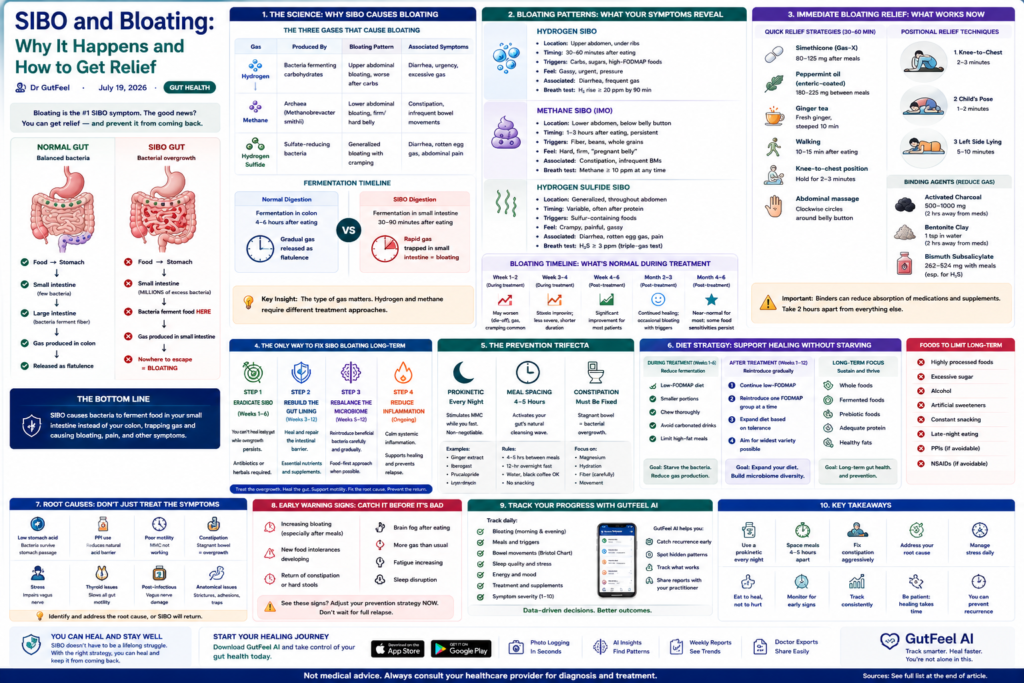
Why SIBO Recurs: Understanding the Root Problem
The Recurrence Reality Check
| Timeframe | Recurrence Rate |
|---|---|
| 3 months post-treatment | 15-20% |
| 9 months post-treatment | 30-44% |
| 1 year+ post-treatment | Up to 50% |
Source: Pimentel et al., various follow-up studies
Why Does SIBO Come Back?
| Root Cause | Explanation |
|---|---|
| Impaired Migrating Motor Complex (MMC) | Your gut’s natural cleansing wave isn’t working properly |
| Unaddressed root cause | Original trigger (food poisoning, low acid, adhesions) still present |
| No prokinetic support | Missing the single most important prevention tool |
| Poor meal spacing | Constant eating prevents MMC activation |
| Ongoing constipation | Stagnant bowel = bacterial paradise |
| Continued PPI use | Low stomach acid removes natural bacteria barrier |
| Anatomical issues | Strictures, diverticula, or adhesions create bacterial traps |
The key insight: SIBO isn’t a one-and-done infection. It’s a condition that develops when your gut’s defense mechanisms are compromised. Fix the defenses, and you prevent recurrence.
Strategy #1: Prokinetics — The Non-Negotiable Prevention Tool
What Is a Prokinetic?
A prokinetic is a substance that stimulates the migrating motor complex (MMC) — a series of wave-like muscle contractions that sweep through your small intestine during fasting states.
Think of it this way: The MMC is your gut’s self-cleaning cycle. When it’s not working, bacteria accumulate in the small intestine.
How the MMC Works
Fed state (eating) → MMC is OFF → Digestion occurs
↓
Fasting state (4+ hours after eating) → MMC activates → Cleansing waves push bacteria toward colon
↓
Every 90-120 minutes during fasting → MMC sweeps → Prevents bacterial overgrowth
In SIBO patients: The MMC is often impaired, allowing bacteria to stay and multiply in the small intestine.
Prokinetic Options Compared
| Prokinetic | Dosage | Duration | Effectiveness | Side Effects | Cost |
|---|---|---|---|---|---|
| Ginger extract | 250-500 mg before bed | 3-6 months | Moderate | Minimal | $ |
| Iberogast (STW 5) | 20 drops 3x daily | 3-6 months | Moderate-High | Low | $$ |
| Low-dose erythromycin | 50 mg before bed | 3-6 months | High | Moderate (antibiotic resistance concern) | $$ |
| Prucalopride | 0.5-2 mg daily | 3-6 months | High | Headache, diarrhea (usually temporary) | $$$ |
| Low-dose naltrexone | 1.5-4.5 mg daily | 3-6 months | Moderate-High | Vivid dreams (some patients) | $$ |
| Tegaserod | 6 mg 2x daily | 3-6 months | Moderate | Rare cardiovascular (restricted use) | $$$ |
Natural Prokinetics
| Supplement | Dosage | Notes |
|---|---|---|
| Ginger root extract | 250-500 mg before bed | Well-tolerated; also anti-nausea |
| Artichoke leaf extract | 300-500 mg before bed | Mild prokinetic; bile stimulant |
| Iberogast | 20 drops 3x daily | 9-herb formula; well-studied |
| 5-HTP | 50-100 mg before bed | Serotonin precursor; supports motility |
Prescription Prokinetics
| Medication | Dosage | Best For | Notes |
|---|---|---|---|
| Prucalopride (Motegrity) | 0.5-2 mg daily | IBS-C, chronic constipation | 5-HT4 agonist; very effective |
| Low-dose erythromycin | 50 mg before bed | Post-infectious SIBO | Antibiotic at low dose; prokinetic effect |
| Metoclopramide (Reglan) | 5-10 mg before bed | Severe gastroparesis | Black box warning; short-term only |
| Domperidone | 10 mg 3x daily | Outside US | Fewer CNS side effects than Reglan |
Prokinetic Protocol: Step-by-Step
When to start: Immediately after completing antimicrobial treatment (day 1 after finishing)
Duration: Minimum 3 months; often 6 months; some patients need longer
Step-by-step:
- Complete antimicrobial treatment (antibiotics or herbs)
- Wait 24 hours after last dose
- Start prokinetic at recommended dose
- Continue for 3 months minimum
- Assess symptoms at 3 months
- Consider tapering if symptom-free, or continue longer if high-risk
High-risk patients (multiple recurrences, post-infectious, scleroderma) may need indefinite prokinetic support.
Which Prokinetic Should You Choose?
| Your Situation | Best Choice |
|---|---|
| Want natural approach | Ginger extract or Iberogast |
| Have constipation | Prucalopride (dual benefit) |
| Post-infectious SIBO | Low-dose erythromycin |
| Failed natural prokinetics | Prescription option |
| On a budget | Ginger extract (most affordable) |
| Multiple recurrences | Prescription + natural combination |
Strategy #2: Meal Spacing — Activating Your MMC Naturally
Why Meal Timing Matters
The MMC only activates during fasting states — not when you’re constantly eating.
| Eating Pattern | MMC Activation |
|---|---|
| Snacking every 2 hours | MMC never activates |
| Eating every 3 hours | Minimal MMC activation |
| 4-5 hours between meals | Full MMC cycles occur |
| 12-hour overnight fast | Extended MMC activity during sleep |
The Meal Spacing Protocol
Rules:
- 4-5 hours between meals — No snacks, no caloric beverages
- 12-hour overnight fast — Finish dinner by 7 PM, breakfast at 7 AM
- Water is OK — Plain water, black coffee, plain tea between meals
- No grazing — Even a few calories can interrupt the MMC
Sample schedule:
| Time | Activity |
|---|---|
| 7:00 AM | Breakfast |
| 12:00 PM | Lunch (5 hours later) |
| 5:00 PM | Dinner (5 hours later) |
| 7:00 PM | Begin fasting window |
| 7:00 AM | Breakfast (12-hour fast complete) |
What Breaks a Fast?
| Item | Breaks Fast? | MMC Impact |
|---|---|---|
| Water | No | OK |
| Black coffee | No | OK |
| Plain tea (no honey) | No | OK |
| Bone broth | Yes | Stops MMC |
| Bulletproof coffee | Yes | Stops MMC |
| Gum (even sugar-free) | Yes (debated) | May stimulate digestion |
| Milk in coffee | Yes | Stops MMC |
| Apple cider vinegar | Minimal | Probably OK |
Rule of thumb: If it has calories, it breaks the fast and pauses the MMC.
Common Meal Spacing Mistakes
| Mistake | Why It’s a Problem | Fix |
|---|---|---|
| “Just one bite” | Even small calories can interrupt MMC | Stick to non-caloric beverages |
| Afternoon snacks | Prevents MMC activation | Have adequate protein/fat at meals |
| Late-night eating | Shortens overnight fasting window | Finish dinner 3-4 hours before bed |
| Skipping meals | Can slow motility long-term | Eat regular, spaced meals |
| Being too rigid | Creates stress (which impairs motility) | Aim for consistency, not perfection |
Strategy #3: Address Constipation — Aggressively
Why Constipation Matters
Hard truth: Constipation is the #1 predictor of SIBO recurrence, especially methane SIBO (IMO).
| Reason | Explanation |
|---|---|
| Stagnant bowel | Slow transit allows bacteria to multiply |
| Methane production | Archaea thrive in slow-moving environments |
| Toxin reabsorption | Waste products linger, feeding bacteria |
| Impaired MMC | Constipation and MMC dysfunction feed each other |
The Constipation Prevention Protocol
| Intervention | Dosage/Approach | Goal |
|---|---|---|
| Magnesium citrate | 200-400 mg daily | Soft, regular stools |
| Vitamin C | 1000-2000 mg to bowel tolerance | Osmotic effect |
| Hydration | 2-3 liters water daily | Adequate stool hydration |
| Movement | 20-30 min walking daily | Stimulates motility |
| Squatty potty | Use for bowel movements | Better anorectal angle |
| Fiber (carefully) | Partially hydrolyzed guar gum | Gentle, non-fermentable |
| Prokinetic | As prescribed | Prevents stagnation |
Target: 1-2 soft, formed bowel movements daily (Bristol Stool Scale type 3-4)
Constipation Red Flags
| Symptom | Concern | Action |
|---|---|---|
| No BM for 3+ days | Severe constipation | Increase magnesium; consider enema |
| Hard, pebble-like stools | Inadequate hydration/fiber | Increase water; add gentle fiber |
| Straining required | Pelvic floor dysfunction | Consider pelvic floor PT |
| Incomplete evacuation | Possible dyssynergia | Medical evaluation |
Strategy #4: Address Root Causes — Fix the Foundation
Common SIBO Root Causes
| Root Cause | How It Causes SIBO | How to Address |
|---|---|---|
| Food poisoning (post-infectious) | Damages vagus nerve → impaired MMC | Prokinetic; consider LDN |
| Low stomach acid (hypochlorhydria) | Bacteria survive stomach passage | Betaine HCl (if appropriate); avoid unnecessary PPIs |
| PPI use | Reduces acid barrier | Taper if possible; address reflux differently |
| Opioid use | Slows gut motility | Address constipation; consider alternatives |
| Hypothyroidism | Slows all motility | Optimize thyroid treatment |
| Diabetes | Autonomic neuropathy affects MMC | Blood sugar control; prokinetic |
| Adhesions (prior surgery) | Physical obstruction/traps | Visceral manipulation; surgery if severe |
| Ileocecal valve dysfunction | Colonic bacteria migrate upward | Treat constipation; manual therapy |
| Chronic stress | Impairs vagal tone and MMC | Stress management essential |
| Scleroderma/Ehlers-Danlos | Structural/connective tissue issues | Aggressive prokinetic; specialist care |
The Root Cause Assessment
Ask yourself:
| Question | If Yes, Action |
|---|---|
| Did SIBO start after food poisoning? | Prioritize prokinetic; consider LDN |
| Are you on a PPI? | Discuss tapering with doctor |
| Do you have constipation? | Aggressive bowel regimen |
| Did you have abdominal surgery? | Consider visceral manipulation |
| Do you have hypothyroidism? | Optimize thyroid levels |
| Are you on opioids? | Address constipation; explore alternatives |
| Is stress chronically high? | Implement stress management daily |
Strategy #5: Strategic Diet — Support Without Starving
During Treatment (First 4-6 Weeks)
| Approach | Details |
|---|---|
| Low-FODMAP diet | Reduces fermentable substrates; decreases symptoms |
| SIBO Biphasic Diet | Combines low-FODMAP + SCD principles |
| Cedars-Sinai Diet | Developed by SIBO researchers |
Recommendation: Low-FODMAP is usually sufficient and more sustainable.
Post-Treatment (Weeks 7-12)
| Phase | Action |
|---|---|
| Weeks 1-2 post-treatment | Continue low-FODMAP; assess symptom improvement |
| Weeks 3-4 | Reintroduce one FODMAP group at a time |
| Weeks 5-8 | Expand diet based on tolerance |
| Long-term | Aim for widest variety possible |
Critical: Don’t stay on a restrictive diet indefinitely. Your microbiome needs diversity.
Foods to Emphasize for Prevention
| Category | Foods | Why |
|---|---|---|
| Prebiotic foods (once tolerated) | Cooked and cooled potatoes, green bananas | Feed beneficial bacteria |
| Fermented foods (introduce slowly) | Sauerkraut, kimchi, kefir | Introduce beneficial bacteria |
| Bone broth | Homemade or quality store-bought | Supports gut lining |
| Lean proteins | Fish, chicken, eggs | Easy to digest |
| Cooked vegetables | Well-cooked, peeled initially | Easier to digest than raw |
| Healthy fats | Olive oil, avocado (if tolerated) | Anti-inflammatory |
Foods to Limit Long-Term
| Food | Why Limit |
|---|---|
| Highly processed foods | Disrupt microbiome diversity |
| Excessive sugar | Feeds pathogenic bacteria |
| Alcohol | Impairs MMC; damages gut lining |
| Artificial sweeteners | Some disrupt microbiome |
| Constant snacking | Prevents MMC activation |
Strategy #6: Stress Management — The Gut-Brain Connection
Why Stress Matters
The science: Stress directly impairs the vagus nerve, which controls the MMC.
| Stress Effect | Impact on Gut |
|---|---|
| Reduced vagal tone | Slower MMC, reduced motility |
| Decreased stomach acid | Bacteria survive stomach passage |
| Increased gut permeability | Inflammation, immune activation |
| Altered microbiome | Dysbiosis, reduced diversity |
Evidence-Based Stress Management
| Practice | Duration | Evidence |
|---|---|---|
| Diaphragmatic breathing | 10 min, 2x daily | Increases vagal tone; proven in SIBO patients |
| Meditation | 10-20 min daily | Reduces cortisol; improves gut-brain communication |
| Yoga | 20-30 min, 3x weekly | Combines movement, breath, stress reduction |
| Walking in nature | 20-30 min daily | Reduces cortisol; gentle movement |
| Gut-directed hypnotherapy | 6-8 sessions | Strong evidence for IBS; may help SIBO |
| CBT for GI symptoms | 8-12 sessions | Addresses stress-gut connection |
The 5-Minute Daily Practice
Diaphragmatic breathing protocol:
- Sit or lie comfortably
- Place one hand on chest, one on belly
- Breathe in through nose for 4 counts (belly rises, chest stays still)
- Hold for 2 counts
- Breathe out through mouth for 6 counts
- Repeat for 5-10 minutes
When: Morning (to start day calm) and/or before bed (to activate rest-digest state)
Strategy #7: Monitor and Catch Early — Don’t Wait for Full Relapse
What to Track
| Metric | How to Measure | Frequency |
|---|---|---|
| Bloating severity | 1-10 scale, morning and evening | Daily |
| Bowel movement frequency | Number per day | Daily |
| Stool form | Bristol Stool Chart | Daily |
| Abdominal pain | 1-10 scale | Daily |
| Food tolerance changes | Which foods cause symptoms | As symptoms occur |
| Energy level | 1-10 scale | Weekly |
Early Warning Signs of Recurrence
| Symptom | What It Means | Action |
|---|---|---|
| Increasing bloating | Bacteria may be regrowing | Review meal spacing; increase prokinetic |
| New food intolerances | Fermentation increasing | Temporarily reduce trigger foods; assess |
| Return of constipation | Motility slowing | Increase magnesium; ensure prokinetic working |
| Brain fog after meals | Possible bacterial toxins | Review diet; consider binders |
| Increased gas | Fermentation increasing | Assess recent dietary changes |
When to Re-Test
| Situation | Recommendation |
|---|---|
| Complete symptom resolution | Re-test optional |
| Mild symptom return | Try adjusting prevention first; re-test if no improvement in 2 weeks |
| Significant symptom return | Re-test before retreatment |
| After second treatment | Re-test 4-6 weeks post-treatment to confirm eradication |
Special Considerations
Multiple Recurrences
If this is your 2nd+ recurrence:
| Action | Why |
|---|---|
| Extended prokinetic | May need 6-12 months or indefinite |
| Combination prokinetic | Natural + prescription together |
| Address all root causes | Leave no stone unturned |
| Consider biofilms | Add biofilm disruptors during treatment |
| Specialist care | Work with SIBO-experienced practitioner |
Methane SIBO (IMO)
Higher recurrence risk — be aggressive:
| Strategy | Details |
|---|---|
| Longer prokinetic | Minimum 6 months |
| Aggressive constipation management | Daily magnesium, vitamin C, hydration |
| Consider maintenance | Some patients need ongoing low-dose antimicrobials |
| Regular monitoring | Don’t wait for full relapse |
Post-Infectious SIBO
Vagus nerve damage requires specific approach:
| Intervention | Details |
|---|---|
| Prokinetic is essential | Often long-term |
| Vagus nerve exercises | Humming, gargling, cold exposure |
| Low-dose naltrexone | May help restore nerve function |
| Patience | Nerve healing takes months |
The GutFeel Approach
Tracking your SIBO prevention helps you:
- Catch recurrence early – Before it becomes a full relapse
- Monitor prevention adherence – Are you actually meal-spacing?
- Track prokinetic effectiveness – Is it working?
- Identify triggers – What precedes symptom flares?
- Share with your practitioner – Data-driven decisions
GutFeel AI helps you organize this information systematically, so you can spot patterns before they become problems.
FAQs
How long do I need to take a prokinetic?
Minimum 3 months. Many patients need 6 months. Those with multiple recurrences or significant motility issues may need indefinite support.
Can I prevent SIBO without a prokinetic?
It’s much harder. The prokinetic is the single most important prevention tool. Natural options (ginger, Iberogast) are effective for many patients.
Is meal spacing really that important?
Yes. The MMC only activates during fasting. Constant eating (even healthy food) prevents your gut’s self-cleaning cycle.
Can SIBO come back even if I do everything right?
Yes, but your risk is significantly lower. Some patients have anatomical issues or conditions that make recurrence more likely despite best efforts.
Should I stay on a restrictive diet long-term?
No. Long-term restriction can reduce microbiome diversity. Expand your diet as tolerated after treatment.
Do I need to re-test after treatment?
If symptoms resolve completely, re-testing is optional. If symptoms return, re-test before retreatment.
Can probiotics prevent SIBO recurrence?
Controversial. Some strains may help; others may worsen. Saccharomyces boulardii is generally safe. Discuss with your practitioner.
What if I can’t afford a prescription prokinetic?
Ginger extract (250-500 mg before bed) is effective and affordable. Start there.
Is SIBO prevention permanent?
Most patients can eventually reduce prevention intensity. However, many benefit from ongoing meal spacing and some form of prokinetic support.
Key Takeaways
- 44% recurrence rate without prevention — But you can dramatically reduce your risk
- Prokinetic is non-negotiable — Minimum 3 months; start day 1 after treatment
- Ginger works — Natural prokinetics are effective for many patients
- Meal spacing is crucial — 4-5 hours between meals, 12-hour overnight fast
- Constipation must be addressed — Aggressively; it’s the #1 recurrence predictor
- Root causes matter — Identify and address why SIBO developed
- Diet is temporary — Expand as tolerated; don’t restrict indefinitely
- Stress impairs the MMC — Daily stress management is prevention
- Monitor for early signs — Catch recurrence before it becomes full relapse
- Some patients need long-term support — Multiple recurrences may need indefinite prokinetic
Sources
- Pimentel M, et al. “Recurrence of Small Intestinal Bacterial Overgrowth After Treatment.” American Journal of Gastroenterology. 2011.
- Rezaie A, et al. “Hydrogen and Methane-Based Breath Testing in Gastrointestinal Disorders: The North American Consensus.” American Journal of Gastroenterology. 2017.
- ACG Clinical Guideline: Small Intestinal Bacterial Overgrowth. American Journal of Gastroenterology. 2020.
- Madisch A, et al. “Treatment of Functional Dyspepsia with a Fixed Herbal Preparation (STW 5).” Alimentary Pharmacology & Therapeutics. 2004.
- Thiny MT, et al. “Prokinetic Agents for the Treatment of Gastroparesis and Small Intestinal Bacterial Overgrowth.” Gastroenterology & Hepatology. 2022.
- Mayo Clinic. “Small Intestinal Bacterial Overgrowth (SIBO).” 2024.
- Cleveland Clinic. “SIBO: Prevention and Long-Term Management.” 2024.
- Siebecker A. “SIBO Prevention Protocols.” SIBO Info. 2023.
- NIDDK. “Small Intestinal Bacterial Overgrowth (SIBO).” 2023.
- Monash University. “FODMAPs and IBS.” 2024.
Not medical advice: This article is educational and does not replace care from a licensed clinician. SIBO prevention should be supervised by a qualified healthcare provider. Don’t stop prescription medications without consulting your doctor. If you have severe symptoms (weight loss, blood in stool, persistent vomiting), seek medical evaluation.