
Personalized Gut Health: How to Find YOUR Unique Triggers and Tolerances
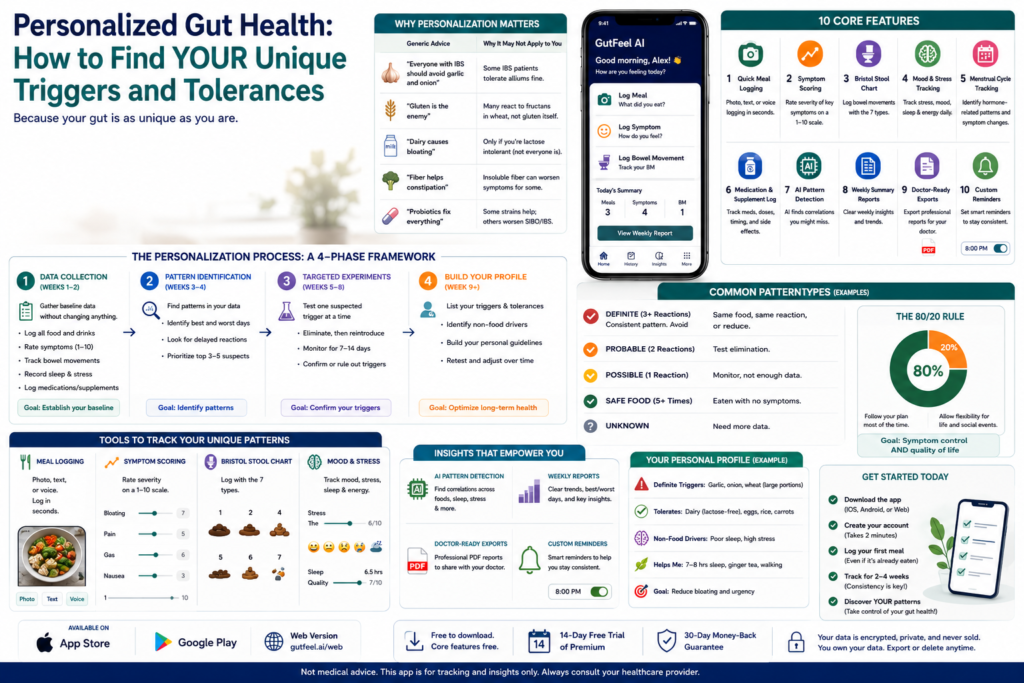
Why Personalization Matters
The Problem with Generic Advice
| Generic Recommendation | Why It May Not Apply to You |
|---|---|
| “Everyone with IBS should avoid garlic and onion” | Some IBS patients tolerate alliums fine |
| “Gluten is the enemy” | Many react to fructans in wheat, not gluten itself |
| “Dairy causes bloating” | Only if you’re lactose intolerant (not everyone is) |
| “Fiber helps constipation” | Insoluble fiber can worsen symptoms for some |
| “Probiotics fix everything” | Some strains help; others worsen SIBO/IBS |
The Science of Individual Variation
| Factor | How It Creates Uniqueness |
|---|---|
| Microbiome composition | Your bacteria are unique (like a fingerprint) |
| Genetics | Some people metabolize foods differently |
| Gut permeability | “Leaky gut” severity varies person to person |
| Visceral sensitivity | Some guts are more sensitive to normal sensations |
| Enzyme production | Lactase, amylase, and other enzymes vary by person |
| Stress reactivity | Some people have stronger gut-brain responses |
| Hormonal patterns | Menstrual cycles affect symptoms differently |
Key insight: Two people with the same diagnosis (e.g., IBS-D) can have completely different triggers and require different treatments.
The Personalization Process: A Step-by-Step Framework
Phase 1: Data Collection (Weeks 1-2)
Goal: Gather baseline data without changing anything.
| What to Track | How to Measure |
|---|---|
| All food and drink | Photos or written log within 15 min of eating |
| Symptom severity | 1-10 scale for bloating, pain, gas, urgency |
| Bowel movements | Frequency + Bristol Stool Chart type |
| Sleep | Hours + quality (1-10) |
| Stress/mood | 1-10 scale + major events |
| Medications/supplements | Name, dose, time taken |
Rules for this phase:
- Don’t change your diet yet
- Aim for 80% logging consistency
- Log everything, even “bad” days
Phase 2: Pattern Identification (Weeks 3-4)
Goal: Identify your top 3-5 suspected triggers.
Questions to ask:
| Question | What to Look For |
|---|---|
| Which days were best? | What was different? (food, sleep, stress) |
| Which days were worst? | Common foods, situations, or patterns? |
| What do I eat on good days vs. bad? | Any consistent differences? |
| Do symptoms track with food or non-food factors? | Sleep, stress, timing may matter more |
| Are there delayed reactions? | Foods that trigger symptoms 12-24 hours later |
The Trigger Confidence Scale
| Confidence Level | Criteria | Action |
|---|---|---|
| Definite trigger | 3+ consistent reactions, same food, similar symptoms | Eliminate or reduce |
| Probable trigger | 2 reactions, or mild but consistent pattern | Test elimination |
| Possible trigger | 1 reaction, or unclear pattern | Monitor, don’t eliminate yet |
| Safe food | 5+ times eaten with no symptoms | Keep in your diet |
| Unknown | Not enough data | Need more logging |
Important: A food needs at least 3 consistent reactions to be considered a definite trigger.
Phase 3: Targeted Experiments (Weeks 5-8)
Goal: Test your suspected triggers systematically.
The elimination-rechallenge method:
- Eliminate the suspected food completely for 7-14 days
- Monitor symptoms during elimination
- Rechallenge by eating the food in a controlled way
- Observe for 72 hours after rechallenge
- Conclude whether it’s a true trigger
Example: Testing Dairy
| Day | Action | Symptoms (1-10) | Notes |
|---|---|---|---|
| Day 1-7 | Eliminate all dairy | Bloating: 7→4 | Gradual improvement |
| Day 8 | Rechallenge: 1 cup milk with breakfast | Bloating: 4→7 (6 hours later) | Clear reaction |
| Day 9-10 | Back to elimination | Bloating: 7→5 | Symptoms settling |
| Day 11 | Rechallenge: Lactose-free milk | Bloating: 5→5 (no change) | Tolerated fine |
| Conclusion | Lactose is the trigger, not dairy proteins |
Phase 4: Building Your Personal Profile (Week 9+)
Goal: Create your personalized food and lifestyle guidelines.
Your profile should include:
| Category | Your Personal Findings |
|---|---|
| Definite triggers | Foods to avoid or minimize |
| Tolerated in small amounts | Portion-dependent foods |
| Safe staples | Foods you can eat regularly |
| Non-food triggers | Stress, sleep, timing factors |
| Helpful interventions | What actually works for you |
Understanding Your Personal Patterns
Pattern Type 1: The Food-Specific Trigger
Characteristics:
- Same food triggers symptoms every time
- Reaction is consistent regardless of context
- Often relates to specific intolerances (lactose, fructose, etc.)
Example:
Sarah eats yogurt → Bloating within 2 hours (every time)
Sarah eats lactose-free yogurt → No symptoms
Conclusion: Lactose intolerance
Action: Eliminate or use enzyme supplements (e.g., lactase for dairy).
Pattern Type 2: The Cumulative Trigger
Characteristics:
- One serving is fine; multiple servings trigger symptoms
- “Bucket overflows” after several days of similar foods
- Common with FODMAPs, histamine, caffeine
Example:
Day 1: Onion at dinner → Fine
Day 2: Onion at lunch AND dinner → Mild bloating
Day 3: Onion + garlic + wheat → Severe bloating
Conclusion: Fructan "bucket" overflowed
Action: Limit frequency, control portions, space out trigger foods.
Pattern Type 3: The Context-Dependent Trigger
Characteristics:
- Food is fine in some contexts, triggers in others
- Timing, stress, or sleep modify the reaction
- Very common in IBS
Example:
Pizza on vacation (relaxed, well-rested) → Fine
Pizza before deadline (stressed, poor sleep) → Severe symptoms
Conclusion: Stress + sleep matter more than the food itself
Action: Address contextual factors (stress management, sleep) alongside diet.
Pattern Type 4: The Delayed Reaction
Characteristics:
- Symptoms appear 12-48 hours after eating the food
- Hard to identify without careful tracking
- Common with gluten sensitivity, some FODMAPs
Example:
Monday dinner: Wheat pasta → Fine Monday night
Tuesday: Bloating and pain all day → Can't identify trigger
Thursday: Symptoms finally resolve
Conclusion: Without tracking, the wheat connection is invisible
Action: Track for at least 48 hours after each meal; look for delayed patterns.
Pattern Type 5: The Combination Trigger
Characteristics:
- Individual foods are fine alone
- Specific combinations cause problems
- Often relates to meal composition
Example:
High-fat meal + high-FODMAP vegetables → Severe bloating
High-fat meal alone → Fine
High-FODMAP vegetables alone → Fine
Conclusion: The combination is the problem, not individual foods
Action: Identify problematic combinations; adjust meal composition.
Common Personalization Discoveries
Discovery 1: “It’s Not Gluten — It’s Fructans”
| Clue | What It Means |
|---|---|
| Bread triggers you, but rice pasta doesn’t | Could be fructans in wheat, not gluten |
| Sourdough spelt is fine, regular wheat bread is not | Fermentation breaks down fructans |
| Garlic and onion also trigger you | Same FODMAP group (fructans) |
Test: Try sourdough spelt bread (low-fructan) vs. regular wheat bread. If only regular wheat triggers you, it’s likely fructans, not gluten.
Discovery 2: “It’s Not Dairy — It’s Lactose”
| Clue | What It Means |
|---|---|
| Milk and ice cream trigger you, but hard cheese doesn’t | Lactose intolerance (hard cheese is lactose-free) |
| Lactose-free dairy is fine | Confirms lactose, not dairy proteins |
| Aged cheeses are fine, fresh cheeses trigger | Aging reduces lactose |
Test: Try lactose-free milk. If it’s fine, you’re lactose intolerant, not sensitive to dairy proteins.
Discovery 3: “It’s Not Food — It’s Timing”
| Clue | What It Means |
|---|---|
| Same food is fine at lunch, triggers at dinner | Late eating may be the issue |
| Rushed meals trigger more than relaxed meals | Eating speed and stress matter |
| Symptoms worse when you skip meals | Irregular eating disrupts gut rhythms |
Test: Eat the same meal at different times/contexts. If timing matters more than food, address meal patterns.
Discovery 4: “It’s Not One Food — It’s the Bucket”
| Clue | What It Means |
|---|---|
| Small portions are fine, large portions trigger | Cumulative FODMAP load |
| Multiple “low” FODMAP foods together trigger | FODMAPs add up across a meal |
| Symptoms worse on days with many different foods | Variety can increase total FODMAP load |
Test: Track total FODMAP load per meal, not just individual foods. Space out moderate-FODMAP foods.
Discovery 5: “Sleep Predicts My Symptoms Better Than Food”
| Clue | What It Means |
|---|---|
| Bad sleep days = bad symptom days (regardless of food) | Sleep is a primary driver |
| Good sleep = tolerance of “trigger” foods | Sleep improves resilience |
| Stress + poor sleep = guaranteed flare | Combined non-food triggers |
Test: Track sleep quality alongside food. If sleep correlates more strongly than food, prioritize sleep improvement.
Tools for Personalization
The Food Reintroduction Grid
Use this to track your challenge results:
| Food Tested | Portion | Day 1 | Day 2 | Day 3 | Conclusion |
|---|---|---|---|---|---|
| Wheat bread | 1 slice | Bloating 3/10 | Bloating 5/10 | Pain 6/10 | TRIGGER |
| Lactose-free milk | 1 cup | No symptoms | No symptoms | No symptoms | SAFE |
| Onion (raw) | ¼ medium | Gas, bloating | Mild bloating | Normal | TRIGGER |
| Tomato | 1 medium | No symptoms | No symptoms | No symptoms | SAFE |
| Almonds | 15 nuts | Mild gas | No symptoms | No symptoms | SAFE in moderation |
The Symptom-Food Correlation Matrix
| Food | Times Eaten | Times with Symptoms | Correlation |
|---|---|---|---|
| Garlic | 8 | 7 | HIGH (87%) |
| Dairy | 12 | 9 | HIGH (75%) |
| Wheat | 15 | 10 | MODERATE (67%) |
| Eggs | 20 | 2 | LOW (10%) |
| Rice | 18 | 1 | LOW (5%) |
Interpretation:
- HIGH (>70%): Likely trigger — eliminate or reduce
- MODERATE (40-70%): Possible trigger — test elimination
- LOW (<40%): Probably safe — keep in diet
The Weekly Pattern Summary
Every Sunday, ask:
| Question | Week 1 | Week 2 | Week 3 | Week 4 |
|---|---|---|---|---|
| Best day this week? | Tuesday | Thursday | Monday | Wednesday |
| Worst day this week? | Saturday | Monday | Friday | Sunday |
| Common factor on best days? | Good sleep, low stress | Home-cooked meals | Regular meal times | Exercise |
| Common factor on worst days? | Alcohol, late dinner | Restaurant food | High stress | Poor sleep |
| One pattern I noticed? | Sleep matters more than food | Garlic at restaurants triggers me | Stress is a bigger trigger than food | Late dinners = bad mornings |
Working with Healthcare Providers
What Your Data Tells Your Doctor
| Information | Why It’s Useful |
|---|---|
| Symptom timeline | Shows when problems started, progression |
| Food-symptom patterns | Suggests specific intolerances |
| Bowel habit details | Helps differentiate IBS-D, IBS-C, IBS-M |
| Non-food triggers | Identifies gut-brain axis involvement |
| Treatment responses | Shows what’s worked (and what hasn’t) |
Tests That May Help Personalization
| Test | What It Reveals | When to Consider |
|---|---|---|
| Hydrogen/methane breath test | SIBO, lactose/fructose intolerance | Persistent bloating, gas |
| Celiac panel | Celiac disease (gluten autoimmune reaction) | Family history, diarrhea, weight loss |
| Fecal calprotectin | Intestinal inflammation (IBD vs. IBS) | Blood in stool, persistent symptoms |
| Comprehensive stool test | Microbiome composition, infections | Chronic symptoms, unclear diagnosis |
| Food sensitivity panel | IgG antibodies to foods (controversial) | After other testing, as adjunct |
| Zonulin test | Intestinal permeability (“leaky gut”) | Suspected leaky gut |
Important: No test replaces careful self-observation. Tests inform; your patterns confirm.
The GutFeel AI Approach to Personalization
How AI Enhances Pattern Detection
| Human Limitation | AI Advantage |
|---|---|
| Bad at remembering details | Never forgets a logged meal |
| Misses delayed reactions | Tracks 24-48 hour correlations |
| Biased toward recent events | Analyzes all data equally |
| Can’t see multi-factor patterns | Identifies food + sleep + stress combinations |
| Emotional attachment to conclusions | Objective, data-driven insights |
Weekly Personalization Reports
GutFeel AI generates:
| Report Section | What You Learn |
|---|---|
| Top triggers this week | Foods most correlated with symptoms |
| Best days analysis | What was different on your best days? |
| Non-food factors | Sleep, stress, and timing correlations |
| Safe foods confirmed | Foods eaten multiple times without issues |
| Suggestions for next week | Based on emerging patterns |
Common Personalization Mistakes
Mistake 1: Eliminating Too Many Foods Too Fast
Problem: You remove 15 foods at once. Symptoms improve. You don’t know which food(s) were the problem.
Better approach: Eliminate 1-3 suspected triggers at a time. Reintroduce systematically.
Mistake 2: Not Giving Elimination Enough Time
Problem: You eliminate a food for 2 days, don’t see change, conclude it’s not a trigger.
Better approach: Some foods take 7-14 days to clear from your system. Give elimination a fair trial.
Mistake 3: Fear-Based Restriction
Problem: You avoid foods that never triggered you “just in case.”
Better approach: Only eliminate foods with evidence. Your gut needs diversity.
Mistake 4: Ignoring Non-Food Factors
Problem: You obsess over food but ignore sleep, stress, and timing — which may be bigger drivers.
Better approach: Track non-food factors. Address the biggest levers first.
Mistake 5: Not Reintroducing
Problem: You stay on an elimination diet indefinitely, narrowing your diet over time.
Better approach: Reintroduce systematically. Your goal is the widest possible diet.
Building Your Long-Term Personalized Plan
Your Personal Gut Health Profile
Fill this in after 4-8 weeks of tracking:
MY TRIGGERS:
- Definite triggers (avoid): _______________
- Portion-dependent (limit): _______________
- Context-dependent (manage context): _______________

MY SAFE FOODS:
- Reliable proteins: _______________
- Reliable carbohydrates: _______________
- Reliable vegetables: _______________
- Reliable fruits: _______________

MY NON-FOOD DRIVERS:
- Sleep: ___ hours needed for good days
- Stress management: What works: _______________
- Meal timing: Best pattern for me: _______________

MY INTERVENTIONS THAT WORK:
- Dietary: _______________
- Supplements: _______________
- Lifestyle: _______________
- Stress/sleep: _______________
The 80/20 Rule for Long-Term Success
Principle: 80% of the time, eat within your personalized guidelines. 20% of the time, allow flexibility.
Why this works:
- Perfection is unsustainable
- Your gut can handle occasional triggers
- Life includes restaurants, travel, celebrations
- Flexibility reduces food anxiety
Example:
- Monday-Saturday: Strict with triggers
- Saturday dinner out: Order as best you can, don’t stress about the rest
- Result: Good symptom control + quality of life
FAQs
How long does it take to personalize my gut health approach?
Most people identify clear patterns within 4-6 weeks. Complex cases with multiple triggers may take 8-12 weeks.
What if everything I eat triggers symptoms?
This suggests either (a) severe underlying issue needing medical evaluation, or (b) hypervigilance where normal sensations are perceived as symptoms. Consider working with a GI dietitian and/or gut psychologist.
Can my triggers change over time?
Yes. As your gut heals, you may tolerate previously triggering foods. Stress, illness, and life changes can also shift your tolerances. Re-test periodically.
Should I test for food sensitivities (IgG testing)?
IgG food sensitivity tests are controversial. Many experts don’t recommend them because IgG often indicates exposure, not intolerance. Careful elimination-rechallenge is more reliable.
What if my partner/family doesn’t have the same triggers?
This is normal and expected. Your gut is unique. Cook components separately or find overlapping safe foods.
Is it possible to have no triggers?
Yes! Some people’s symptoms are primarily driven by non-food factors (stress, sleep, motility). If food tracking shows no clear patterns, focus elsewhere.
Should I stay on my elimination diet forever?
No. The goal is to expand your diet as much as possible. Reintroduce foods systematically after the elimination phase.
What if I can’t afford a dietitian?
Start with careful self-tracking. Use free resources (Monash FODMAP app has free version, online support groups). Many dietitians offer sliding scale or virtual consultations.
Key Takeaways
- Your triggers are unique — What bothers others may not bother you, and vice versa
- Data beats guessing — Systematic tracking reveals patterns memory can’t
- Three reactions = trigger — One bad day doesn’t condemn a food forever
- Non-food factors matter — Sleep, stress, and timing often drive symptoms
- Delayed reactions are real — Track for 48 hours after each meal
- Context changes everything — The same food can trigger or be fine depending on circumstances
- Cumulative effects exist — Small amounts of multiple triggers can overflow your “bucket”
- Elimination requires rechallenge — Otherwise you’ll never know if you still need to avoid it
- Your profile evolves — Retest foods periodically; tolerances can change
- Aim for flexibility — 80/20 rule allows symptom control AND quality of life
Sources
- American Journal of Gastroenterology. “ACG Clinical Guideline: Irritable Bowel Syndrome.” 2021.
- Monash University. “Personalizing the Low FODMAP Diet.” 2024.
- Gut Journal. “Food-Symptom Relationships in IBS: Individual Variation and Clinical Implications.” 2022.
- Nature Reviews Gastroenterology. “Precision Medicine in Gastroenterology: Current Status and Future Directions.” 2023.
- Mayo Clinic. “Food Intolerance vs. Food Allergy.” 2024.
- NIDDK. “Symptoms & Causes of IBS.” 2023.
- International Foundation for Gastrointestinal Disorders. “Identifying Your Trigger Foods.” 2024.
- Harvard Medical School. “Personalized Nutrition: Finding What Works for You.” 2024.
- American Gastroenterological Association. “Dietary Management of IBS.” 2020.
- British Dietetic Association. “Food Fact Sheet: IBS and Personalization.” 2024.
Not medical advice: This article is educational and does not replace care from a licensed clinician or dietitian. If you have severe symptoms, weight loss, or red flags, seek medical evaluation.