Low FODMAP Meal Planning: Complete 4-Week Guide with Food Lists and Recipes
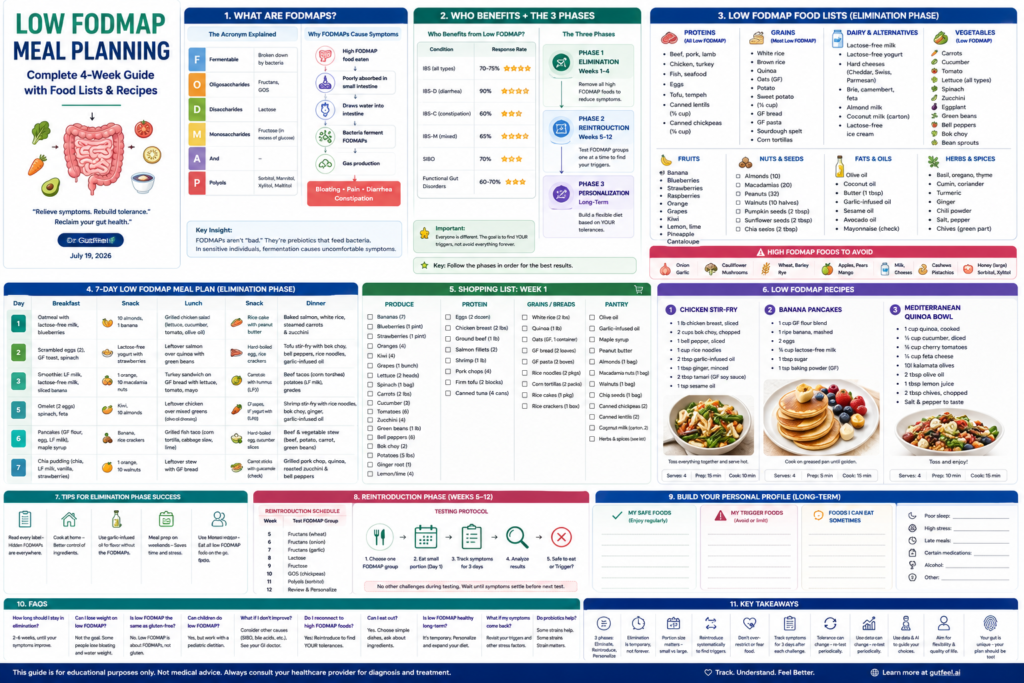
What Are FODMAPs?
The Acronym Explained
| Letter | Stands For | Examples |
|---|---|---|
| F | Fermentable | Broken down by bacteria |
| O | Oligosaccharides | Fructans, GOS (galacto-oligosaccharides) |
| D | Disaccharides | Lactose |
| M | Monosaccharides | Fructose (in excess of glucose) |
| A | And | |
| P | Polyols | Sorbitol, mannitol, xylitol, maltitol |
Why FODMAPs Cause Symptoms
The mechanism:
High-FODMAP food eaten
↓
Poorly absorbed in small intestine
↓
Draws water into intestine (osmotic effect)
↓
Bacteria ferment FODMAPs → Gas production
↓
Bloating, pain, diarrhea, constipation
Key insight: FODMAPs aren’t “bad.” They’re prebiotics that feed bacteria. But in people with IBS or SIBO, this fermentation causes significant symptoms.
Who Benefits from Low FODMAP?
| Condition | Response Rate |
|---|---|
| IBS (all types) | 70-75% improve on low FODMAP |
| IBS-D (diarrhea-predominant) | Highest response rate |
| IBS-C (constipation-predominant) | Moderate response |
| IBS-M (mixed) | Moderate response |
| SIBO | Often helps during treatment |
| Functional gut symptoms | Good response |
Phase 1: Elimination (Weeks 1-4)
Low FODMAP Food List
✅ PROTEINS (All Low FODMAP)
| Food | Serving Size | Notes |
|---|---|---|
| Beef, pork, lamb | 1 serving | Unmarinated |
| Chicken, turkey | 1 serving | Skin OK |
| Fish, seafood | 1 serving | Fresh or frozen |
| Eggs | 2 eggs | Any preparation |
| Tofu, tempeh | 170g (6 oz) | Firm tofu best |
| Canned lentils | ½ cup | Rinse well |
| Canned chickpeas | ¼ cup | Rinse well |
Avoid: Marinated meats (may contain garlic/onion), processed meats with added FODMAPs
✅ GRAINS (Most Low FODMAP)
| Food | Serving Size | Notes |
|---|---|---|
| White rice | 1 cup cooked | Basmati, jasmine OK |
| Brown rice | 1 cup cooked | |
| Quinoa | 1 cup cooked | Rinse before cooking |
| Oats | ½ cup dry | Gluten-free if sensitive |
| Potato | 1 medium | All varieties |
| Sweet potato | ½ cup | Larger amounts = high FODMAP |
| Gluten-free bread | 2 slices | Check ingredients |
| Gluten-free pasta | 1 cup cooked | Rice or corn-based |
| Sourdough spelt | 2 slices | Traditional fermentation |
| Corn tortillas | 2 tortillas |
Avoid: Wheat bread, wheat pasta, barley, rye, most crackers
✅ DAIRY & ALTERNATIVES
| Food | Serving Size | Notes |
|---|---|---|
| Lactose-free milk | 1 cup | Any fat % |
| Lactose-free yogurt | ¾ cup | Plain or flavored |
| Hard cheeses | 40g (1.5 oz) | Cheddar, parmesan, Swiss |
| Brie, camembert | 40g | |
| Feta | 40g | |
| Almond milk | 1 cup | Unsweetened |
| Coconut milk (carton) | 1 cup | Not canned |
| Lactose-free ice cream | ½ cup | Check ingredients |
Avoid: Regular milk, soft cheeses (ricotta, cottage), yogurt with high-FODMAP fruit
✅ VEGETABLES (Low FODMAP Choices)
| Food | Serving Size | Notes |
|---|---|---|
| Carrots | 1 cup | Raw or cooked |
| Cucumber | ½ cup | |
| Tomato | 1 medium | |
| Lettuce (all types) | 2 cups | |
| Spinach | 2 cups | |
| Kale | ½ cup | |
| Zucchini | ½ cup | |
| Eggplant | 1 cup | |
| Green beans | ½ cup | |
| Bell peppers | ½ cup | All colors |
| Bamboo shoots | ½ cup | Canned OK |
| Bok choy | 1 cup | |
| Bean sprouts | ½ cup |
Avoid: Onion, garlic, cauliflower, mushrooms, asparagus, artichokes
✅ FRUITS (Low FODMAP Choices)
| Food | Serving Size | Notes |
|---|---|---|
| Banana | 1 medium | Not overripe |
| Blueberries | ½ cup | |
| Strawberries | 1 cup | |
| Raspberries | ½ cup | |
| Orange | 1 medium | |
| Grapefruit | ½ medium | |
| Grapes | 1 cup | |
| Kiwi | 2 fruits | |
| Lemon, lime | 1 fruit | |
| Cantaloupe | ½ cup | |
| Pineapple | 1 cup | |
| Dragon fruit | 1 fruit |
Avoid: Apples, pears, mango, watermelon, peaches, plums, cherries
✅ FATS & OILS
| Food | Serving Size | Notes |
|---|---|---|
| Olive oil | 1 tbsp | All types |
| Coconut oil | 1 tbsp | |
| Butter | 1 tbsp | Small amounts OK |
| Garlic-infused oil | 1 tbsp | FODMAPs not oil-soluble |
| Sesame oil | 1 tbsp | |
| Avocado oil | 1 tbsp | |
| Mayonnaise | 2 tbsp | Check ingredients |
Avoid: Large amounts of butter, margarines with high-FODMAP additives
✅ NUTS & SEEDS
| Food | Serving Size | Notes |
|---|---|---|
| Almonds | 10 nuts | More = high FODMAP |
| Macadamia nuts | 20 nuts | |
| Peanuts | 32 nuts | |
| Walnuts | 10 halves | |
| Pumpkin seeds | 2 tbsp | |
| Sunflower seeds | 2 tbsp | |
| Sesame seeds | 1 tbsp | |
| Chia seeds | 2 tbsp |
Avoid: Cashews, pistachios (high FODMAP)
✅ SWEETENERS
| Food | Serving Size | Notes |
|---|---|---|
| Sugar (table) | 1 tbsp | Sucrose |
| Maple syrup | 2 tbsp | |
| Honey | 1 tbsp | Small amounts OK |
| Stevia | To taste | |
| Rice malt syrup | 1 tbsp |
Avoid: High-fructose corn syrup, agave, sorbitol, mannitol, xylitol
✅ HERBS & SPICES
| Food | Serving Size | Notes |
|---|---|---|
| Basil, oregano, thyme | 1 tsp | Dried or fresh |
| Cumin, coriander | 1 tsp | |
| Turmeric | 1 tsp | |
| Ginger | 1 tbsp | Fresh or dried |
| Chili powder | 1 tsp | Pure, no additives |
| Salt, pepper | To taste | |
| Chives | 2 tbsp | Green part only |
| Garlic-infused oil | 1 tbsp | For garlic flavor |
Avoid: Garlic powder, onion powder, inulin, chicory root
High FODMAP Foods to Avoid
| Category | High FODMAP Foods |
|---|---|
| Vegetables | Onion, garlic, cauliflower, mushrooms, asparagus, artichokes, snow peas |
| Fruits | Apples, pears, mango, watermelon, peaches, plums, cherries, dried fruit |
| Grains | Wheat bread, wheat pasta, barley, rye, most crackers and cookies |
| Dairy | Regular milk, soft cheeses, regular yogurt, ice cream |
| Proteins | Marinated meats, processed meats with garlic/onion |
| Nuts | Cashews, pistachios |
| Sweeteners | Honey (large amounts), high-fructose corn syrup, sorbitol, mannitol, xylitol |
| Legumes | Most beans (except canned lentils/chickpeas in small amounts) |
7-Day Low FODMAP Meal Plan (Elimination Phase)
Day 1
| Meal | Menu |
|---|---|
| Breakfast | Oatmeal with lactose-free milk, blueberries, maple syrup |
| Snack | 10 almonds, 1 banana |
| Lunch | Grilled chicken salad with lettuce, cucumber, tomato, olive oil dressing |
| Snack | Rice cake with peanut butter |
| Dinner | Baked salmon, white rice, steamed carrots and zucchini |
Day 2
| Meal | Menu |
|---|---|
| Breakfast | Scrambled eggs (2), gluten-free toast, spinach |
| Snack | Lactose-free yogurt with strawberries |
| Lunch | Leftover salmon over quinoa with green beans |
| Snack | Hard-boiled egg, rice crackers |
| Dinner | Stir-fry: firm tofu, bok choy, bell peppers, rice noodles, garlic-infused oil |
Day 3
| Meal | Menu |
|---|---|
| Breakfast | Smoothie: lactose-free milk, banana, blueberries, chia seeds |
| Snack | 1 orange, 10 macadamia nuts |
| Lunch | Turkey sandwich on gluten-free bread with lettuce, tomato, mayo |
| Snack | Carrot sticks with hummus (check ingredients) |
| Dinner | Ground beef tacos with corn tortillas, lettuce, cheese, tomato |
Day 4
| Meal | Menu |
|---|---|
| Breakfast | Gluten-free cereal with lactose-free milk, sliced banana |
| Snack | Rice cake with cream cheese (lactose-free) |
| Lunch | Tuna salad (canned tuna, mayo, celery) on gluten-free crackers |
| Snack | Handful of grapes, string cheese (lactose-free) |
| Dinner | Roasted chicken thighs, mashed potatoes (lactose-free milk), green beans |
Day 5
| Meal | Menu |
|---|---|
| Breakfast | Omelet with 2 eggs, spinach, feta cheese |
| Snack | Kiwi fruit, 10 almonds |
| Lunch | Leftover roasted chicken over mixed greens with olive oil dressing |
| Snack | Lactose-free yogurt with raspberries |
| Dinner | Shrimp stir-fry with rice noodles, bok choy, ginger, garlic-infused oil |
Day 6
| Meal | Menu |
|---|---|
| Breakfast | Pancakes (gluten-free flour, egg, lactose-free milk) with maple syrup |
| Snack | Banana, rice crackers |
| Lunch | Grilled fish taco with corn tortilla, cabbage slaw, lime |
| Snack | Hard-boiled egg, cucumber slices |
| Dinner | Beef and vegetable stew (beef, potato, carrot, green beans) |
Day 7
| Meal | Menu |
|---|---|
| Breakfast | Chia pudding (chia seeds, lactose-free milk, vanilla, strawberries) |
| Snack | 1 orange, 10 walnuts |
| Lunch | Leftover beef stew with gluten-free bread |
| Snack | Carrot sticks with guacamole (check portion) |
| Dinner | Grilled pork chop, quinoa, roasted zucchini and bell peppers |
Shopping List: Week 1
Produce
- Bananas (7)
- Blueberries (1 pint)
- Strawberries (1 pint)
- Oranges (4)
- Kiwi (4)
- Grapes (1 bunch)
- Lettuce (2 heads)
- Spinach (1 bag)
- Carrots (2 lbs)
- Cucumber (3)
- Tomatoes (6)
- Zucchini (4)
- Green beans (1 lb)
- Bell peppers (6)
- Bok choy (2)
- Potatoes (5 lbs)
- Ginger root (1)
- Lemon/lime (4)
Protein
- Eggs (2 dozen)
- Chicken breast (2 lbs)
- Ground beef (1 lb)
- Salmon fillets (2)
- Shrimp (1 lb)
- Pork chops (4)
- Firm tofu (2 blocks)
- Canned tuna (4 cans)
Dairy/Alternatives
- Lactose-free milk (1 gallon)
- Lactose-free yogurt (4 cups)
- Hard cheese (cheddar, Swiss)
- Feta cheese
- Lactose-free string cheese
Grains
- White rice (2 lbs)
- Quinoa (1 lb)
- Oats (gluten-free, 1 container)
- Gluten-free bread (2 loaves)
- Gluten-free pasta (2 boxes)
- Rice noodles (2 packages)
- Corn tortillas (2 packs)
- Rice cakes (1 package)
- Rice crackers (1 box)
Pantry
- Olive oil
- Garlic-infused oil
- Maple syrup
- Peanut butter
- Almonds (1 bag)
- Macadamia nuts (1 bag)
- Walnuts (1 bag)
- Chia seeds (1 bag)
- Canned chickpeas (2)
- Canned lentils (2)
- Coconut milk (carton, 2)
- Sugar, salt, pepper
- Herbs and spices (see list above)
Low FODMAP Recipes
Recipe 1: Simple Chicken Stir-Fry
Ingredients:
- 1 lb chicken breast, sliced
- 2 cups bok choy, chopped
- 1 bell pepper, sliced
- 1 cup rice noodles
- 2 tbsp garlic-infused oil
- 1 tbsp ginger, minced
- 2 tbsp gluten-free soy sauce (tamari)
- 1 tsp sesame oil
Instructions:
- Cook rice noodles according to package
- Heat garlic-infused oil in wok or large pan
- Add chicken, cook until done (5-7 min)
- Add vegetables, stir-fry 3-4 minutes
- Add noodles, soy sauce, sesame oil
- Toss to combine, serve hot
Serves: 4 | Prep time: 15 min | Cook time: 10 min
Recipe 2: Low FODMAP Banana Pancakes
Ingredients:
- 1 cup gluten-free flour blend
- 1 ripe banana, mashed
- 2 eggs
- ¾ cup lactose-free milk
- 1 tbsp sugar
- 1 tsp baking powder (gluten-free)
- Butter or oil for cooking
Instructions:
- Blend all ingredients until smooth
- Heat griddle or pan over medium heat
- Pour ¼ cup batter per pancake
- Cook until bubbles form, flip
- Cook until golden brown
- Serve with maple syrup and berries
Serves: 4 | Prep time: 5 min | Cook time: 15 min
Recipe 3: Mediterranean Quinoa Bowl
Ingredients:
- 1 cup quinoa, cooked
- ½ cup cucumber, diced
- ½ cup cherry tomatoes, halved
- ¼ cup feta cheese
- 10 kalamata olives
- 2 tbsp olive oil
- 1 tbsp lemon juice
- 2 tbsp chives, chopped
- Salt and pepper to taste
Instructions:
- Cook quinoa according to package, let cool
- Combine all vegetables in bowl
- Whisk olive oil, lemon juice, salt, pepper
- Toss quinoa with vegetables and dressing
- Top with feta and chives
Serves: 2 | Prep time: 10 min | Cook time: 15 min
Tips for Elimination Phase Success
| Tip | Why It Matters |
|---|---|
| Read every label | Onion powder and garlic hide everywhere |
| Cook at home | Restaurant food often contains hidden FODMAPs |
| Use garlic-infused oil | Gives garlic flavor without FODMAPs |
| Meal prep on weekends | Reduces temptation to order takeout |
| Tell family/friends | They can support your dietary needs |
| Download Monash app | Verified FODMAP information on the go |
| Don’t over-restrict | Eat all low-FODMAP foods; don’t add extra restrictions |
Phase 2: Reintroduction (Weeks 5-12)
Why Reintroduce?
The goal: Identify YOUR specific triggers. Most people don’t react to ALL FODMAPs.
Why it matters:
- Long-term restriction can reduce beneficial gut bacteria
- Unnecessary restriction reduces quality of life
- Knowing your triggers allows a varied, flexible diet
The Reintroduction Protocol
| Step | Action |
|---|---|
| 1. Choose one FODMAP group | Start with fructans (most common trigger) |
| 2. Eat test food | Specific portion, specific food |
| 3. Track symptoms | For 3 days after test |
| 4. Wait and observe | No other challenges during testing |
| 5. Record results | Positive, negative, or unclear reaction |
| 6. Move to next group | Or retest if unclear |
FODMAP Challenge Foods
| FODMAP Group | Challenge Food | Day 1 | Day 2 | Day 3 |
|---|---|---|---|---|
| Fructans (wheat) | Wheat bread | 1 slice | 2 slices | 3 slices |
| Fructans (onion) | Onion | ¼ medium | ½ medium | 1 medium |
| Fructans (garlic) | Garlic | 1 clove | 2 cloves | 3 cloves |
| Lactose | Milk | ¼ cup | ½ cup | 1 cup |
| Fructose | Honey | 1 tsp | 1 tbsp | 2 tbsp |
| GOS | Canned chickpeas | ¼ cup | ½ cup | ¾ cup |
| Polyols (sorbitol) | Dried apricot | 1 half | 2 halves | 3 halves |
| Polyols (mannitol) | Canned mushroom | ¼ cup | ½ cup | ¾ cup |
Tracking Your Challenges
| Challenge | Day 1 Symptoms | Day 2 Symptoms | Day 3 Symptoms | Result |
|---|---|---|---|---|
| Fructans (bread) | Bloating 4/10 | Bloating 6/10 | Pain, bloating 7/10 | POSITIVE |
| Lactose (milk) | None | None | None | NEGATIVE (tolerated) |
| Fructose (honey) | Mild gas | None | None | NEGATIVE (tolerated) |
Positive reaction: Symptoms increased significantly during challenge
Negative reaction: No change in symptoms (food is tolerated)
Unclear: Mild or inconsistent symptoms (retest later)
Reintroduction Order (Recommended)
| Week | FODMAP Group | Challenge Food |
|---|---|---|
| Week 5-6 | Fructans (wheat) | Wheat bread |
| Week 7 | Fructans (onion/garlic) | Fresh onion |
| Week 8 | Lactose | Milk |
| Week 9 | Fructose | Honey |
| Week 10 | GOS | Canned chickpeas |
| Week 11 | Polyols | Dried apricot |
| Week 12 | Review results, plan personalization |
Note: If you react to a food, wait until symptoms settle before testing the next group.
Phase 3: Personalization (Long-Term)
Your Personal FODMAP Profile
After reintroduction, you’ll know which FODMAPs you tolerate:
| Your Profile | Diet Approach |
|---|---|
| Tolerate all FODMAPs | Return to normal diet |
| Tolerate most FODMAPs | Only avoid your triggers |
| Sensitive to 1-2 groups | Limit those specific FODMAPs |
| Sensitive to most FODMAPs | Continue mostly low-FODMAP, expand as tolerated |
Long-Term Guidelines
| Principle | Details |
|---|---|
| Eat your tolerated foods | No need to avoid foods that don’t trigger you |
| Watch portion sizes | Some foods are low-FODMAP in small amounts, high in large |
| Spread FODMAPs through the day | Multiple small servings may be better than one large |
| Re-test periodically | Tolerance can change over time |
| Consider gut-directed therapy | CBT, hypnotherapy can improve tolerance |
Using GutFeel AI During Low FODMAP
Elimination Phase Tracking
| What to Log | Why |
|---|---|
| All meals and snacks | Ensure you’re staying low-FODMAP |
| Symptom severity | Establish baseline for comparison |
| Bowel movements | Track changes in pattern |
| Energy and mood | Nutritional adequacy check |
Reintroduction Phase Tracking
| What to Log | Why |
|---|---|
| Challenge food and portion | Exact amount consumed |
| Symptoms for 3 days | Delayed reactions common |
| Other foods eaten | Rule out confounding factors |
| Stress and sleep | Can affect symptom interpretation |
Weekly Reports
GutFeel AI generates:
- Symptom trends during elimination
- Challenge results summary
- Identified triggers
- Foods you tolerate well
- Printable reports for your dietitian
FAQs
How long do I need to stay in elimination?
2-6 weeks is typical. Stay until symptoms significantly improve. Don’t extend beyond 6 weeks without reintroducing.
Can I lose weight on low FODMAP?
It’s not a weight-loss diet, but some people lose weight initially due to reduced bloating and water retention. Focus on symptom relief, not weight.
Is low FODMAP the same as gluten-free?
No. Low FODMAP eliminates wheat due to fructans, not gluten. Some gluten-free products contain high-FODMAP ingredients (onion, garlic, inulin).
Can children do low FODMAP?
Yes, but work with a pediatric dietitian. Children have different nutritional needs.
What if I don’t improve on low FODMAP?
About 25-30% of people don’t respond. Consider other causes: SIBO, bile acid diarrhea, pancreatic issues, endometriosis. See your gastroenterologist.
Do I need to avoid all high-FODMAP foods forever?
No. After reintroduction, most people can eat SOME high-FODMAP foods. The goal is to identify YOUR triggers, not eliminate everything.
Can I drink alcohol on low FODMAP?
Some alcohol is low-FODMAP: wine (red, white, sparkling), gin, vodka, whiskey. Avoid: rum, beer (in large amounts), cocktails with high-FODMAP mixers.
Is low FODMAP healthy long-term?
The diet is meant to be temporary (elimination) followed by liberalization (reintroduction/personalization). Long-term, eat the widest variety your gut tolerates.
What about probiotics on low FODMAP?
Some probiotics contain prebiotics (FODMAPs). Choose FODMAP-free probiotics during elimination. Discuss with your healthcare provider.
Can I eat out at restaurants?
Yes, but it requires planning. Choose simple dishes (grilled protein + vegetables), ask about ingredients, avoid sauces and marinades.
Key Takeaways
- Low FODMAP has 3 phases – Elimination, reintroduction, personalization
- Elimination is 2-6 weeks – Not permanent
- 70-75% of IBS patients improve – But not everyone responds
- Read labels carefully – Onion and garlic hide in unexpected places
- Garlic-infused oil is your friend – Garlic flavor without FODMAPs
- Portion sizes matter – Some foods are low-FODMAP in small amounts
- Reintroduction is essential – Identifies YOUR specific triggers
- Don’t over-restrict long-term – Eat the widest variety you tolerate
- Track during challenges – 3 days of symptoms after each test food
- Tolerance can change – Re-test foods periodically
Sources
- Monash University. “The Low FODMAP Diet.” 2024.
- American Gastroenterological Association. “AGA Clinical Practice Update on Dietary Management of IBS.” 2020.
- American Journal of Gastroenterology. “ACG Clinical Guideline: Irritable Bowel Syndrome.” 2021.
- Halmos EP, et al. “A Diet Low in FODMAPs Reduces Symptoms of Irritable Bowel Syndrome.” Gastroenterology. 2014.
- Staudacher HM, et al. “Mechanisms and Efficacy of the Low FODMAP Diet in IBS.” Current Opinion in Gastroenterology. 2017.
- Gibson PR, Shepherd SJ. “Evidence-based Dietary Management of Functional Gastrointestinal Symptoms: The FODMAP Approach.” Journal of Gastroenterology and Hepatology. 2010.
- Mayo Clinic. “Low FODMAP Diet.” 2024.
- NIDDK. “Eating, Diet, & Nutrition for IBS.” 2023.
- British Dietetic Association. “FODMAPs Information Sheet.” 2024.
- King’s College London. “FODMAP Resources.” 2024.
Not medical advice: This article is educational and does not replace care from a licensed clinician or dietitian. The low FODMAP diet should ideally be undertaken with guidance from a healthcare provider, especially for those with other medical conditions, pregnant women, and children.