Lactose Intolerance Symptoms: Complete Guide to Dairy Sensitivity Signs & Solutions
What Is Lactose Intolerance?
The Basic Mechanism
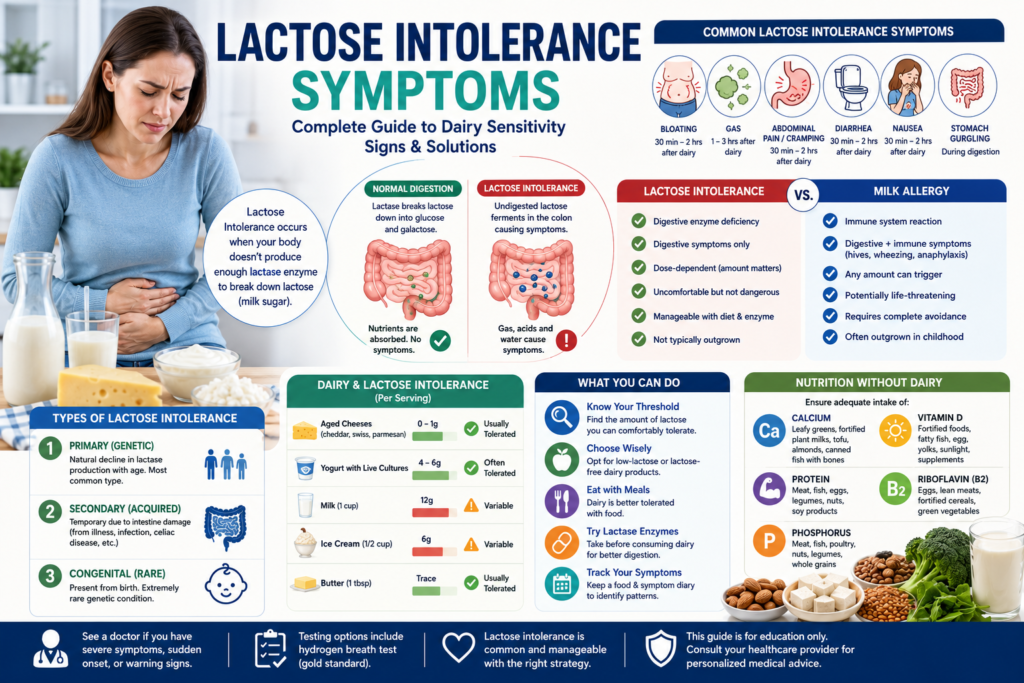
Lactose intolerance occurs when your small intestine doesn’t produce enough lactase, the enzyme responsible for breaking down lactose (the natural sugar found in milk and dairy products).
Normal Digestion:
- You consume dairy containing lactose
- Lactase enzyme in small intestine breaks lactose into glucose and galactose
- These simple sugars are absorbed into the bloodstream
- No symptoms occur
Lactose Intolerance:
- You consume dairy containing lactose
- Insufficient lactase means lactose remains undigested
- Undigested lactose travels to the colon
- Gut bacteria ferment the lactose
- This produces gas, acids, and draws water into the colon
- Symptoms occur (bloating, gas, diarrhea, cramping)
Lactose Intolerance vs. Milk Allergy: Critical Difference
These conditions are NOT the same:
| Feature | Lactose Intolerance | Milk Allergy |
|---|---|---|
| What it is | Enzyme deficiency | Immune system reaction |
| What triggers it | Lactose (milk sugar) | Milk protein (casein, whey) |
| Onset | 30 minutes to 2 hours after dairy | Minutes to hours |
| Symptoms | Digestive only | Digestive PLUS hives, wheezing, anaphylaxis |
| Severity | Uncomfortable but not dangerous | Potentially life-threatening |
| Treatment | Limit lactose; lactase supplements | Complete milk protein avoidance; epinephrine |
| Outgrown? | No (but tolerance can vary) | Often outgrown in childhood |
Important: Milk allergy requires complete avoidance of all milk products and carries risk of anaphylaxis. Lactose intolerance is about comfort and quality of life, not safety.
Common Lactose Intolerance Symptoms
Primary Digestive Symptoms
| Symptom | Description | Typical Timing |
|---|---|---|
| Bloating | Feeling of fullness, abdominal distension | 30 min – 2 hours after dairy |
| Abdominal pain/cramping | Ranging from mild discomfort to severe cramps | 30 min – 2 hours |
| Gas (flatulence) | Excessive gas production | 1-3 hours |
| Diarrhea | Loose, watery stools; urgency | 30 min – 2 hours |
| Nausea | Feeling sick to stomach; sometimes vomiting | 30 min – 2 hours |
| Stomach gurgling | Audible bowel sounds (borborygmi) | During digestion |
Less Common Symptoms
Some people experience:
- Headache (possibly from gut-brain axis activation)
- Fatigue (after significant digestive distress)
- Muscle aches (rare; possibly inflammatory response)
- Difficulty concentrating (“brain fog” during active symptoms)
- Constipation (less common than diarrhea; methane-producing bacteria)
Symptom Severity Factors
Not all lactose exposure is equal. Symptom severity depends on:
1. Amount of Lactose Consumed
- Small amounts may cause no symptoms
- Larger amounts overwhelm available lactase
- Most people have a “threshold” below which they’re symptom-free
2. Type of Dairy Product
| Dairy Product | Lactose Content (per serving) | Typically Tolerated? |
|---|---|---|
| Hard cheeses (cheddar, Swiss, parmesan) | 0-1g | Usually YES |
| Yogurt with live cultures | 4-6g | Often YES (bacteria help digest) |
| Milk (1 cup) | 12g | Variable |
| Ice cream (½ cup) | 6g | Variable |
| Cottage cheese | 5g | Variable |
| Butter | Trace | Usually YES |
| Whey protein concentrate | Varies (can be high) | Check label |
3. Whether Consumed Alone or With Food
- Dairy on empty stomach = faster, more severe symptoms
- Dairy with meals = slower digestion, more time for lactase to work
4. Individual Lactase Production
- Some people produce small amounts of lactase
- Others produce none at all
Types of Lactose Intolerance
Understanding the type helps determine if it’s temporary or permanent:
1. Primary Lactose Intolerance (Most Common)
What happens: Lactase production naturally decreases with age
Who gets it:
- Begins after infancy (lactase production normally decreases after weaning)
- Symptoms often appear in late childhood, adolescence, or adulthood
- Affects up to 68% of the global population
- Prevalence varies by ethnicity:
- East Asian: 90%+
- West African: 80%+
- Arab: 70%+
- Jewish: 60%+
- Greek: 60%+
- Italian: 40%+
- Northern European: 5-15%
Is it permanent? Yes, but tolerance can be managed
2. Secondary Lactose Intolerance
What happens: Temporary lactase deficiency due to small intestine damage
Causes:
- Gastroenteritis (stomach flu)
- Celiac disease (untreated)
- Crohn’s disease affecting small intestine
- Intestinal surgery
- Chemotherapy or radiation
- Prolonged antibiotic use
Is it permanent? Often temporary—resolves when underlying condition is treated
Important: If lactose intolerance develops suddenly in adulthood, especially with other symptoms, see a doctor to rule out underlying conditions.
3. Congenital Lactose Intolerance (Rare)
What happens: Babies born with complete lactase deficiency
Who gets it: Extremely rare genetic condition; affects infants from birth
Symptoms: Severe diarrhea from first milk feeding; failure to thrive
Treatment: Lactose-free infant formula; genetic counseling
4. Developmental Lactose Intolerance
Who gets it: Premature infants (lactase production increases late in pregnancy)
Is it permanent? No—resolves as infant matures
When Symptoms Appear: Timing Matters
Typical Symptom Timeline
| Time After Dairy | What’s Happening | Symptoms |
|---|---|---|
| 0-30 minutes | Lactose reaches small intestine | Usually no symptoms yet |
| 30-60 minutes | Undigested lactose enters colon | Bloating, gas begins |
| 1-2 hours | Bacterial fermentation peaks | Cramping, diarrhea, urgency |
| 2-4 hours | Digestion continues | Symptoms may persist or worsen |
| 4-6 hours | Lactose fully processed | Symptoms gradually resolve |
Factors affecting timing:
- Faster onset: Dairy on empty stomach, liquid dairy (milk vs. cheese)
- Slower onset: Dairy with fatty meal, aged cheese, yogurt
Self-Assessment: Could It Be Lactose?
Questions to Ask Yourself
- Do symptoms consistently occur after dairy?
- Yes = suggests lactose intolerance
- No = may be something else
- Are symptoms dose-dependent?
- Small amounts okay, large amounts cause problems = suggests lactose intolerance
- Any amount causes symptoms = could be allergy or complete intolerance
- Do certain dairy products cause worse symptoms?
- Milk and ice cream worse than cheese and yogurt = suggests lactose intolerance
- All dairy equally problematic = could be milk protein sensitivity
- Do lactase supplements (Lactaid) help?
- Yes = strongly suggests lactose intolerance
- No = may be different condition
- Did symptoms start after a stomach bug or illness?
- Yes = could be secondary lactose intolerance (potentially temporary)
At-Home Elimination Test
Week 1-2: Complete Lactose Elimination
- Avoid ALL dairy products containing lactose
- Read labels carefully (lactose hides in bread, processed foods, medications)
- Track symptoms daily
Week 3: Controlled Challenge
- Day 1: Consume ½ cup milk on empty stomach
- Track symptoms for 4 hours
- Day 3: Consume 1 cup milk
- Track symptoms
- Day 5: Consume dairy with meal
- Track symptoms
Interpretation:
- Symptoms improve during elimination AND return during challenge = likely lactose intolerant
- No change during elimination = lactose probably not the culprit
- Symptoms during elimination = may be milk protein sensitivity or different condition
Limitation: This suggests but doesn’t confirm lactose intolerance. Medical testing provides definitive diagnosis.
Medical Testing for Lactose Intolerance
1. Hydrogen Breath Test (Gold Standard)
How it works:
- Drink lactose-containing liquid
- Breath samples collected over 2-3 hours
- Elevated hydrogen indicates undigested lactose being fermented by bacteria
Preparation:
- Fast for 8-12 hours before
- No antibiotics for 4 weeks prior
- Avoid certain laxatives before test
Accuracy: 90-95% sensitive and specific
2. Lactose Tolerance Test (Blood Test)
How it works:
- Drink lactose-containing liquid
- Blood glucose measured over 2 hours
- If lactose is digested, blood sugar rises; if not, it stays flat
Limitations:
- Less accurate than breath test
- Affected by diabetes, bacterial overgrowth
- Requires multiple blood draws
3. Stool Acidity Test (For Infants/Young Children)
How it works: Undigested lactose creates lactic acid in stool
When used: Primarily for infants and young children who can’t do breath test
4. Genetic Testing
What it tests: LCT gene variants associated with lactase persistence/non-persistence
Limitations:
- Only detects primary (genetic) lactose intolerance
- Doesn’t detect secondary causes
- Positive result doesn’t indicate severity
5. Trial of Lactase Enzyme
How it works: Take lactase supplement before dairy; if symptoms improve, suggests lactose intolerance
Limitations: Not definitive; placebo effect possible
Conditions That Mimic Lactose Intolerance
Irritable Bowel Syndrome (IBS)
Overlap: Bloating, gas, diarrhea, abdominal pain
Differences:
- IBS symptoms not specifically tied to dairy
- IBS often triggered by FODMAPs (not just lactose)
- IBS may include constipation (less common in lactose intolerance)
Testing: Rome IV criteria for IBS diagnosis; may need breath tests to rule out lactose/SIBO
Milk Protein Allergy
Overlap: Digestive symptoms after dairy
Differences:
- Allergy includes immune symptoms (hives, wheezing, swelling)
- Allergy can be life-threatening
- Allergy often diagnosed in infancy
Testing: Skin prick test, IgE blood test
Small Intestinal Bacterial Overgrowth (SIBO)
Overlap: Bloating, gas, diarrhea after eating
Differences:
- SIBO symptoms triggered by many foods, not just dairy
- SIBO may cause nutrient deficiencies
- SIBO can CAUSE secondary lactose intolerance
Testing: Hydrogen/methane breath test (different protocol than lactose breath test)
Celiac Disease
Overlap: Bloating, gas, diarrhea, abdominal pain after eating
Differences:
- Celiac triggered by gluten (not lactose)
- Celiac causes intestinal damage
- Untreated celiac can cause SECONDARY lactose intolerance
Testing: Celiac blood panel (tTG-IgA), endoscopy with biopsy
Inflammatory Bowel Disease (Crohn’s, Ulcerative Colitis)
Overlap: Diarrhea, abdominal pain, urgency
Differences:
- IBD includes blood in stool, weight loss, fever
- IBD is chronic inflammatory condition
- IBD can cause secondary lactose intolerance
Testing: Colonoscopy, imaging, blood tests (inflammatory markers)
When to See a Doctor
Seek Medical Evaluation If:
Symptoms suggest something other than lactose intolerance:
- Blood in stool
- Unexplained weight loss
- Fever
- Severe or persistent vomiting
- Symptoms that wake you from sleep
- Symptoms that don’t improve with lactose avoidance
Symptoms developed suddenly:
- Adult-onset without prior history
- After travel to developing countries
- After starting new medications
In children:
- Poor growth or weight loss
- Signs of dehydration
- Persistent diarrhea
- Blood in stool
You need confirmation:
- Considering major dietary changes
- Symptoms significantly impact quality of life
- Want to rule out other conditions
Managing Lactose Intolerance Symptoms
Dietary Strategies
1. Know Your Threshold
- Most lactose-intolerant people can tolerate 12-15g lactose (about 1 cup milk) when consumed with food
- Some can tolerate more; some less
- Find YOUR limit through careful testing
2. Choose Lower-Lactose Products
| Lower Lactose | Higher Lactose |
|---|---|
| Aged cheeses (cheddar, Swiss, parmesan) | Milk (all types from cows) |
| Yogurt with live cultures | Ice cream |
| Lactose-free milk | Cottage cheese |
| Butter (in moderation) | Cream cheese |
| Heavy cream (small amounts) | Ricotta cheese |
| Kefir (fermented; lower lactose) | Whey protein concentrate |
3. Consume Dairy With Meals
- Slows digestion
- Gives lactase more time to work
- Reduces symptom severity
4. Try Lactase Enzyme Supplements
- Lactaid, Dairy Ease, store brands
- Take immediately BEFORE consuming dairy
- Effectiveness varies by person and product
- May need to adjust dose based on lactose amount
5. Gradually Increase Tolerance
- Some evidence suggests regular small lactose exposure may help gut bacteria adapt
- Start with very small amounts
- Increase slowly over weeks
- Stop if symptoms become problematic
Nutritional Considerations
Dairy is a major source of several nutrients. If avoiding dairy, ensure adequate intake of:
| Nutrient | Why Important | Non-Dairy Sources |
|---|---|---|
| Calcium | Bone health, muscle function | Fortified plant milks, leafy greens, canned fish with bones, tofu (calcium-set), almonds |
| Vitamin D | Calcium absorption, immune function | Fortified foods, fatty fish, egg yolks, sunlight, supplements |
| Protein | Muscle, tissue repair | Meat, fish, eggs, legumes, soy products |
| Riboflavin (B2) | Energy metabolism | Eggs, lean meats, fortified cereals, green vegetables |
| Phosphorus | Bone health | Meat, fish, poultry, nuts, legumes |
Recommendation: If eliminating dairy, consider meeting with a dietitian to ensure nutritional adequacy.
Frequently Asked Questions
Can lactose intolerance develop suddenly?
Yes. Secondary lactose intolerance can develop after intestinal illness, surgery, or with conditions like celiac disease or Crohn’s. Sudden onset in adulthood warrants medical evaluation to identify underlying causes.
Is lactose intolerance permanent?
Primary lactose intolerance (genetic) is permanent but manageable. Secondary lactose intolerance often resolves when the underlying condition is treated (e.g., after celiac patient heals on gluten-free diet).
Can I build tolerance to lactose?
Some people can increase tolerance through gradual exposure. The gut bacteria may adapt to better handle lactose. However, lactase enzyme production itself doesn’t increase. Try small amounts regularly and slowly increase.
Does lactose intolerance cause weight gain?
No direct link. However, some people gain weight when eliminating dairy if they replace it with higher-calorie alternatives. Others lose weight if they cut out high-calorie dairy (ice cream, full-fat cheese).
Is goat milk easier to digest than cow milk?
Goat milk contains slightly less lactose than cow milk, but the difference is small. Some people find it easier to digest, possibly due to different protein structure or fat composition. Worth trying if you’re mildly intolerant.
Is butter lactose-free?
Butter contains trace amounts of lactose. Most lactose-intolerant people tolerate butter well. Clarified butter (ghee) has virtually no lactose and is usually safe.
Can lactose intolerance cause anxiety?
No direct link. However, chronic digestive discomfort can contribute to anxiety. Some people also report “brain fog” or mood changes during active symptoms, possibly from gut-brain axis activation.
Do lactase supplements work?
For most people with lactose intolerance, yes. Effectiveness varies by individual and product. Take immediately before consuming dairy. Some trial and error may be needed to find the right dose.
Can babies have lactose intolerance?
True congenital lactose intolerance is extremely rare. Breast milk contains lactose, and most babies produce adequate lactase. Temporary lactose intolerance can occur after gastroenteritis. If you suspect lactose issues in an infant, consult a pediatrician before making dietary changes.
Is “lactose-free” the same as “dairy-free”?
No. Lactose-free products contain dairy (milk protein) but have lactase enzyme added to break down lactose. Dairy-free products contain no milk components at all. People with milk allergy need dairy-free; lactose-intolerant people need lactose-free.
Key Takeaways
- Lactose intolerance is common—affects up to 68% of the global population
- Symptoms are digestive—bloating, gas, diarrhea, cramping 30 min to 2 hours after dairy
- It’s NOT a milk allergy—no immune response or anaphylaxis risk
- Most people have SOME tolerance—find your personal threshold
- Aged cheeses and yogurt are often tolerated even when milk is not
- Lactase supplements can help—take immediately before consuming dairy
- Consume dairy with meals to reduce symptom severity
- Sudden onset warrants medical evaluation—could indicate underlying condition
- Nutritional adequacy matters—ensure adequate calcium and vitamin D if avoiding dairy
- Testing is available—hydrogen breath test is most accurate
Medical Disclaimer: This article provides educational information only and does not replace professional medical advice, diagnosis, or treatment. If you suspect lactose intolerance or have persistent digestive symptoms, consult a qualified healthcare provider.
Medical Review: This content has been reviewed for accuracy against current guidelines from the American College of Gastroenterology, National Institute of Diabetes and Digestive and Kidney Diseases (NIDDK), and American Gastroenterological Association.
Sources:
- NIDDK – Lactose Intolerance: Definition & Facts – 2025
- Mayo Clinic – Lactose Intolerance: Symptoms & Causes – 2025
- American Gastroenterological Association – Lactose Intolerance Guidelines – 2024
- NIH Consensus Conference – Lactose Intolerance and Health – 2025
- Journal of Gastroenterology – Lactose Malabsorption Diagnosis – 2025
- Cleveland Clinic – Lactose Intolerance vs. Milk Allergy – 2025
Last Updated: March 9, 2026