GutFeel AI Review: How This App Transforms IBS and Digestive Health Tracking
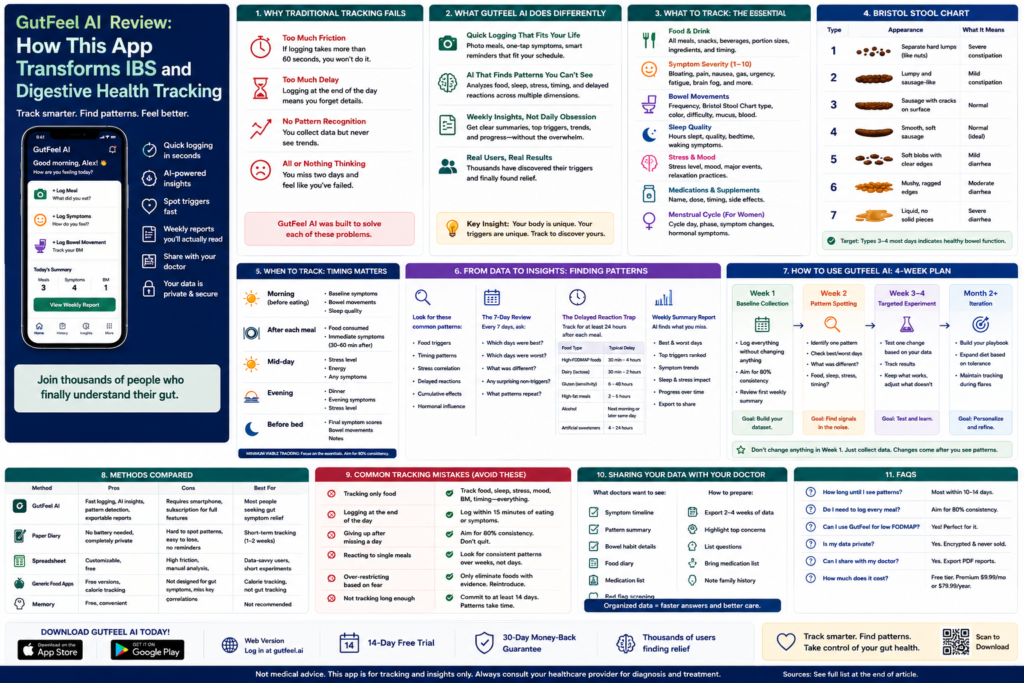
Why Traditional Tracking Fails
You’ve probably tried tracking before. Maybe you used a notebook, a notes app, or one of those detailed food diary templates with seventeen fields.
And then you stopped.
Here’s why that happened:
1. Too Much Friction
If logging takes more than 60 seconds, you won’t do it consistently. Life gets in the way.
2. Too Much Delay
Logging at the end of the day means you forget details. What was that snack at 3 p.m.? Did you have coffee before or after breakfast?
3. No Pattern Recognition
You collect data but never see trends. A spreadsheet doesn’t tell you that your symptoms spike after poor sleep, not just after certain foods.
4. All or Nothing Thinking
You miss two days and feel like you’ve failed. So you quit.
GutFeel AI was built to solve each of these problems.
What GutFeel AI Does Differently
Quick Logging That Fits Your Life
Photo-based meal tracking: Snap a picture. Add a quick note if you want. Done in seconds.
One-tap symptom logging: Rate your bloating, pain, energy, and mood with simple sliders. No essays required.
Smart reminders: Get nudged at times that make sense for your schedule—not generic 9 a.m. alerts.
AI That Finds Patterns You Can’t See
The app analyzes your data across multiple dimensions:
- Food + timing combinations (that salad at lunch vs. dinner)
- Sleep and stress correlations (do your symptoms actually track more with poor sleep than with food?)
- Delayed reactions (symptoms that appear 12-24 hours after eating)
- Cumulative effects (one slice of pizza is fine; three days of heavy meals triggers a flare)
Weekly Insights, Not Daily Obsession
Instead of reacting to every bad meal, you get:
- Weekly summaries showing your best and worst days
- Top triggers ranked by how consistently they affect you
- Progress trends so you can see improvement over time
- Exportable reports you can share with your doctor or dietitian
Real Users, Real Results
Here’s what people discover when they start tracking with GutFeel AI:
“I Thought Dairy Was My Problem”
Priya, 32: After months of avoiding dairy, Priya’s bloating didn’t improve. Two weeks of logging showed her urgency spikes happened most after rushed lunches and poor sleep—not after lactose-free meals. She fixed her lunch timing and bedtime. Flare days dropped from 9 per two weeks to 3.
“The Caffeine Connection Surprised Me”
Marcus, 45: Marcus suspected gluten. The data showed his afternoon crashes and bloating tracked with his second coffee on an empty stomach, not with bread. He switched his caffeine timing. Symptoms resolved in 10 days.
“I Was Eating Too Little”
Sarah, 28: Sarah’s constipation worsened when she tried to “eat clean.” Her log revealed she was averaging 1,200 calories daily with minimal fat. After increasing portions and adding healthy fats, bowel movements normalized within two weeks.
“Stress Was Louder Than Food”
David, 51: David’s symptom scores tracked more closely with his stress ratings than with any food category. He started daily breathing exercises. His gut symptoms decreased by 40% without diet changes.
How to Use GutFeel AI for Maximum Insight
Week 1: Baseline Collection
Goal: Log honestly without changing anything.
- Log every meal (yes, even the “bad” ones)
- Rate symptoms 1-10 at consistent times
- Track sleep quality and stress levels
- Don’t judge—just observe
You’re building a dataset. The more accurate it is, the better your insights.
Week 2: Pattern Spotting
Goal: Review your weekly summary and identify one pattern.
Look for:
- Foods that consistently correlate with symptoms
- Times of day when symptoms peak
- Whether sleep or stress scores predict bad days
- Any surprising non-triggers (foods you feared but tolerate fine)
Week 3-4: Targeted Experiment
Goal: Test one change based on your data.
Examples:
- Move your largest meal earlier in the day
- Add a fiber source at breakfast
- Reduce caffeine or move it after food
- Implement a 3-hour eating window before bed
Track whether symptoms improve. If they do, keep it. If not, try a different lever.
Month 2+: Iteration
Goal: Build your personal playbook.
By now you know:
- Your reliable trigger foods
- Your safe meals for flare days
- How much sleep you need for good digestion
- Which stress management tools actually help
This is your foundation. Refine it over time.
Features That Make GutFeel AI Worth It
What You Get
| Feature | What It Does | Why It Matters |
|---|---|---|
| Photo food logging | Snap meals in seconds | Reduces friction so you actually log |
| Symptom scoring | Rate bloating, pain, energy, mood | Quantifies how you feel for pattern detection |
| Bristol Stool Chart | Visual reference for bowel movements | Removes guesswork from descriptions |
| Sleep tracking | Rate quality and duration | Captures a major symptom driver |
| Stress logging | Daily stress scores | Identifies gut-brain axis patterns |
| Weekly reports | AI-generated insights | Shows trends you’d miss on your own |
| Export function | PDF reports for providers | Helps your clinician help you faster |
| Trigger alerts | Notifications of patterns | Catches issues before they become flares |
What You Don’t Get
We don’t promise to:
- Diagnose medical conditions (we’re not your doctor)
- Replace elimination diets (we help you navigate them)
- Work overnight (patterns take time to emerge)
- Tell you what to eat (we show you what works for your body)
Who GutFeel AI Is For
Great fit if you:
- Have IBS or IBS-like symptoms
- Suspect food sensitivities but aren’t sure which
- Get bloated regularly
- Have been told “it’s stress” and want data
- Are starting a low FODMAP diet and need tracking
- Want to share better data with your doctor
Not a fit if you:
- Need a medical diagnosis (see a gastroenterologist)
- Want a meal plan or recipe database (we’re a tracker, not a cookbook)
- Expect instant answers (give it at least 2 weeks)
- Have active eating disorder behaviors (restrictive tracking can be triggering)
How GutFeel AI Compares to Alternatives
| Method | Pros | Cons |
|---|---|---|
| GutFeel AI | Fast logging, AI insights, pattern detection, exportable reports | Requires smartphone, subscription for full features |
| Paper journal | No battery needed, completely private | Hard to spot patterns, easy to lose, no reminders |
| Generic food apps | Free, calorie tracking | Not designed for gut symptoms, miss key correlations |
| Spreadsheet | Customizable, free | High friction, requires manual analysis |
| Memory | Free, convenient | Highly unreliable, especially when you feel bad |
Pricing and Plans
GutFeel AI offers:
Free Tier:
- Basic meal and symptom logging
- 7 days of history
- Manual pattern review
Premium ($9.99/month or $79.99/year):
- AI-powered insights
- Unlimited history
- Weekly summary reports
- Export to PDF
- Priority support
Is it worth it? If you’ve spent money on supplements, elimination diets, or doctor visits without answers, the cost of clarity is low.
Getting Started: Your First 7 Days
Day 1: Download and set up your profile. Log everything you eat and drink.
Day 2-3: Continue logging. Notice how easy (or hard) it feels. Adjust reminders if needed.
Day 4: Check your symptom scores. Any early patterns?
Day 5-6: Keep logging. Try to log within 30 minutes of eating for accuracy.
Day 7: Review your first weekly summary. What stands out?
Don’t change anything in Week 1. Just collect data. Changes come after you see patterns.
FAQs
How long until I see results?
Most users spot at least one clear pattern within 10-14 days. Some take 3-4 weeks. Complex cases with multiple triggers may need 6-8 weeks of data.
Do I need to log every single meal?
Aim for 80% consistency. Four honest days out of seven gives you usable data. Perfection isn’t required.
Can I use GutFeel AI for low FODMAP?
Yes. Many users track their elimination and reintroduction phases with GutFeel. The weekly reports help you see which FODMAP groups trigger symptoms.
Is my data private?
Yes. Your health data is encrypted and never sold to third parties. You control what you share.
Can I share reports with my doctor?
Absolutely. The export function creates clean PDF summaries your provider can review. Many users find this speeds up diagnosis and treatment.
What if I have an eating disorder history?
Talk to your treatment team before using any tracking app. For some people, logging is therapeutic. For others, it can be triggering. We’re happy to provide refunds if tracking isn’t right for you.
Is GutFeel AI available on iOS and Android?
Yes. GutFeel AI is available for both iOS (iPhone/iPad) and Android devices. Download from the App Store or Google Play. A web version is also available for desktop logging.
How much does GutFeel AI cost?
Free tier includes basic logging and 7 days of history. Premium is $9.99/month or $79.99/year (save 33%) with AI insights, unlimited history, and exportable reports. 30-day money-back guarantee.
Can I use GutFeel AI for SIBO symptom tracking?
Yes. Many users track SIBO symptoms during treatment and use GutFeel to monitor treatment response, identify die-off patterns, and share data with their practitioners.
Does GutFeel AI work with Apple Health or Google Fit?
Yes. GutFeel AI integrates with both Apple Health and Google Fit to automatically import sleep, activity, and heart rate data for more comprehensive pattern analysis.
Ready to Find Your Patterns?
Your gut is sending signals. The question is whether you’re collecting them—or just guessing.
GutFeel AI turns months of confusion into weeks of clarity. Not because it’s magic. Because it’s consistent.
Start your 14-day free trial today:
- iOS users: [Download on the App Store](#)
- Android users: [Get it on Google Play](#)
- Web version: [Log in at gutfeel.ai](#)
30-day money-back guarantee. If you don’t discover at least one actionable pattern, we’ll refund your subscription.
Sources
- WHO. “Digital Interventions for Health System Strengthening.” 2019.
- NIH National Library of Medicine. “Mobile Health (mHealth).” 2024.
- JMIR. “Digital Self-Management Interventions for GI Symptoms.” 2022.
- NIDDK. “Digestive Diseases Overview.” 2024.
- CDC. “Sleep and Chronic Disease.” 2024.
- NHS. “Self-Help for IBS.” 2024.
- American Journal of Gastroenterology. “ACG Clinical Guideline: Irritable Bowel Syndrome.” 2021.
- Monash University. “FODMAP Diet App and Resources.” 2024.
- Nature Digital Medicine. “AI-Powered Symptom Tracking in Gastroenterology.” 2023.
- Gut Journal. “Food-Symptom Relationships in IBS: A Digital Health Approach.” 2022.
Not medical advice: GutFeel AI is a wellness tool and does not diagnose or treat medical conditions. Consult your healthcare provider for medical concerns.