Hidden Lactose: 50+ Foods and Medications That Contamine Your Dairy-Free Diet
Understanding Hidden Lactose
Why Lactose Hides in Foods
Lactose and milk derivatives serve multiple purposes in processed foods:
| Function | Why Manufacturers Use It | Common Products |
|---|---|---|
| Filler/bulking agent | Adds volume without affecting taste | Medications, protein bars, powdered products |
| Flavor enhancer | Adds richness and mouthfeel | Processed meats, sauces, snacks |
| Texture modifier | Improves consistency | Baked goods, ice cream alternatives |
| Browning agent | Promotes golden color in baking | Bread, crackers, cookies |
| Protein source | Inexpensive protein additive | Protein bars, shakes, supplements |
The “Non-Dairy” Trap
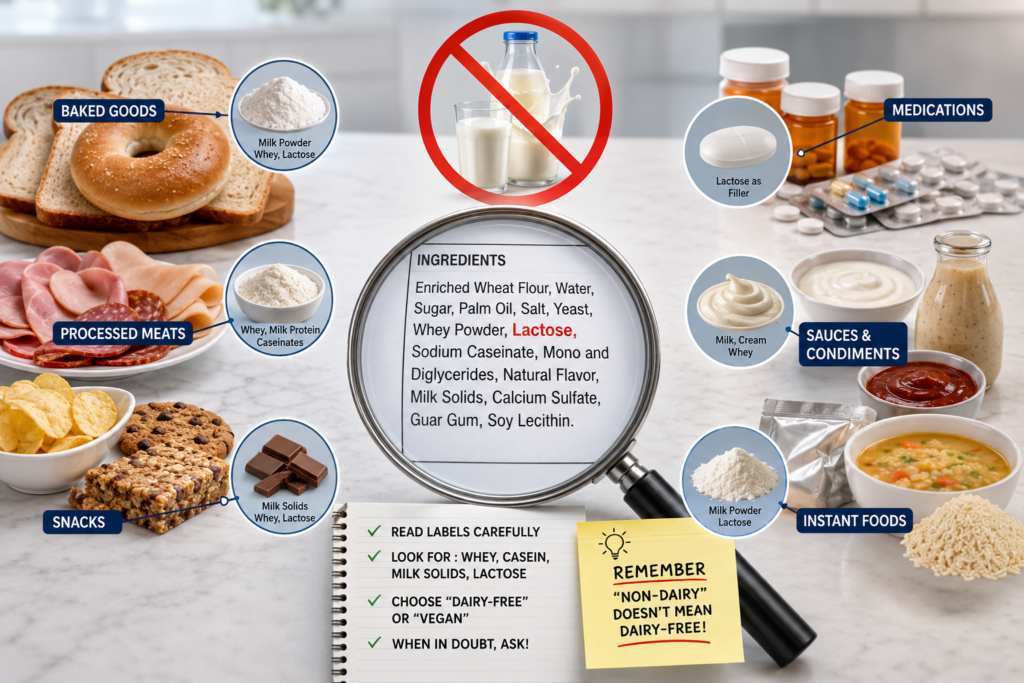
Critical: In the U.S., products labeled “non-dairy” can legally contain milk derivatives.
Why? FDA regulations allow “non-dairy” on products containing casein or caseinates (milk proteins). This is particularly common in:
- Non-dairy creamers
- Coffee whiteners
- Some vegan cheese alternatives
- Powdered drink mixes
Look for: “Dairy-free” or “Vegan” labels instead—these standards prohibit milk derivatives.
Hidden Lactose Foods: The Complete List
Baked Goods and Breads
| Food | Why It Contains Lactose | Safer Alternative |
|---|---|---|
| Commercial bread | Dry milk powder, whey, or butter | Check labels; bakery bread (ask ingredients); gluten-free bread |
| Bagels | Milk powder in dough; butter brushed on top | Plain bagels from bakeries that confirm no dairy |
| English muffins | Often contain milk solids | Thomas’ Original (some varieties are dairy-free) |
| Pancake/waffle mix | Dry milk powder | Krusteaz Buttermilk (contains dairy) → Use plant milk + dairy-free mix |
| Muffins | Milk, butter, or milk powder | Homemade with plant milk; some coffee shop options |
| Biscuits | Butter or shortening with milk solids | Homemade dairy-free versions |
| Pizza dough | Some recipes include milk or whey | Ask restaurant; most traditional recipes are dairy-free |
| Crackers | Whey, milk solids, butter | Check labels; many plain crackers are dairy-free |
| Cookies | Butter, milk solids | Oreos (original) are dairy-free; check labels |
| Cake mixes | Dry milk powder | Duncan Hines (some varieties); check labels |
Label Terms to Avoid:
- Dry milk powder
- Milk solids
- Whey
- Buttermilk
- Butter
Breakfast Foods
| Food | Why It Contains Lactose | Safer Alternative |
|---|---|---|
| Instant oatmeal packets | Dry milk powder in flavored varieties | Plain oats + your own milk/sweeteners |
| Cereal | Some contain milk powder or whey | Most plain cereals are dairy-free; check flavored varieties |
| Granola bars | Yogurt coating, milk chocolate, whey protein | Larabar, Kind (some varieties), homemade |
| Breakfast sandwiches | Cheese, butter, creamy sauces | Order without cheese; request no butter |
| Frozen waffles | Some contain milk | Check labels; many are dairy-free |
| Smoothie mixes | Yogurt powder, whey protein | Plant-based protein smoothies |
Processed Meats
| Food | Why It Contains Lactose | Safer Alternative |
|---|---|---|
| Deli meats | Fillers, binders often contain whey or milk protein | Applegate Farms (many dairy-free varieties); check labels |
| Hot dogs | Milk protein as filler | All-beef hot dogs; check labels |
| Sausages | Milk protein, casein | Check labels; some Italian sausages contain milk |
| Bacon | Some flavored varieties contain dairy | Plain bacon; avoid maple/honey flavors |
| Breaded chicken/fish | Milk in breading | Check labels; most frozen breaded products contain dairy |
| Meatballs | Milk or breadcrumbs with milk | Homemade; check restaurant ingredients |
| Burgers (pre-made) | Fillers may contain milk | Plain ground beef; avoid pre-seasoned |
Sauces, Dressings, and Condiments
| Food | Why It Contains Lactose | Safer Alternative |
|---|---|---|
| Salad dressings | Cream-based, cheese flavoring, buttermilk | Oil and vinegar; check creamy varieties |
| Mayonnaise | Usually dairy-free, but some varieties contain milk | Hellmann’s/Best Foods (regular is dairy-free) |
| Gravy | Butter, cream, or milk powder | Check ingredients; some are dairy-free |
| Alfredo sauce | Cream, cheese, butter | Dairy-free alternatives (Follow Your Heart) |
| Cheese sauce | Obviously contains dairy | Nutritional yeast-based sauces |
| Pesto | Some contain parmesan | Check labels; many traditional pestos have cheese |
| Salsa | Usually dairy-free | Most are safe; check creamy varieties |
| Soy sauce | Dairy-free | Most are safe |
| Worcestershire sauce | Some contain anchovies (not dairy but allergen concern) | Lea & Perrins (dairy-free) |
| BBQ sauce | Usually dairy-free; some contain butter | Check labels |
| Marinades | May contain butter, cream, or yogurt | Check labels carefully |
Snacks
| Food | Why It Contains Lactose | Safer Alternative |
|---|---|---|
| Potato chips | Flavored varieties (sour cream, cheese) | Plain, salted chips |
| Tortilla chips | Some cheese-flavored varieties | Plain corn chips |
| Pretzels | Butter-flavored varieties | Plain pretzels |
| Popcorn | Butter flavoring, cheese powder | Air-popped; check microwave varieties |
| Protein bars | Whey protein, milk chocolate | Plant-based protein bars (Vega, Garden of Life) |
| Trail mix | Yogurt-covered items, milk chocolate | Make your own with dairy-free chocolate |
| Rice cakes | Some flavored varieties contain dairy | Plain; check caramel/chocolate varieties |
| Crackers | Cheese crackers, butter crackers | Plain crackers; check labels |
Beverages
| Food | Why It Contains Lactose | Safer Alternative |
|---|---|---|
| Coffee drinks | Milk, cream, flavored syrups with dairy | Plant milk; black coffee |
| Tea lattes | Milk, milk powder | Plant milk alternatives |
| Hot chocolate | Milk powder, whey | Dairy-free hot chocolate mixes |
| Protein shakes | Whey or casein protein | Plant-based protein (pea, soy, rice) |
| Meal replacement drinks | Milk derivatives | Plant-based options (ensure some are dairy-free) |
| Alcohol | Cream liqueurs (Baileys), some cocktails | Wine, most spirits, dairy-free beer |
| Powdered drink mixes | Milk powder, whey | Check labels; many are dairy-free |
Unexpected Sources
| Food | Why It Contains Lactose | Safer Alternative |
|---|---|---|
| Instant potatoes | Dry milk powder, butter powder | Plain potatoes; check boxed varieties |
| Instant rice/pasta sides | Cheese powder, butter | Plain grains; check flavored varieties |
| Soup (canned/dry) | Cream-based, cheese, milk powder | Broth-based soups; check labels |
| Frozen dinners | Cheese, cream sauces, butter | Check labels carefully; many contain dairy |
| Veggie burgers | Some contain cheese or milk protein | Check labels; many are dairy-free |
| Breaded tofu | May contain milk in breading | Plain tofu; check ingredients |
| Sugar substitutes | Some contain lactose as filler | Check labels |
| Sugar-free candy | Lactose used as bulking agent | Check labels carefully |
| Chewing gum | Some contain milk derivatives | Check labels |
| Dark chocolate | Some brands contain milk solids | Check labels; Lindt 70%+ is dairy-free |
| Margarine | Some contain milk derivatives | Earth Balance (dairy-free varieties) |
Lactose in Medications and Supplements
How Common Is Lactose in Medications?
Studies show: Approximately 20-25% of prescription medications and up to 70% of over-the-counter medications contain lactose as a filler or binder.
Medications That Often Contain Lactose
| Medication Type | Examples | Lactose-Free Options |
|---|---|---|
| Birth control pills | Many brands | Ask pharmacist for specific brands |
| Antacids | Some Tums, Rolaids | Calcium citrate without lactose |
| Antihistamines | Some Benadryl formulations | Check with pharmacist |
| Anti-anxiety medications | Some Xanax, Ativan | May have alternatives |
| Cholesterol medications | Some statins | Many are lactose-free |
| Blood pressure medications | Some ACE inhibitors | Many alternatives available |
| Pain relievers | Some acetaminophen, ibuprofen | Many are lactose-free |
| Antidepressants | Some SSRIs | Ask about alternatives |
| Thyroid medications | Some levothyroxine | Synthroid contains lactose; alternatives exist |
| Metformin | Some formulations | Many generic versions are lactose-free |
What to Do
- Ask your pharmacist to check medication ingredients
- Request lactose-free alternatives when available
- Don’t stop prescribed medications without consulting your doctor
- Know that most people tolerate medication lactose (amounts are typically very small)
How Much Lactose Is in Medications?
Typically 50-500 mg per tablet—far less than the 12,000 mg in a cup of milk. Most lactose-intolerant people tolerate medication amounts without issues.
Label Reading: Ingredient Names That Indicate Lactose
ALWAYS Contains Lactose
| Ingredient | What It Is |
|---|---|
| Milk | Obvious source |
| Milk solids | Dried milk |
| Dry milk powder | Concentrated milk |
| Non-fat dry milk | Dried skim milk |
| Lactose | Milk sugar itself |
| Lactulose | Synthetic lactose derivative |
| Whey | Liquid byproduct of cheese making |
| Whey protein | Protein from whey |
| Whey hydrolysate | Pre-digested whey |
| Casein | Milk protein |
| Caseinates (calcium, sodium, potassium) | Casein derivatives |
| Rennet casein | Casein from cheese production |
| Hydrolyzed casein | Broken-down casein |
| Milk protein concentrate | Concentrated milk protein |
| Milk protein isolate | Isolated milk protein |
| Sweet cream butter | Butter from sweet cream |
| Butter | Contains trace lactose |
| Butterfat | Milk fat |
| Butter oil | Concentrated butter fat |
| Ghee | Clarified butter (trace lactose) |
| Cream | High in lactose |
| Half and half | Cream and milk mixture |
| Sour cream | Fermented cream |
| Yogurt | Contains lactose (usually less than milk) |
| Kefir | Fermented milk drink |
| Custard | Milk-based dessert |
| Pudding | Milk-based dessert |
Usually Safe (NOT Lactose)
| Ingredient | Why It’s Safe |
|---|---|
| Lactic acid | Despite the name, not lactose (fermentation product) |
| Lactate | Salt form of lactic acid |
| Sodium lactate | Salt of lactic acid |
| Calcium lactate | Salt of lactic acid |
| Potassium lactate | Salt of lactic acid |
| Lactylate | Chemical derivative (not lactose) |
| Sodium stearoyl lactylate | Emulsifier (not lactose) |
| Cocoa butter | From cocoa beans (dairy-free) |
Important: “Lact-” prefix doesn’t always mean lactose! Lactic acid and lactates are NOT lactose.
“Non-Dairy” Products That Contain Milk
The Legal Loophole
FDA regulations allow products to be labeled “non-dairy” even if they contain casein or caseinates. This is because these terms were defined before modern food science.
Common “Non-Dairy” Products with Milk
| Product | Milk Ingredient | Why It’s Misleading |
|---|---|---|
| Coffee creamers (Coffee-Mate, etc.) | Sodium caseinate | Labeled “non-dairy” but contains milk protein |
| Whipped topping (Cool Whip) | Sodium caseinate | “Non-dairy” but contains milk derivative |
| Some vegan cheeses | Casein (rare but exists) | Check labels carefully |
| Powdered drink mixes | Whey or milk powder | May say “non-dairy” on front |
| Some chocolate products | Milk fat, casein | “Non-dairy chocolate” may contain milk |
What to Look For Instead
- “Dairy-free” label (stricter standard)
- “Vegan” certification (no animal products)
- Ingredient list (always verify)
Cross-Contact: Hidden Lactose in Food Preparation
Restaurant Risks
| Situation | Risk | Solution |
|---|---|---|
| Shared grill | Butter residue from other foods | Request oil instead; clean surface |
| Shared fryer | Dairy residue from breaded items | Ask about dedicated fryer |
| Salad bar | Cheese contamination | Request freshly prepared salad |
| Sandwich shop | Shared knives, cutting boards | Ask for clean utensils and surface |
| Pizza restaurant | Flour contaminated with milk | High risk; consider avoiding |
| Bakery | Airborne milk particles | High risk for sensitive individuals |
Home Kitchen Cross-Contact
| Situation | Risk | Solution |
|---|---|---|
| Shared toaster | Breadcrumbs from regular bread | Dedicated gluten/dairy-free toaster |
| Shared cutting board | Residue from cheese cutting | Separate cutting board; clean thoroughly |
| Shared butter | Knife contamination | Separate butter container |
| Shared condiments | Crumb contamination | Squeeze bottles; separate jars |
Hidden Lactose Calculator: How Much Is Too Much?
Typical Lactose Thresholds
Research shows most lactose-intolerant adults can tolerate:
| Lactose Amount | Equivalent To | Typical Tolerance |
|---|---|---|
| 0-6 grams | ½ cup milk, 1 oz aged cheese | Usually tolerated by most |
| 6-12 grams | 1 cup milk | Tolerated by ~70% when consumed with food |
| 12-18 grams | 1½ cups milk | Variable tolerance |
| 18+ grams | 2+ cups milk | Usually causes symptoms |
Hidden Lactose Accumulation
Example day that exceeds threshold:
- Coffee with regular milk (breakfast): 3g
- Deli meat sandwich (lunch): 2g
- Protein bar (snack): 5g
- Bread with dinner: 1g
- Medication: 0.5g
- Total: 11.5g (may cause symptoms in sensitive individuals)
Frequently Asked Questions
Is lactose in medication enough to cause symptoms?
For most people, no. Medication lactose (50-500mg) is far less than milk (12,000mg per cup). However, highly sensitive individuals may notice symptoms, especially with multiple medications.
Are there lactose-free versions of common medications?
Often yes. Ask your pharmacist to check ingredients and request alternatives. Many manufacturers offer lactose-free formulations.
Can I take lactase enzyme with medications?
Yes, but it’s usually unnecessary. The small amount of lactose in medications is typically tolerated without enzyme supplementation.
Does cooking destroy lactose?
No. Lactose is heat-stable and survives baking, boiling, and frying. Cooking doesn’t reduce lactose content.
Is “milk-free” the same as “lactose-free”?
No. “Lactose-free” means lactose sugar has been removed (but milk protein remains). “Milk-free” or “dairy-free” means no milk components at all. People with milk allergy need milk-free products.
Are there hidden lactose sources in fast food?
Yes. Many fast food items contain hidden lactose:
- McDonald’s french fries (contain beef flavoring with milk derivative)
- Most burger buns (may contain milk)
- Breaded chicken items
- Creamy sauces and dressings
Always check allergen information online or ask staff.
Is lactose in protein powder dangerous for lactose intolerance?
Whey protein concentrate contains lactose. Whey protein isolate has most lactose removed. Plant-based proteins (pea, rice, soy) are lactose-free. Choose based on your tolerance level.
Does lactose affect everyone the same way?
No. Tolerance varies widely:
- Some people react to 3g of lactose
- Others tolerate 20g+ without symptoms
- Tolerance can change over time
- Consuming lactose with food increases tolerance
Can lactose intolerance develop gradually?
Yes. Many people notice increasing sensitivity over years as lactase production naturally decreases. What was once tolerated may become problematic.
Are there lactose-free versions of processed foods?
Increasingly yes. Many manufacturers now offer:
- Lactose-free bread
- Lactose-free protein bars
- Lactose-free snacks
Check labels or look for “lactose-free” certification.
Key Takeaways
- Lactose hides in surprising places—bread, processed meats, medications, and even some “non-dairy” products
- Read every label, every time—formulas change without notice
- “Non-dairy” doesn’t mean dairy-free—look for “dairy-free” or “vegan” labels instead
- Learn the ingredient names—whey, casein, milk solids all indicate lactose
- Medications often contain lactose—but amounts are usually too small to cause symptoms
- Cross-contact matters—shared cooking surfaces can transfer lactose
- Track your total daily intake—small amounts add up throughout the day
- Most people can tolerate SOME lactose—find your personal threshold
- Lactic acid and lactates are NOT lactose—despite similar names
- When in doubt, ask—restaurants and manufacturers can provide ingredient information
Medical Disclaimer: This article provides educational information only and does not replace professional medical advice or dietary guidance. Work with a qualified healthcare provider and registered dietitian for personalized recommendations.
Sources:
- NIDDK – Lactose Intolerance: Diet Management – 2025
- FDA – Food Labeling Guide – 2025
- Journal of Food Science – Hidden Dairy Ingredients in Processed Foods – 2024
- Academy of Nutrition and Dietetics – Reading Food Labels for Lactose – 2025
- Mayo Clinic – Lactose Intolerance: Treatment – 2025
- NIH – Lactose in Medications Database – 2025
Last Updated: March 9, 2026