Gallbladder Attacks: What to Do When Pain Strikes—Emergency Signs, Immediate Relief, and When to Seek Care
What Is a Gallbladder Attack?
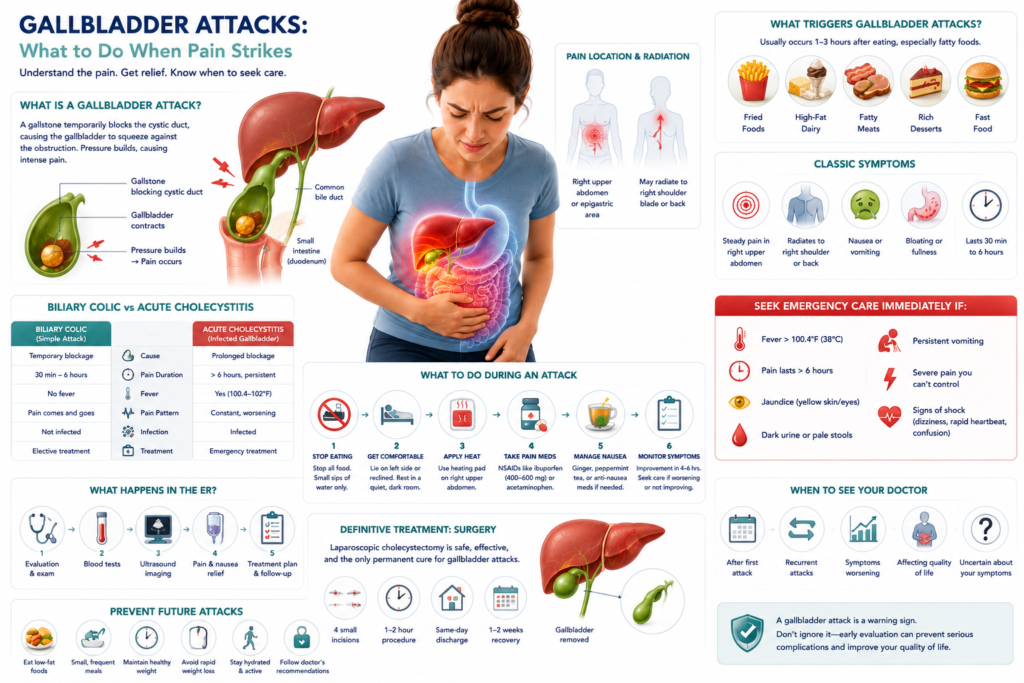
A “gallbladder attack” (medically termed biliary colic) occurs when a gallstone temporarily blocks the cystic duct—the tube that carries bile from your gallbladder to your small intestine.
The Attack Mechanism
Normal function:
- You eat food, especially fatty food
- Your body releases cholecystokinin (CCK), a hormone
- CCK signals your gallbladder to contract
- Gallbladder squeezes bile through the cystic duct
- Bile flows into small intestine to help digest fat
During an attack:
- You eat food (often high-fat)
- Gallbladder contracts to release bile
- A gallstone blocks the cystic duct
- Gallbladder continues squeezing against the obstruction
- Pressure builds dramatically inside the gallbladder
- This pressure causes intense pain
When the stone moves:
- Stone falls back into gallbladder OR passes through into common bile duct
- Duct opens, pressure releases
- Pain gradually subsides over 1-4 hours
Biliary Colic vs. Acute Cholecystitis
It’s crucial to understand the difference:
| Feature | Biliary Colic (Simple Attack) | Acute Cholecystitis (Infected Gallbladder) |
|---|---|---|
| Cause | Temporary blockage | Prolonged blockage with infection |
| Pain duration | 30 min to 6 hours | >6 hours, persistent and worsening |
| Fever | No | Yes (100.4-102°F / 38-39°C) |
| White blood cells | Normal | Elevated |
| Gallbladder tenderness | Mild | Severe, positive Murphy’s sign |
| Systemic symptoms | Nausea only | Malaise, anorexia, tachycardia |
| Treatment | Elective surgery | Hospitalization, urgent surgery |
| Complications | None if resolved | Gangrene, perforation, sepsis |
Why this matters: Biliary colic is painful but not an emergency. Acute cholecystitis IS an emergency requiring immediate medical care.
Recognizing a Gallbladder Attack: Classic Symptoms
The Pain Pattern
Location:
- Primary: Right upper quadrant (under right rib cage)
- Also common: Epigastrium (upper middle abdomen, below breastbone)
- May start in: Middle abdomen, then localize to right side
Radiation (highly characteristic):
- To right shoulder blade (scapula)—most common
- To right shoulder tip
- To right side of back
- Sometimes to chest (can mimic heart attack)
Quality:
- Steady, constant pressure (NOT cramping or wave-like despite the term “colic”)
- Deep, boring, or squeezing sensation
- Patients often describe: “Someone squeezing my ribs with a vise” or “A heavy weight under my ribs”
- NOT relieved by changing position, passing gas, or having a bowel movement
Intensity:
- Moderate to severe
- Often causes patients to stop activities, lie down, or pace
- May cause sweating
- Can be severe enough to require emergency room visit
Timing:
- Onset: Sudden, typically 1-3 hours after eating
- Peak: Within 30-60 minutes of onset
- Duration: 30 minutes to 6 hours (typically 1-4 hours)
- Resolution: Gradual, as stone dislodges
- Frequency: Variable—some people have one attack, others have weekly attacks
Associated Symptoms
Gastrointestinal:
- Nausea: Present in 60-70% of attacks
- Vomiting: Present in 30-40% of attacks
- Belching/bloating: Common
- Feeling of fullness: Frequent complaint
What’s NOT typical of simple biliary colic:
- Fever (suggests infection/cholecystitis)
- Chills (suggests infection)
- Jaundice (yellow skin/eyes—suggests bile duct obstruction)
- Dark urine or pale stools (suggests bile duct obstruction)
- Diarrhea (uncommon)
What Triggers Gallbladder Attacks?
Primary trigger: Fatty meals
Fat is the strongest stimulus for gallbladder contraction. Common trigger foods include:
| Food Category | Specific Triggers |
|---|---|
| Fried foods | French fries, fried chicken, donuts, onion rings |
| High-fat dairy | Ice cream, whole milk, cheese, cream, butter |
| Fatty meats | Bacon, sausage, ribs, marbled steaks, hot dogs |
| Pizza | Combination of cheese and oil |
| Rich desserts | Pastries, cakes, chocolate |
| Creamy sauces | Alfredo, hollandaise, béarnaise |
| Fast food | Burgers, fried fish, tacos |
Why the delay?
It takes 1-3 hours for fat to travel from stomach to small intestine, trigger CCK release, and cause gallbladder contraction. This is why attacks often occur at night, hours after dinner.
Other triggers:
- Large meals (distend stomach, trigger stronger gallbladder contraction)
- Late-night eating (attacks often wake people from sleep)
- Certain individuals report eggs as a trigger
- Some report chocolate as a specific trigger
Who Gets Gallbladder Attacks?
Risk factors (the classic “5 F’s” plus more):
- Female: Women are 2-3x more likely than men
- Forty (or older): Risk increases with age
- Fat (obese): BMI >30 increases risk 2-3x
- Fertile (multiple pregnancies): Each pregnancy increases risk
- Family history: Genetics play significant role
- Rapid weight loss: >3 lbs/week dramatically increases risk
- Certain medications: Estrogen therapy, fibrates, ceftriaxone
- Ethnicity: Native American, Hispanic > Caucasian > African American
What to Do DURING a Gallbladder Attack
If you’re experiencing what you believe is a gallbladder attack, here’s a step-by-step approach.
Step 1: Stop Eating
Immediately:
- Stop eating any food
- Your gallbladder will continue contracting as long as fat is in your digestive system
- Eating more will prolong the attack
Drinking:
- Small sips of water are okay
- Avoid fatty liquids (milk, cream)
- Avoid alcohol
Step 2: Get Comfortable
Positioning:
- Lie down on your left side (may reduce pressure on gallbladder)
- Or lie on your back with knees bent
- Some people find sitting leaned forward helps
- Find whatever position feels least painful
Environment:
- Quiet, dark room
- Minimize movement
- Rest—don’t try to “push through” with activity
Step 3: Apply Heat
Heat therapy:
- Heating pad or hot water bottle to right upper abdomen
- Warm (not hot) temperature
- 15-20 minutes at a time
- Can provide significant pain relief through muscle relaxation and improved blood flow
Alternative:
- Warm bath or shower
- Warm compress
Step 4: Take Pain Medication
Over-the-counter options:
| Medication | Dose | Notes |
|---|---|---|
| Ibuprofen (Advil, Motrin) | 400-600 mg every 6-8 hours | NSAID, reduces inflammation; take with small amount of food |
| Naproxen (Aleve) | 440-550 mg every 12 hours | Longer-acting NSAID |
| Acetaminophen (Tylenol) | 500-1000 mg every 6 hours | Not anti-inflammatory but helps pain; safer for stomach |
Important considerations:
- NSAIDs (ibuprofen, naproxen) are actually preferred for biliary colic—they reduce gallbladder inflammation
- Don’t exceed maximum daily doses
- Avoid NSAIDs if you have kidney disease, stomach ulcers, or are on blood thinners
- If OTC medications don’t touch the pain, you need medical evaluation
Prescription medications (if you have them):
- Antispasmodics: Hyoscyamine, dicyclomine—can reduce gallbladder spasm
- Stronger pain relievers: Some patients have prescription opioids for severe attacks
Step 5: Manage Nausea
If nauseated:
- Ginger tea or ginger ale (flat)
- Peppermint tea
- Small sips of clear liquids
- Rest in quiet environment
Over-the-counter options:
- Dimenhydrinate (Dramamine): Can help with nausea
- Meclizine (Bonine): Antihistamine with anti-nausea effects
Prescription options (if you have them):
- Ondansetron (Zofran)
- Metoclopramide (Reglan)
- Promethazine (Phenergan)
Step 6: Monitor Your Symptoms
Track:
- When pain started
- Pain intensity (1-10 scale)
- Any fever (check temperature)
- Whether you’re vomiting
- Whether pain is getting better or worse
Set a mental alarm:
- If pain isn’t improving after 4-6 hours, you need medical evaluation
- If you develop fever, jaundice, or persistent vomiting, seek care immediately
What NOT to Do During an Attack
Don’t:
- Eat more food (even “bland” food)
- Drink alcohol
- Take a “gallbladder flush” (olive oil and lemon juice)—this can make things much worse
- Ignore severe or worsening symptoms
- Drive yourself to the hospital if in severe pain
- Take multiple medications without checking for interactions
When to Seek Emergency Care
This is the most critical information. Knowing when a gallbladder attack has become an emergency can save your life.
Go to Emergency Room IMMEDIATELY If You Have:
Fever with abdominal pain:
- Temperature >100.4°F (38°C)
- Suggests infected gallbladder (acute cholecystitis)
- Requires IV antibiotics and often urgent surgery
Pain lasting more than 6 hours:
- Simple biliary colic should resolve within 6 hours
- Persistent pain suggests ongoing obstruction/infection
- Don’t wait—go to ER
Severe pain you can’t tolerate:
- Pain not relieved by OTC medications
- Pain so severe you can’t find a comfortable position
- Pain with rigid, board-like abdomen
Jaundice:
- Yellowing of skin or whites of eyes
- Dark, tea-colored urine
- Pale, clay-colored stools
- Suggests stone in common bile duct
Repeated vomiting:
- Can’t keep liquids down
- Vomiting blood or material that looks like coffee grounds
- Signs of dehydration (dry mouth, decreased urination, dizziness)
Signs of shock:
- Lightheadedness, fainting
- Rapid heartbeat
- Confusion or altered mental status
- Cold, clammy skin
- Rapid breathing
High-risk patients (lower threshold for ER):
- Age >60
- Diabetes
- Immune suppression
- Pregnancy
- History of heart disease
Call 911 If:
- Unconscious or nearly unconscious
- Severe shortness of breath
- Chest pain with sweating and arm/jaw radiation (could be heart attack)
- Signs of severe sepsis (confusion, very low blood pressure, inability to stay awake)
Go to Urgent Care or Call Your Doctor Within 24 Hours If:
- First gallbladder attack (need confirmation of diagnosis)
- Recurrent attacks (need to discuss surgical options)
- Mild fever without other emergency signs
- Uncertain about symptoms
What Happens at the Emergency Room
Understanding the ER process can reduce anxiety and help you advocate for appropriate care.
Initial Assessment
Vital signs:
- Blood pressure (lying and standing)
- Heart rate
- Temperature
- Respiratory rate
- Oxygen saturation
Physical exam:
- Abdominal examination (checking for tenderness, guarding, Murphy’s sign)
- Assessment for jaundice
- Heart and lung examination
Diagnostic Tests
Blood tests:
- Complete blood count (CBC): Checks for infection (elevated white blood cells)
- Comprehensive metabolic panel: Liver function (bilirubin, alkaline phosphatase, AST/ALT), kidney function, electrolytes
- Lipase/amylase: To rule out pancreatitis
- Pregnancy test: If applicable
Imaging:
- Right upper quadrant ultrasound: First-line test for gallbladder disease
- Looks for gallstones
- Gallbladder wall thickening (>3-4mm suggests cholecystitis)
- Pericholecystic fluid (fluid around gallbladder)
- Sonographic Murphy’s sign (pain when ultrasound probe presses on gallbladder)
- Common bile duct dilation
- CT scan: If diagnosis unclear or evaluating for complications
- HIDA scan: Occasionally used if ultrasound is equivocal
ER Treatment
For uncomplicated biliary colic:
- IV fluids: For hydration
- Pain control: IV NSAIDs (ketorolac) and/or opioids
- Anti-nausea medication: IV ondansetron, metoclopramide, or promethazine
- Observation: Until pain improves and you can tolerate oral intake
- Discharge: Most patients go home same day with follow-up instructions
For acute cholecystitis:
- Admission to hospital: Typically 2-4 days
- IV antibiotics: Ceftriaxone + metronidazole, or piperacillin-tazobactam, or ampicillin-sulbactam
- IV fluids and pain control
- Surgical consultation: For cholecystectomy (typically within 72 hours)
- NPO: Nothing by mouth initially
For common bile duct stones:
- GI consultation: For ERCP (endoscopic stone removal)
- ERCP: Typically within 24-48 hours
- Cholecystectomy: After stone removal, during same hospitalization
Discharge Instructions
If you’re sent home from the ER:
You should receive:
- Prescription for pain medication (if needed)
- Prescription for anti-nausea medication
- Instructions to follow up with surgeon or gastroenterologist
- Dietary recommendations (low-fat diet)
- Return precautions (when to come back)
Make sure you understand:
- What diagnosis you were given
- What medications to take and how
- Who to follow up with and when
- What symptoms should bring you back immediately
After the Attack: Next Steps
A gallbladder attack is a warning sign. Here’s what to do next.
Schedule Follow-Up Appointment
Who to see:
- General surgeon: For consultation about cholecystectomy
- Gastroenterologist: If diagnosis uncertain or if ERCP may be needed
Timing:
- Within 1-2 weeks of first attack
- Sooner if you had complications
What to expect:
- Review of ER records and test results
- Additional imaging if needed (ultrasound if not done in ER)
- Discussion of treatment options
- Recommendation for surgery in most cases
Understand Your Risk of Recurrence
The statistics:
- After first attack: 50% will have another within 1 year
- After first attack: 70% will have another within 2 years
- Attacks often become more frequent and severe over time
- Risk of complications: 1-2% per year
Why surgery is usually recommended:
- Recurrent attacks affect quality of life
- Each attack carries risk of serious complications
- Laparoscopic cholecystectomy is safe and effective (90-95% success rate)
- Recovery is relatively quick (1-2 weeks for most activities)
Dietary Modifications Until Surgery
While waiting for surgery:
Avoid trigger foods:
- Fried and fatty foods
- High-fat dairy
- Fatty meats
- Rich desserts
- Large meals
Eat:
- Small, frequent meals (5-6 per day)
- Lean proteins (chicken breast, fish, tofu)
- Low-fat dairy
- Fruits and vegetables (cooked initially)
- Whole grains (if tolerated)
Keep a food diary:
- Track what you eat
- Note any symptoms
- Identify your personal triggers
Prepare for Surgery
If surgery is recommended:
Pre-operative preparation:
- Medical clearance if needed
- Pre-operative blood work
- Review medications with surgeon (which to stop before surgery)
- Arrange for transportation and help at home
- Fill post-operative prescriptions in advance
What to expect:
- Laparoscopic cholecystectomy (4 small incisions)
- General anesthesia
- 1-2 hour procedure
- Same-day discharge or one night in hospital
- 1-2 week recovery for desk work
Preventing Future Attacks
Definitive Prevention: Surgery
Laparoscopic cholecystectomy:
- Removes the gallbladder entirely
- No gallbladder = no gallbladder attacks
- 90-95% of patients have complete symptom resolution
- Low complication rate (<5%)
- Most people live normally without a gallbladder
If You’re Not Having Surgery
Dietary prevention:
- Strict low-fat diet (<30g fat per day)
- Small, frequent meals
- Avoid known trigger foods
- Don’t skip meals (regular gallbladder emptying is important)
Medications:
- Ursodiol (ursodeoxycholic acid): Can reduce stone formation in some patients, but takes months and stones recur when stopped
- Pain medications: Keep on hand for attacks (discuss with doctor)
Important reality check:
Diet and medications may reduce attack frequency, but they don’t eliminate the underlying problem. Stones remain in the gallbladder and can cause complications at any time. Surgery is the only definitive solution for symptomatic gallstones.
Frequently Asked Questions
How long does a gallbladder attack last?
Typical biliary colic lasts 1-4 hours, with a range of 30 minutes to 6 hours. Pain that persists beyond 6 hours suggests acute cholecystitis (infected gallbladder) and requires emergency evaluation.
Can a gallbladder attack go away on its own?
Yes—biliary colic typically resolves on its own when the stone dislodges and falls back into the gallbladder. However, this doesn’t mean the problem is gone. The stones remain, and attacks are likely to recur (70% within 2 years).
What’s the best position for gallbladder pain?
Many people find relief lying on their left side or on their back with knees bent. These positions may reduce pressure on the gallbladder. Apply heat to the right upper abdomen for additional relief.
Can I prevent gallbladder attacks with diet?
A strict low-fat diet can reduce attack frequency by minimizing gallbladder contractions. However, diet doesn’t eliminate stones or prevent complications. It’s a temporary measure, not a cure.
When is gallbladder surgery urgent vs. elective?
Elective: Uncomplicated biliary colic—schedule surgery within weeks to months.
Urgent (within 72 hours): Acute cholecystitis, gallstone pancreatitis (after initial improvement).
Emergency: Gangrenous gallbladder, gallbladder perforation, ascending cholangitis.
Can gallbladder attacks cause permanent damage?
Individual attacks don’t cause permanent damage, but repeated attacks increase the risk of complications like chronic cholecystitis, gallbladder scarring, and progression to acute cholecystitis or pancreatitis.
Are gallbladder attacks dangerous?
Simple biliary colic is painful but not dangerous. However, it can progress to serious complications (acute cholecystitis, pancreatitis, cholangitis) that CAN be life-threatening if not treated promptly.
What if I’m pregnant and having gallbladder attacks?
Gallbladder attacks are more common during pregnancy due to hormonal changes. Laparoscopic cholecystectomy can be performed safely during pregnancy (preferably in second trimester) if attacks are recurrent or complications develop.
Can children have gallbladder attacks?
Yes, though less common. Gallstones in children are associated with obesity, hemolytic diseases (sickle cell, hereditary spherocytosis), certain medications, and total parenteral nutrition. Treatment is similar to adults.
Will I have gallbladder attacks forever if I don’t have surgery?
Most people with symptomatic gallstones will have recurrent attacks (70% within 2 years). Attacks often become more frequent and severe over time. The risk of serious complications is 1-2% per year.
The Bottom Line
Gallbladder attacks are intensely painful but typically self-limited episodes caused by temporary gallstone obstruction. However, they’re a warning sign that shouldn’t be ignored.
Key takeaways:
- Recognize the pattern: Right upper abdominal pain 1-3 hours after fatty meals, radiating to right shoulder blade, lasting 1-6 hours.
- Know emergency signs: Fever, pain >6 hours, jaundice, persistent vomiting, or severe uncontrolled pain require immediate emergency care.
- Get relief safely: Stop eating, apply heat, take NSAIDs, rest, and monitor symptoms closely.
- Follow up promptly: After any gallbladder attack, see a surgeon to discuss definitive treatment.
- Understand the risks: 70% recurrence rate within 2 years; 1-2% annual risk of serious complications.
- Surgery is definitive: Laparoscopic cholecystectomy is safe, effective, and curative for 90-95% of patients.
Don’t ignore gallbladder attacks. While the pain may resolve on its own, the underlying problem remains. Early evaluation and treatment can prevent serious complications and improve your quality of life.
Medically Reviewed By: Dr. Sarah Mitchell, MD, FACG (Fellow of the American College of Gastroenterology)
Last Updated: March 12, 2026
Medical Disclaimer: This article is for educational purposes only and does not constitute medical advice. If you’re experiencing severe abdominal pain, seek immediate medical attention. Consult with a qualified healthcare provider for diagnosis and treatment of gallbladder disease.