Cross-Contamination in Celiac Disease: The Complete Safety Guide
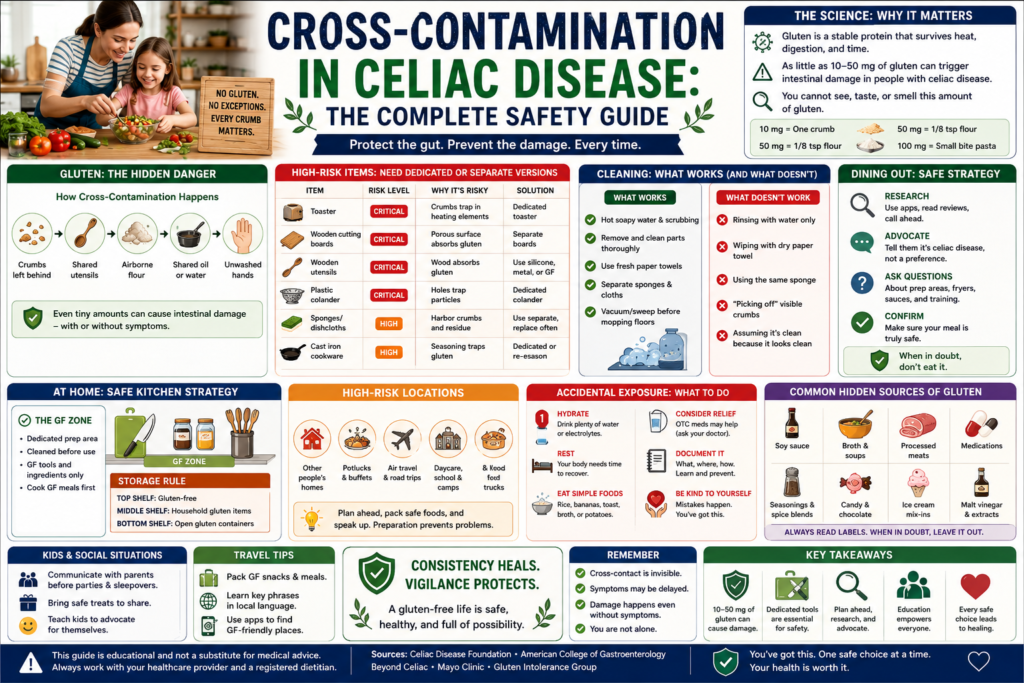
Understanding Cross-Contamination: The Science
What Is Gluten Cross-Contamination?
Cross-contamination occurs when gluten-free foods come into contact with gluten-containing foods or surfaces, making the previously safe food unsafe for people with celiac disease.
Key point: Unlike food allergies where trace amounts might cause mild symptoms, gluten cross-contamination in celiac disease triggers an autoimmune response that causes intestinal damage—even if you don’t feel symptoms.
How Much Gluten Is Dangerous?
Research shows that people with celiac disease can react to as little as 10-50 milligrams of gluten per day. To put this in perspective:
| Gluten Amount | Equivalent To |
|---|---|
| 10 mg | One crumb from a slice of bread |
| 50 mg | 1/8th of a teaspoon of flour |
| 100 mg | A small bite of regular pasta |
| 500 mg | One slice of bread |
Translation: You cannot see, taste, or smell this amount of gluten. A surface can look and feel perfectly clean but still contain enough gluten to cause damage.
How Long Does Gluten Stay Active?
Gluten is a remarkably stable protein:
- On dry surfaces: Can remain active for weeks or months
- In water: Doesn’t dissolve; can contaminate entire pot
- With heat: Cooking does NOT destroy gluten (it survives temperatures up to 500°F+)
- In oil: Survives frying temperatures; contaminates everything cooked in shared oil
Important: Normal rinsing is NOT sufficient. Proper cleaning requires soap, hot water, and scrubbing—or replacement of porous items.
Home Kitchen: Your Cross-Contamination Command Center
Items That MUST Be Dedicated Gluten-Free
These items are high-risk and should be replaced with dedicated gluten-free versions:
| Item | Risk Level | Why | Replacement Cost |
|---|---|---|---|
| Toaster | CRITICAL | Crumbs trap in heating elements; impossible to fully clean | $25-50 |
| Wooden cutting boards | CRITICAL | Porous surface absorbs gluten particles | $15-30 each |
| Wooden spoons/utensils | CRITICAL | Wood absorbs gluten; releases during cooking | $10-20 |
| Plastic colander | CRITICAL | Holes trap particles; nearly impossible to clean | $8-15 |
| Non-stick pans (scratched) | HIGH | Scratches trap gluten particles | $30-50 each |
| Cast iron (shared) | HIGH | Seasoning layer traps gluten | Varies |
| Sponges/dishcloths | HIGH | Harbor crumbs and residue | $5-10 |
| Flour sifter | CRITICAL | Impossible to fully clean once used with wheat flour | $15-25 |
Pro Tip: Color-code your gluten-free items. Use green tape or green-handled tools to mark “safe” items. Everyone in the household should understand the system.
Items That Need Separate Versions
These items should have dedicated gluten-free versions (clearly labeled):
| Item | Why Separate | Storage Strategy |
|---|---|---|
| Butter/margarine | Knives with crumbs dip back in | Use squeeze bottles OR have separate labeled jars |
| Peanut butter/jam | Crumb-contaminated knives | Squeeze bottles OR separate labeled containers |
| Condiments (mayo, mustard) | Same issue | Squeeze bottles preferred |
| Sugar/flour bins | Scoops can mix | Separate containers, clearly labeled, stored apart |
| Cooking oil | Used for frying breaded foods | Separate bottles, stored separately |
Kitchen Prep: Safe Zone Strategy
Create a dedicated gluten-free prep area:
- Choose a zone (one section of counter) that is always gluten-free
- Clean thoroughly before any GF prep
- Store GF ingredients near this zone
- Use separate cutting boards (color-coded)
- Keep GF utensils in a separate container
Best practice: Prepare gluten-free meals FIRST, before any gluten-containing food is prepared. This reduces airborne flour and crumb risk.
Cooking and Baking Safety
Stovetop Safety:
- Use separate pots and pans (or thoroughly clean between uses)
- Never cook GF pasta in water used for regular pasta
- Use separate cooking water for boiling
- Keep GF items covered when cooking alongside gluten
Oven Safety:
- Gluten does NOT become airborne in normal cooking
- However, avoid baking with wheat flour in the same oven at the same time
- Use separate baking sheets (or line with fresh foil/parchment)
- Position GF items on upper rack if cooking simultaneously
Air Fryer/Instant Pot:
- Must be thoroughly cleaned between gluten and GF use
- Consider dedicated GF appliances if used frequently
- Basket inserts can trap crumbs in crevices
Storage Strategies
Pantry Organization:
TOP SHELF: Gluten-free foods (safe zone)
MIDDLE SHELF: Household gluten items
BOTTOM SHELF: Open gluten containers (prevents spill contamination)
Refrigerator Organization:
- Store gluten-free items on designated shelves
- Use sealed containers for all foods
- Label everything clearly
- Store gluten-free items away from potential spill zones
Freezer Organization:
- Wrap GF items separately in sealed bags
- Store above gluten items (prevents crumb fall)
- Label everything with dates and contents
Cleaning Protocols That Actually Work
Effective Cleaning Methods:
| Surface | Method | Notes |
|---|---|---|
| Countertops | Hot soapy water + scrub | Rinse well; paper towels preferred |
| Stovetop | Remove grates, scrub thoroughly | Clean between each use if shared |
| Sink | Scrub with soap, sanitize | Clean before GF dishwashing |
| Dishwasher | Safe for GF dishes | Use separate rack if possible |
| Floors | Sweep/vacuum first, then mop | Crumbs settle on floor |
What DOESN’T Work:
- Rinsing with water alone (ineffective)
- Wiping with dry paper towel (spreads gluten)
- Using the same sponge for gluten and GF areas
- “Picking off” visible crumbs (not sufficient)
Best Practice: Use disposable paper towels for cleaning when preparing for gluten-free cooking.
Dining Out: Navigating Restaurants Safely
Before You Go: Research Is Everything
Step 1: Find Celiac-Safe Restaurants
- Use Find Me Gluten Free app (read reviews from other celiacs)
- Look for restaurants with dedicated GF menus
- Call during off-peak hours (2-4 PM) to discuss protocols
Step 2: Questions to Ask When Calling
- “Do you have a dedicated gluten-free menu?”
- “Is there a separate prep area for gluten-free meals?”
- “Do you use dedicated fryers for gluten-free items?”
- “Can you accommodate a customer with celiac disease?”
- “What training do staff receive on allergens?”
Red Flags:
- “We can just pick the croutons off the salad”
- “A little won’t hurt”
- No allergen menu available
- Server seems confused or dismissive
- Kitchen seems unwilling to discuss protocols
At the Restaurant: Advocacy Saves Lives
When You Arrive:
- Inform the server you have celiac disease (not just “preference” or “sensitivity”)
- Ask to speak with the manager or chef if unsure
- Confirm protocols before ordering
Scripts That Work:
| Situation | What to Say |
|---|---|
| Explaining celiac | “I have celiac disease, which is an autoimmune condition. Even tiny amounts of gluten—like crumbs—can make me very sick. Can you help me order safely?” |
| Fryer question | “Are the french fries cooked in a dedicated fryer, or do they share oil with breaded items?” |
| Grill question | “Can my food be cooked on a clean surface? I can’t have it cooked where bread or buns were prepared.” |
| Sauce question | “Are the sauces made in-house? Do any contain flour, barley, or malt vinegar?” |
High-Risk Restaurant Scenarios
| Restaurant Type | Risk Level | Notes |
|---|---|---|
| Pizza place (no dedicated GF) | CRITICAL | Airborne flour; cross-contact everywhere |
| Bakery/cafe | CRITICAL | Flour in air; shared equipment |
| Buffet | CRITICAL | Shared utensils; food mixing |
| Food truck | HIGH | Limited space; shared surfaces |
| Asian restaurant | HIGH | Soy sauce contains wheat; shared woks |
| Italian restaurant | HIGH | Same pasta water; shared prep areas |
| Pub/bar | HIGH | Shared fryers; flour-heavy environment |
| Steakhouse | MODERATE | Usually safer; watch for cross-contact |
| Mexican restaurant | MODERATE | Corn tortillas usually safe; watch fryers |
Restaurant Chains with Celiac Protocols (2026)
Always verify at your specific location:
| Chain | GF Options | Protocol Notes |
|---|---|---|
| Native Foods | Extensive | Plant-based; mostly GF |
| True Food Kitchen | Extensive | Dedicated GF menu; trained staff |
| P.F. Chang’s | Dedicated menu | Separate prep area; GF soy sauce |
| Yard House | Dedicated menu | Allergen training; GF modifications |
| Outback Steakhouse | GF menu | Well-trained; GF bread available |
| Chipotle | Many options | Avoid flour tortillas; watch for shared surfaces |
| In-N-Out | Limited | Protein style (lettuce wrap); no buns |
| Five Guys | Limited | GF buns available; fries are GF |
Social Situations: Family, Friends, and Events
Family Gatherings and Holidays
Before the Event:
- Contact the host: “I have celiac disease. I’d love to bring a few dishes to share so there’s something safe for me.”
- Ask about the menu to identify naturally safe options
- Offer to bring your own GF versions of shared dishes
At the Event:
- Arrive early (food is less contaminated before others serve)
- Position your plate away from shared serving dishes
- Use separate serving utensils (or bring your own)
- Be first in line at the buffet
Scripts for Family:
| Situation | What to Say |
|---|---|
| “Just a little won’t hurt” | “My doctor has been very clear—even a crumb causes intestinal damage. I appreciate you understanding.” |
| “I made this special for you!” (contains gluten) | “That’s so thoughtful. I actually brought a GF version I’d love to share with everyone!” |
| “You don’t look sick” | “Celiac disease is invisible most days. Eating gluten-free keeps me healthy.” |
Potlucks and Work Events
Strategies:
- Bring enough to share (so there’s plenty for you)
- Label your dish “Gluten-Free – Please Don’t Share”
- Keep your food separate from shared dishes
- Eat beforehand if options are uncertain
Travel and Vacations
Air Travel:
- Pack GF snacks in carry-on (TSA allows solid food)
- Pre-order GF meals (but bring backups—airlines make mistakes)
- Sanitize tray tables before use
- Bring hand wipes for surfaces
Road Trips:
- Pack a cooler with GF meals
- Research grocery stores along your route
- Download offline maps of GF restaurants
- Bring disposable plates for picnics
International Travel:
- Learn key phrases in the local language:
- “I have a serious medical condition”
- “I cannot eat wheat, barley, or rye”
- “This food must not touch other foods”
- Download translation cards (Celiac Travel Cards)
- Book accommodations with kitchenette
- Pack emergency GF snacks
Product and Brand Recommendations
Certified Gluten-Free Brands
| Category | Trusted Brands | Notes |
|---|---|---|
| Flour Blends | Bob’s Red Mill 1-to-1, King Arthur Measure for Measure | Both certified GF |
| Pasta | Barilla GF, Banza, Jovial, Tinkyada | Rice-based or legume-based |
| Bread | Canyon Bakehouse, Little Northern Bakehouse, Schär | Freeze extras |
| Oats | Bob’s Red Mill GF, Bobo’s, GF Harvest | Must be certified GF |
| Snacks | Kind Bars (most), Larabars, RX Bars | Always verify labels |
| Sauces | Primal Kitchen, G Hughes, San-J Tamari | Verify each product |
Apps and Tools
| Tool | Purpose | Cost |
|---|---|---|
| Find Me Gluten Free | Restaurant reviews from celiacs | Free / $4.99 premium |
| Fig | Product scanning for allergens | Free |
| Spoonful | Ingredient scanning | Free |
| Gluten-Free Scanner | Barcode scanner | Free |
| Celiac Travel Cards | Translation cards for travel | $10-15 |
Recognizing and Managing Accidental Exposure
Symptoms of Gluten Exposure
| Symptom Type | Examples | Timeline |
|---|---|---|
| Digestive | Diarrhea, bloating, abdominal pain, gas | 30 min – several hours |
| Systemic | Fatigue, brain fog, joint pain | Hours to days |
| Neurological | Headache, difficulty concentrating | Hours to days |
| Mood | Irritability, depression, anxiety | Hours to days |
| Skin | Dermatitis herpetiformis flare | Days to weeks |
What to Do After Exposure
- Hydrate aggressively (water, electrolytes like Liquid IV or Pedialyte)
- Rest (fatigue is common and real)
- Eat simple, bland foods until symptoms subside (rice, bananas, toast)
- Consider OTC remedies:
- Loperamide (Imodium) for diarrhea
- Peppermint tea for bloating
- Ginger for nausea
- Pain reliever for headache
- Document the exposure (what, where, how) to prevent recurrence
- Be kind to yourself (mistakes happen; learn and move on)
Note: Some people use digestive enzymes (like DPP-IV) after exposure. Evidence is limited, but some find symptom relief. These do NOT prevent intestinal damage.
When to Seek Medical Help
Contact your doctor if you experience:
- Severe dehydration (dark urine, dizziness, extreme thirst)
- Persistent vomiting (can’t keep fluids down)
- Blood in stool
- Symptoms lasting more than a week
- Frequent exposures (may need dietitian consultation)
Creating Your Cross-Contamination Prevention Plan
Room-by-Room Checklist
Kitchen:
- [ ] Dedicated GF toaster purchased and labeled
- [ ] Wooden items replaced with GF-dedicated versions
- [ ] Separate cutting boards (color-coded)
- [ ] Squeeze bottles for condiments
- [ ] GF zone established on counter
- [ ] Pantry reorganized (GF on top)
- [ ] New sponges and dishcloths
- [ ] Dedicated GF colander and utensils
Dining:
- [ ] Family educated on cross-contamination
- [ ] Serving utensils labeled or color-coded
- [ ] Plan for holiday meals discussed
- [ ] Restaurant list compiled
Travel:
- [ ] GF snacks packed
- [ ] Translation cards (if traveling internationally)
- [ ] Find Me Gluten Free app downloaded
- [ ] Cooler packed for road trips
Family Education Template
Share this with family members:
What Is Celiac Disease?
Celiac disease is an autoimmune condition where eating gluten (a protein in wheat, barley, and rye) causes the immune system to attack the small intestine. Even tiny amounts of gluten—far less than you can see—can cause damage that lasts for weeks.
How You Can Help:
- Don’t share utensils, condiments, or cooking tools between gluten and gluten-free foods
- Clean surfaces thoroughly before preparing gluten-free food
- Don’t put croutons on my salad “just this once”—it really does make me sick
- Ask before borrowing my labeled gluten-free items
- Understand that this is lifelong, not a diet trend
Frequently Asked Questions
Can I get sick from kissing someone who ate gluten?
Yes, it’s possible. Gluten can remain in saliva for hours after eating. Some people react to kissing; others don’t. If you’re sensitive, ask your partner to brush their teeth and rinse thoroughly after eating gluten.
Is secondhand smoke from people burning bread dangerous?
No. Gluten is not airborne in normal circumstances. However, airborne flour (in bakeries or when baking) can be inhaled and cause reactions.
Can I use the same dishwasher?
Yes, dishwashers effectively clean gluten. However, rinse dishes before loading, and consider running GF dishes on a separate cycle or placing them on a separate rack.
What about pets?
Pet food often contains gluten. Wash hands after handling pet food, and don’t let pets eat near your food prep area.
Do I need to replace my mattress or pillows?
No. Gluten is not a concern in bedding unless you’re getting flour on it. Normal laundering is sufficient.
Can children with celiac disease play with play-dough?
No. Play-dough contains wheat. Use gluten-free alternatives (homemade GF play-dough, modeling clay).
Is distilled alcohol safe?
Yes. Distilled spirits are gluten-free even if made from wheat (distillation removes gluten). However, some people react to grain-derived alcohol. Wine and most spirits are safe; beer requires GF certification.
What about medications?
Some medications use gluten as a binding agent. Check with your pharmacist or use resources like DailyMed to verify. Most pharmacies can confirm gluten-free status.
Key Takeaways
- Cross-contamination is the #1 cause of persistent symptoms in people with celiac disease
- 10-50 mg of gluten can cause damage—that’s less than 1/8th teaspoon of flour
- Dedicated kitchen tools are essential—toaster, cutting boards, wooden utensils, colander
- Restaurants require research and advocacy—call ahead, ask questions, use celiac-safe apps
- Family education prevents accidents—help loved ones understand the seriousness
- Travel requires planning—pack snacks, research restaurants, bring translation cards
- Accidents happen—have a management plan, be kind to yourself, learn from it
Medical Disclaimer: This article provides educational information only and does not replace professional medical advice. Work with a qualified healthcare provider and registered dietitian for celiac disease management.
Medical Review: This content has been reviewed for accuracy against current celiac disease management guidelines from the Celiac Disease Foundation, American College of Gastroenterology, and Beyond Celiac.
Sources:
- Celiac Disease Foundation – Cross-Contact Prevention – 2026
- American College of Gastroenterology – Celiac Disease Treatment Guidelines – 2025
- Beyond Celiac – Living Gluten-Free – 2026
- Mayo Clinic – Celiac Disease: Management and Lifestyle – 2025
- Gluten Intolerance Group – Cross-Contamination Guide – 2025
Last Updated: March 9, 2026