Constipation and Bloating: Understanding the Connection and Finding Relief
Why Constipation and Bloating Occur Together
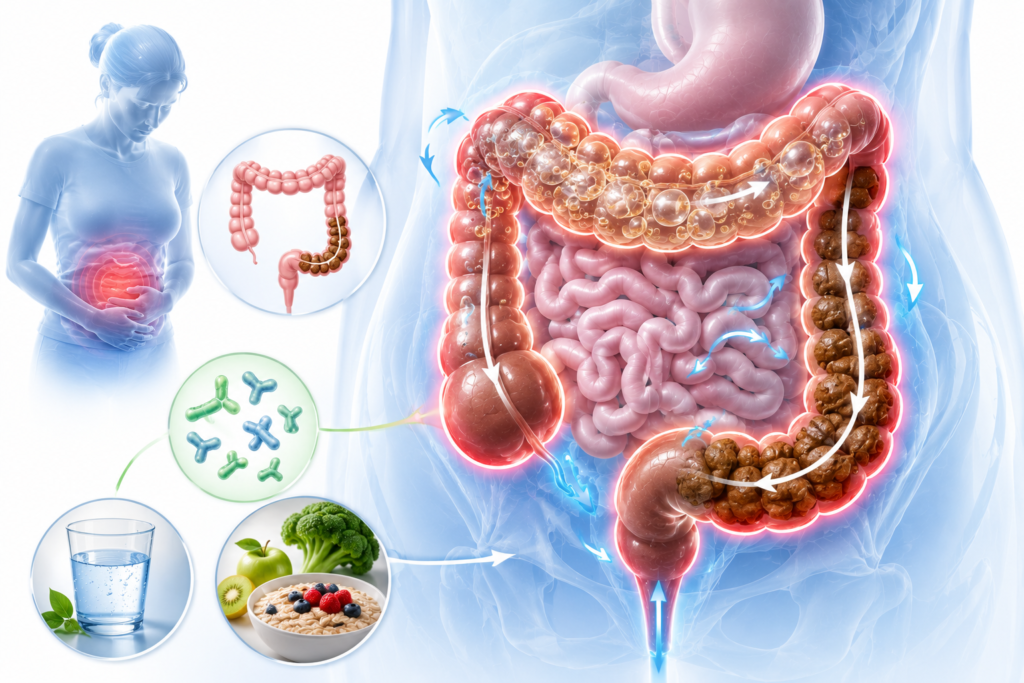
Understanding the connection between these symptoms is the first step to effective treatment. They’re not separate problems—they’re interconnected manifestations of digestive dysfunction.
The Primary Mechanisms
1. Stool Backup and Gas Trapping
When stool moves slowly through the colon or accumulates in the rectum:
- Gas produced by gut bacteria gets trapped behind the stool
- Normal gas transit (normally 14-23 times daily) becomes impaired
- Bacteria continue fermenting undigested food, producing more gas
- Result: Progressive abdominal distension and discomfort
Think of it like a traffic jam: Cars (gas) can’t move forward because the road (colon) is blocked.
2. Altered Gut Microbiota (Dysbiosis)
Constipation changes the gut environment:
- Slower transit allows more time for bacterial fermentation
- Certain bacteria overgrow while others diminish
- Increased gas production (hydrogen, methane, carbon dioxide)
- Methane-producing archaea (Methanobrevibacter smithii) specifically slow transit AND cause bloating
Research Finding: People with constipation-predominant IBS have 3-4 times more methane-producing organisms than healthy controls.
3. Visceral Hypersensitivity
People with functional bowel disorders often have heightened gut sensitivity:
- Normal amounts of gas feel painful or uncomfortable
- Gut nerves overreact to stretching
- Brain perceives normal digestive sensations as threatening
- Creates a cycle of pain, bloating, and altered bowel habits
4. Impaired Gas Transit
Even normal amounts of gas can cause symptoms if not moved efficiently:
- Colonic contractions coordinate gas movement
- Constipation disrupts this coordination
- Gas pools in certain segments rather than moving smoothly
- Leads to localized distension and discomfort
5. Abdominophrenic Dyssynergia
A reflex problem between the diaphragm and abdominal muscles:
- Normally, diaphragm relaxes and abs contract to accommodate gas
- In bloating, this reverses: diaphragm contracts downward, abs relax outward
- Causes visible distension even with normal gas volumes
- Common in functional bloating and IBS
The Vicious Cycle
Constipation
    ↓
Slower transit time
    ↓
More bacterial fermentation
    ↓
Increased gas production
    ↓
Impaired gas clearance
    ↓
Bloating and distension
    ↓
Reduced appetite, altered eating
    ↓
Worse constipation
    ↓
(cycle continues)
Common Conditions That Cause Both Symptoms
Several specific conditions commonly present with constipation and bloating together.
Irritable Bowel Syndrome with Constipation (IBS-C)
What It Is: Functional bowel disorder affecting the brain-gut axis
Prevalence: Affects 10-15% of adults worldwide; more common in women
Diagnostic Criteria (Rome IV):
- Recurrent abdominal pain at least 1 day/week for 3 months
- Associated with 2 or more of:
- Related to defecation
- Change in stool frequency
- Change in stool form (appearance)
- Symptoms started at least 6 months ago
- Plus: >25% of bowel movements are hard/lumpy (types 1-2 on Bristol Stool Chart)
- Plus: <25% are loose/watery (types 6-7)
Why Both Symptoms Occur:
- Altered gut-brain signaling affects motility
- Visceral hypersensitivity amplifies normal sensations
- Microbiota changes increase gas production
- Impaired gas transit worsens bloating
Treatment Approach:
- Dietary modifications (low FODMAP)
- Stress management
- Prescription medications (linaclotide, plecanatide)
- Peppermint oil
- Regular exercise
Small Intestinal Bacterial Overgrowth (SIBO)
What It Is: Excessive bacteria in the small intestine (where bacteria shouldn’t be abundant)
Prevalence: Affects 30-50% of people with IBS-C; exact prevalence debated
Why It Causes Both Symptoms:
- Bacteria ferment food before nutrients are absorbed
- Produces excessive gas (hydrogen and/or methane)
- Methane specifically slows intestinal transit
- Causes bloating, distension, and constipation
Types of SIBO:
| Type | Gas Produced | Symptoms | Treatment |
|---|---|---|---|
| Hydrogen-dominant | Hydrogen | Bloating, diarrhea, gas | Rifaximin |
| Methane-dominant (IMO) | Methane | Bloating, constipation, distension | Rifaximin + Neomycin |
| Hydrogen sulfide | H2S | Bloating, diarrhea, sulfur burps | Not well established |
Diagnosis:
- Lactulose or glucose breath test: Measures hydrogen and methane after drinking sugar solution
- Positive test: Hydrogen rise ≥20 ppm within 90 minutes; methane ≥10 ppm at any point
- Limitations: False positives/negatives occur; clinical correlation needed
Treatment:
- Antibiotics: Rifaximin (550mg 3x daily for 14 days) ± Neomycin for methane
- Elemental diet: 2-3 weeks of pre-digested nutrients (starves bacteria)
- Herbal antimicrobials: Oregano oil, berberine, neem (limited evidence)
- Prokinetics: Low-dose naltrexone, erythromycin, prucalopride (prevent recurrence)
- Dietary support: Low FODMAP during treatment (controversial)
Recurrence Rate: 40-50% within 1 year without prokinetic therapy
Chronic Idiopathic Constipation (CIC)
What It Is: Persistent constipation without identifiable cause or abdominal pain as primary symptom
Diagnostic Criteria:
- At least 2 of the following for 3+ months (symptoms started 6+ months ago):
- Straining >25% of bowel movements
- Hard/lumpy stools >25%
- Sensation of incomplete evacuation >25%
- Sensation of anorectal obstruction >25%
- Manual maneuvers needed >25%
- <3 spontaneous bowel movements per week
- Loose stools uncommon without laxatives
- Doesn’t meet IBS criteria
Why Bloating Occurs:
- Stool accumulation traps gas
- Altered microbiota from slow transit
- Abdominophrenic dyssynergia
Treatment:
- Fiber optimization (soluble fiber preferred)
- Osmotic laxatives (PEG 3350/Miralax)
- Prescription medications if OTC fails
- Pelvic floor therapy if dysfunction present
Pelvic Floor Dysfunction (Dyssynergic Defecation)
What It Is: Incoordination of pelvic floor muscles during defecation
Prevalence: Affects 30-50% of people with chronic constipation
Why It Causes Both Symptoms:
- Can’t relax pelvic floor to evacuate stool
- Stool backs up, trapping gas
- Repeated straining introduces air into abdomen
- Incomplete evacuation leaves room for gas accumulation
Signs and Symptoms:
- Excessive straining
- Sensation of blockage
- Need for digital maneuvers (using fingers to help)
- Feeling of incomplete evacuation
- Bloating that improves after bowel movement
Diagnosis:
- Anorectal manometry (measures pressures during simulated defecation)
- Balloon expulsion test (ability to expel water-filled balloon)
- Defecography (X-ray or MRI during defecation)
Treatment:
- Biofeedback therapy: 70-80% success rate
- Pelvic floor physical therapy
- Diaphragmatic breathing
- Proper toilet positioning
Gastroparesis
What It Is: Delayed stomach emptying without mechanical obstruction
Causes: Diabetes, post-viral, idiopathic, medications (opioids, GLP-1 agonists)
Why It Causes Both Symptoms:
- Food sits in stomach longer, causing upper bloating
- Reduced food delivery to intestines affects downstream motility
- Often associated with constipation
Symptoms:
- Early satiety (feeling full quickly)
- Upper abdominal bloating after meals
- Nausea
- Vomiting undigested food
- Constipation
Diagnosis: Gastric emptying study (scintigraphy)
Endometriosis (Bowel Endometriosis)
What It Is: Endometrial tissue growing on or near the bowel
Why It Causes Both Symptoms:
- Inflammation affects bowel motility
- Adhesions can physically obstruct bowel
- Cyclical hormonal changes affect symptoms
Key Feature: Symptoms often worsen around menstruation
Other Causes to Consider
| Condition | Key Features |
|---|---|
| Hypothyroidism | Fatigue, weight gain, cold intolerance, dry skin |
| Medication side effects | Opioids, anticholinergics, calcium channel blockers, iron |
| Pregnancy | Hormonal changes, uterine pressure |
| Ovarian cancer | New bloating/constipation in postmenopausal women (red flag) |
| Celiac disease | Bloating, diarrhea or constipation, fatigue, anemia |
| Inflammatory bowel disease | Bloody diarrhea, weight loss, fever (usually diarrhea-predominant) |
| Colon cancer | New constipation after 50, blood in stool, weight loss (red flag) |
Distinguishing Features: What Your Symptoms Mean
Not all bloating and constipation are the same. Specific patterns point to different causes.
Timing Patterns
| Pattern | Likely Cause |
|---|---|
| Bloating worst in morning, improves | Gas that accumulated overnight |
| Bloating worsens throughout day | Functional bloating, abdominophrenic dyssynergia |
| Bloating after specific foods | Food intolerance, SIBO |
| Bloating relieved by bowel movement | Constipation-related |
| Cyclical (monthly) pattern | Hormonal, endometriosis |
| Constant bloating | More concerning; needs evaluation |
Location of Discomfort
| Location | Likely Source |
|---|---|
| Upper abdomen (below ribs) | Stomach, gastroparesis, functional dyspepsia |
| Right side | Ascending colon, liver, gallbladder |
| Left side | Descending colon, sigmoid (common stool storage) |
| Lower abdomen | Rectum, pelvic floor, gynecological |
| Diffuse (all over) | General gas, IBS, SIBO |
Associated Symptoms
| Symptom | Points Toward |
|---|---|
| Excessive belching | Upper GI issue, aerophagia (swallowing air) |
| Excessive flatulence | Colonic fermentation, SIBO |
| Visible distension | Abdominophrenic dyssynergia, severe gas |
| Nausea | Gastroparesis, severe constipation |
| Early satiety | Gastroparesis |
| Abdominal pain relieved by BM | IBS |
| Blood in stool | Needs medical evaluation (hemorrhoids, IBD, cancer) |
| Weight loss | Red flag; needs prompt evaluation |
Diagnostic Approach
If constipation and bloating persist despite lifestyle changes, medical evaluation may be needed.
Initial Evaluation
Medical History:
- Symptom onset and duration
- Bowel movement frequency and characteristics
- Dietary habits
- Medication review
- Family history of GI diseases
- Alarm symptoms (weight loss, bleeding, anemia, fever)
Physical Examination:
- Abdominal exam (distension, tenderness, masses)
- Rectal exam (stool in rectum, masses, tone)
- Signs of underlying conditions
Basic Laboratory Tests
| Test | What It Checks |
|---|---|
| Complete blood count (CBC) | Anemia, infection |
| Comprehensive metabolic panel (CMP) | Electrolytes, kidney/liver function |
| Thyroid function (TSH) | Hypothyroidism |
| Celiac serology | Celiac disease |
| Inflammatory markers (CRP, ESR) | Inflammation (IBD) |
| Fecal occult blood | Hidden blood in stool |
| Calprotectin | Intestinal inflammation |
Specialized Testing
For Constipation:
- Colonic transit study: Radiopaque markers to measure transit time
- Anorectal manometry: Pelvic floor muscle coordination
- Balloon expulsion test: Ability to evacuate
- Defecography: X-ray or MRI of defecation
For Bloating:
- Hydrogen/methane breath test: SIBO evaluation
- Upper endoscopy: If upper GI symptoms predominate
- Colonoscopy: If alarm features or age-appropriate screening
- Abdominal imaging: CT or ultrasound if structural cause suspected
Treatment Strategies
Effective treatment addresses both constipation and bloating simultaneously. A stepwise approach works best.
Step 1: Foundation (Diet and Lifestyle)
Dietary Modifications
Increase Fiber—But Choose Wisely
Not all fiber is created equal. Some types help constipation without worsening bloating.
Better Choices (Soluble, Less Fermentable):
- Psyllium (Metamucil)
- Methylcellulose (Citrucel)
- Partially hydrolyzed guar gum (PHGG)
- Acacia fiber
Use Caution (Highly Fermentable):
- Inulin
- Fructooligosaccharides (FOS)
- Wheat dextrin (Benefiber) – can cause gas
- Large amounts of beans, lentils
Fiber Introduction Protocol:
Week 1: 1/2 teaspoon psyllium in 8 oz water daily
Week 2: 1 teaspoon daily
Week 3: 1 teaspoon twice daily
Week 4+: Adjust based on response

Key: Increase slowly and drink adequate fluids
Hydration:
- Aim for 6-8 glasses of water daily
- Warm liquids in morning stimulate bowel
- Limit carbonated beverages (add gas)
Low FODMAP Diet
What Are FODMAPs?
Fermentable Oligosaccharides, Disaccharides, Monosaccharides, and Polyols—short-chain carbohydrates that are poorly absorbed and rapidly fermented by gut bacteria.
Why It Works:
- Reduces substrate for gas production
- Decreases osmotic effect (water pulling into intestine)
- 70% of IBS patients improve on low FODMAP diet
High FODMAP Foods to Limit:
| Category | High FODMAP | Low FODMAP Alternatives |
|---|---|---|
| Oligosaccharides | Wheat, rye, onions, garlic, legumes | Rice, oats, quinoa, chives, green onion tops |
| Disaccharides | Milk, yogurt, soft cheeses | Lactose-free dairy, hard cheeses |
| Monosaccharides | Honey, apples, mangoes, watermelon | Grapes, oranges, strawberries, pineapple |
| Polyols | Stone fruits, mushrooms, sugar alcohols | Bananas, blueberries, regular sugar |
How to Do Low FODMAP:
- Elimination phase (2-6 weeks): Strictly avoid high FODMAP foods
- Reintroduction phase (8-12 weeks): Systematically challenge each FODMAP type
- Personalization phase: Identify individual tolerances
Important: Work with dietitian if possible; don’t stay on strict elimination long-term
Eating Habits
Reduce Air Swallowing:
- Eat slowly
- Avoid talking while eating
- Don’t use straws
- Avoid chewing gum
- Limit carbonated beverages
Meal Pattern:
- Smaller, more frequent meals
- Don’t skip meals
- Avoid large, fatty meals
- Finish eating 3 hours before bedtime
Step 2: Targeted Supplements
Peppermint Oil
Evidence: Multiple studies show peppermint oil reduces IBS symptoms including bloating
Dosing: 180-225 mg enteric-coated capsules, 2-3 times daily before meals
Mechanism: Relaxes intestinal smooth muscle, has antimicrobial effects
Side Effects: Heartburn (enteric coating prevents this)
Probiotics
Evidence: Mixed; some strains show benefit for bloating
Best-Studied Strains:
- Bifidobacterium infantis 35624 (Align)
- Lactobacillus plantarum 299V
- Bifidobacterium lactis HN019
- Multi-strain products (VSL#3, Visbiome)
Dosing: 1-10 billion CFU daily for 4-8 weeks minimum
Trial Approach: Try one product for 4 weeks; if no benefit, try different strain
Caution: Some probiotics can worsen bloating initially or in SIBO
Digestive Enzymes
For Specific Intolerances:
- Lactase: For lactose intolerance
- Alpha-galactosidase (Beano): For beans and cruciferous vegetables
- Fructosidase: For fructose malabsorption (limited availability)
Effectiveness: Works for specific food intolerances; not a general solution
Ginger
Evidence: Ginger accelerates gastric emptying and has anti-inflammatory effects
Dosing: 500-1000 mg before meals, or ginger tea
Forms: Capsules, tea, crystallized ginger
Step 3: Medications
For Constipation (Which Helps Bloating)
First-Line:
- PEG 3350 (Miralax): 17g daily; safe, effective, minimal gas
- Bulk-forming fiber: Psyllium, methylcellulose
Second-Line:
- Stimulant laxatives: Bisacodyl, senna (short-term or intermittent)
- Stool softeners: Docusate (limited efficacy)
Prescription Options:
- Linaclotide (Linzess): 145-290 mcg daily; increases fluid secretion, reduces pain
- Plecanatide (Trulance): 3 mg daily; similar to linaclotide
- Lubiprostone (Amitiza): 24 mcg twice daily; chloride channel activator
- Prucalopride (Motegrity): 2 mg daily; prokinetic, helps motility
For Bloating Specifically
Simethicone:
- Dosing: 80-125 mg after meals and at bedtime
- Mechanism: Breaks up gas bubbles
- Evidence: Limited but safe; may provide modest relief
Antibiotics (for SIBO):
- Rifaximin: 550 mg 3 times daily for 14 days
- Rifaximin + Neomycin: For methane-positive SIBO
- Evidence: 40-50% response rate for bloating
Antispasmodics:
- Dicyclomine: 10-20 mg before meals
- Hyoscyamine: 0.125-0.25 mg as needed
- Use: For cramping component; limited effect on bloating itself
Step 4: Specialized Therapies
Biofeedback for Pelvic Floor Dysfunction
What It Is: Training to coordinate pelvic floor muscles using visual feedback
Success Rate: 70-80% improvement in constipation and bloating
Protocol: 4-6 sessions over 2-3 months with pelvic floor physical therapist
Prokinetics (for Motility)
For Gastroparesis or Severe Slow Transit:
- Metoclopramide: 5-10 mg before meals (limit to 12 weeks due to side effects)
- Erythromycin: 250 mg before meals (antibiotic used for prokinetic effect)
- Prucalopride: 2 mg daily (also treats constipation)
- Low-dose naltrexone: Emerging option for SIBO-related motility issues
Psychological Therapies
Gut-Directed Hypnotherapy:
- Evidence: 70% response rate in IBS
- Mechanism: Reduces visceral hypersensitivity, improves brain-gut signaling
- Format: In-person or app-based (Nerva, Mahana)
Cognitive Behavioral Therapy (CBT):
- Reduces symptom-related anxiety
- Improves coping strategies
- Can be as effective as medications for IBS
Immediate Relief Strategies
When you’re bloated and constipated right now, these can provide faster relief:
For Quick Constipation Relief
Glycerin Suppository:
- Works in 15-30 minutes
- Gentle, draws water into rectum
- Good for hard stool in rectum
Bisacodyl Suppository:
- Works in 15-60 minutes
- Stimulates rectal contractions
- More potent than glycerin
Enema (occasional use):
- Fleet enema works in 5-10 minutes
- For severe impaction
- Don’t use regularly
Magnesium Citrate (single dose):
- Works in 30 minutes to 6 hours
- Powerful osmotic effect
- Don’t use if kidney problems
For Quick Bloating Relief
Simethicone (Gas-X):
- Take 125 mg after meals
- Breaks up gas bubbles
- Safe, minimal side effects
Peppermint Tea or Capsules:
- Relaxes intestinal muscles
- Can provide relief within 30 minutes
Gentle Movement:
- Walking for 10-15 minutes
- Yoga poses (knees to chest, supine twist)
- Helps move gas through
Abdominal Massage:
- Clockwise circles following colon path
- Start lower right, go up, across, down left side
- 10-15 minutes, 1-2 times daily
Heat:
- Heating pad on abdomen
- Relaxes muscles, can help gas move
Position for Gas Relief
Knees-to-Chest Pose:
- Lie on your back
- Pull one or both knees to chest
- Hold for 30-60 seconds
- Gently rock side to side
- Repeat several times
Child’s Pose:
- Kneel, sit back on heels
- Fold forward, arms extended
- Rest forehead on floor
- Hold for 1-2 minutes
Prevention Strategies
Long-term management requires consistent habits.
Daily Habits
Morning Routine:
- Drink 8-16 oz warm water upon waking
- Consider warm beverage (coffee or tea if tolerated)
- Eat breakfast (triggers gastrocolic reflex)
- Sit on toilet for 5-10 minutes (even if no urge)
- Use footstool for optimal position
Throughout the Day:
- Sip water consistently (don’t chug large amounts)
- Move every hour (5-minute walk)
- Don’t ignore the urge to have a bowel movement
- Eat mindfully (slowly, without distraction)
Evening:
- Finish eating 3 hours before bed
- Gentle walk after dinner
- Stress-reduction practice (meditation, gentle yoga)
Weekly Habits
- Exercise: At least 150 minutes moderate activity
- Meal prep: Prepare gut-friendly meals in advance
- Symptom review: Note patterns, triggers, improvements
Monthly Habits
- Medication review: Assess need for constipating medications
- Healthcare follow-up: If on treatment, monitor response
- Diet variety: Ensure diverse, balanced nutrition
Foods That Help vs. Harm
Constipation-Friendly, Low-Bloat Foods
Grains:
- White rice
- Oats/oatmeal
- Quinoa
- Rice cakes
- Sourdough bread (lower FODMAP)
Proteins:
- Eggs
- Chicken, turkey
- Fish
- Tofu (firm, in moderation)
- Hard cheeses (parmesan, cheddar)
Vegetables:
- Carrots
- Zucchini
- Spinach
- Green beans
- Cucumber
- Bell peppers
- Green onion tops, chives
Fruits:
- Bananas (not overripe)
- Blueberries
- Strawberries
- Oranges
- Grapes
- Kiwi (excellent for constipation)
- Cantaloupe
Fats:
- Olive oil
- Coconut oil
- Small amounts of nuts/seeds
Foods That Often Worsen Symptoms
High FODMAP:
- Onions, garlic
- Wheat products
- Beans, lentils
- Cauliflower, mushrooms
- Apples, pears
- Honey
- Sugar alcohols (sorbitol, mannitol, xylitol)
Gas-Producing:
- Cruciferous vegetables (broccoli, cabbage, Brussels sprouts)
- Carbonated beverages
- Beer
- Large amounts of fiber supplements
Constipating:
- Red meat (large portions)
- Processed foods
- Cheese (large amounts)
- Unripe bananas
- White bread (low fiber)
Special Considerations
Pregnancy
Why It Happens:
- Progesterone relaxes smooth muscle (slows digestion)
- Uterus compresses bowel
- Iron supplements can constipate
Safe Treatments:
- Fiber supplements (psyllium, methylcellulose)
- Miralax (PEG 3350)
- Docusate (stool softener)
- Gentle exercise
- Prunes, kiwi
Avoid:
- Castor oil
- Herbal laxatives (senna only with OB approval)
- Sodium phosphate
Elderly
Risk Factors:
- Multiple medications
- Reduced mobility
- Decreased thirst sensation
- Slower metabolism
Approach:
- Review medications for constipating effects
- Ensure adequate hydration
- Start with Miralax (safe, well-tolerated)
- Consider pelvic floor evaluation
- Rule out underlying conditions
Children
Common Causes:
- Withholding behavior
- Toilet training issues
- Dietary factors (too much dairy, not enough fiber)
- School bathroom avoidance
Treatment:
- Miralax (commonly used, talk to pediatrician)
- Fiber through diet (fruits, vegetables, whole grains)
- Regular toilet sitting routine
- Positive reinforcement
- Address behavioral factors
Red Flags: When to See a Doctor
Seek medical attention if you have:
Immediate/Emergency:
- Severe, unrelenting abdominal pain
- Inability to pass gas or stool with severe pain (possible obstruction)
- Vomiting with abdominal distension
- Blood in stool (significant amounts)
- Black, tarry stools
Urgent (within days):
- New constipation after age 50
- Unintentional weight loss
- Iron deficiency anemia
- Family history of colon cancer with new symptoms
- Fever with abdominal symptoms
- Persistent vomiting
Routine Appointment:
- Symptoms lasting >3 months
- Symptoms affecting quality of life
- Need for daily laxatives
- Suspect SIBO
- Pelvic floor symptoms
Frequently Asked Questions
How do I know if my bloating is from constipation or something else?
Bloating from constipation typically:
- Improves after a good bowel movement
- Is worse later in the day
- Is associated with infrequent or hard stools
- May be relieved by passing gas
Bloating from other causes may:
- Occur regardless of bowel movements
- Be associated with specific foods
- Include upper abdominal symptoms (early satiety, nausea)
- Have different patterns (cyclical, constant)
Can probiotics make bloating worse?
Yes, initially. Probiotics can cause temporary increased gas and bloating during the first 1-2 weeks as your microbiome adjusts. This usually resolves. If bloating persists or worsens after 2-3 weeks, try a different strain or discontinue.
Some people with SIBO may not tolerate probiotics well—they can feed the bacterial overgrowth.
Why am I bloated even though I poop every day?
Daily bowel movements don’t guarantee complete evacuation. You may have:
- Incomplete evacuation: Stool remains in rectum
- Slow transit: Stool sits in colon for days before arriving in rectum
- SIBO: Bacterial overgrowth causing gas regardless of bowel frequency
- Visceral hypersensitivity: Normal amounts of gas feel like bloating
- Abdominophrenic dyssynergia: Muscle coordination problem causing visible distension
Does coffee help or worsen bloating and constipation?
Coffee has mixed effects:
- Helps constipation: Stimulates colonic contractions in many people
- Can worsen bloating: Acidic, can cause gas in some, often consumed with dairy or sugar
Try black coffee in moderation. If it helps constipation without worsening bloating, it can be part of your routine.
Is bloating dangerous?
Bloating itself is not dangerous—it’s a symptom. However, persistent or worsening bloating can indicate underlying conditions that need treatment. New, constant bloating in postmenopausal women should be evaluated promptly (ovarian cancer consideration).
How long does it take to resolve constipation-related bloating?
With appropriate treatment:
- Acute relief: Some improvement within 24-48 hours
- Significant improvement: 1-2 weeks of consistent treatment
- Full resolution: 4-8 weeks for chronic cases
- SIBO treatment: 2-4 weeks for antibiotic course, may need retreatment
What’s the difference between bloating and distension?
Bloating: Subjective feeling of abdominal fullness or tightness
Distension: Objective, measurable increase in abdominal girth (visible swelling)
Many people experience both, but they don’t always occur together.
Conclusion
Constipation and bloating are interconnected symptoms with multiple potential causes. The most common culprits—IBS-C, SIBO, pelvic floor dysfunction, and functional bloating—are all treatable with the right approach.
Key Principles for Success:
- Address constipation first: Clearing stool often improves bloating significantly
- Choose fiber wisely: Soluble, less-fermentable fibers are better tolerated
- Consider SIBO: If bloating predominates, get tested or empirically treated
- Don’t forget the pelvic floor: Dyssynergia is common and treatable with biofeedback
- Diet matters: Low FODMAP diet helps 70% of IBS patients
- Be patient: Chronic symptoms take time to resolve
- Get help when needed: Persistent symptoms warrant medical evaluation
Most people find significant relief with a combination of dietary changes, targeted supplements or medications, and lifestyle modifications. Work with your healthcare provider to develop a personalized plan that addresses your specific pattern of symptoms.
Medical Disclaimer: This article is for educational purposes only and does not constitute medical advice. Consult with a qualified healthcare provider for diagnosis and treatment of digestive conditions.
Sources:
- Lacy BE, et al. – Bowel Disorders – Gastroenterology – 2016 – https://www.gastrojournal.org/article/S0016-5085(16)00222-5/fulltext
- Pimentel M, et al. – Development of a consensus guideline for the diagnosis and treatment of small intestinal bacterial overgrowth – American Journal of Gastroenterology – 2020 – https://journals.lww.com/ajg/Fulltext/2020/11000/Development_of_a_Consensus_Guideline_for_the.13.aspx
- Staudacher HM, Whelan K – The low FODMAP diet: recent advances in understanding its mechanism and efficacy in IBS – Gut – 2017 – https://gut.bmj.com/content/66/8/1517
- Rao SSC – Update on neuroenteric mechanisms underlying defecation – Gastroenterology – 2023 – https://www.gastrojournal.org/article/S0016-5085(23)00193-2/fulltext
- Ford AC, et al. – American College of Gastroenterology Monograph on the Management of Irritable Bowel Syndrome – American Journal of Gastroenterology – 2023 – https://journals.lww.com/ajg/Fulltext/2023/01000/American_College_of_Gastroenterology_Monograph_on.16.aspx
- Camilleri M, et al. – Chronic Constipation – Nature Reviews Disease Primers – 2017 – https://www.nature.com/articles/nrdp201773
- ACG Clinical Guideline: Management of Chronic Idiopathic Constipation – American Journal of Gastroenterology – 2023 – https://gi.org/guidelines/chronic-constipation/
- NHS – Bloating and Constipation – 2023 – https://www.nhs.uk/conditions/bloating/
- Mayo Clinic – Intestinal Gas – 2025 – https://www.mayoclinic.org/symptoms/intestinal-gas/basics/causes/sym-20050931
- Systematic Review – Probiotics for functional bowel disorders – Gastroenterology – 2023 – https://www.gastrojournal.org/article/S0016-5085(23)00445-6/fulltext