When to See a Doctor for Gut Symptoms: Red Flags You Shouldn’t Ignore
The Urgency Stratification System
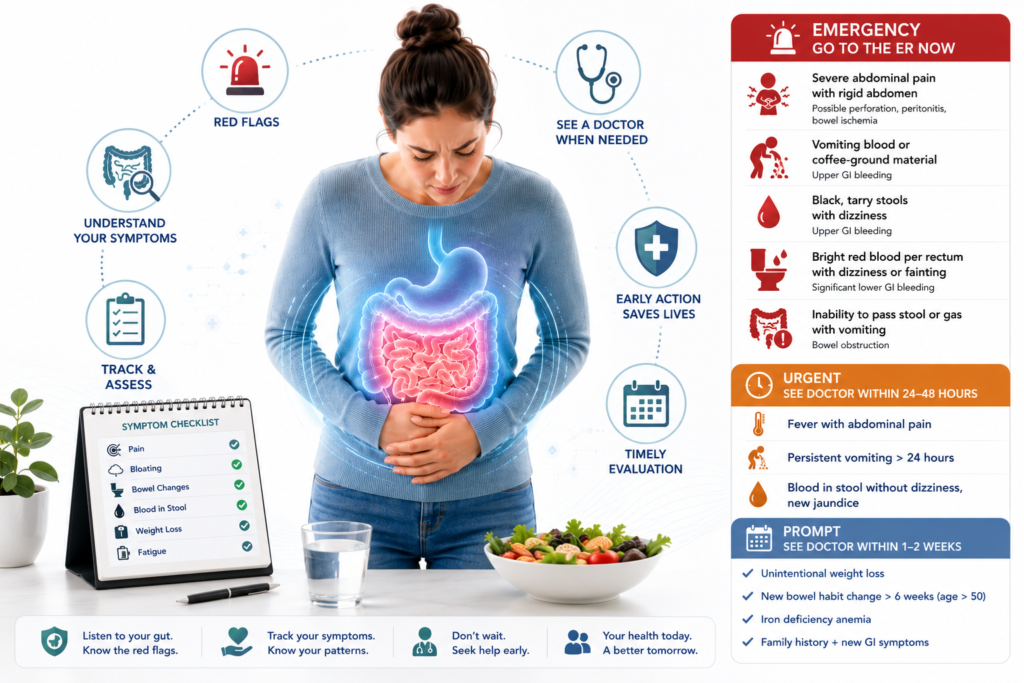
Not all gut symptoms deserve the same response. We categorize them into three tiers:
Table 1: Symptom Urgency Classification
| Urgency Level | Response Timeline | Examples |
|---|---|---|
| EMERGENCY | Call 911 / Go to ER immediately | Severe pain with rigid abdomen, vomiting blood, black tarry stools with dizziness, inability to pass stool/gas with vomiting |
| URGENT | Medical evaluation within 24-48 hours | Fever + abdominal pain, persistent vomiting >24 hours, blood in stool without dizziness, new jaundice |
| PROMPT | Schedule appointment within 1-2 weeks | Unintentional weight loss, new bowel habit change >6 weeks (age >50), iron deficiency anemia, family history + new symptoms |
| ROUTINE | Schedule when convenient | Chronic symptoms without red flags, mild intermittent symptoms, known condition flare without warning signs |
Emergency Symptoms: Go to the ER Now
These symptoms suggest life-threatening conditions. Do not wait. Do not call your doctor’s office (they’ll send you to the ER anyway). Do not try home remedies.
1. Severe Abdominal Pain with Rigid Abdomen
What it feels like:
- Pain so severe you can’t stand up straight
- Abdomen feels hard/board-like to touch
- Worsens with any movement or touch
- May be accompanied by fever, nausea, vomiting
Possible causes:
- Perforated viscus (hole in stomach, intestine, or appendix)
- Peritonitis (infection of abdominal cavity lining)
- Ruptured appendix
- Bowel ischemia (loss of blood flow to intestine)
- Ruptured ectopic pregnancy
Why it’s urgent: These conditions cause rapid progression to sepsis and death without surgical intervention. Mortality increases 7-10% for every hour delay in treatment of bowel ischemia.
2. Vomiting Blood or Coffee-Ground Material
What it looks like:
- Bright red blood: Fresh, active bleeding
- Coffee-ground emesis: Dark, grainy material (blood digested by stomach acid)
Possible causes:
- Bleeding peptic ulcer (most common)
- Esophageal varices (enlarged veins, often from liver disease)
- Mallory-Weiss tear (from violent retching)
- Gastritis or esophagitis (severe inflammation)
- Upper GI malignancy
Why it’s urgent: Upper GI bleeding causes ~300,000 hospitalizations annually in the US with 2-15% mortality. Early endoscopy (within 24 hours) improves outcomes.
What to expect in ER:
- IV fluids, blood type and crossmatch
- IV proton pump inhibitor (reduces stomach acid)
- Urgent upper endoscopy to locate and treat bleeding source
- Possible blood transfusion if hemoglobin low
3. Black, Tarry Stools (Melena) with Dizziness
What it looks like:
- Black, sticky, foul-smelling stool
- Looks like tar, not just dark brown
- Often accompanied by lightheadedness when standing
Important distinction: Iron supplements and bismuth (Pepto-Bismol) can turn stool black, but these don’t cause dizziness or have the tarry consistency.
Table 2: Differentiating Black Stool Causes
| Feature | Melena (GI Bleeding) | Iron/Bismuth Stool |
|---|---|---|
| Color | Jet black | Dark green-black |
| Consistency | Tarry, sticky | Normal formed |
| Odor | Extremely foul, distinctive | Normal stool odor |
| Associated symptoms | Dizziness, weakness, rapid heartbeat | None |
| Duration | Persists until bleeding stops | Resolves 1-3 days after stopping supplement |
Why it’s urgent: Melena indicates upper GI bleeding (esophagus, stomach, or small intestine). The black color comes from hemoglobin breakdown as blood travels through the digestive tract. By the time melena appears, significant bleeding has already occurred.
4. Bright Red Blood Per Rectum with Dizziness or Fainting
What it looks like:
- Blood in toilet bowl (can be significant amount)
- Blood on toilet paper or coating stool
- May be accompanied by lightheadedness, rapid heartbeat, or fainting
Possible causes:
- Lower GI bleed (diverticular bleeding most common in adults >60)
- Inflammatory bowel disease flare (ulcerative colitis, Crohn’s)
- Ischemic colitis (loss of blood flow to colon)
- Hemorrhoids (typically painless, blood only, no systemic symptoms)
Why it’s urgent: While hemorrhoids are common and benign, you cannot assume this without evaluation when systemic symptoms (dizziness, fainting) are present. These suggest significant blood loss.
5. Inability to Pass Stool or Gas with Vomiting
What it feels like:
- Progressive abdominal distension
- Cramping pain in waves
- Nausea and vomiting (may become feculent)
- Complete constipation (no stool or gas passage)
Possible causes:
- Bowel obstruction (adhesions from prior surgery most common)
- Volvulus (twisted bowel)
- Intussusception (telescoping of bowel)
- Impacted stool (severe constipation)
- Tumor causing obstruction
Why it’s urgent: Bowel obstruction can progress to perforation, peritonitis, and sepsis. Mortality for strangulated obstruction approaches 25% if untreated beyond 36 hours.
What to expect in ER:
- Abdominal X-ray or CT scan
- NG tube (through nose to stomach) for decompression
- IV fluids and bowel rest
- Possible urgent surgery if complete obstruction or signs of ischemia
Urgent Symptoms: See a Doctor Within 24-48 Hours
These symptoms need prompt medical evaluation but don’t require the ER unless they worsen or you can’t access timely outpatient care.
Fever + Abdominal Pain
Temperature threshold: >100.4°F (38°C) oral
Possible causes:
- Diverticulitis (infection of colon pouches)
- Cholecystitis (gallbladder infection)
- Appendicitis (early stages)
- Infectious colitis (bacterial or parasitic infection)
- Inflammatory bowel disease flare
Why it’s urgent: Fever indicates systemic inflammation or infection. Untreated intra-abdominal infections can progress to abscess formation or sepsis.
When to go to ER instead:
- Fever >102°F (39°C)
- Unable to keep fluids down
- Confusion or altered mental status
- Severe pain preventing movement
Persistent Vomiting (>24 Hours)
Definition: Unable to keep liquids down for >24 hours, or >6 episodes of vomiting in 24 hours
Risks:
- Dehydration (dark urine, dry mouth, dizziness when standing)
- Electrolyte abnormalities (can cause heart rhythm disturbances)
- Mallory-Weiss tear (from violent retching)
Seek ER care if:
- Signs of severe dehydration (no urine >12 hours, extreme thirst, confusion)
- Vomiting blood
- Severe abdominal pain
- Unable to access IV fluids as outpatient
Blood in Stool Without Dizziness
Appearance:
- Bright red blood (hematochezia)
- Maroon-colored stool
- Blood mixed with or coating stool
Possible causes:
- Hemorrhoids (most common, especially if blood only on toilet paper)
- Anal fissure (painful, often from constipation)
- Diverticular bleed (painless, can be significant volume)
- Inflammatory bowel disease
- Colorectal polyps or cancer
Why it needs evaluation: While often benign, rectal bleeding is the presenting symptom in 30% of colorectal cancer cases. Age <45 doesn’t rule out serious causes—incidence of early-onset colorectal cancer has doubled since 1995.
New Jaundice (Yellow Skin or Eyes)
What to look for:
- Yellowing of whites of eyes (scleral icterus)
- Yellow skin tone
- Dark urine (tea-colored)
- Pale or clay-colored stools
Possible causes:
- Bile duct obstruction (gallstone, tumor)
- Hepatitis (viral, alcoholic, autoimmune)
- Pancreatic cancer (especially if painless jaundice)
- Primary sclerosing cholangitis
Why it’s urgent: Jaundice indicates biliary obstruction or liver dysfunction. Obstructive jaundice can progress to cholangitis (bile duct infection), which has 10-30% mortality if untreated.
Prompt Evaluation: Schedule Within 1-2 Weeks
These symptoms warrant medical investigation but aren’t emergencies. Don’t ignore them—early diagnosis improves outcomes for serious conditions.
Unintentional Weight Loss
Definition: >10 lbs (4.5 kg) or >5% of body weight over 6-12 months without trying
Why it matters: Unintentional weight loss in the context of GI symptoms is a red flag for:
- Malignancy (colorectal cancer, gastric cancer, pancreatic cancer)
- Inflammatory bowel disease (malabsorption, reduced intake due to pain)
- Celiac disease (malabsorption)
- Chronic pancreatitis (pancreatic insufficiency)
- Chronic infection (parasites, tuberculosis)
Data point: In patients >50 with unintentional weight loss and GI symptoms, prevalence of malignancy is 15-25%. Even in patients <50, prevalence is 3-5%.
New Bowel Habit Change >6 Weeks (Age >50)
What qualifies:
- New constipation (especially if progressive)
- New diarrhea
- Alternating constipation and diarrhea
- Change in stool caliber (pencil-thin stools)
- Change in bowel movement frequency
Why age matters: Colorectal cancer incidence rises sharply after age 50. New bowel habit changes in this age group require colonoscopy to rule out structural lesions.
Important: While colorectal cancer screening now starts at 45 (per ACS guidelines), any age with red flag symptoms warrants evaluation.
Iron Deficiency Anemia
Symptoms:
- Fatigue, weakness
- Shortness of breath with exertion
- Pale skin
- Cold hands and feet
- Craving ice or non-food items (pica)
Why it’s a red flag: In adult men and postmenopausal women, iron deficiency anemia is GI bleeding until proven otherwise. The GI tract is the most common source of chronic blood loss in these populations.
Required workup:
- Upper endoscopy (EGD)
- Colonoscopy
- Celiac disease serology
- If both negative: capsule endoscopy or deep enteroscopy
Family History of GI Cancer + New Symptoms
High-risk family history:
- First-degree relative (parent, sibling, child) diagnosed <60 years
- Two or more first-degree relatives at any age
- Known hereditary syndrome (Lynch syndrome, FAP)
Screening recommendations:
- Lynch syndrome: Colonoscopy every 1-2 years starting age 20-25
- Family history <60: Colonoscopy starting age 40 or 10 years before youngest diagnosis
- Average risk: Colonoscopy starting age 45
Routine Evaluation: Schedule When Convenient
These symptoms are typically manageable and don’t suggest serious disease, but deserve evaluation if persistent or impacting quality of life.
Chronic Symptoms Without Red Flags
Examples:
- Intermittent bloating for months
- Mild abdominal discomfort
- Occasional heartburn (<2x/week)
- Known IBS flare without new features
Approach:
- Trial of conservative management (dietary modification, OTC medications)
- If no improvement after 4-6 weeks: schedule primary care or GI appointment
- If symptoms worsen or red flags develop: escalate to prompt evaluation
Mild Intermittent Symptoms
Characteristics:
- Symptoms don’t wake you from sleep
- No impact on daily activities
- No associated weight loss, fever, or bleeding
- Normal appetite
Self-care trial period: 2-4 weeks of conservative management before seeking evaluation
Age-Specific Considerations
Table 3: Red Flag Thresholds by Age
| Age Group | Key Concerns | Screening Thresholds |
|---|---|---|
| <45 years | IBD, celiac, functional disorders | Lower threshold for symptom duration (earlier onset CRC rising) |
| 45-50 years | Begin colorectal cancer screening | Colonoscopy starting age 45 (ACS guidelines) |
| >50 years | Malignancy, diverticular disease, ischemic colitis | Any new bowel habit change warrants evaluation |
| >65 years | Malignancy, ischemic colitis, medication effects | Lower threshold for investigation |
Critical note: Colorectal cancer incidence in adults <50 has doubled since 1995. Don’t dismiss rectal bleeding or bowel changes as “just hemorrhoids” or “probably IBS” based on age alone.
What to Expect During a GI Workup
Understanding the evaluation process reduces anxiety and helps you advocate for appropriate testing.
Initial Evaluation (Primary Care or GI)
History:
- Symptom onset, duration, pattern
- Associated symptoms (weight loss, fever, bleeding)
- Medication review (NSAIDs, antibiotics, PPIs)
- Family history of GI diseases
- Travel history, dietary changes
Physical Exam:
- Abdominal exam (tenderness, masses, organ enlargement)
- Rectal exam (if bleeding, constipation)
- Signs of anemia, jaundice, malnutrition
Initial Labs:
- Complete blood count (CBC) – checks for anemia, infection
- Comprehensive metabolic panel (CMP) – liver function, electrolytes
- Celiac serology (tTG-IgA)
- Fecal calprotectin (inflammation marker for IBD)
- TSH (thyroid dysfunction mimics GI symptoms)
Further Testing (Based on Symptoms)
| Symptom Pattern | Likely Testing |
|---|---|
| Upper GI symptoms (heartburn, dyspepsia, upper pain) | Upper endoscopy (EGD), H. pylori testing |
| Lower GI symptoms (diarrhea, constipation, lower pain) | Colonoscopy, stool studies, abdominal imaging |
| Bloating/gas predominant | Breath testing (SIBO, lactose intolerance), celiac serology |
| Weight loss + GI symptoms | CT abdomen/pelvis, upper/lower endoscopy |
| Abnormal liver tests | Liver ultrasound, hepatitis panel, autoimmune markers |
The Danger of “Wait and See”
Some symptoms improve on their own. Others progress. Knowing the difference is critical.
When “Wait and See” Is Appropriate
- Mild symptoms without red flags
- First episode of otherwise typical IBS flare
- Symptoms clearly triggered by identifiable cause (travel, antibiotic use, dietary indiscretion)
- Improving trajectory over 48-72 hours
When “Wait and See” Becomes Dangerous
Our analysis identified common delays:
| Condition | Average Delay to Diagnosis | Impact of Delay |
|---|---|---|
| Colorectal cancer | 4-6 months from symptom onset | Stage at diagnosis directly impacts survival |
| Celiac disease | 6-10 years from symptom onset | Increased risk of complications, osteoporosis |
| Inflammatory bowel disease | 9-12 months from symptom onset | Increased risk of strictures, fistulas, surgery |
| Pancreatic cancer | 2-4 months from symptom onset | 5-year survival: 20% (regional) vs. 3% (metastatic) |
Key takeaway: Persistent symptoms (>4-6 weeks) deserve evaluation even without dramatic red flags. Early diagnosis matters.
FAQs
Should I go to the ER or call my doctor for abdominal pain?
Go to the ER if: pain is severe (can’t stand up straight), abdomen is rigid/hard, you’re vomiting blood, stools are black and tarry, or you have signs of shock (dizziness, rapid heartbeat, confusion). Call your doctor if: pain is mild-moderate, you can function normally, no warning signs, or you have a known condition that’s responding to usual treatment.
How much blood in stool is too much?
Any amount of blood in stool warrants attention. Seek urgent care if: blood fills the toilet bowl, you feel dizzy or lightheaded, you’re passing clots, or bleeding persists >24 hours. Small amounts on toilet paper from known hemorrhoids are less concerning but mention at your next appointment.
Is it normal to have abdominal pain during my period?
Mild-moderate cramping is common. However, severe pain that prevents normal activities, pain outside of menstruation, pain with bowel movements during periods, or progressively worsening pain suggests endometriosis and warrants gynecologic evaluation.
When does constipation need medical attention?
Seek evaluation if: constipation is new and you’re >50, it persists >3 weeks despite fiber and fluids, you need laxatives regularly to have bowel movements, there’s blood in stool, or it alternates with diarrhea.
Can anxiety cause gut symptoms that feel like emergencies?
Yes. Anxiety can amplify pain perception and cause symptoms like nausea, diarrhea, and abdominal discomfort. However, never assume anxiety is the cause without first ruling out organic disease, especially if symptoms are new, severe, or progressive.