Post-Gallbladder Removal Diet: Complete Guide to Eating After Cholecystectomy
Understanding Digestive Changes After Gallbladder Removal
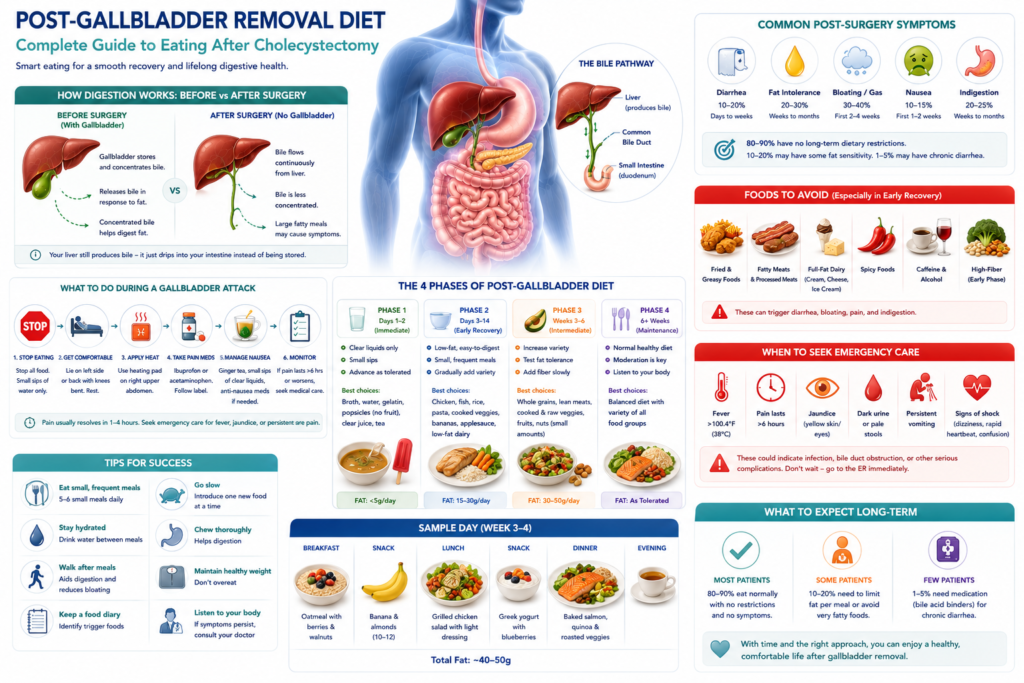
What Your Gallbladder Used to Do
Before surgery, your digestive system worked like this:
- Liver produces bile continuously (about 500-1000 mL daily)
- Bile travels to gallbladder via hepatic ducts
- Gallbladder stores and concentrates bile (removes water, concentrating bile 5-10x)
- When you eat fat, hormone CCK signals gallbladder to contract
- Concentrated bile releases into small intestine to emulsify fats
- Fat gets digested and absorbed with bile’s help
How Digestion Works After Surgery
After gallbladder removal (cholecystectomy):
- Liver still produces bile (unchanged)
- No storage reservoir—bile drips continuously into small intestine via common bile duct
- Bile is less concentrated (not concentrated by gallbladder)
- Constant bile flow whether you eat or not
- Large fat loads overwhelm the available bile supply
- Excess bile in colon can cause diarrhea (bile acid malabsorption)
Key implication: Your body can handle moderate amounts of fat spread throughout the day, but large fatty meals may cause symptoms because there’s no concentrated bile reserve.
Common Post-Cholecystectomy Digestive Symptoms
Understanding what’s normal helps you manage expectations and recognize when something needs medical attention.
| Symptom | Frequency | Typical Duration | Cause |
|---|---|---|---|
| Diarrhea | 10-20% of patients | Days to weeks (usually resolves in 3-6 months) | Bile acid malabsorption, constant bile flow |
| Fat intolerance | 20-30% initially | Weeks to months | Limited bile concentration for large fat loads |
| Bloating/gas | 30-40% | First 2-4 weeks | Surgical trauma, anesthesia, dietary changes |
| Nausea | 10-15% | First 1-2 weeks | Anesthesia effects, pain medications |
| Abdominal discomfort | Common | First 1-2 weeks | Surgical trauma, healing |
| Indigestion | 20-25% | Weeks to months | Altered bile flow, dietary changes |
Long-term outcomes:
- 80-90% of patients have NO long-term dietary restrictions
- 10-20% have some ongoing fat sensitivity
- 1-5% have chronic diarrhea requiring medication (bile acid binders)
Phase 1: Immediate Post-Op Diet (First 24-48 Hours)
Your digestive system needs time to “wake up” after surgery. Anesthesia slows intestinal motility, and your body needs gentle reintroduction to food.
What to Expect
First few hours after surgery:
- Grogginess from anesthesia
- Possible nausea (common side effect of anesthesia)
- Sore throat (from breathing tube during surgery)
- Incisional pain and abdominal discomfort
- Gas pain (from CO2 used during laparoscopic surgery)
When to start eating:
- Most patients can drink clear liquids within 2-4 hours after surgery
- Advance diet as tolerated
- Don’t force food if nauseated
Recommended Foods: First 24 Hours
Start with clear liquids:
- Water (small sips initially)
- Clear broth (chicken, beef, or vegetable)
- Apple juice (diluted 50/50 with water)
- Electrolyte drinks (Pedialyte, Gatorade—diluted)
- Gelatin (without fruit pieces)
- Popsicles (without fruit pieces)
- Clear tea (decaffeinated)
- Ginger ale (flat, for nausea)
Advance to full liquids if tolerated:
- Low-fat yogurt (non-fat or low-fat, no fruit chunks)
- Skim milk or lactose-free milk (if you tolerate dairy)
- Low-fat pudding
- Cream soups (strained, low-fat)
- Protein shakes (low-fat, low-sugar)
- Applesauce (smooth, no chunks)
Sample Day 1 Menu:
| Time | Food/Drink | Amount |
|---|---|---|
| Morning | Clear liquids | Small sips every 15-20 min |
| Late morning | Gelatin, diluted juice | 1/2 cup each |
| Lunch | Clear broth, electrolyte drink | 1/2 cup broth, 4 oz drink |
| Afternoon | Popsicle, water | 1 popsicle, small sips |
| Dinner | Low-fat yogurt, applesauce | 1/2 cup each |
| Evening | Herbal tea, crackers | 1/2 cup tea, 2-3 saltines |
Foods to AVOID: First 48 Hours
- All fatty foods (fried foods, fatty meats, full-fat dairy)
- Gas-producing foods (beans, broccoli, cabbage, onions)
- Spicy foods (can irritate sensitive stomach)
- Caffeine (can stimulate bowel too aggressively)
- Carbonated beverages (gas will worsen discomfort)
- Alcohol (interacts with medications, dehydrating)
- High-fiber foods (can cause bloating initially)
- Large meals (overwhelms recovering digestive system)
Tips for Success: Phase 1
- Start slowly: Small sips, not gulps
- Walk frequently: Helps move gas through, stimulates bowel function
- Use heat: Heating pad on abdomen helps with gas pain
- Manage nausea: Ask for anti-nausea medication if needed
- Don’t rush: Advancing too quickly can cause vomiting
- Stay hydrated: Sip fluids consistently throughout the day
Phase 2: Early Recovery Diet (Days 3-14)
As your digestive system wakes up and incisions begin healing, you can gradually introduce more substantial foods—but still with important restrictions.
Goals for This Phase
- Provide adequate protein for healing
- Maintain hydration
- Avoid triggering diarrhea or severe discomfort
- Establish regular bowel function
- Gradually expand food variety
Recommended Foods: Days 3-14
Lean proteins (well-cooked, easy to digest):
- Skinless chicken breast (baked, boiled, or poached)
- White fish (cod, tilapia, haddock—baked or poached)
- Turkey (ground or breast, no skin)
- Egg whites or scrambled eggs (use minimal oil)
- Tofu (soft or silken, steamed or poached)
Easy-to-digest carbohydrates:
- White rice (plain or with broth)
- Plain pasta (with minimal sauce)
- White bread or toast (not whole grain initially)
- Saltine crackers
- Plain potatoes (boiled or baked, no skin)
- Oatmeal (instant or quick-cooking, made with water)
Cooked vegetables (low-fiber, well-cooked):
- Carrots (cooked until soft)
- Green beans (well-cooked)
- Zucchini (peeled, cooked)
- Squash (well-cooked, no skin)
- Spinach (cooked, not raw)
Fruits (low-fiber, non-gas-producing):
- Bananas (ripe)
- Applesauce (smooth)
- Cantaloupe (ripe, small portions)
- Peeled peaches (cooked or canned in juice)
- Watermelon (small portions)
Low-fat dairy (if tolerated):
- Low-fat or non-fat yogurt (plain or with smooth fruit)
- Skim milk or lactose-free milk
- Low-fat cottage cheese
- Small amounts of low-fat cheese
Fats (minimal, carefully introduced):
- 1-2 teaspoons of olive oil for cooking
- Small amounts of avocado (1-2 tablespoons)
- Light salad dressing (1 tablespoon, low-fat)
Sample Menu: Days 3-7
| Meal | Food | Fat Content |
|---|---|---|
| Breakfast | Oatmeal (1/2 cup dry) made with water, banana (1/2), skim milk (1/4 cup) | <1g |
| Snack | Applesauce (1/2 cup), saltine crackers (4-5) | <1g |
| Lunch | Chicken breast (3 oz, baked), white rice (1/2 cup), cooked carrots (1/2 cup) | 2-3g |
| Snack | Low-fat yogurt (1/2 cup), white toast (1 slice) | 1-2g |
| Dinner | White fish (3 oz, poached), plain pasta (1/2 cup) with marinara (2 tbsp), green beans (1/2 cup) | 2-3g |
| Evening | Herbal tea, graham crackers (2) | <1g |
Total daily fat: Approximately 15-20g
Sample Menu: Days 8-14
| Meal | Food | Fat Content |
|---|---|---|
| Breakfast | Scrambled eggs (2 egg whites + 1 yolk), white toast (1 slice), cantaloupe (1/2 cup) | 3-4g |
| Snack | Banana (1 small), low-fat cottage cheese (1/4 cup) | 1-2g |
| Lunch | Turkey sandwich (2 oz turkey, 1 slice low-fat cheese, lettuce, 1 tsp mayo on white bread), applesauce (1/2 cup) | 5-7g |
| Snack | Low-fat yogurt (3/4 cup), graham crackers (3-4) | 2-3g |
| Dinner | Chicken breast (4 oz, grilled), baked potato (small, no skin, 1 tsp butter), zucchini (1/2 cup, cooked) | 5-7g |
| Evening | Herbal tea, angel food cake (small slice) | <1g |
Total daily fat: Approximately 25-30g
Foods to AVOID: Days 3-14
- Fried foods (French fries, fried chicken, donuts)
- Fatty meats (bacon, sausage, ribs, marbled steaks, hot dogs)
- Full-fat dairy (whole milk, ice cream, regular cheese, butter, sour cream)
- Raw vegetables (especially gas-producing: broccoli, cabbage, cauliflower, onions)
- Beans and legumes (can cause significant gas)
- Whole grains (brown rice, whole wheat bread—too much fiber initially)
- Spicy foods (hot peppers, curry, spicy sauces)
- Caffeine (coffee, energy drinks—can worsen diarrhea)
- Alcohol (continues to irritate digestive system)
- Very sweet foods (can worsen diarrhea through osmotic effect)
- Nuts and seeds (too much fat and fiber at this stage)
- Chocolate (high fat, can trigger reflux)
Tips for Success: Phase 2
- Eat small, frequent meals: 5-6 small meals instead of 3 large ones
- Chew thoroughly: Helps digestion, reduces workload on intestines
- Rest after eating: Don’t lie down, but avoid strenuous activity for 30 minutes
- Keep a food diary: Track what you eat and any symptoms
- Introduce one new food per day: Helps identify triggers
- Stay hydrated: Drink water between meals (not during)
- Walk after meals: Gentle movement aids digestion
- Don’t skip meals: Regular eating helps regulate bile flow
Phase 3: Intermediate Recovery Diet (Weeks 3-6)
By week 3, most patients can tolerate a wider variety of foods. This phase focuses on gradually returning to a normal diet while identifying any persistent sensitivities.
Goals for This Phase
- Expand food variety significantly
- Increase fiber gradually
- Test fat tolerance
- Establish long-term eating patterns
- Identify personal trigger foods
Foods to Gradually Introduce
Higher-fiber grains:
- Brown rice (start with 1/4 cup portions)
- Whole wheat bread
- Whole grain pasta
- Quinoa
- Barley
- Bran cereals (in small amounts)
Raw vegetables (introduce slowly):
- Lettuce and leafy greens
- Cucumbers (peeled initially)
- Tomatoes (without seeds if they bother you)
- Bell peppers (well-tolerated by most)
- Introduce gas-producing vegetables last (broccoli, cabbage, cauliflower)
Legumes:
- Start with well-cooked lentils
- Try hummus (small amounts)
- Introduce beans gradually (black beans, kidney beans)
- Watch for gas and bloating
Higher-fat foods (test tolerance):
- Eggs (whole eggs, not just whites)
- Cheese (regular, not just low-fat)
- Small amounts of red meat (lean cuts)
- Nuts (start with 5-10 almonds)
- Nut butters (1-2 tablespoons)
- Olive oil (1-2 tablespoons per meal)
- Avocado (1/4 to 1/2)
Beverages:
- Coffee (if tolerated, start with 1/2 cup)
- Tea (including caffeinated)
- Small amounts of alcohol (1 drink, with food)
Sample Menu: Weeks 3-6
| Meal | Food | Fat Content |
|---|---|---|
| Breakfast | Oatmeal (3/4 cup dry) with walnuts (1 tbsp), blueberries (1/2 cup), skim milk | 5-7g |
| Snack | Apple (1 medium) with peanut butter (1 tbsp) | 7-8g |
| Lunch | Grilled chicken salad (4 oz chicken, mixed greens, vegetables, 1 tbsp olive oil dressing, 1/4 avocado) | 12-15g |
| Snack | Greek yogurt (3/4 cup) with granola (2 tbsp) | 3-5g |
| Dinner | Salmon (4 oz, baked), quinoa (1/2 cup), roasted vegetables (1 cup with 1 tsp olive oil) | 12-15g |
| Evening | Herbal tea, small piece of dark chocolate | 3-5g |
Total daily fat: Approximately 45-55g
Monitoring Your Response
Keep tracking:
- Foods that cause diarrhea
- Foods that cause bloating or gas
- Foods that cause abdominal pain
- Timing of symptoms relative to meals
- Stool frequency and consistency
Signs you’re advancing too quickly:
- Diarrhea (3+ loose stools per day)
- Significant bloating or gas
- Abdominal cramping
- Nausea after eating
- Urgency to have bowel movements
What to do if symptoms occur:
- Go back to previous phase for 2-3 days
- Identify the likely trigger food
- Reintroduce more slowly
- Consider smaller portions
- Discuss with your doctor if symptoms persist
Phase 4: Long-Term Maintenance Diet (6+ Weeks)
By 6 weeks post-surgery, most patients can eat a completely normal diet. Some may have ongoing fat sensitivity that requires long-term modification.
For Most Patients (80-90%)
You can:
- Eat a normal, varied diet
- Consume moderate amounts of fat at meals
- Enjoy occasional indulgences
- Eat out at restaurants without special ordering
- Drink alcohol in moderation
- Eat fiber-rich foods
General healthy eating guidelines:
- Balanced diet with variety of food groups
- Emphasize fruits, vegetables, whole grains
- Lean proteins
- Healthy fats (olive oil, nuts, fish)
- Limit processed foods, added sugars
- Stay hydrated
- Maintain healthy weight
For Patients with Ongoing Fat Sensitivity (10-20%)
Some people continue to experience symptoms with higher-fat meals. If this describes you:
Long-term modifications:
- Limit fat per meal to 10-15g
- Avoid very fatty meals (fried foods, heavy cream sauces)
- Spread fat intake throughout the day
- Choose lean proteins
- Use cooking methods that don’t add fat (baking, grilling, steaming vs. frying)
- Consider MCT oil (doesn’t require bile for absorption)
Sample long-term menu for fat-sensitive patients:
| Meal | Food | Fat Content |
|---|---|---|
| Breakfast | Oatmeal with fruit, egg white omelet with vegetables, whole grain toast | 8-10g |
| Snack | Fruit with small handful of almonds (10-12) | 5-7g |
| Lunch | Grilled chicken breast, large salad with light dressing, whole grain roll | 10-12g |
| Snack | Low-fat yogurt with berries | 2-3g |
| Dinner | Baked fish, brown rice, steamed vegetables with 1 tsp olive oil | 8-10g |
Total daily fat: Approximately 35-45g
Managing Post-Cholecystectomy Diarrhea
If you have ongoing diarrhea (beyond 6 weeks):
Dietary strategies:
- Increase soluble fiber (psyllium, oats, bananas, applesauce)
- Limit insoluble fiber (bran, raw vegetables, whole grains) temporarily
- Reduce fat intake
- Eat smaller, more frequent meals
- Avoid trigger foods (spicy, very sweet, caffeine)
- Stay well-hydrated
- Consider probiotics
Over-the-counter options:
- Loperamide (Imodium): Can be used as needed for diarrhea
- Psyllium (Metamucil): Soluble fiber supplement, helps bulk stools
- Probiotics: May help normalize bowel function
Prescription options (discuss with doctor):
- Bile acid binders: Cholestyramine, colesevelam, colestipol
- Antispasmodics: For cramping (dicyclomine, hyoscyamine)
When to see your doctor:
- Diarrhea persists beyond 6-8 weeks
- More than 6 watery stools per day
- Signs of dehydration
- Weight loss
- Blood in stool
- Fever
- Severe abdominal pain
Eating Out After Gallbladder Removal
Navigating restaurants requires some strategy, especially in early recovery.
Restaurant Strategies by Phase
Phase 2 (Days 3-14):
- Stick to simple preparations (grilled, baked, steamed)
- Ask for sauces and dressings on the side
- Choose lean proteins (chicken, fish)
- Request vegetables well-cooked
- Avoid buffet-style (temptation to overeat)
- Skip appetizers and desserts initially
Best restaurant choices:
- Grilled chicken with rice and vegetables
- Baked fish with potato
- Plain pasta with marinara sauce
- Soup (broth-based, not cream-based) and salad (light dressing)
Phase 3-4 (Weeks 3+):
- Gradually expand choices
- Try small portions of new foods
- Share entrees (portions are often too large)
- Don’t feel pressured to finish everything
- Save half for later
Restaurant Types and Recommendations
| Restaurant Type | Good Choices | What to Avoid |
|---|---|---|
| Italian | Grilled chicken/fish, marinara sauce, minestrone, vegetables | Alfredo, fettuccine, lasagna, breaded cutlets, pizza |
| American | Grilled chicken/fish, salad with light dressing, baked potato | Burgers, fried chicken, buffalo wings, creamy soups |
| Mexican | Grilled fish/chicken tacos, fajitas (no sour cream), black beans | Chimichangas, nachos, quesadillas, refried beans |
| Chinese | Steamed dishes, stir-fry with vegetables (light oil), brown rice | Deep-fried, General Tso’s, orange chicken, fried rice |
| Mediterranean | Grilled fish/chicken, hummus (small amount), tabbouleh, Greek salad | Fried calamari, lamb with heavy sauces |
Frequently Asked Questions
How long after gallbladder surgery can I eat normally?
Most patients can eat a relatively normal diet by 4-6 weeks after surgery. However, “normal” should still be a healthy, balanced diet. You may find that very fatty meals cause discomfort even long-term, which is why moderation is key.
Can I drink alcohol after gallbladder removal?
Yes, in moderation. Wait until you’re off narcotic pain medications and eating normally (typically 1-2 weeks). Start with small amounts (one drink) with food. Alcohol can worsen diarrhea in some people, so monitor your response.
Will I gain weight after gallbladder surgery?
Some patients gain weight because they can eat comfortably again (if gallbladder disease caused appetite loss). Others lose weight due to dietary changes. The surgery itself doesn’t cause weight gain—long-term weight is determined by overall diet and activity levels.
Can I eat eggs after gallbladder removal?
Yes. Start with egg whites in the first week or two, then gradually introduce whole eggs. Some people find egg yolks trigger symptoms initially, but most tolerate them well long-term.
Is coffee okay after gallbladder surgery?
Yes, but wait until week 2-3 to reintroduce it. Caffeine can stimulate bowel movements and may worsen diarrhea initially. Start with small amounts (1/2 cup) and see how you tolerate it.
What supplements should I take after gallbladder removal?
Most people don’t need special supplements after gallbladder surgery. If you have chronic diarrhea, discuss with your doctor whether you need fat-soluble vitamin (A, D, E, K) monitoring. A standard multivitamin is reasonable but not required.
Can I eat spicy food after gallbladder surgery?
Eventually, yes. Wait until weeks 3-4 to reintroduce spicy foods. Start with mild spices and small amounts. Some people find spicy foods trigger diarrhea or discomfort long-term, but many tolerate them without issues.
How much fat can I eat per meal after gallbladder removal?
In early recovery (weeks 1-2): 10-15g per meal. By weeks 3-6: 15-20g per meal. Long-term: most people tolerate 20-30g per meal without issues. Very high-fat meals (>40g) may cause symptoms even long-term.
What if I can’t keep any food down?
Contact your surgeon immediately. Persistent vomiting is not normal and could indicate:
- Anesthesia complications
- Bowel obstruction
- Infection
- Other surgical complications
Can gallbladder removal cause permanent digestive problems?
For most people (80-90%), no. Long-term digestive problems are uncommon. About 10-20% have some ongoing fat sensitivity, and 1-5% have chronic diarrhea requiring medication. These are manageable with diet and/or medication.
The Bottom Line
Eating after gallbladder removal is a gradual process, but the vast majority of patients return to completely normal eating within weeks to months. The key principles:
Early recovery (weeks 1-2):
- Low-fat diet (<20g/day)
- Small, frequent meals
- Easily digestible foods
- Gradual advancement
Intermediate recovery (weeks 3-6):
- Gradually increase fat intake
- Expand food variety
- Introduce fiber slowly
- Test tolerance to new foods
Long-term (6+ weeks):
- Most patients: Normal, healthy diet without restrictions
- Some patients: Moderate fat intake, avoid very fatty meals
- Diarrhea if present: Usually manageable with diet or medication
Listen to your body: You are the best judge of what foods work for you. Keep a food diary, introduce new foods gradually, and don’t hesitate to discuss persistent symptoms with your doctor.
Remember: The goal isn’t a perfect diet—it’s a workable eating pattern that supports your recovery and allows you to enjoy food while keeping your digestive system comfortable.
Medically Reviewed By: Dr. Sarah Mitchell, MD, FACG (Fellow of the American College of Gastroenterology)
Last Updated: March 12, 2026
Medical Disclaimer: This article is for educational purposes only and does not constitute medical advice. Consult with your surgeon and healthcare provider for personalized dietary recommendations after gallbladder surgery.