Gallbladder Removal (Cholecystectomy): Complete Guide to Surgery, Recovery, and Life After
Why Is Gallbladder Removal Recommended?
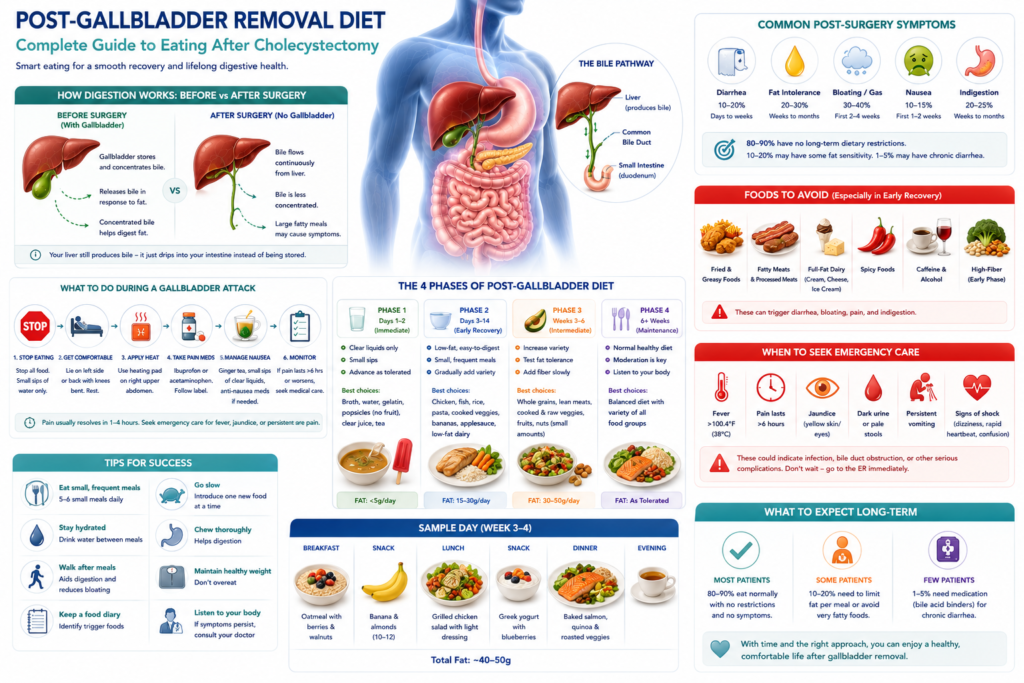
The gallbladder is a small organ that stores bile produced by your liver. While it serves a function, it’s not essential for survival or healthy digestion. Your liver continues producing bile after gallbladder removal—it simply drips continuously into your small intestine rather than being stored and concentrated.
Gallbladder removal is recommended when the gallbladder is causing problems that outweigh the benefits of keeping it.
Common Reasons for Cholecystectomy
1. Symptomatic Gallstones (Most Common)
Indication: Gallstones causing recurrent biliary colic (gallbladder attacks)
Why surgery:
- 70% of patients will have recurrent attacks within 2 years
- Each attack carries risk of serious complications (cholecystitis, pancreatitis, cholangitis)
- Medications to dissolve stones have low success rates and high recurrence
Success rate: 90-95% complete symptom resolution
2. Acute Cholecystitis
Indication: Infected, inflamed gallbladder
Why surgery:
- Antibiotics alone have 20-30% failure rate
- Recurrence rate after conservative treatment: 25% within 1 year
- Early surgery (within 72 hours) has better outcomes than delayed surgery
Timing:
- Early cholecystectomy: Within 72 hours of symptom onset (preferred)
- Delayed cholecystectomy: 6-8 weeks after initial treatment (if patient too unstable for immediate surgery)
3. Gallstone Complications
Choledocholithiasis (stone in common bile duct):
- ERCP first to remove duct stone
- Then cholecystectomy to prevent future stones
Gallstone pancreatitis:
- Cholecystectomy during same hospitalization (after pancreatitis resolves)
- Prevents recurrent pancreatitis
Acute cholangitis (infected bile duct):
- Emergency ERCP for drainage
- Cholecystectomy once infection controlled
4. Gallbladder Polyps
Indication: Polyps >10mm, or any polyp with concerning features
Why surgery:
- Polyps >10mm have 50% risk of being cancerous
- Polyps 6-9mm: Surgery if additional risk factors (age >50, primary sclerosing cholangitis, sessile morphology)
- Polyps <6mm: Usually surveillance with ultrasound
5. Porcelain Gallbladder
Indication: Calcification of gallbladder wall
Why surgery:
- Associated with 15-60% risk of gallbladder cancer (older studies; more recent data suggests 5-10%)
- Prophylactic cholecystectomy recommended even if asymptomatic
6. Large Gallstones
Indication: Stones >3cm
Why surgery:
- Increased risk of gallbladder cancer (3-5% vs. <1% for smaller stones)
- More likely to become symptomatic
7. Biliary Dyskinesia (Functional Gallbladder Disorder)
Indication: Gallbladder ejection fraction <35-40% on HIDA scan WITH typical symptoms
Why surgery:
- 70-85% symptom improvement in properly selected patients
- Diagnosis of exclusion—other causes must be ruled out
Controversy: Some debate exists about optimal ejection fraction cutoff and patient selection criteria
8. Gallbladder Cancer
Indication: Known or suspected gallbladder malignancy
Surgery type: Often requires more extensive surgery than simple cholecystectomy (may include liver resection, lymph node dissection)
When Surgery May NOT Be Recommended
Asymptomatic gallstones (silent stones):
- 60-80% never develop symptoms
- Annual risk of symptoms: only 1-2%
- Surgery risks outweigh benefits
Exceptions (prophylactic surgery may be considered):
- Native American ethnicity (very high complication rates)
- Sickle cell disease (symptoms hard to distinguish from sickle crises)
- Before bariatric surgery or organ transplant
- Patients with limited access to medical care (remote areas)
Patients too unstable for surgery:
- Severe heart or lung disease
- Uncorrectable coagulopathy
- Advanced liver disease with portal hypertension
Alternative: Percutaneous cholecystostomy (drainage tube) as bridge to surgery or definitive management in critically ill patients
Types of Gallbladder Surgery
Laparoscopic Cholecystectomy (Gold Standard)
What it is: Minimally invasive surgery using small incisions, camera, and specialized instruments.
Procedure details:
- Anesthesia: General anesthesia (you’re completely asleep)
- Incisions: 4 small incisions (5-10mm each)
- One at or near the belly button (for camera)
- One in epigastrium (upper middle abdomen)
- Two in right upper quadrant (for instruments)
- Abdominal insufflation: Carbon dioxide gas pumped into abdomen to create working space
- Dissection:
- Gallbladder identified and grasped
- Cystic duct and cystic artery identified (Critical View of Safety)
- Clips applied to duct and artery
- Structures divided
- Gallbladder dissected from liver bed
- Removal: Gallbladder removed through one of the incisions (often the umbilical port)
- Completion:
- Surgical site inspected for bleeding or bile leak
- Instruments removed
- Gas evacuated
- Incisions closed with sutures or surgical glue
Duration: 1-2 hours typically (longer if inflammation, scarring, or complications)
Advantages:
- Less pain than open surgery
- Shorter hospital stay (often same-day discharge)
- Faster recovery (1-2 weeks vs. 6-8 weeks)
- Better cosmetic results (small scars)
- Lower wound infection rate
- Earlier return to normal activities
Success rate: 90-95% completed laparoscopically
Conversion to open surgery: 5-10% of cases
- May be necessary if severe inflammation, scarring, bleeding, or unclear anatomy
- Not a complication—appropriate surgical judgment to ensure safety
Robotic-Assisted Cholecystectomy
What it is: Similar to laparoscopic surgery but surgeon controls robotic arms from console.
Advantages:
- 3D high-definition visualization
- Greater range of motion than human hand
- Tremor filtration
- May be beneficial in complex cases or obese patients
Outcomes: Similar to standard laparoscopic cholecystectomy
Availability: Limited to centers with robotic systems
Cost: Higher than standard laparoscopic
Open Cholecystectomy
What it is: Traditional surgery with larger incision.
When it’s done:
- Laparoscopic approach not feasible (severe inflammation, scarring, bleeding)
- Intraoperative complications (bile duct injury, uncontrolled bleeding)
- Patient factors (severe cardiopulmonary disease, previous upper abdominal surgery)
- Surgeon expertise (rare in developed countries)
Incision: Right subcostal (Kocher) incision or upper midline incision, 10-20cm long
Duration: 1-3 hours
Hospital stay: 3-7 days
Recovery: 6-8 weeks for full recovery
Disadvantages vs. laparoscopic:
- More postoperative pain
- Longer hospital stay
- Slower return to normal activities
- Larger scar
- Higher wound infection rate
- Higher risk of incisional hernia
Single-Incision Laparoscopic Surgery (SILS)
What it is: All instruments inserted through single incision at belly button.
Advantages:
- Essentially scarless (hidden in umbilicus)
- Potentially less pain
Disadvantages:
- Technically more challenging
- Longer operative time
- Higher conversion rate
- Not suitable for all patients
Availability: Limited to specialized centers
Natural Orifice Transluminal Endoscopic Surgery (NOTES)
What it is: Incisions inside body (vagina, mouth, rectum) with no external scars.
Status: Experimental, limited availability
Not routinely recommended outside of clinical trials
Preparing for Surgery
Pre-Operative Evaluation
Medical history and physical examination:
- Review of symptoms and previous gallbladder attacks
- Assessment of surgical risk factors
- Physical exam focusing on heart, lungs, abdomen
Laboratory tests:
- Complete blood count (CBC)
- Comprehensive metabolic panel (liver and kidney function)
- Coagulation studies (PT/INR, PTT)
- Type and screen (blood typing, in case transfusion needed)
- Pregnancy test (if applicable)
Imaging:
- Right upper quadrant ultrasound (if not already done)
- Additional imaging (MRCP, CT) if common bile duct stones suspected
Cardiac clearance:
- EKG for patients >50 or with cardiac risk factors
- Cardiology consultation if significant heart disease
Anesthesia consultation:
- Review of medical history, medications, allergies
- Airway assessment
- Discussion of anesthesia risks
Medication Management
Medications to STOP before surgery:
| Medication | When to Stop | Reason |
|---|---|---|
| Warfarin | 5 days before | Bleeding risk; may bridge with heparin |
| Clopidogrel (Plavix) | 5-7 days before | Bleeding risk |
| NSAIDs (ibuprofen, naproxen) | 3-5 days before | Bleeding risk |
| Aspirin | 5-7 days before (if for primary prevention) | Bleeding risk; may continue if for secondary prevention (discuss with cardiologist) |
| Herbal supplements (garlic, ginkgo, ginseng, vitamin E) | 7 days before | Bleeding risk |
| Diabetes medications (oral) | Day of surgery | Fasting required |
| Insulin | Adjusted dosing day before/day of | Fasting required |
Medications to CONTINUE:
- Blood pressure medications (take morning of surgery with small sip of water)
- Beta-blockers
- Statins
- Thyroid medications
- Seizure medications
- Most antidepressants
Special considerations:
- Blood thinners: Requires coordination with prescribing physician
- Diabetes: Requires specific plan for insulin/oral medication adjustment
- Steroids: May need “stress dose” during surgery
Pre-Operative Instructions
The day before surgery:
- Clear liquid diet after lunch (water, broth, clear juices, gelatin)
- No solid food after midnight
- No alcohol for 24 hours before
- Shower with antibacterial soap (some centers recommend chlorhexidine)
- Arrange transportation home
- Fill postoperative prescriptions in advance
The morning of surgery:
- Nothing by mouth after midnight (NPO)
- Take approved medications with small sip of water
- No lotions, perfumes, deodorants
- Remove nail polish, jewelry
- Wear loose, comfortable clothing
- Arrive 1-2 hours before scheduled surgery time
What to bring:
- Photo ID and insurance card
- List of current medications
- Glasses/contacts case (if applicable)
- Comfortable clothes for going home
- Someone to drive you home and stay with you first night
The Day of Surgery: What to Expect
Pre-Operative Area (1-2 hours before surgery)
Check-in process:
- Registration and verification of identity
- Change into hospital gown
- Secure belongings in locker
- Meet with surgical team members
IV placement:
- Intravenous line started for fluids and medications
- Blood drawn for pre-op labs if not already done
Pre-operative medications:
- Antibiotics (typically cefazolin) within 60 minutes of incision
- Anti-anxiety medication if needed
- Compression devices placed on legs (prevent blood clots)
Team introductions:
- Surgeon confirms procedure and marks surgical site
- Anesthesiologist reviews plan
- Operating room nurse verifies consent and checklist
Operating Room
Anesthesia induction (5-10 minutes):
- Monitors placed (blood pressure cuff, EKG, oxygen monitor)
- Oxygen mask applied
- Anesthesia medications given through IV
- You fall asleep within seconds
- Breathing tube placed once asleep (protects airway during surgery)
Surgical preparation (10-15 minutes):
- Positioning on operating table (flat on back)
- Abdomen cleaned with antiseptic solution
- Sterile drapes placed
- Surgical team scrubs and gowns
The procedure (60-120 minutes typically):
- Incisions made
- Abdomen inflated with CO2 gas
- Camera and instruments inserted
- Gallbladder dissected and removed
- Surgical site inspected
- Instruments removed, gas evacuated
- Incisions closed
Emergence from anesthesia (10-20 minutes):
- Anesthesia stopped
- Breathing tube removed when you’re breathing on your own
- You wake up in recovery room (may not remember this)
Post-Anesthesia Care Unit (PACU)
Recovery time: 1-2 hours typically
What happens:
- Vital signs monitored frequently
- Pain medication given as needed
- IV fluids continued
- Nausea medication if needed
- Gradual awakening
Discharge criteria:
- Awake and alert
- Vital signs stable
- Pain controlled with oral medication
- Able to drink liquids
- Able to urinate
- No active nausea or vomiting
- Responsible adult available for transportation
Going home: Same day for most laparoscopic cases; 23-hour observation for some patients
Recovery Timeline
First 24 Hours
What you’ll experience:
- Grogginess from anesthesia
- Incisional pain (moderate, managed with medication)
- Shoulder pain (from CO2 gas irritation—very common)
- Nausea (may persist for several hours)
- Fatigue
- Sore throat (from breathing tube)
Activity:
- Walk short distances with assistance
- Deep breathing exercises (prevent pneumonia)
- Rest between activities
Diet:
- Start with clear liquids
- Advance to bland, low-fat foods as tolerated
- Small, frequent portions
Pain management:
- Prescription pain medication as needed
- Acetaminophen on schedule
- Ice packs to incision sites
- Walking helps reduce gas pain
Days 2-7
What improves:
- Energy level increases
- Pain becomes more manageable
- Shoulder pain resolves
- Appetite returns
- Bowel function normalizes
Activity:
- Walk several times daily
- Climb stairs slowly
- Light household activities
- No lifting >10 lbs
- No driving while taking narcotic pain medication
Work:
- Desk work: May return within 3-7 days if feeling well
- Physical work: Wait 2-4 weeks
Diet:
- Gradual advancement to regular diet
- Continue low-fat choices initially
- Small, frequent meals
- Avoid greasy, fried foods
- Stay well-hydrated
Wound care:
- Showering allowed (pat incisions dry)
- No bathing or swimming until incisions healed
- Steri-strips fall off on their own (7-10 days)
- Watch for signs of infection
Weeks 2-4
What to expect:
- Most pain resolved (may have occasional twinges)
- Energy near normal
- Incisions healing well
- Digestive system adjusting
Activity:
- Gradual return to normal activities
- Light exercise (walking, stationary bike)
- No heavy lifting (>20 lbs) until week 4
- May resume driving when off narcotics and can brake without pain
Work:
- Most patients return to desk work
- Manual laborers may need 4-6 weeks
Diet:
- Most patients tolerate regular diet
- Some fat sensitivity may persist
- Continue to avoid very fatty meals
- Increase fiber if experiencing diarrhea
Weeks 4-6
Full recovery milestones:
- No activity restrictions
- Full return to exercise and sports
- Heavy lifting permitted
- Incisions fully healed
Long-term:
- 80-90% of patients have no dietary restrictions
- 10-20% have some ongoing fat sensitivity
- <5% have chronic diarrhea requiring medication
Potential Complications
While cholecystectomy is generally safe, complications can occur. Understanding the risks helps you recognize warning signs and seek timely care.
Common, Minor Complications
Incisional pain:
- Expected for several days
- Managed with oral pain medication
- Gradually improves
Shoulder pain (referred from CO2):
- Very common (30-50% of patients)
- Peaks at 24 hours
- Resolves within 2-3 days
- Walking and heat help
Nausea and vomiting:
- Common first 24 hours
- Anti-nausea medications effective
- Usually resolves quickly
Diarrhea:
- Occurs in 10-20% of patients
- Usually temporary (days to weeks)
- Managed with dietary modification
- May require bile acid binder medication if persistent
Bloating and gas:
- Common first week
- Gradual improvement
- Walking helps
Less Common, More Serious Complications
Wound infection:
- Incidence: 1-3%
- Signs: Redness, warmth, swelling, pus, fever
- Treatment: Antibiotics, possible wound opening
Bleeding:
- Incidence: 1-2%
- May require transfusion or reoperation
- Signs: Dizziness, rapid heart rate, abdominal distension
Bile leak:
- Incidence: 0.5-1%
- Bile leaking from cystic duct stump or liver bed
- Signs: Increasing abdominal pain, fever, abdominal distension
- Diagnosis: HIDA scan, CT scan
- Treatment: ERCP with stent, possible reoperation
Retained common bile duct stone:
- Incidence: 2-5%
- Stone missed during surgery
- Signs: Jaundice, abdominal pain, elevated liver enzymes
- Diagnosis: Ultrasound, MRCP
- Treatment: ERCP
Rare, Serious Complications
Bile duct injury:
- Incidence: 0.3-0.5% (3-5 per 1000 surgeries)
- Most serious complication of cholecystectomy
- Types: Cut, clipped, or thermal injury to common bile duct
- Signs: Jaundice, bile leak, abdominal pain, fever
- May be recognized intraoperatively or days/weeks later
- Treatment: Often requires complex reconstructive surgery (hepaticojejunostomy)
- Long-term: Possible strictures requiring multiple interventions
Bowel injury:
- Incidence: 0.1-0.2%
- Trocar or thermal injury to intestine
- May require bowel resection
Vascular injury:
- Incidence: 0.1-0.2%
- Injury to hepatic artery, portal vein, or other vessels
- May require conversion to open surgery
Conversion to open surgery:
- Incidence: 5-10%
- Not technically a complication but appropriate surgical judgment
- Reasons: Severe inflammation, unclear anatomy, bleeding, equipment failure
- Associated with longer recovery than planned laparoscopic surgery
Deep vein thrombosis (DVT) / Pulmonary embolism (PE):
- Incidence: <1%
- Blood clot in leg or lung
- Prevention: Early ambulation, compression devices, blood thinners in high-risk patients
- Signs: Leg swelling/pain (DVT), shortness of breath/chest pain (PE)
Anesthesia complications:
- Allergic reactions
- Breathing problems
- Heart complications
- Very rare with modern anesthesia
Death:
- Extremely rare for elective cholecystectomy
- Mortality rate: <0.1% (1 per 1000) for elective laparoscopic
- Higher for emergency surgery and elderly/comorbid patients
When to Call Your Doctor
Contact your surgeon if you experience:
- Fever >101°F (38.3°C)
- Worsening abdominal pain (not improving with medication)
- Persistent nausea or vomiting
- Inability to keep liquids down
- Yellowing of skin or eyes (jaundice)
- Dark urine or pale stools
- Increasing redness, swelling, or drainage from incisions
- Pus draining from incisions
- Incision opening
- Severe diarrhea (more than 6-8 watery stools per day)
- Signs of blood clot (leg swelling, calf pain, shortness of breath, chest pain)
Go to Emergency Department if:
- High fever with shaking chills
- Severe abdominal pain with rigid abdomen
- Uncontrolled vomiting
- Confusion or extreme weakness
- Chest pain or difficulty breathing
- Heavy bleeding from incisions
Life After Gallbladder Removal
How Digestion Changes
Before surgery:
- Liver produces bile continuously
- Bile stored and concentrated in gallbladder
- Gallbladder contracts in response to fat, releasing concentrated bile into intestine
After surgery:
- Liver still produces bile (unchanged)
- No storage reservoir—bile drips continuously into small intestine
- Bile less concentrated
- Less bile available for large fatty meals
Adaptation:
- Bile ducts gradually dilate slightly, taking over some storage function
- Intestine adapts to continuous bile flow
- Most people digest food normally within weeks to months
Long-Term Dietary Considerations
Most patients (80-90%):
- No long-term dietary restrictions
- Can eat normal, varied diet
- May choose to limit very fatty meals for comfort
Some patients (10-20%):
- Ongoing fat sensitivity
- Diarrhea after fatty meals
- Benefit from:
- Smaller, more frequent meals
- Limiting fried and high-fat foods
- Gradual reintroduction of fats
Few patients (<5%):
- Chronic diarrhea (bile acid malabsorption)
- Require bile acid binder medication (cholestyramine, colesevelam)
- May need ongoing dietary modification
Post-Cholecystectomy Syndrome
What it is: Persistent or recurrent symptoms after gallbladder removal.
Frequency: 10-40% report some symptoms (most are mild and self-limited)
Possible causes:
Biliary causes:
- Retained common bile duct stone (2-5%)
- Bile duct stricture
- Cystic duct stump stone
- Sphincter of Oddi dysfunction
Non-biliary GI causes:
- Irritable bowel syndrome
- Functional dyspepsia
- GERD
- Peptic ulcer disease
- Pancreatitis
Non-GI causes:
- Musculoskeletal pain
- Cardiac disease
- Psychological factors
Evaluation:
- Detailed history and physical
- Liver function tests
- Ultrasound or MRCP
- EUS if high suspicion
- ERCP if intervention needed
Treatment:
- Depends on underlying cause
- ERCP for stones or sphincter of Oddi dysfunction
- Medications for functional disorders
- Reassurance for mild, non-specific symptoms
Pregnancy After Cholecystectomy
Safety:
- Cholecystectomy does not affect fertility
- Pregnancy is safe after gallbladder removal
- No increased risk of complications
Timing:
- Wait until fully recovered before conceiving (typically 4-6 weeks)
- No waiting period required beyond recovery
During pregnancy:
- No special dietary requirements
- Same prenatal care as women with gallbladder
- Diarrhea (if present) can be managed safely
Exercise and Physical Activity
Short-term (first 4-6 weeks):
- Walking encouraged immediately
- Gradual increase in activity
- No heavy lifting (>10-20 lbs) for 4 weeks
- No contact sports for 6 weeks
Long-term:
- No restrictions
- All forms of exercise permitted
- No increased risk of hernia after full healing
- Athletes return to full competition
Quality of Life
Studies show:
- 90-95% of patients satisfied with surgical outcome
- Significant improvement in quality of life scores
- Resolution of pain in vast majority
- Return to normal activities and work
Patient-reported benefits:
- Freedom from pain and unpredictable attacks
- No more dietary anxiety
- Better sleep
- Improved work productivity
- No more emergency room visits
Alternatives to Surgery
For Patients Who Cannot or Will Not Have Surgery
Ursodiol (Ursodeoxycholic Acid):
- Oral bile acid that reduces cholesterol secretion
- Works only for small cholesterol stones (<1.5cm)
- Requires functioning gallbladder
- Success rate: 60-70% stone dissolution
- Treatment duration: 6-24 months
- Recurrence rate: 50% within 5 years
- Best for: Poor surgical candidates, small radiolucent stones
Extracorporeal Shock Wave Lithotripsy (ESWL):
- Sound waves break up stones
- Limited availability
- High recurrence rate
- Rarely used
Contact dissolution:
- Solvent (MTBE) injected directly into gallbladder
- High complication rate
- Rarely used
Dietary management:
- Low-fat diet may reduce attack frequency
- Does NOT eliminate stones
- Does NOT prevent complications
- Appropriate only as temporary measure or for patients who cannot have surgery
Percutaneous cholecystostomy:
- Drainage tube placed through skin into gallbladder
- For critically ill patients who cannot tolerate surgery
- Bridge to eventual cholecystectomy or definitive management in select patients
Why Surgery Is Preferred
For symptomatic gallstones, surgery is the gold standard because:
- Definitive cure (no recurrence)
- High success rate (90-95%)
- Safe (low complication rate)
- Quick recovery (laparoscopic)
- Cost-effective (one-time treatment vs. ongoing medications)
Frequently Asked Questions
Will I have diarrhea forever after gallbladder removal?
No. While 10-20% of patients experience diarrhea in the first few weeks, most adapt within 3-6 months. Only about 1-2% have chronic diarrhea requiring medication. Bile acid binders (cholestyramine, colesevelam) are very effective if needed.
Can I drink alcohol after gallbladder surgery?
Yes, in moderation. Wait until you’re off narcotic pain medication and eating normally (typically 1-2 weeks). Alcohol doesn’t affect the surgical site but may worsen diarrhea or interact with medications.
How soon can I drive after surgery?
Typically 3-7 days, when you:
- Are no longer taking narcotic pain medication
- Can brake suddenly without pain
- Have adequate range of motion
- Feel alert (no residual anesthesia effects)
Check with your surgeon and insurance company for specific guidance.
Can the gallbladder grow back?
No. Once removed, the gallbladder does not regenerate. However, gallstones can occasionally form in the bile ducts (not the gallbladder) years after surgery.
Will I gain weight after gallbladder removal?
Some patients report weight changes, but surgery itself doesn’t cause weight gain. Some patients gain weight because they can eat comfortably again. Others lose weight due to dietary changes. Long-term weight is determined by diet and exercise habits.
How many scars will I have?
Standard laparoscopic cholecystectomy leaves 4 small scars:
- One at the belly button (often hidden)
- One in upper middle abdomen
- Two on the right side under the ribs
Scars are typically 5-10mm and fade significantly over 6-12 months. Single-incision surgery leaves one hidden scar at the belly button.
Can I have children after gallbladder removal?
Yes. Gallbladder removal has no effect on fertility or ability to carry a pregnancy. Many women have successful pregnancies after cholecystectomy.
What if I’m pregnant and need gallbladder surgery?
Laparoscopic cholecystectomy can be performed safely during pregnancy, typically in the second trimester. Untreated gallbladder disease can also cause pregnancy complications. Discuss risks and benefits with your surgeon and obstetrician.
Will I need to take supplements after surgery?
No special supplements are needed. Your body absorbs nutrients normally without a gallbladder. If you have chronic diarrhea, discuss with your doctor whether you need fat-soluble vitamin (A, D, E, K) monitoring.
Can gallstones come back after surgery?
Gallstones cannot form in the gallbladder after it’s removed. However, stones can occasionally form in the bile ducts (choledocholithiasis) in the years after surgery. This is uncommon (2-5%).
The Bottom Line
Gallbladder removal is one of the most common and safest surgeries performed today. For patients with symptomatic gallstones or gallbladder disease, it offers:
- Definitive cure in 90-95% of cases
- Minimally invasive approach with quick recovery
- Low complication rate when performed by experienced surgeons
- Return to normal life within weeks
- No long-term dietary restrictions for most patients
Key points to remember:
- The gallbladder is not essential—you can live a completely normal life without it
- Laparoscopic surgery is the gold standard—small incisions, quick recovery
- Most patients go home the same day or after one night
- Full recovery takes 4-6 weeks, but most feel much better within 1-2 weeks
- Long-term quality of life is excellent for the vast majority of patients
If your doctor has recommended cholecystectomy, discuss your specific situation, ask about the surgeon’s experience and outcomes, and understand both the benefits and risks. For most patients with symptomatic gallbladder disease, surgery provides lasting relief and a return to normal life.
Medically Reviewed By: Dr. Sarah Mitchell, MD, FACG (Fellow of the American College of Gastroenterology)
Last Updated: March 10, 2026
Medical Disclaimer: This article is for educational purposes only and does not constitute medical advice. Consult with a qualified surgeon and healthcare provider for diagnosis and treatment recommendations specific to your situation.