Stress and Peptic Ulcers: What’s the Real Connection?
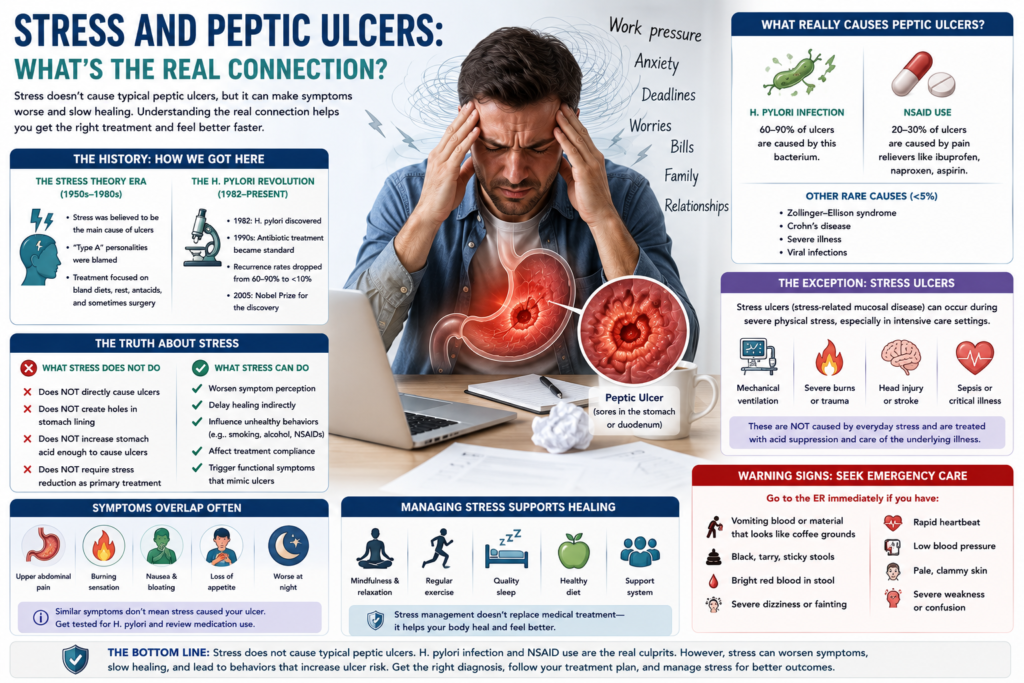
The History: How We Got Here
Understanding the evolution of ulcer theory helps explain why confusion persists.
The Stress Theory Era (1950s-1980s)
What Doctors Believed:
- Stress was the primary cause of ulcers
- “Type A” personalities (competitive, ambitious) were at higher risk
- Treatment focused on:
- Bland diets (milk, cream, boiled chicken)
- Rest and relaxation
- Antacids
- Sometimes surgery for severe cases
Why This Theory Persisted:
- Ulcers seemed to flare during stressful periods
- Certain occupations (executives, doctors) had higher ulcer rates
- Animal studies showed stress could cause gastric changes
- No better explanation existed (H. pylori not yet discovered)
The Problem:
- Recurrence rates were 60-90% within one year
- Treatments didn’t address the real cause
- Patients blamed themselves for “not handling stress well enough”
The H. pylori Revolution (1982-Present)
The Discovery:
- 1982: Australian researchers Barry Marshall and Robin Warren discovered H. pylori in stomach biopsies
- 1984: Marshall famously drank H. pylori culture to prove causation
- 1990s: Antibiotic treatment became standard
- 2005: Marshall and Warren won Nobel Prize
What Changed:
- Ulcers recognized as primarily infectious/medication-induced
- Treatment shifted to antibiotics + acid suppression
- Recurrence rates dropped from 60-90% to <10%
- Patients no longer blamed for their condition
What the Research Shows:
| Study Finding | Implication |
|---|---|
| 90%+ of duodenal ulcers have H. pylori | Bacteria is primary cause |
| 60-70% of gastric ulcers have H. pylori | Bacteria is major cause |
| 20-30% of ulcers are NSAID-induced | Medications are second major cause |
| <5% of ulcers occur without H. pylori or NSAIDs | Other causes (including stress) are rare |
| Stress reduction alone doesn’t heal ulcers | Not a primary treatment |
| Antibiotics heal ulcers by eradicating H. pylori | Proves bacterial causation |
The Truth About Stress and Ulcers
Let’s separate fact from fiction about stress and peptic ulcers.
What Stress Does NOT Do
Everyday Psychological Stress Does NOT:
- Directly cause typical peptic ulcers
- Create holes in the stomach lining
- Increase stomach acid enough to cause ulcers
- Suppress protective mucus production significantly
- Require stress reduction as primary treatment
Common Myths:
- ❌ “Work stress gave me an ulcer”
- ❌ “If I manage stress better, my ulcer will heal”
- ❌ “Type A personalities get more ulcers”
- ❌ “Relaxation cures ulcers”
What Stress DOES Do
Stress CAN:
- Worsen Symptom Perception
- Stress amplifies pain signals (visceral hypersensitivity)
- Same amount of acid feels more painful when stressed
- Brain-gut axis modulates symptom intensity
- Delay Healing Indirectly
- Stress affects sleep quality
- Poor sleep impairs tissue repair
- May affect immune function
- Influence Behaviors
- Stressed people more likely to:
- Smoke (doubles ulcer risk)
- Drink alcohol (irritates lining)
- Take NSAIDs (for stress headaches, muscle tension)
- Skip meals or eat irregularly
- Drink more coffee (stimulates acid)
- Stressed people more likely to:
- Affect Treatment Compliance
- High stress may lead to:
- Forgetting medications
- Not completing full antibiotic course
- Poor follow-up
- High stress may lead to:
- Trigger Functional Symptoms
- Stress can cause IBS-like symptoms
- Overlaps with ulcer symptoms (pain, bloating, nausea)
- May be confused with ulcer recurrence
The Exception: Stress-Related Mucosal Injury
While everyday stress doesn’t cause typical ulcers, severe physiological stress can cause a specific type of ulcer called “stress ulcers” or “stress-related mucosal disease.”
What Are Stress Ulcers?
Stress ulcers are acute erosions or ulcers that develop in the stomach or duodenum during severe physiological stress.
Key Differences from Typical Peptic Ulcers:
| Feature | Typical Peptic Ulcer | Stress Ulcer |
|---|---|---|
| Cause | H. pylori, NSAIDs | Severe physiological stress |
| Onset | Gradual (weeks to months) | Rapid (hours to days) |
| Setting | Outpatient, everyday life | ICU, critical illness |
| Number | Usually single | Often multiple |
| Depth | Can be deep | Usually superficial |
| Treatment | Antibiotics, PPIs | PPIs, treat underlying illness |
| Prevention | Eradicate H. pylori, avoid NSAIDs | PPI prophylaxis in ICU |
Who Gets Stress Ulcers?
High-Risk Groups:
| Risk Factor | Relative Risk |
|---|---|
| Mechanical ventilation >48 hours | 15-30x |
| Coagulopathy (bleeding disorder) | 5-10x |
| Severe burns (>35% body surface) | 10-20x |
| Head trauma/spinal cord injury | 5-10x |
| Sepsis | 5-8x |
| Multiple organ failure | 5-10x |
| Major surgery | 2-4x |
| ICU stay with multiple risk factors | 10-30x |
Note: These are critically ill patients in intensive care—not people with everyday work or relationship stress.
Why Physiological Stress Causes Ulcers
Mechanisms:
- Reduced Blood Flow
- Critical illness causes blood to be shunted away from gut
- Reduced oxygen and nutrient delivery
- Impaired mucus production
- Tissue becomes vulnerable to acid
- Impaired Mucus Production
- Stress hormones affect mucus-secreting cells
- Protective barrier weakened
- Acid can damage lining
- Increased Acid (in Some Cases)
- Head trauma can trigger massive acid production (Cushing’s ulcers)
- Severe burns increase acid (Curling’s ulcers)
- Bile Reflux
- Critical illness can cause bile to flow backward into stomach
- Bile damages protective mucus layer
Prevention in Critical Care
ICU Stress Ulcer Prophylaxis:
Who Should Get It:
- Patients with any high-risk factor (see above)
- Generally recommended for ICU patients expected to stay >48 hours
What’s Used:
- PPIs (IV or via feeding tube)
- H2 blockers (famotidine IV)
- Sucralfate (coats stomach lining)
Effectiveness:
- Reduces clinically significant bleeding by 50-70%
- Standard of care in modern ICUs
The Brain-Gut Connection
While stress doesn’t directly cause typical ulcers, the brain-gut axis is real and relevant to digestive health.
What Is the Brain-Gut Axis?
The brain-gut axis is the bidirectional communication system between your central nervous system (brain and spinal cord) and your enteric nervous system (the “brain in your gut”).
Communication Pathways:
Brain ←→ Gut

Vagus nerve (primary pathway)
Hormonal signals (cortisol, CRH)
Immune signals (cytokines)
Microbiome signals (bacterial metabolites)
What This Means:
- Emotions affect gut function
- Gut status affects mood and cognition
- Stress can alter gut motility, sensitivity, and secretion
- Gut inflammation can affect mental state
How Stress Affects Digestive Function
Physiological Effects:
| Effect | Impact on Digestion |
|---|---|
| Increased cortisol | Alters gut permeability, immune function |
| Sympathetic activation | Reduces blood flow to gut |
| Altered motility | Can cause diarrhea or constipation |
| Visceral hypersensitivity | Normal sensations feel painful |
| Immune modulation | Affects inflammation, healing |
| Microbiome changes | Alters bacterial composition |
Symptoms Stress Can Cause or Worsen:
- Abdominal pain
- Bloating
- Nausea
- Diarrhea or constipation
- Heartburn/reflux
- Loss of appetite or emotional eating
Important: These symptoms can overlap with ulcer symptoms, leading to confusion about the actual cause.
Stress and Functional GI Disorders
Functional Dyspepsia (Indigestion Without Ulcer):
- Symptoms mimic ulcers (upper abdominal pain, bloating, early satiety)
- No ulcer found on endoscopy
- Strong association with stress and anxiety
- Brain-gut axis plays major role
- Treatment includes stress management, gut-directed therapies
Irritable Bowel Syndrome (IBS):
- Abdominal pain with bowel habit changes
- Strong brain-gut component
- Stress is a major trigger for flares
- Stress management is part of treatment
Key Point: Stress-related digestive symptoms are real and valid—even when they’re not caused by ulcers.
Stress Management for Ulcer Patients
While stress reduction doesn’t cure ulcers, it plays a supportive role in comprehensive care.
Why Stress Management Still Matters
Benefits for Ulcer Patients:
- Improved Symptom Tolerance
- Same level of healing feels better
- Reduced pain perception
- Better quality of life during treatment
- Better Treatment Compliance
- Lower stress = better medication adherence
- More likely to complete full antibiotic course
- Better follow-up
- Healthier Coping Behaviors
- Less likely to smoke, drink excessively
- Less likely to overuse NSAIDs
- Better eating patterns
- Overall Health Benefits
- Better sleep
- Improved immune function
- Lower cardiovascular risk
- Better mental health
Evidence-Based Stress Management Techniques
1. Mindfulness Meditation
Evidence:
- Reduces perceived stress by 30-40% in 8 weeks
- Improves IBS and functional dyspepsia symptoms
- May reduce visceral hypersensitivity
How to Start:
- 10-15 minutes daily
- Apps: Headspace, Calm, Insight Timer
- Focus on breath, body awareness
- No special equipment needed
2. Diaphragmatic Breathing
Evidence:
- Activates parasympathetic nervous system (rest-and-digest)
- Reduces cortisol levels
- Can be done anywhere, anytime
Technique:
1. Sit or lie comfortably
2. Hand on chest, hand on belly
3. Inhale through nose (4 seconds), belly rises
4. Hold briefly (2 seconds)
5. Exhale through mouth (6 seconds), belly falls
6. Repeat for 5-10 minutes
3. Progressive Muscle Relaxation
Evidence:
- Reduces physical tension
- Improves sleep quality
- Decreases perceived stress
Technique:
- Systematically tense and release each muscle group
- Start with feet, work up to face
- 15-20 minutes, before bed
4. Regular Exercise
Evidence:
- Reduces stress hormones
- Improves mood and sleep
- Supports overall gut health
- 30 minutes most days
Recommendations:
- Walking, swimming, yoga (gentle options)
- Avoid intense exercise during active ulcer phase
- Listen to your body
5. Cognitive Behavioral Therapy (CBT)
Evidence:
- Gold standard for stress and anxiety
- Gut-directed CBT shows 70% improvement in functional GI disorders
- Helps change unhelpful thought patterns
Access:
- In-person therapist
- Online programs
- Self-help books based on CBT principles
6. Sleep Hygiene
Why It Matters:
- Poor sleep increases stress hormones
- Impairs healing
- Worsens pain perception
Recommendations:
- 7-9 hours nightly
- Consistent sleep/wake times
- Dark, cool, quiet bedroom
- No screens 1 hour before bed
What NOT to Rely On
Ineffective or Harmful “Stress Relief”:
- ❌ Alcohol (irritates stomach, increases acid)
- ❌ Smoking (doubles ulcer risk, impairs healing)
- ❌ Overeating or emotional eating (can worsen symptoms)
- ❌ NSAIDs for stress headaches (can cause/worsen ulcers)
- ❌ Excessive caffeine (stimulates acid production)
When to Address Stress vs. When to Address Ulcer
It’s important to know when stress management is appropriate vs. when medical evaluation is needed.
Seek Medical Evaluation For:
Ulcer Symptoms:
- Burning stomach pain lasting >1 week
- Pain that wakes you from sleep
- Pain related to meals (worse or better with eating)
- Need for daily antacids >2 weeks
- Unexplained weight loss
Emergency Symptoms:
- Vomiting blood or coffee-ground material
- Black, tarry stools
- Sudden, severe abdominal pain
- Dizziness, fainting
Consider Stress Management For:
Functional Symptoms:
- Symptoms without clear organic cause
- Symptoms that fluctuate with stress levels
- Normal endoscopy but ongoing symptoms
- Co-existing anxiety or depression
Supportive Care:
- During ulcer treatment (to support healing)
- After ulcer heals (to prevent stress-related symptom flares)
- For overall well-being
Special Considerations
Anxiety and Health Worry
Common Scenario:
- Patient diagnosed with ulcer
- Becomes anxious about cancer, complications
- Monitors every sensation
- Symptoms feel worse due to hypervigilance
Helpful Approach:
- Understand that most ulcers heal completely
- H. pylori is treatable (85-90% success rate)
- Follow medical advice, complete treatment
- Use stress management to reduce health anxiety
- Avoid excessive internet symptom-checking
Work-Related Stress
If Your Job Is High-Stress:
- Take regular breaks
- Eat meals away from your desk
- Practice brief breathing exercises
- Set boundaries when possible
- Consider whether job changes are needed (long-term)
Remember: Work stress didn’t cause your ulcer, but managing it supports overall health.
The Role of Support Systems
Social Support Matters:
- Better treatment adherence
- Lower perceived stress
- Better coping with illness
Ways to Engage Support:
- Tell family/friends about your diagnosis
- Ask for practical help during treatment
- Join support groups (online or in-person)
- Consider counseling if struggling emotionally
Frequently Asked Questions
Can stress cause an ulcer if I don’t have H. pylori or take NSAIDs?
It’s very unlikely. Less than 5% of ulcers occur without H. pylori or NSAID involvement. If you have an ulcer without these risk factors, doctors will investigate other causes (Zollinger-Ellison syndrome, Crohn’s disease, viral infections, cancer). Everyday psychological stress is not considered a direct cause of typical peptic ulcers.
I was told my ulcer was caused by stress. Was my doctor wrong?
Your doctor may have been using outdated information, or may have been simplifying. Before the 1980s, stress was believed to be the primary cause. We now know H. pylori and NSAIDs cause 90%+ of ulcers. However, stress can worsen symptoms and affect healing indirectly, so there’s a grain of truth in the connection.
If stress doesn’t cause ulcers, why do my symptoms get worse when I’m stressed?
Stress affects pain perception through the brain-gut axis. The same amount of acid or inflammation can feel more painful when you’re stressed. Stress can also affect sleep, eating patterns, and medication compliance—all of which can impact how you feel.
Should I still manage stress if I have an ulcer?
Yes, absolutely. While stress management won’t cure your ulcer (antibiotics and acid suppression do that), it can:
- Improve symptom tolerance
- Support better sleep and healing
- Reduce unhealthy coping behaviors
- Improve overall quality of life
Can stress cause ulcer recurrence after successful treatment?
Not directly. Once H. pylori is eradicated and the ulcer heals, recurrence is unlikely (<10%) regardless of stress levels. However, if stress leads to behaviors like smoking, heavy drinking, or frequent NSAID use, those could increase recurrence risk.
What about “stress ulcers” in the ICU?
These are real but completely different from everyday ulcers. ICU stress ulcers occur in critically ill patients (on ventilators, with severe burns, head trauma, sepsis). They’re caused by severe physiological stress (reduced blood flow to the gut), not everyday psychological stress. Prevention involves acid-suppressing medications in the ICU setting.
Are people with high-stress jobs more likely to get ulcers?
Studies have shown mixed results. Some occupations historically showed higher ulcer rates, but this is likely due to:
- Higher H. pylori prevalence in certain populations
- More NSAID use for stress-related headaches
- More smoking and drinking
- Irregular eating patterns
When controlling for H. pylori status, the stress-ulcer connection largely disappears.
Can meditation or relaxation cure my ulcer?
No. Ulcers require medical treatment:
- H. pylori: Antibiotics + acid suppression
- NSAID-induced: Stop NSAID + acid suppression
Stress management can support healing and improve how you feel, but it cannot replace medical treatment.
Conclusion
The relationship between stress and peptic ulcers has been misunderstood for decades. While everyday psychological stress doesn’t directly cause typical peptic ulcers (H. pylori and NSAIDs do), stress still matters for digestive health.
Key Points:
- H. pylori and NSAIDs cause 90%+ of ulcers—not stress
- Severe physiological stress (critical illness) can cause different “stress ulcers”
- Everyday stress can worsen symptoms through the brain-gut axis
- Stress affects behaviors that do increase ulcer risk (smoking, drinking, NSAID use)
- Stress management supports overall health even if it doesn’t directly cure ulcers
- Don’t blame yourself—ulcers are not a sign of weakness or poor stress management
If you have ulcer symptoms, seek medical evaluation for proper diagnosis and treatment. Once the underlying cause is addressed (H. pylori eradication, NSAID management), most ulcers heal completely. Stress management techniques can support your recovery and improve your quality of life during and after treatment.
Medical Disclaimer: This article is for educational purposes only and does not constitute medical advice. Peptic ulcers require proper medical diagnosis and treatment. If you have symptoms of an ulcer, consult a healthcare provider. If you have signs of bleeding (black stools, vomiting blood) or severe pain, seek emergency medical attention.
Sources:
- NIDDK – Peptic Ulcers (Stomach Ulcers) – National Institute of Diabetes and Digestive and Kidney Diseases – 2020 – https://www.niddk.nih.gov/health-information/digestive-diseases/peptic-ulcers-stomach-ulcers
- Mayo Clinic – Peptic Ulcer – 2025 – https://www.mayoclinic.org/diseases-conditions/peptic-ulcer/symptoms-causes/syc-20354223
- Marshall BJ, Warren JR – Unidentified curved bacilli in the stomach of patients with gastritis and peptic ulceration – The Lancet – 1984 – https://www.thelancet.com/journals/lancet/article/PIIS0140-6736(84)91816-6/fulltext
- Lanza FL, et al. – Guidelines for prevention of NSAID-related ulcer complications – American Journal of Gastroenterology – 2023 – https://journals.lww.com/ajg/Fulltext/2023/03000/Guidelines_for_Prevention_of_NSAID_Related_Ulcer.15.aspx
- American College of Gastroenterology – ACG Clinical Guideline: Treatment of Helicobacter pylori Infection – 2024 – https://gi.org/journals-publications/ebgi/schoenfeld_sep2024/
- Systematic Review – Psychological stress and peptic ulcer disease – American Journal of Gastroenterology – 2023 – https://journals.lww.com/ajg/Fulltext/2023/04000/Psychological_Stress_and_Peptic_Ulcer_Disease.11.aspx
- Research – Stress-related mucosal disease in the ICU – Critical Care Medicine – 2023 – https://journals.lww.com/ccmjournal/Fulltext/2023/05000/Stress_Related_Mucosal_Disease_in_the_ICU.12.aspx
- Review – Brain-gut axis and functional gastrointestinal disorders – Gastroenterology – 2024 – https://www.gastrojournal.org/article/S0016-5085(24)00123-4/fulltext
- UpToDate – Pathogenesis of peptic ulcer disease – 2025 – https://www.uptodate.com/contents/pathogenesis-of-peptic-ulcer-disease
- NHS – Stomach ulcer – Causes – 2023 – https://www.nhs.uk/conditions/stomach-ulcer/causes/