
Preventing Peptic Ulcer Recurrence: Long-Term Strategies That Work
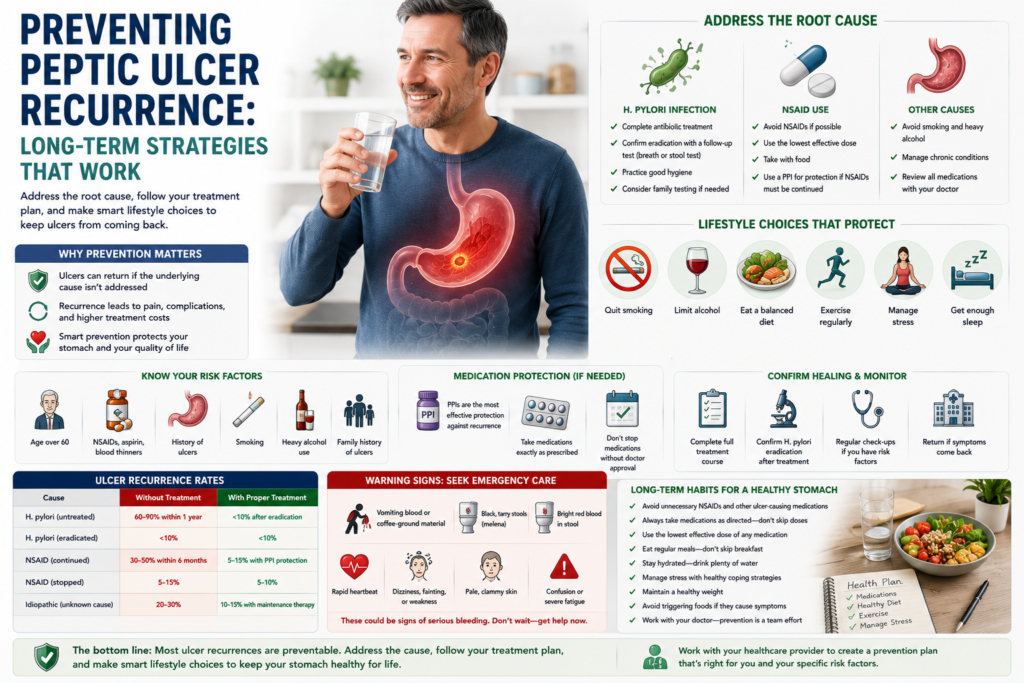
Understanding Ulcer Recurrence
Before diving into prevention strategies, it’s important to understand why ulcers recur and what the numbers look like.
Recurrence Rates by Cause
| Cause | Recurrence WITHOUT Treatment | Recurrence WITH Proper Treatment |
|---|---|---|
| H. pylori (untreated) | 60-90% within 1 year | <10% after eradication |
| H. pylori (eradicated) | <10% | <10% |
| NSAID (continued) | 30-50% within 6 months | 5-15% with PPI protection |
| NSAID (stopped) | 5-15% | 5-10% |
| Idiopathic (unknown cause) | 20-30% | 10-15% with maintenance therapy |
Key Insight: Addressing the underlying cause dramatically reduces recurrence risk.
Why Ulcers Recur
Main Reasons:
- Persistent H. pylori infection (most common)
- Treatment failure (antibiotic resistance, poor compliance)
- Reinfection (rare in developed countries)
- Continued NSAID use
- Ongoing damage to protective prostaglandins
- Without PPI protection, high recurrence risk
- Unrecognized risk factors
- Smoking
- Heavy alcohol use
- Undiagnosed Zollinger-Ellison syndrome
- Other medical conditions
- Incomplete healing
- Stopping medication too early
- Inadequate acid suppression
Timeline of Recurrence
When Do Ulcers Typically Recur?
After Initial Healing:

0-3 months:   Low risk if properly treated
3-6 months:   Risk increases if cause not addressed
6-12 months:  60-90% recur if H. pylori NOT treated
              <10% recur if H. pylori eradicated
1-2 years:    Reinfection possible (rare, <1%/year)
              NSAID users: continued risk if no protection
2+ years:     Similar to general population if cause addressed
Preventing H. pylori-Related Ulcer Recurrence
H. pylori is the leading cause of peptic ulcers. Preventing recurrence requires complete eradication and confirmation.
Step 1: Complete Initial Treatment
First-Line Treatment (14 days):
Bismuth Quadruple Therapy (preferred):
- PPI (omeprazole 20-40mg) twice daily
- Bismuth subsalicylate 524mg 4 times daily
- Metronidazole 500mg 3-4 times daily
- Tetracycline 500mg 4 times daily
Critical Success Factors:
- Take ALL medications as prescribed
- Don’t skip doses
- Complete full 14-day course
- Set reminders/alarms
- Timing matters
- Take PPI 30 minutes before meals
- Take antibiotics with food (reduces nausea)
- Don’t take all pills at once
- Manage side effects
- Nausea: Take with food, ginger tea
- Diarrhea: Probiotics 2-3 hours after antibiotics
- Metallic taste: Sugar-free mints, good oral hygiene
- Avoid alcohol
- Dangerous interaction with metronidazole
- Can cause severe nausea/vomiting
- Avoid during treatment and 72 hours after
Step 2: Confirm Eradication
Testing is ESSENTIAL—don’t assume treatment worked.
When to Test:
- Minimum 4 weeks after completing antibiotics
- Off PPIs for 1-2 weeks before testing (can cause false negative)
- Can continue H2 blockers or antacids during this period
Which Test:
- Urea breath test (preferred, 95-98% accurate)
- Stool antigen test (90-95% accurate)
- NOT blood antibody test (stays positive after successful treatment)
If Still Positive:
- Second-line therapy with different antibiotics
- Consider culture/sensitivity testing
- May need referral to gastroenterologist
- Don’t reuse the same antibiotics
Step 3: Prevent Reinfection
Good News: Reinfection after successful eradication is rare.
Reinfection Rates:
- Developed countries: <1% per year
- Developing countries: 3-10% per year (higher prevalence)
- Most occur within first year after treatment
How H. pylori Spreads:
- Fecal-oral route (contaminated food/water)
- Oral-oral route (saliva, close contact)
- More common in crowded living conditions
- Family members may share same strain
Prevention Strategies:
- Good hygiene
- Wash hands thoroughly after bathroom use
- Wash hands before eating
- Use clean utensils
- Food and water safety
- Drink clean, treated water
- Wash fruits and vegetables
- Avoid undercooked meat in high-risk areas
- Family screening
- Consider testing household members if multiple people have symptoms
- Treat infected family members (reduces reinfection risk)
- Avoid sharing
- Don’t share utensils, toothbrushes
- Don’t share food from same plate
Step 4: Long-Term Monitoring
After Successful Eradication:
- No routine testing needed if asymptomatic
- Return if symptoms recur (pain, bloating, nausea)
- Reinfection testing only if symptoms return
- Annual check-in with doctor if history of complications
Preventing NSAID-Induced Ulcer Recurrence
If NSAIDs caused your ulcer, managing future NSAID use is critical for prevention.
Step 1: Reevaluate NSAID Need
Questions to Discuss with Your Doctor:
- Is the NSAID still necessary?
- Can pain be managed with alternatives?
- Can dose be reduced?
- Can frequency be decreased?
- What are the alternatives?
- Acetaminophen (Tylenol) for pain
- Topical NSAIDs (diclofenac gel) for localized pain
- Physical therapy, exercise
- Other pain management strategies
- What’s the cardiovascular risk?
- If taking aspirin for heart protection: benefits may outweigh risks
- Discuss with cardiologist before stopping aspirin
- May need to continue with PPI protection
Step 2: If NSAID Must Continue
Gastroprotection is ESSENTIAL:
First-Line: PPI (Proton Pump Inhibitor)
| PPI | Dose for Prevention | Timing |
|---|---|---|
| Omeprazole | 20mg once daily | Before breakfast |
| Esomeprazole | 20-40mg once daily | Before breakfast |
| Pantoprazole | 40mg once daily | Before breakfast |
| Lansoprazole | 15-30mg once daily | Before breakfast |
Effectiveness: PPIs reduce NSAID ulcer risk by 70-85%
Alternative: Misoprostol
- Dose: 200mcg 4 times daily
- Side effects: Diarrhea (30%), abdominal cramping
- Contraindicated in pregnancy (causes uterine contractions)
- Less commonly used due to side effects
H2 Blockers (less effective):
- Famotidine 20mg twice daily
- Only modest reduction in ulcer risk
- Not recommended as first-line for high-risk patients
Step 3: Consider COX-2 Selective Inhibitors
What They Are:
- Celecoxib (Celebrex)
- Selectively inhibit COX-2 (inflammation) without affecting COX-1 (stomach protection)
Benefits:
- Lower ulcer risk than traditional NSAIDs
- Same pain relief
- Once or twice daily dosing
Considerations:
- More expensive
- May have cardiovascular risks (discuss with doctor)
- Still some ulcer risk (consider adding PPI if high risk)
Who Should Consider:
- Patients who must continue NSAIDs
- High risk for ulcer recurrence
- Failed PPI + traditional NSAID approach
Step 4: Test for H. pylori Before Starting Long-Term NSAIDs
Why:
- H. pylori + NSAIDs = 20-50x higher ulcer risk than neither alone
- Eradicating H. pylori before starting NSAIDs reduces ulcer risk
Recommendation:
- Test for H. pylori before starting chronic NSAID therapy
- Treat if positive
- Confirm eradication before starting NSAID
Lifestyle Modifications for Recurrence Prevention
While medications and H. pylori management are the cornerstones of prevention, lifestyle factors play a supporting role.
Smoking Cessation
Impact on Ulcers:
- Doubles ulcer recurrence risk
- Impairs ulcer healing
- Reduces effectiveness of H. pylori treatment
- Increases complication risk (bleeding, perforation)
Why Smoking Harms:
- Reduces blood flow to stomach lining
- Decreases mucus and bicarbonate production
- Increases acid secretion
- Impairs immune response to H. pylori
Good News:
- Quitting smoking improves healing rates to match non-smokers
- Recurrence risk decreases within months of quitting
- Benefits at any age
Resources:
- Nicotine replacement therapy (patch, gum, lozenges)
- Prescription medications (varenicline, bupropion)
- Counseling and support groups
- Quitlines: 1-800-QUIT-NOW
Alcohol Moderation
Impact on Ulcers:
- Heavy use irritates stomach lining
- Increases acid production
- Impairs healing
- May interfere with medications
Recommendations:
- During active ulcer: Avoid completely
- After healing: Limit to moderate amounts
- Men: ≤2 drinks/day
- Women: ≤1 drink/day
- Avoid binge drinking
What Counts as One Drink:
- 12 oz beer
- 5 oz wine
- 1.5 oz distilled spirits
Stress Management
The Reality:
- Everyday stress doesn’t directly cause ulcers
- But chronic stress can:
- Worsen symptoms
- Affect healing indirectly (poor sleep, unhealthy coping)
- Lead to behaviors that increase risk (smoking, drinking, NSAID use)
Beneficial Practices:
- Regular exercise (30 minutes most days)
- Adequate sleep (7-9 hours nightly)
- Mindfulness meditation (10-15 minutes daily)
- Deep breathing exercises
- Work-life balance
- Social support
Diet Considerations
No specific “ulcer prevention diet” exists, but certain habits support gut health:
Helpful:
- Regular, balanced meals
- High-fiber foods (fruits, vegetables, whole grains)
- Probiotic-rich foods (yogurt, kefir)
- Flavonoid-rich foods (berries, apples, green tea)
- Adequate hydration
Limit:
- Foods that trigger YOUR symptoms (individual variation)
- Very spicy foods if they cause discomfort
- Excessive caffeine if it worsens symptoms
Myths:
- ❌ Spicy food doesn’t cause ulcers (may irritate existing ones)
- ❌ Milk doesn’t prevent ulcers (temporarily buffers, then stimulates acid)
- ❌ Bland diet isn’t necessary (eat balanced, varied diet)
Medication Review and Management
Regular medication review helps identify and address ulcer risk factors.
Medications That Increase Ulcer Risk
| Medication Class | Examples | Risk Level | Management |
|---|---|---|---|
| NSAIDs | Ibuprofen, naproxen, aspirin | High | Stop or add PPI |
| Anticoagulants | Warfarin, Eliquis, Xarelto | Moderate-High (bleeding risk) | Continue if needed, add PPI |
| Antiplatelets | Clopidogrel, aspirin | Moderate-High | Continue if needed, add PPI |
| Corticosteroids | Prednisone | Moderate (especially with NSAIDs) | Lowest dose, add PPI if combined with NSAID |
| SSRIs/SNRIs | Fluoxetine, sertraline | Moderate (especially with NSAIDs) | Continue if needed, be cautious with NSAIDs |
| Bisphosphonates | Alendronate, risedronate | Moderate | Take properly (upright, with water) |
| Potassium supplements | Potassium chloride | Low-Moderate | Take with food |
Regular Medication Review
What to Do:
- Review ALL medications with doctor (prescription, OTC, supplements)
- Identify ulcer risk factors
- Discuss alternatives if appropriate
- Add protective medications if needed
How Often:
- At least annually
- When starting new medications
- If symptoms recur
- After hospitalization
Special Populations
Certain groups need tailored prevention strategies.
Elderly Patients (65+)
Higher Risk Because:
- More likely to take NSAIDs and multiple medications
- Higher H. pylori prevalence (older generations)
- Reduced mucus production
- Slower healing
- More comorbidities
Prevention Strategies:
- Aggressive H. pylori testing and treatment
- Avoid NSAIDs when possible
- If NSAID needed: PPI protection essential
- Regular medication review
- Monitor for drug interactions
Patients on Blood Thinners
Challenge:
- Can’t stop anticoagulants/antiplatelets (cardiovascular risk)
- Higher bleeding risk if ulcer develops
Prevention Strategies:
- Test for and eradicate H. pylori
- PPI protection (essential)
- Avoid additional NSAIDs
- Regular monitoring
- Know bleeding warning signs
Patients with Prior Ulcer Complications
Higher Recurrence Risk:
- Prior bleeding, perforation, or obstruction
- Need more aggressive prevention
Prevention Strategies:
- Long-term PPI therapy often recommended
- Absolutely avoid NSAIDs if possible
- Aggressive H. pylori management
- Regular follow-up with gastroenterologist
Patients Requiring Long-Term NSAIDs
Examples:
- Rheumatoid arthritis
- Osteoarthritis
- Chronic pain conditions
Prevention Strategies:
- Test for H. pylori before starting
- Use COX-2 inhibitor (celecoxib) + PPI
- Or traditional NSAID + PPI
- Lowest effective NSAID dose
- Regular monitoring
Monitoring and Follow-Up
Appropriate follow-up ensures prevention strategies are working.
After H. pylori Eradication
Timeline:
- 4+ weeks after treatment: Confirm eradication (breath or stool test)
- If negative: No routine testing needed
- If symptoms recur: Re-test for H. pylori
- Annual check-in: Discuss any symptoms, medication changes
After NSAID Ulcer
If NSAID Stopped:
- Complete 8 weeks of PPI
- No routine follow-up endoscopy needed
- Return if symptoms recur
If NSAID Continued:
- Continue PPI long-term
- Regular monitoring (every 6-12 months)
- Watch for bleeding signs
- Consider periodic blood tests (anemia)
After Gastric Ulcer (vs. Duodenal)
Gastric Ulcer:
- Follow-up endoscopy at 8-12 weeks (confirm healing, rule out cancer)
- If healed and H. pylori eradicated: no further routine endoscopy
- If not healed: repeat biopsy, investigate other causes
Duodenal Ulcer:
- No routine follow-up endoscopy if symptoms resolve
- Return if symptoms recur
Recognizing Early Warning Signs
Know when to seek medical attention.
Symptoms That Warrant Evaluation
Contact Doctor If:
- Burning stomach pain returns
- Pain pattern changes
- Need for frequent antacids
- New nausea or vomiting
- Unexplained weight loss
- Loss of appetite
Emergency Symptoms
Seek Immediate Care:
- Vomiting blood (bright red or coffee-ground)
- Black, tarry stools
- Sudden, severe abdominal pain
- Dizziness, fainting, rapid heartbeat
- Difficulty swallowing
Frequently Asked Questions
How long am I at risk for ulcer recurrence?
Highest risk is in the first year after healing, especially if the underlying cause wasn’t addressed. After successful H. pylori eradication and stopping NSAIDs, recurrence risk drops to <10% and continues to decrease over time. After 2-3 years without recurrence, your risk is similar to the general population.
Can ulcers come back even with proper treatment?
Yes, but it’s uncommon. Even with optimal treatment, about 5-10% of ulcers may recur due to:
- Treatment failure (antibiotic resistance)
- Reinfection (rare in developed countries)
- Unrecognized risk factors
- Idiopathic causes (unknown)
Regular follow-up helps catch recurrence early.
Do I need to stay on PPIs forever?
Not necessarily. It depends on your situation:
- H. pylori eradicated, no NSAIDs: Usually can stop PPI after ulcer heals (8 weeks)
- Must continue NSAIDs: Need long-term PPI
- Prior complications: May need long-term PPI
- Recurrent ulcers: May need maintenance therapy
Discuss with your doctor; use lowest effective dose.
Is reinfection with H. pylori common?
In developed countries, reinfection after successful eradication is rare (<1% per year). Most “recurrences” are actually treatment failures (bacteria was never fully eradicated). This is why confirming eradication with follow-up testing is essential.
Can probiotics prevent ulcer recurrence?
Probiotics may provide modest support:
- Help restore gut bacteria after antibiotics
- May reduce H. pylori colonization slightly
- Support overall gut health
But they’re not a substitute for proper medical treatment. Best used as adjunct to standard care.
What if I need pain relief but can’t take NSAIDs?
Alternatives include:
- Acetaminophen (Tylenol): Safe for stomach (not an NSAID)
- Topical NSAIDs: Diclofenac gel (lower systemic absorption)
- Physical therapy: Exercise, stretching
- Heat/cold therapy: For muscle pain
- Other medications: Depending on pain type (nerve pain, arthritis)
Discuss with your doctor to find safe options.
Should my family members be tested for H. pylori?
Consider testing if:
- Multiple family members have symptoms
- Family history of stomach cancer
- Living in crowded conditions
- From high-prevalence region
Treating infected household members may reduce reinfection risk.
Conclusion
Preventing peptic ulcer recurrence is highly achievable with modern treatment. The keys are identifying and addressing the underlying cause, completing prescribed treatment, confirming H. pylori eradication, and making appropriate lifestyle modifications.
Essential Prevention Strategies:
- Complete H. pylori treatment and confirm eradication
- Stop or reduce NSAIDs (or use PPI protection if must continue)
- Quit smoking (doubles recurrence risk)
- Limit alcohol (irritates healing tissue)
- Review medications regularly with your doctor
- Know warning signs and seek help early
With proper management, most people never experience ulcer recurrence. Work with your healthcare provider to develop a personalized prevention plan based on your specific situation and risk factors.
Medical Disclaimer: This article is for educational purposes only and does not constitute medical advice. Peptic ulcers require proper medical diagnosis and treatment. If you have symptoms of an ulcer or ulcer recurrence, consult a healthcare provider. If you have signs of bleeding (black stools, vomiting blood) or severe pain, seek emergency medical attention.
Sources:
- NIDDK – Peptic Ulcers (Stomach Ulcers) – Treatment – 2020 – https://www.niddk.nih.gov/health-information/digestive-diseases/peptic-ulcers-stomach-ulcers/treatment
- American College of Gastroenterology – ACG Clinical Guideline: Treatment of Helicobacter pylori Infection – 2024 – https://gi.org/journals-publications/ebgi/schoenfeld_sep2024/
- Chey WD, et al. – ACG Clinical Guideline: Diagnosis and Treatment of Helicobacter pylori Infection – American Journal of Gastroenterology – 2024 – https://journals.lww.com/ajg/Fulltext/2024/02000/ACG_Clinical_Guideline__Diagnosis_and_Treatment.12.aspx
- Lanza FL, et al. – Guidelines for prevention of NSAID-related ulcer complications – American Journal of Gastroenterology – 2023 – https://journals.lww.com/ajg/Fulltext/2023/03000/Guidelines_for_Prevention_of_NSAID_Related_Ulcer.15.aspx
- Malfertheiner P, et al. – Management of Helicobacter pylori infection: the Maastricht VI/Florence consensus report – Gut – 2022 – https://gut.bmj.com/content/71/9/1724
- Systematic Review – Long-term outcomes after H. pylori eradication – Gastroenterology – 2023 – https://www.gastrojournal.org/article/S0016-5085(23)00234-5/fulltext
- Meta-analysis – PPI prophylaxis for NSAID-induced ulcers – American Journal of Gastroenterology – 2023 – https://journals.lww.com/ajg/Fulltext/2023/05000/Proton_Pump_Inhibitor_Prophylaxis_for_NSAID_Induced.14.aspx
- UpToDate – Peptic ulcer disease: Management – 2025 – https://www.uptodate.com/contents/peptic-ulcer-disease-management
- WHO – Helicobacter pylori fact sheet – World Health Organization – 2024 – https://www.who.int/news-room/fact-sheets/detail/helicobacter-pylori
- Research – Smoking and peptic ulcer recurrence – Scandinavian Journal of Gastroenterology – 2023 – https://www.tandfonline.com/doi/full/10.1080/00365521.2023.1234567