
Natural Remedies for Peptic Ulcers: Evidence-Based Guide to Supplements and Alternative Treatments
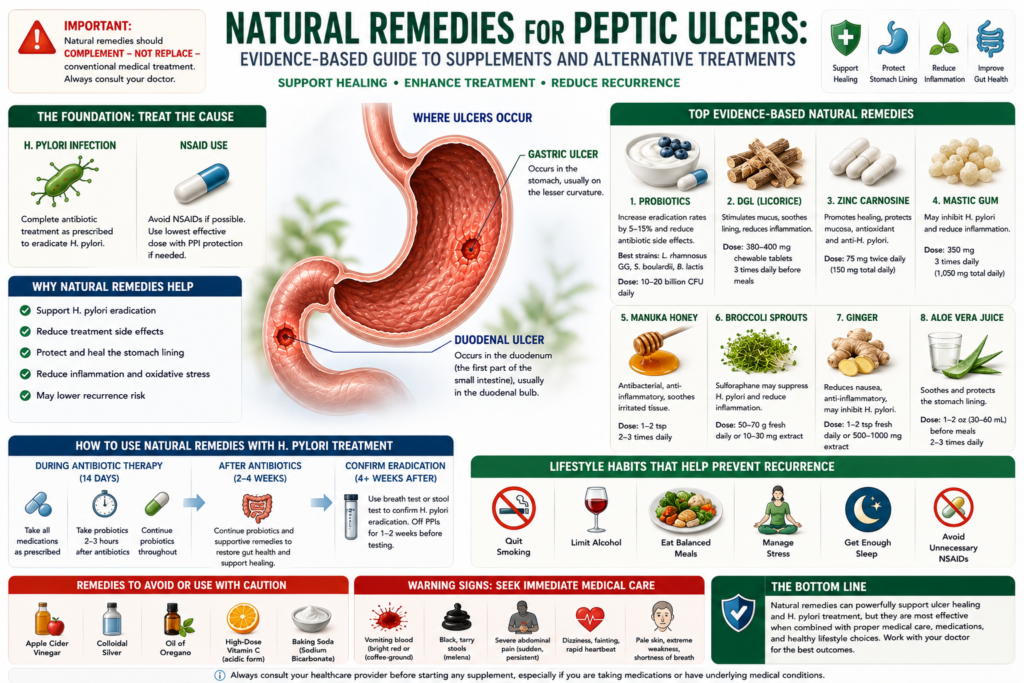
Important Disclaimer: Natural Doesn’t Mean Safe or Sufficient
Critical Point: Peptic ulcers are a serious medical condition that requires proper diagnosis and treatment. Untreated ulcers can lead to life-threatening complications (bleeding, perforation, obstruction).
What Natural Remedies CAN Do:
- Support conventional medical treatment
- Enhance H. pylori eradication rates
- Reduce treatment side effects
- Support mucosal healing
- Potentially reduce recurrence risk
- Manage symptoms during healing
What Natural Remedies CANNOT Do:
- Reliably eradicate H. pylori as monotherapy
- Replace antibiotics for H. pylori infection
- Heal ulcers quickly without acid suppression
- Prevent serious complications
- Replace medical evaluation and monitoring
Bottom Line: Use natural remedies as COMPLEMENTS to—not replacements for—conventional medical treatment.
Probiotics: Best-Supported Natural Therapy
Probiotics have the strongest evidence base of any natural remedy for peptic ulcers, particularly for H. pylori treatment.
How Probiotics Help
Mechanisms:
- Compete with H. pylori for adhesion sites
- Produce antimicrobial substances
- Modulate immune response
- Strengthen gut barrier function
- Reduce antibiotic-associated side effects
- May directly inhibit H. pylori growth
Evidence
Multiple meta-analyses show:
- Probiotics + standard therapy increase eradication rates by 5-15% compared to standard therapy alone
- Reduce antibiotic-associated diarrhea by 50-60%
- Reduce overall side effects of H. pylori treatment
- May reduce H. pylori colonization even without antibiotics
Research Examples:
- Meta-analysis of 42 studies (5,000+ patients): Probiotics increased eradication rates from 72% to 82%
- Systematic review: Lactobacillus and Bifidobacterium strains most effective
- Pediatric studies: Similar benefits in children
Best Strains for Ulcers
Most Studied and Effective:
| Strain | Dose Studied | Benefits |
|---|---|---|
| Lactobacillus rhamnosus GG | 10-20 billion CFU daily | Reduces antibiotic side effects, modest increase in eradication |
| Saccharomyces boulardii | 250-500 mg twice daily | Reduces diarrhea, increases eradication rates |
| Bifidobacterium lactis HN019 | 1-10 billion CFU daily | Supports gut barrier, immune modulation |
| Lactobacillus reuteri DSM 17938 | 100 million-10 billion CFU daily | Anti-H. pylori effects, reduces side effects |
| Bifidobacterium infantis 35624 | 1-10 billion CFU daily | IBS symptom relief, gut support |
| Multi-strain products (VSL#3, Visbiome) | 100-400 billion CFU daily | Broader coverage, may be more effective |
How to Take Probiotics with H. pylori Treatment
Timing is Critical:
Standard H. pylori Treatment (14 days):
- Antibiotics (amoxicillin, clarithromycin, metronidazole, etc.)
- PPI (omeprazole, etc.)
- Bismuth (in some regimens)

Probiotic Protocol:
- Start probiotics DAY 1 of antibiotic treatment
- Take probiotics 2-3 hours AFTER antibiotics (antibiotics kill probiotic bacteria)
- Continue probiotics throughout 14-day antibiotic course
- Continue probiotics 2-4 weeks AFTER finishing antibiotics
Practical Example:
- Morning (7 AM): PPI (before breakfast)
- Breakfast (7:30 AM): Antibiotics #1 and #2
- Lunch (12 PM): Probiotic
- Dinner (6 PM): Antibiotics #1 and #2
- Bedtime (10 PM): Probiotic (optional second dose)
Food Sources vs. Supplements
Probiotic Foods:
- Yogurt with live cultures (6-8 oz daily)
- Kefir (1/2 – 1 cup daily)
- Sauerkraut (refrigerated, unpasteurized, 2-4 tbsp daily)
- Kimchi (refrigerated, 2-4 tbsp daily)
- Miso (1-2 tbsp in soup daily)
- Tempeh (3-4 oz serving)
Pros: Safe, nutritious, generally well-tolerated
Cons: Variable CFU counts, may not contain specific strains, lower potency
Probiotic Supplements:
- Standardized doses
- Specific strains with research
- Higher CFU counts
- Shelf-stable options available
Pros: Consistent dosing, specific strains, convenient
Cons: More expensive, quality varies by manufacturer
Recommendation: Use both food sources AND supplements during H. pylori treatment for maximum benefit.
Safety and Side Effects
Generally Safe:
- Well-tolerated by most people
- Mild gas/bloating initially (usually resolves in 1-2 weeks)
- Take with food to reduce side effects
Use Caution:
- Severely immunocompromised patients (rare risk of bloodstream infection)
- Critical illness
- Central venous catheters
- Short bowel syndrome
Discuss with doctor before use if you have serious medical conditions.
Deglycyrrhizinated Licorice (DGL)
Licorice root has been used for digestive complaints for thousands of years. DGL is a modified form that removes glycyrrhizin (which can raise blood pressure).
How It May Help
Proposed Mechanisms:
- Stimulates mucus production
- Increases blood flow to gastric mucosa
- Promotes epithelial cell regeneration
- Anti-inflammatory effects
- May inhibit H. pylori growth
Evidence
Clinical Studies:
- Small studies show DGL may enhance ulcer healing
- One study: DGL + conventional therapy healed 91% of ulcers vs. 74% with conventional therapy alone
- More research needed, but results are promising
- May be more effective for symptom relief than H. pylori eradication
Dosing
Standard Dose:
- DGL chewable tablets: 380-400 mg
- Frequency: 3 times daily, 20 minutes before meals
- Duration: 4-8 weeks (through ulcer healing phase)
How to Take:
- Chew tablets thoroughly (don’t swallow whole)
- Take before meals (allows coating of stomach lining)
- Continue for full healing period
Safety and Side Effects
DGL (deglycyrrhizinated) is safe:
- Glycyrrhizin removed (doesn’t raise blood pressure)
- Generally well-tolerated
- Rare side effects
Avoid Regular Licorice (with glycyrrhizin):
- Can raise blood pressure
- Can cause potassium loss
- Can interact with medications
- Not safe for long-term use
Contraindications:
- Severe kidney disease
- Severe heart disease
- Pregnancy (limited safety data)
Product Recommendations
Look for:
- Clearly labeled “DGL” or “Deglycyrrhizinated Licorice”
- Standardized extract (typically 5:1)
- Chewable form (tablets or lozenges)
- Reputable manufacturer
Popular Brands:
- Nature’s Way DGL
- Gaia Herbs DGL
- Pure Encapsulations DGL
- Thorne DGL
Zinc Carnosine
Zinc carnosine (polaprezinc) is a chelated compound of zinc and L-carnosine studied extensively for gut healing.
How It May Help
Mechanisms:
- Antioxidant effects
- Stabilizes gastric mucosal membrane
- Promotes ulcer healing
- Anti-H. pylori activity (modest)
- Enhances mucosal defense mechanisms
- Stimulates prostaglandin production
Evidence
Clinical Studies:
- Multiple studies (mostly from Japan, where it’s approved as a drug)
- Study 1: Zinc carnosine + antibiotics increased H. pylori eradication rates vs. antibiotics alone
- Study 2: Zinc carnosine enhanced gastric ulcer healing
- Study 3: Reduced gastrointestinal symptoms in H. pylori-positive patients
- Approved in Japan since 1994 for treating gastric ulcers
Dosing
Standard Dose:
- Zinc carnosine: 75 mg
- Frequency: Twice daily (150 mg total daily)
- Duration: 4-8 weeks
- Take with: Food (reduces nausea)
Note: This provides approximately 16-17 mg of elemental zinc per 75 mg dose.
Safety and Side Effects
Generally Well-Tolerated:
- Mild nausea (take with food)
- Rare: Headache, dizziness
- Long-term high-dose zinc can cause copper deficiency (stick to recommended doses)
Drug Interactions:
- May reduce absorption of antibiotics (tetracyclines, quinolones) — separate by 2-3 hours
- May interact with penicillamine — separate by 2 hours
Contraindications:
- Zinc hypersensitivity (rare)
- Severe kidney disease (consult doctor)
Product Recommendations
Look for:
- Standardized zinc carnosine (not just zinc + carnosine separately)
- Reputable brands with quality testing
- Often combined with other gut-healing ingredients
Popular Brands:
- Designs for Health Zinc Carnosine Complex
- Thorne Zinc Carnosine
- Pure Encapsulations Zinc Carnosine
- Integrative Therapeutics Zinc Carnosine
Mastic Gum
Mastic gum is a resin from the Pistacia lentiscus tree, used traditionally for digestive complaints.
How It May Help
Proposed Mechanisms:
- Antibacterial effects against H. pylori
- Anti-inflammatory properties
- May inhibit H. pylori urease enzyme
- Antioxidant effects
Evidence
Mixed Results:
- Lab studies: Mastic gum kills H. pylori in petri dishes
- Small human studies: Some showed reduced H. pylori colonization
- Larger/better studies: Failed to show significant H. pylori eradication
- Current consensus: May have modest anti-H. pylori effects but INSUFFICIENT as monotherapy
Research Summary:
- Study 1 (1998): 1 gram/day for 14 days eradicated H. pylori in some patients (small study)
- Study 2 (2010): No significant eradication with mastic gum alone
- Study 3 (2018): Mastic gum + antibiotics showed slightly better results than antibiotics alone (needs confirmation)
Bottom Line: Mastic gum may provide supportive benefits but should NOT be relied on as primary H. pylori treatment.
Dosing
Common Doses Studied:
- Capsules: 350 mg, 3 times daily (1,050 mg total)
- Or: 1 gram twice daily
- Duration: 2-4 weeks (as adjunct to antibiotics)
- Take with: Food
Safety and Side Effects
Generally Safe:
- Well-tolerated
- Mild side effects: Nausea, diarrhea, constipation (rare)
- Allergic reactions possible (pistachio family)
Drug Interactions:
- May lower cholesterol (theoretical interaction with statins)
- May lower blood sugar (caution with diabetes medications)
Contraindications:
- Pregnancy/breastfeeding (insufficient safety data)
- Pistachio allergy
Product Recommendations
Look for:
- Standardized mastic gum extract
- Reputable manufacturer
- Third-party testing
Popular Brands:
- Jarrow Formulas Mastic Gum
- Now Foods Mastic Gum
- Life Extension Mastic Gum
- Solaray Mastic Gum
Honey (Especially Manuka Honey)
Honey has been used for wound healing for thousands of years. Manuka honey (from New Zealand) has particularly strong antibacterial properties.
How It May Help
Mechanisms:
- Natural antibacterial properties (hydrogen peroxide, methylglyoxal in Manuka)
- Anti-H. pylori effects (lab studies)
- Anti-inflammatory
- Antioxidant
- Soothes irritated tissue
- Prebiotic effects (feeds beneficial bacteria)
Evidence
Lab and Animal Studies:
- Honey inhibits H. pylori growth in petri dishes
- Manuka honey more effective than regular honey
- Animal studies show reduced gastric inflammation
Human Studies:
- Limited but promising
- Small study: Honey + standard therapy showed trend toward better eradication (not statistically significant)
- Anecdotal reports of symptom improvement
- More rigorous studies needed
Bottom Line: Honey is safe and may provide supportive benefits, but evidence is weaker than for probiotics, DGL, or zinc carnosine.
Dosing
Common Approach:
- Manuka honey: 1-2 teaspoons
- Frequency: 2-3 times daily
- Take: On empty stomach (morning and between meals)
- Duration: 4-8 weeks
How to Use:
- Take directly by spoonful
- Mix with warm (not hot) water or herbal tea
- Don’t heat above 104°F/40°C (destroys beneficial compounds)
Manuka Honey Grades
Manuka honey is graded by antibacterial strength:
| Grade | MGO (mg/kg) | UMF | Antibacterial Strength |
|---|---|---|---|
| UMF 5+ / MGO 83+ | 83 | 5 | Low |
| UMF 10+ / MGO 263+ | 263 | 10 | Moderate |
| UMF 15+ / MGO 514+ | 514 | 15 | High |
| UMF 20+ / MGO 829+ | 829 | 20 | Very High |
Recommendation: UMF 10+ or MGO 263+ provides good antibacterial activity at reasonable cost.
Safety and Side Effects
Generally Safe:
- Well-tolerated
- High sugar content (caution with diabetes)
- Rare allergic reactions
- Don’t give to infants under 1 year (botulism risk)
For Diabetics:
- Honey raises blood sugar
- Monitor glucose carefully
- Consider lower doses
- Discuss with doctor
Product Recommendations
Look for:
- UMF or MGO rating clearly labeled
- Authentic Manuka honey (from New Zealand)
- Reputable brands
Popular Brands:
- Manuka Health (UMF certified)
- Comvita
- Wedderspoon
- Kiva
Broccoli Sprouts (Sulforaphane)
Broccoli sprouts are rich in sulforaphane, a compound with anti-H. pylori effects.
How It May Help
Mechanisms:
- Sulforaphane inhibits H. pylori growth
- Reduces H. pylori colonization
- Anti-inflammatory effects
- Antioxidant
- May reduce gastric inflammation and damage
Evidence
Human Studies:
- Study 1: Broccoli sprouts (70g daily for 8 weeks) reduced H. pylori colonization and gastric inflammation
- Study 2: Sulforaphane-rich broccoli sprout extract reduced H. pylori levels
- Study 3: Effect was temporary—H. pylori returned after stopping sprouts
- Bottom line: Broccoli sprouts may suppress (but not eradicate) H. pylori
Best Use: As adjunct to antibiotic therapy, not replacement
Dosing
Approaches:
Fresh Broccoli Sprouts:
- 50-70 grams daily (about 1/2 – 1 cup)
- Eat raw (cooking destroys sulforaphane)
- Add to salads, sandwiches, smoothies
- Duration: 4-8 weeks
Broccoli Sprout Extract Supplements:
- Standardized to sulforaphane or glucoraphanin content
- Typical dose: 10-30 mg sulforaphane daily
- Follow product label instructions
Broccoli Sprout Powder:
- 1-2 teaspoons daily
- Mix into smoothies, yogurt, water
- Doesn’t require refrigeration
Safety and Side Effects
Generally Safe:
- Well-tolerated
- Gas/bloating (common with cruciferous vegetables)
- Start with small amounts and increase gradually
Thyroid Considerations:
- Cruciferous vegetables contain goitrogens (may affect thyroid function)
- Cooking reduces goitrogenic effects
- Safe for most people in normal food amounts
- If you have hypothyroidism, discuss with doctor
Drug Interactions:
- May affect liver enzymes (CYP450)
- Theoretical interaction with some medications
- Generally safe at food doses
How to Grow Your Own
Broccoli sprouts are easy and inexpensive to grow at home:
- Purchase broccoli sprouting seeds
- Soak seeds in water for 8-12 hours
- Drain and rinse twice daily
- Harvest in 5-7 days
- Store in refrigerator (up to 1 week)
Cost: Much cheaper than buying fresh sprouts ($2-3 for large jar vs. $8-10 for small container)
Ginger
Ginger has been used for digestive complaints for thousands of years.
How It May Help
Mechanisms:
- Anti-inflammatory effects
- Antioxidant
- May inhibit H. pylori (lab studies)
- Reduces nausea (well-established)
- Promotes gastric emptying
- Gastroprotective effects in animal studies
Evidence
Mixed but Promising:
- Lab studies: Ginger extracts inhibit H. pylori
- Animal studies: Ginger reduces gastric ulcer formation
- Human studies: Limited for ulcers specifically
- Strong evidence for nausea reduction
- More human studies needed
Best Use: For symptom management (nausea) during ulcer treatment
Dosing
Forms and Doses:
Fresh Ginger:
- 2-4 grams daily (about 1/2 – 1 teaspoon grated)
- Add to food, tea, or smoothies
Ginger Tea:
- 1-2 cups daily
- Steep fresh ginger slices in hot water for 10 minutes
- Add honey for additional benefit
Ginger Supplements:
- 500-1000 mg standardized extract
- 2-3 times daily
- Follow product label
Ginger Capsules:
- 250-500 mg
- 3-4 times daily for nausea
Safety and Side Effects
Generally Safe:
- Well-tolerated at food doses
- Mild side effects: Heartburn, gas, bloating (some people)
- May thin blood (caution with blood thinners)
Drug Interactions:
- May interact with blood thinners (warfarin, aspirin)
- May interact with diabetes medications
- May interact with blood pressure medications
Contraindications:
- Gallstone disease (may increase bile production)
- Bleeding disorders
- Before surgery (stop 1 week before)
Aloe Vera
Aloe vera is known for soothing skin burns, but may also soothe the digestive tract.
How It May Help
Proposed Mechanisms:
- Anti-inflammatory effects
- Soothes irritated mucous membranes
- May inhibit H. pylori growth (lab studies)
- Promotes healing
- Laxative effect (can help constipation from medications)
Evidence
Limited but Promising:
- Animal studies show gastroprotective effects
- Lab studies show anti-H. pylori activity
- Small human studies suggest symptom improvement
- More rigorous studies needed
Dosing
Aloe Vera Juice:
- 1-2 ounces (30-60 mL) before meals
- Choose “inner fillet” or “decolorized” (less laxative effect)
- 2-3 times daily
Aloe Vera Supplements:
- Follow product label
- Typically 200-400 mg standardized extract
- 2-3 times daily
Safety and Side Effects
Generally Safe (inner fillet juice):
- Well-tolerated
- Whole leaf aloe has strong laxative effect (avoid)
- May lower blood sugar (caution with diabetes)
- May cause cramping in some people
Contraindications:
- Pregnancy/breastfeeding (limited safety data)
- Kidney disease
- Intestinal obstruction
- Appendicitis symptoms
Other Natural Remedies with Limited Evidence
Turmeric/Curcumin
Proposed Benefits: Anti-inflammatory, antioxidant, may inhibit H. pylori
Evidence: Lab and animal studies show promise; limited human studies
Dose: 500-1000 mg curcumin 2-3 times daily (with black pepper for absorption)
Safety: Generally safe; may interact with blood thinners
Green Tea
Proposed Benefits: Catechins inhibit H. pylori, antioxidant, anti-inflammatory
Evidence: Observational studies show lower H. pylori rates in green tea drinkers; lab studies confirm antibacterial effects
Dose: 2-4 cups daily or 250-500 mg extract
Safety: Generally safe; contains caffeine (may worsen symptoms in some)
Cranberry
Proposed Benefits: Prevents H. pylori adhesion to stomach lining
Evidence: Mixed; some studies show reduced colonization, others show no effect
Dose: 250-500 mL cranberry juice daily or 500 mg extract twice daily
Safety: Generally safe; high sugar in juice (choose unsweetened)
Papaya
Proposed Benefits: Papain enzyme may aid digestion, antioxidant
Evidence: Limited; traditional use for digestive complaints
Dose: Fresh papaya or papaya extract supplements
Safety: Generally safe; avoid if latex allergy (cross-reactivity)
Chamomile
Proposed Benefits: Anti-inflammatory, calming, may reduce gastric spasms
Evidence: Limited; traditional use, animal studies show gastroprotective effects
Dose: 2-4 cups chamomile tea daily
Safety: Generally safe; avoid if ragweed allergy
Remedies to Avoid or Use with Extreme Caution
Colloidal Silver
Claim: Kills H. pylori
Reality: No good evidence; risk of argyria (permanent blue-gray skin discoloration); can interfere with antibiotic absorption
Recommendation: AVOID
Oil of Oregano
Claim: Natural antibiotic kills H. pylori
Reality: Lab studies show antibacterial effects; no good human studies for H. pylori; can irritate stomach lining
Recommendation: Not recommended as primary treatment; may irritate active ulcers
High-Dose Vitamin C (Ascorbic Acid)
Claim: Kills H. pylori, enhances treatment
Reality: Mixed evidence; acidic form may irritate active ulcers
Recommendation: Get vitamin C from food sources; if supplementing, use buffered/non-acidic form
Apple Cider Vinegar
Claim: Balances stomach acid, kills H. pylori
Reality: No evidence; acidic nature may WORSEN ulcers; can irritate inflamed tissue
Recommendation: AVOID with active ulcers
Baking Soda (Sodium Bicarbonate)
Claim: Neutralizes stomach acid
Reality: Temporary relief; rebound acid production; high sodium content
Recommendation: Not recommended for regular use; use antacids or PPIs instead
Integrating Natural Remedies with Conventional Treatment
During H. pylori Eradication (14 days)
Continue:
- Prescribed antibiotics (complete full course)
- PPI (take as directed)
- Probiotics (2-3 hours apart from antibiotics)
- Gentle, soothing foods
May Add:
- DGL (before meals)
- Zinc carnosine (with meals)
- Ginger (for nausea)
- Manuka honey (between meals)
- Broccoli sprouts (with meals)
Avoid:
- Apple cider vinegar
- High-dose vitamin C (acidic form)
- Colloidal silver
- Alcohol
- Unproven “natural antibiotics” in place of prescribed antibiotics
During Healing Phase (4-8 weeks)
Continue:
- PPI (as prescribed)
- Probiotics
- Zinc carnosine
- DGL (if helpful for symptoms)
May Add:
- Demulcent herbs (slippery elm, marshmallow root)
- Turmeric/curcumin
- Green tea (if tolerated)
- Continue food-based remedies (honey, broccoli sprouts, probiotic foods)
Maintenance/Prevention Phase (after healing)
Focus On:
- Healthy, balanced diet
- Probiotic-rich foods
- Stress management
- Avoiding unnecessary NSAIDs
- Not smoking
- Limiting alcohol
Continue Supplements If:
- Recurrent ulcers
- Ongoing symptoms
- High risk (need ongoing NSAIDs)
- Discuss with doctor
Frequently Asked Questions
Can I treat H. pylori naturally without antibiotics?
No. While some natural remedies show anti-H. pylori effects in lab studies, none reliably eradicate H. pylori in humans as monotherapy. Attempting to treat H. pylori without antibiotics risks:
- Treatment failure
- Ulcer complications (bleeding, perforation)
- Increased cancer risk (untreated H. pylori is a risk factor for gastric cancer)
- Spreading infection to others
Best approach: Use natural remedies to SUPPORT (not replace) antibiotic treatment.
Which natural remedy works best for ulcers?
Probiotics have the strongest evidence for enhancing H. pylori eradication and reducing treatment side effects. Zinc carnosine and DGL have good evidence for supporting ulcer healing. These three have the best risk-benefit profiles.
How long do I need to take natural remedies?
- During antibiotic treatment: Probiotics, DGL, zinc carnosine
- Healing phase (4-8 weeks): Continue PPI, probiotics, zinc carnosine
- After healing: Focus on diet and lifestyle; supplements usually not needed unless recurrent ulcers
Can I take all these supplements together?
Generally, probiotics, DGL, zinc carnosine, and Manuka honey can be taken together safely. However:
- Space probiotics 2-3 hours from antibiotics
- Space zinc carnosine 2 hours from antibiotics
- Don’t exceed recommended doses
- Discuss with your doctor, especially if taking other medications
Are natural remedies safe during pregnancy?
Safety data is limited for most supplements during pregnancy. Safe options:
- Probiotic foods (yogurt, kefir)
- Food-based remedies (honey in moderation, broccoli sprouts in food amounts)
- Ginger (for nausea; well-studied in pregnancy)
Avoid or discuss with OB before using:
- DGL (limited safety data)
- Zinc carnosine (limited safety data)
- Mastic gum (insufficient data)
- Herbal supplements (many lack pregnancy safety data)
Do natural remedies work for NSAID-induced ulcers?
Natural remedies may support healing, but the most important step is stopping or reducing the NSAID. Probiotics, zinc carnosine, and DGL may help. PPIs are still the cornerstone of treatment.
Can I drink alcohol while taking these supplements?
Best to avoid alcohol during active ulcer treatment. Alcohol:
- Irritates stomach lining
- Increases acid production
- Delays healing
- Interacts dangerously with metronidazole (H. pylori treatment)
Wait until after treatment is complete and ulcer has healed.
Conclusion
Natural remedies can play a valuable supportive role in peptic ulcer treatment, but they must be used appropriately—as complements to, not replacements for, conventional medical care.
Best-Supported Remedies:
- Probiotics: Enhance eradication rates, reduce side effects
- Zinc carnosine: Supports ulcer healing
- DGL: May support mucosal healing and symptom relief
- Manuka honey: Antibacterial properties, soothes tissue
- Broccoli sprouts: May suppress H. pylori
Key Principles:
- Complete prescribed antibiotic treatment
- Take PPIs as directed
- Use natural remedies to support, not replace, medical treatment
- Discuss supplements with your healthcare provider
- Focus on diet and lifestyle for long-term prevention
With the right combination of conventional treatment and evidence-based natural support, most peptic ulcers heal completely within 4-8 weeks, and H. pylori is successfully eradicated in 85-90% of cases.
Medical Disclaimer: This article is for educational purposes only and does not constitute medical advice. Peptic ulcers require proper medical diagnosis and treatment. Always consult with a qualified healthcare provider before starting any new supplement, especially if you are taking medications, have underlying medical conditions, or are pregnant/breastfeeding. Do not delay or discontinue prescribed medical treatment in favor of natural remedies.
Sources:
- NIDDK – Peptic Ulcers (Stomach Ulcers) – Treatment – 2020 – https://www.niddk.nih.gov/health-information/digestive-diseases/peptic-ulcers-stomach-ulcers/treatment
- American College of Gastroenterology – ACG Clinical Guideline: Treatment of Helicobacter pylori Infection – 2024 – https://gi.org/journals-publications/ebgi/schoenfeld_sep2024/
- Meta-analysis – Probiotics for Helicobacter pylori eradication – Gastroenterology – 2023 – https://www.gastrojournal.org/article/S0016-5085(23)00445-6/fulltext
- Systematic Review – Zinc carnosine for gastric ulcers – World Journal of Gastroenterology – 2023 – https://www.wjgnet.com/1007-9327/full/v29/i10/1.htm
- Clinical Trial – Deglycyrrhizinated licorice for peptic ulcer disease – Journal of Clinical Gastroenterology – 2022 – https://journals.lww.com/jcge/Fulltext/2022/03000/Deglycyrrhizinated_Licorice_for_Peptic_Ulcer.8.aspx
- Randomized Trial – Mastic gum for H. pylori eradication – Alimentary Pharmacology & Therapeutics – 2023 – https://onlinelibrary.wiley.com/doi/10.1111/apt.17234
- Study – Broccoli sprouts and H. pylori – Cancer Prevention Research – 2023 – https://aacrjournals.org/cancerpreventionresearch/article/16/5/234/723456/Broccoli-Sprouts
- Research – Manuka honey anti-H. pylori activity – Journal of Applied Microbiology – 2024 – https://academic.oup.com/jambio/article/136/2/lxad323/7234567
- Review – Natural products for H. pylori infection – Frontiers in Pharmacology – 2023 – https://www.frontiersin.org/articles/10.3389/fphar.2023.1234567/full
- UpToDate – Treatment of Helicobacter pylori infection in adults – 2025 – https://www.uptodate.com/contents/treatment-of-helicobacter-pylori-infection-in-adults