
Exercise for Constipation Relief: Best Movements, Routines, and Evidence-Based Guide
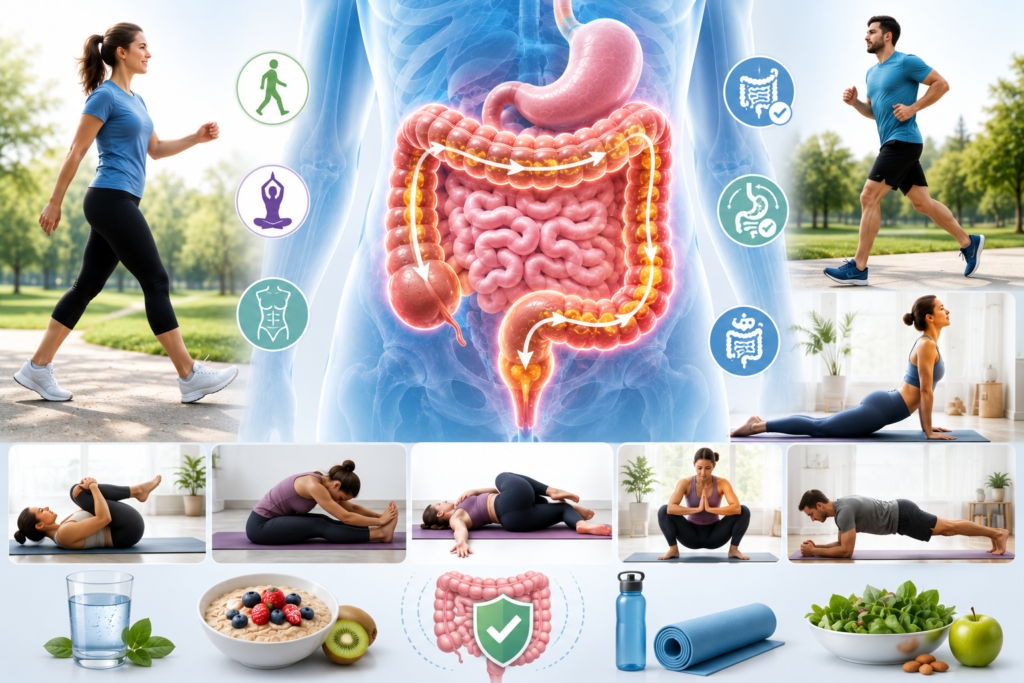
How Exercise Relieves Constipation: The Science
Understanding the mechanisms behind exercise and digestion helps you choose the most effective movements and set realistic expectations.
The Physiological Mechanisms
1. Stimulates Peristalsis
Physical activity activates the sympathetic and parasympathetic nervous systems, which regulate intestinal motility. During exercise:
- Blood flow redistributes to working muscles
- The colon experiences mechanical stimulation from movement
- Neurotransmitters (acetylcholine, serotonin) are released, triggering peristaltic waves
- Result: Faster colonic transit time
2. Reduces Transit Time
Studies using radiopaque markers show that physically active individuals have significantly faster colonic transit compared to sedentary people:
- Active individuals: Average transit time of 35 hours
- Sedentary individuals: Average transit time of 58 hours
3. Decreases Inflammation
Regular moderate exercise reduces systemic inflammation, which can improve gut function in conditions like IBS and inflammatory bowel disease.
4. Manages Stress
Exercise reduces cortisol and activates the parasympathetic nervous system (“rest and digest”), which:
- Improves blood flow to digestive organs
- Enhances enzyme production
- Supports healthy gut bacteria diversity
- Reduces stress-related constipation
5. Strengthens Core and Pelvic Floor
Strong abdominal muscles improve the ability to generate intra-abdominal pressure during defecation. Pelvic floor coordination is essential for complete evacuation.
6. Helps with Weight Management
Obesity is associated with slower colonic transit and increased constipation risk. Exercise supports healthy weight, which indirectly improves bowel function.
What the Research Shows
Key Studies on Exercise and Constipation
| Study | Population | Intervention | Results |
|---|---|---|---|
| De Schryver et al. (2005) | Adults with chronic constipation | 30 min brisk walk, 5 days/week for 12 weeks | Significant improvement in constipation symptoms, reduced laxative use |
| Koffman et al. (2021) | Older adults in care facilities | Daily walking program (20-30 min) | 40% increase in bowel movement frequency |
| Shin & Shin (2010) | Stroke patients with constipation | Abdominal massage + exercise | 67% showed improved bowel function vs. 23% control |
| Chen et al. (2019) | Women with IBS-C | 12-week yoga program | Significant reduction in IBS symptoms, improved bowel function |
| Systematic Review (2022) | 15 studies, various populations | Physical activity interventions | Moderate-quality evidence that exercise improves constipation |
Exercise and IBS
For irritable bowel syndrome specifically:
- Regular physical activity reduces IBS symptom severity by 20-40%
- Improves quality of life scores
- Reduces anxiety and depression (common IBS triggers)
- May normalize gut microbiota composition
Best Exercises for Constipation Relief
Not all exercises are equally effective for constipation. The best options combine cardiovascular activity, core engagement, and specific movements that stimulate the digestive tract.
1. Walking
Why It Works: Walking is the most studied exercise for constipation. It gently jostles the intestines, stimulates peristalsis, and is accessible to almost everyone.
Protocol for Constipation Relief:
Frequency: Daily (minimum 5 days/week)
Duration: 20-30 minutes per session
Intensity: Brisk pace (able to talk but not sing)
Timing: Morning, ideally after breakfast (leverages gastrocolic reflex)
Progression: Start with 10 minutes, add 5 minutes weekly
Evidence: A landmark study found that a 30-minute daily walking program improved constipation symptoms as effectively as some prescription medications in adults with chronic constipation.
Tips for Success:
- Walk after meals (especially breakfast) to maximize the gastrocolic reflex
- Swing your arms to engage your core
- Maintain good posture (shoulders back, core engaged)
- Try interval walking (alternate 3 minutes fast, 2 minutes moderate)
2. Jogging/Running
Why It Works: The up-and-down motion provides more intense mechanical stimulation to the colon. Higher intensity also triggers stronger neurotransmitter release.
Protocol:
Frequency: 3-5 days/week
Duration: 20-45 minutes
Intensity: Moderate to vigorous (60-80% max heart rate)
Best for: Those already cleared for higher-intensity exercise
Important Considerations:
- High-impact exercise can cause “runner’s trot” (urgency/diarrhea) in some people
- Start slowly if you’re new to running
- Stay hydrated (dehydration worsens constipation)
- Avoid running immediately after large meals
3. Swimming
Why It Works: Provides full-body movement with gentle water pressure on the abdomen. Horizontal position may help some people. Low-impact and joint-friendly.
Protocol:
Frequency: 3-5 days/week
Duration: 30-45 minutes
Strokes: All strokes beneficial; breaststroke and backstroke especially good
Intensity: Moderate pace
Best For:
- People with joint pain or arthritis
- Pregnant women (with physician approval)
- Obese individuals who find walking difficult
- Those seeking low-impact options
4. Cycling
Why It Works: Engages core muscles, provides rhythmic movement, and can be done indoors or outdoors.
Protocol:
Frequency: 3-5 days/week
Duration: 30-60 minutes
Intensity: Moderate (able to hold conversation)
Type: Road cycling, stationary bike, or spin class
Tips:
- Adjust seat height to avoid excessive pressure on perineum
- Stand up and stretch periodically during long rides
- Combine with morning routine for best results
5. Jumping Exercises
Why It Works: The vertical impact provides direct mechanical stimulation to the colon.
Options:
- Jumping jacks: 3 sets of 30-60 seconds
- Jump rope: 5-10 minutes daily
- Rebounder (mini-trampoline): 10-15 minutes daily
- Box jumps: 3 sets of 10-15 reps
Protocol:
Frequency: Daily or every other day
Duration: 5-15 minutes
Best timing: Morning, before breakfast
Caution: High-impact; not suitable for those with knee problems, osteoporosis, or pelvic floor disorders.
Yoga for Constipation: Specific Poses That Work
Yoga combines physical postures, breathing exercises, and relaxation—addressing multiple constipation mechanisms simultaneously. Research shows yoga can significantly improve constipation symptoms, especially in people with IBS-C.
Best Yoga Poses for Constipation
1. Wind-Relieving Pose (Pawanmuktasana)
How to Do It:
- Lie on your back, legs extended
- Inhale, lift your right knee to your chest
- Clasp hands around shin, pull knee closer
- Hold for 30-60 seconds while breathing deeply
- Switch legs; repeat 3 times each side
- Then pull both knees to chest, hold 30-60 seconds
Benefits:
- Compresses and releases the colon
- Helps expel trapped gas
- Massages abdominal organs
- Relieves bloating
2. Seated Forward Bend (Paschimottanasana)
How to Do It:
- Sit with legs extended in front of you
- Inhale, lengthen your spine
- Exhale, hinge at hips and reach toward your toes
- Keep back straight; don’t round excessively
- Hold for 1-3 minutes, breathing deeply
Benefits:
- Compresses abdominal organs
- Stimulates digestion
- Calms the nervous system
- Stretches lower back
3. Supine Twist (Supta Matsyendrasana)
How to Do It:
- Lie on your back, arms out to sides in T position
- Bend knees, lift feet off floor
- Exhale, drop both knees to the right
- Turn head to look at left hand
- Hold for 1-2 minutes, breathing deeply
- Repeat on other side
Benefits:
- Wrings out the digestive tract
- Improves spinal mobility
- Relieves lower back tension
- Stimulates colon peristalsis
4. Child’s Pose (Balasana)
How to Do It:
- Kneel on floor, big toes touching, knees wide
- Sit back on heels
- Fold forward, resting torso on thighs
- Extend arms forward or rest them alongside your body
- Hold for 1-3 minutes, breathing deeply
Benefits:
- Gentle compression of abdomen
- Calms nervous system
- Relieves stress-related constipation
- Restorative and relaxing
5. Squat Pose (Malasana/Garland Pose)
How to Do It:
- Stand with feet slightly wider than hip-width
- Turn toes out slightly
- Lower into a deep squat (use block under sit bones if needed)
- Bring palms together at heart center
- Use elbows to press knees wide
- Hold for 1-2 minutes, breathing deeply
Benefits:
- Opens pelvic floor
- Mimics optimal toileting position
- Strengthens legs and core
- Stimulates abdominal organs
6. Cat-Cow Pose (Marjaryasana-Bitilasana)
How to Do It:
- Start on hands and knees (tabletop position)
- Inhale, drop belly, lift chest and tailbone (Cow)
- Exhale, round spine, tuck chin and tailbone (Cat)
- Continue flowing for 1-2 minutes
Benefits:
- Mobilizes the spine
- Massages abdominal organs
- Coordinates breath with movement
- Relieves tension
7. Cobra Pose (Bhujangasana)
How to Do It:
- Lie face down, legs extended
- Place palms under shoulders
- Inhale, press into hands and lift chest
- Keep hips on the floor
- Hold for 15-30 seconds
- Repeat 3-5 times
Benefits:
- Stretches abdominal muscles
- Stimulates digestive organs
- Opens chest and improves breathing
- Strengthens back
Complete Yoga Routine for Constipation (15-20 minutes)
Morning Flow (do daily, ideally before breakfast):
- Cat-Cow – 1 minute
- Child’s Pose – 2 minutes
- Downward Dog – 1 minute
- Low Lunge (each side) – 1 minute each
- Supine Twist (each side) – 2 minutes each
- Wind-Relieving Pose (each side + both) – 2 minutes total
- Seated Forward Bend – 2 minutes
- Squat Pose – 2 minutes
- Corpse Pose (Savasana) – 3 minutes
Evening Flow (gentler, for relaxation):
- Child’s Pose – 3 minutes
- Supine Twist (each side) – 2 minutes each
- Legs Up the Wall – 5 minutes
- Corpse Pose – 5 minutes
Core Strengthening Exercises
Strong abdominal muscles improve your ability to generate the intra-abdominal pressure needed for effective bowel movements.
Essential Core Exercises
1. Diaphragmatic Breathing
How to Do It:
- Lie on your back or sit comfortably
- Place one hand on chest, one on belly
- Inhale through nose, letting belly expand (chest stays still)
- Exhale through mouth, belly falls
- Practice for 5-10 minutes daily
Benefits: Activates parasympathetic nervous system, improves core coordination, reduces stress
2. Dead Bug
How to Do It:
- Lie on back, arms extended toward ceiling
- Lift legs to tabletop position (knees bent 90 degrees)
- Press lower back into floor
- Slowly lower right arm overhead and extend left leg
- Return to start, repeat with opposite arm/leg
- Do 10-15 reps each side
Benefits: Deep core activation without straining, improves coordination
3. Bird Dog
How to Do It:
- Start on hands and knees
- Extend right arm forward and left leg back
- Hold for 5 seconds
- Return to start, switch sides
- Do 10-15 reps each side
Benefits: Core stability, back strength, balance
4. Plank
How to Do It:
- Start in push-up position or on forearms
- Keep body in straight line from head to heels
- Engage core, don’t let hips sag
- Hold for 20-60 seconds
- Repeat 2-3 times
Benefits: Full core engagement, functional strength
5. Bridge Pose
How to Do It:
- Lie on back, knees bent, feet flat on floor
- Press through heels, lift hips toward ceiling
- Squeeze glutes at top
- Hold for 5 seconds
- Lower slowly
- Repeat 10-15 times
Benefits: Glute and core strength, pelvic floor activation
Pelvic Floor Exercises for Constipation
Pelvic floor dysfunction is a common but often overlooked cause of constipation. If you have trouble relaxing the pelvic floor during bowel movements, specific exercises can help.
Understanding Pelvic Floor Dysfunction
Two Types:
- Hypertonic (too tight): Muscles can’t relax to allow bowel movement
- Symptoms: Straining, feeling of incomplete evacuation, pain with bowel movements
- Treatment: Relaxation techniques, reverse Kegels, biofeedback
- Hypotonic (too weak): Muscles can’t contract properly
- Symptoms: Difficulty generating pressure, prolapse symptoms
- Treatment: Kegels, strengthening exercises
For Hypertonic Pelvic Floor (Tight Muscles)
Reverse Kegels
How to Do It:
- Sit or lie comfortably
- Take a deep breath into your belly
- As you inhale, gently push down and out (like starting a bowel movement)
- Feel your pelvic floor relax and descend
- Hold for 5 seconds, then relax
- Repeat 10 times, 2-3 times daily
Key: Focus on relaxation, not pushing hard
Happy Baby Pose
How to Do It:
- Lie on your back
- Bring knees toward armpits
- Grab outside edges of feet or ankles
- Gently rock side to side
- Hold for 1-2 minutes
Deep Squat with Pelvic Floor Release
How to Do It:
- Get into deep squat position
- Place elbows inside knees
- Take deep belly breaths
- With each exhale, imagine pelvic floor melting downward
- Hold for 2-3 minutes
For Hypotonic Pelvic Floor (Weak Muscles)
Kegels
How to Do It:
- Identify the muscles by stopping urine flow mid-stream (don’t do this regularly, just once to identify)
- Contract these muscles (as if holding in gas)
- Hold for 5 seconds
- Relax for 5 seconds
- Repeat 10 times
- Do 3 sets daily
Important: Don’t hold your breath or tighten abs/buttocks
When to See a Pelvic Floor Physical Therapist
Consider specialist evaluation if you experience:
- Persistent straining despite adequate fiber and fluids
- Feeling of blockage or incomplete evacuation
- Need to use fingers to help have a bowel movement
- Pelvic pain or pain with bowel movements
- Urinary incontinence along with constipation
Biofeedback therapy with a pelvic floor PT has 70-80% success rate for dyssynergic defecation.
Timing Your Exercise for Maximum Benefit
When you exercise matters almost as much as what you do.
Morning Exercise (Best Option)
Why: Leverages the gastrocolic reflex, which is strongest in the morning after waking and eating.
Protocol:
- Wake up, drink 8-16 oz water
- Eat light breakfast
- Walk or do yoga for 20-30 minutes
- Sit on toilet 10-15 minutes after exercise
Success Rate: Many people report bowel movement within 30-60 minutes of morning exercise
After-Meal Movement
Why: Eating triggers the gastrocolic reflex; movement amplifies this effect.
Protocol:
- 10-15 minute walk after each meal
- Especially effective after breakfast
- Gentle movement (not intense exercise)
Consistency Over Intensity
Key Principle: Regular daily movement is more important than occasional intense workouts.
Ideal Pattern:
- Daily: 20-30 minutes moderate activity (walking, yoga)
- 3-5x/week: More structured exercise (jogging, swimming, cycling)
- Throughout day: Avoid prolonged sitting; get up every 30-60 minutes
Exercise Plans for Different Fitness Levels
Beginner Plan (Weeks 1-4)
Goal: Build habit of daily movement
Weekly Schedule:
| Day | Activity | Duration |
|---|---|---|
| Monday | Walking | 15 minutes |
| Tuesday | Gentle yoga | 15 minutes |
| Wednesday | Walking | 15 minutes |
| Thursday | Gentle yoga | 15 minutes |
| Friday | Walking | 15 minutes |
| Saturday | Leisurely walk or stretch | 20 minutes |
| Sunday | Rest or gentle stretching | 10 minutes |
Progression: Add 5 minutes to walks each week
Intermediate Plan (Weeks 5-8)
Goal: Increase duration and add variety
Weekly Schedule:
| Day | Activity | Duration |
|---|---|---|
| Monday | Brisk walking or jogging | 30 minutes |
| Tuesday | Yoga for constipation | 20 minutes |
| Wednesday | Cycling or swimming | 30 minutes |
| Thursday | Core exercises + walking | 25 minutes |
| Friday | Brisk walking or jogging | 30 minutes |
| Saturday | Yoga or active hobby | 30-45 minutes |
| Sunday | Rest or gentle walk | 15 minutes |
Advanced Plan (Ongoing)
Goal: Maintain optimal digestive health
Weekly Schedule:
| Day | Activity | Duration |
|---|---|---|
| Monday | Running or vigorous cardio | 45 minutes |
| Tuesday | Yoga + core strengthening | 30 minutes |
| Wednesday | Swimming or cycling | 45 minutes |
| Thursday | HIIT or running | 30 minutes |
| Friday | Strength training + walking | 45 minutes |
| Saturday | Long walk, hike, or active sport | 60 minutes |
| Sunday | Restorative yoga or rest | 20 minutes |
Special Considerations
Exercise and Pregnancy
Safe Options:
- Walking
- Prenatal yoga
- Swimming
- Stationary cycling
Avoid:
- High-impact jumping
- Contact sports
- Exercises lying flat on back (after first trimester)
- Hot yoga
Pelvic Floor: Focus on relaxation and gentle Kegels; consult pelvic floor PT
Exercise with IBS
Recommendations:
- Gentle to moderate exercise (avoid very high intensity)
- Yoga is particularly beneficial
- Walk after meals
- Avoid exercising during severe flare-ups
- Stay hydrated
Timing: Some people with IBS find morning exercise triggers urgency—experiment with timing
Exercise with Pelvic Floor Dysfunction
Important:
- Avoid high-impact exercises if they worsen symptoms
- Focus on coordination and relaxation
- Work with pelvic floor physical therapist
- May need to modify certain core exercises
Exercise for Elderly Adults
Recommendations:
- Walking (even short distances)
- Chair yoga
- Water aerobics
- Gentle stretching
- Seated exercises if mobility limited
Benefits: Exercise is especially important for elderly, who have higher constipation rates due to medications, reduced mobility, and slower transit
Exercise with Ostomy
Generally Safe:
- Walking
- Swimming (with proper supplies)
- Yoga (avoid extreme pressure on stoma)
- Light strength training
Consult Your Surgeon before:
- Heavy lifting
- Contact sports
- High-impact activities
Common Mistakes to Avoid
1. Exercising Too Intensely Too Soon
Problem: High-intensity exercise can actually slow digestion and cause nausea, cramping, or diarrhea.
Solution: Start with moderate intensity (able to hold a conversation), gradually increase over weeks.
2. Not Drinking Enough Water
Problem: Exercise without adequate hydration worsens constipation.
Solution:
- Drink 8-16 oz water before exercise
- Sip water during longer sessions
- Rehydrate after exercise
3. Exercising Right After Large Meals
Problem: Intense exercise immediately after eating can cause cramping and actually slow digestion.
Solution:
- Wait 1-2 hours after large meals
- Gentle walking is fine after meals
- Save intense workouts for before meals or 2+ hours after
4. Inconsistency
Problem: Occasional intense workouts don’t provide the same benefits as daily moderate movement.
Solution: Prioritize daily movement over perfect workouts. Even 10 minutes counts.
5. Ignoring the Urge
Problem: Exercise may trigger the urge to have a bowel movement—don’t ignore it.
Solution: Plan exercise when you have access to a bathroom. Don’t suppress the urge.
6. Poor Form
Problem: Incorrect exercise form can cause injury or worsen pelvic floor dysfunction.
Solution: Learn proper form from qualified instructors. Start with modified versions.
Tracking Your Progress
Keep an exercise and bowel movement log to identify patterns:
Daily Log Should Include:
- Type of exercise
- Duration
- Intensity (1-10 scale)
- Time of day
- Bowel movement (yes/no, time, Bristol stool type)
- Symptoms (bloating, pain, straining)
Sample Tracking Table:
| Date | Exercise | Duration | Time | BM? | Stool Type | Notes |
|---|---|---|---|---|---|---|
| Mon 3/1 | Walking | 25 min | 7 AM | Yes | 4 | Easy, no straining |
| Tue 3/2 | Yoga | 20 min | 7 AM | No | – | Felt gassy |
| Wed 3/3 | Walking | 30 min | 7 AM | Yes | 3-4 | Good movement |
Review Weekly: Look for patterns between exercise type/timing and bowel function.
Frequently Asked Questions
How long does it take for exercise to help constipation?
Most people notice some improvement within 2-4 weeks of consistent daily exercise. Some notice immediate effects (bowel movement during or right after exercise), while others need several weeks for cumulative benefits.
Is walking really enough to help?
Yes. Multiple studies show that daily walking (20-30 minutes) significantly improves constipation symptoms. Walking is one of the best-studied exercises for digestive health and is recommended as first-line therapy.
Can too much exercise cause constipation?
Yes. Excessive high-intensity exercise without adequate recovery can:
- Increase stress hormones (cortisol)
- Cause dehydration
- Disrupt normal digestive function
- Lead to “athlete’s gut” symptoms
Balance intense workouts with rest days and gentle movement.
What’s the best time of day to exercise for constipation?
Morning exercise, especially after breakfast, tends to be most effective because it leverages the natural gastrocolic reflex. However, the best time is whenever you can be consistent.
Should I exercise if I have severe constipation?
Yes, but start gently. Walking and gentle yoga are appropriate even with severe constipation. If you have severe pain, vomiting, or haven’t had a bowel movement in over a week, consult a doctor before starting an exercise program.
Can yoga really help with constipation?
Yes. Multiple studies show yoga improves constipation symptoms, particularly in people with IBS-C. The combination of physical postures, breathing, and relaxation addresses multiple constipation mechanisms.
What if I can’t do vigorous exercise due to health limitations?
Gentle movement still helps. Chair exercises, gentle yoga, short walks, and stretching can all improve bowel function. The key is consistent daily movement, not intensity.
Will running make me need to poop during my run?
It might. Running stimulates colonic contractions, and many runners experience urgency during or after runs. This is normal. Plan routes with bathroom access and avoid large meals right before running.
Conclusion
Exercise is a powerful, evidence-based treatment for constipation that works through multiple mechanisms: stimulating peristalsis, reducing transit time, managing stress, and strengthening the muscles involved in defecation. The best exercise program for constipation relief is one you can sustain long-term.
Key Principles:
- Move daily: Aim for at least 20-30 minutes of moderate activity most days
- Start with walking: It’s the most studied and accessible option
- Add yoga: Specific poses target digestion and stress
- Strengthen your core: Supports effective bowel movements
- Consider pelvic floor: Address muscle dysfunction if present
- Be consistent: Daily movement beats occasional intense workouts
- Time it right: Morning exercise after breakfast often works best
For most people with chronic constipation, combining regular exercise with adequate fiber, proper hydration, and good toilet habits provides significant improvement. If constipation persists despite lifestyle changes, consult your healthcare provider to rule out underlying conditions and discuss additional treatment options.
Medical Disclaimer: This article is for educational purposes only and does not constitute medical advice. Consult with a qualified healthcare provider before starting any new exercise program, especially if you have underlying medical conditions, are pregnant, or have pelvic floor concerns.
Sources:
- De Schryver AM, et al. – Effect of physical activity on colonic transit time in patients with chronic constipation – Digestion – 2005 – https://pubmed.ncbi.nlm.nih.gov/15775694/
- Koffman J, et al. – Exercise interventions for constipation in older adults – Journal of Aging and Physical Activity – 2021 – https://journals.humankinetics.com/view/journals/japa/29 splo/article-p1.xml
- Shin IS, Shin HS – Effect of abdominal massage on constipation in stroke patients – Taehan Kanho Hakhoe Chi – 2010 – https://pubmed.ncbi.nlm.nih.gov/20442533/
- Chen YE, et al. – Effect of yoga on irritable bowel syndrome – World Journal of Clinical Cases – 2019 – https://www.wjgnet.com/2307-8960/full/v7/i19/3130.htm
- Cramer H, et al. – Yoga for irritable bowel syndrome – Cochrane Database of Systematic Reviews – 2017 – https://www.cochranelibrary.com/cdsr/doi/10.1002/14651858.CD011661.pub2/full
- American College of Gastroenterology – Chronic Constipation Guidelines – 2023 – https://gi.org/guidelines/chronic-constipation/
- Mayo Clinic – Constipation Treatment – 2025 – https://www.mayoclinic.org/diseases-conditions/constipation/diagnosis-treatment/drc-20354259
- NHS – Exercise for Constipation – 2023 – https://www.nhs.uk/conditions/constipation/treatment/
- Rao SSC – Update on neuroenteric mechanisms underlying defecation – Gastroenterology – 2023 – https://www.gastrojournal.org/article/S0016-5085(23)00193-2/fulltext
- Systematic Review – Physical activity for chronic constipation – Journal of Clinical Gastroenterology – 2022 – https://journals.lww.com/jcge/Fulltext/2022/03000/Physical_Activity_for_Chronic_Constipation.8.aspx