
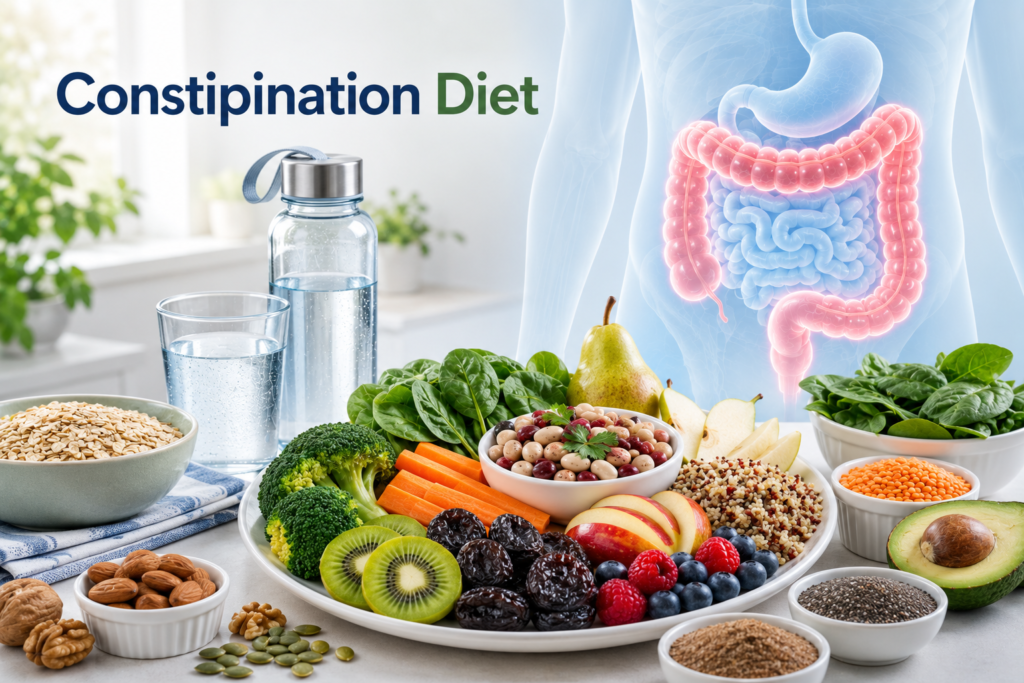
Constipation Diet: High-Fiber Foods and Hydration for Relief
Understanding Fiber: Not All Fiber Is Created Equal
The Two Types of Fiber
Soluble Fiber
- Dissolves in water to form a gel-like substance
- Feeds beneficial gut bacteria (prebiotic effect)
- Softens stool and improves consistency
- Best for: Normal transit constipation, IBS-C
Top sources: Oats, psyllium, chia seeds, flaxseeds, beans, lentils, apples, citrus fruits, carrots
Insoluble Fiber
- Doesn’t dissolve in water
- Adds bulk to stool
- Speeds transit through the colon
- Best for: Slow transit constipation
Top sources: Wheat bran, whole grains, nuts, seeds, vegetable skins, leafy greens, broccoli, cauliflower
Which Type Helps Which Constipation?
| Constipation Type | Best Fiber Approach | Foods to Emphasize | Foods to Limit |
|---|---|---|---|
| Normal Transit | Soluble fiber | Oats, psyllium, kiwi, chia | Excess insoluble fiber |
| Slow Transit | Insoluble fiber + some soluble | Wheat bran, whole grains, vegetables | Low-fiber processed foods |
| IBS-C | Soluble fiber (low FODMAP) | Psyllium, oats, firm bananas | High FODMAP fibers (inulin, GOS) |
| Pelvic Floor Dysfunction | Moderate fiber (too much worsens) | Cooked vegetables, soluble fiber | Large amounts of bulk |
| SIBO with Constipation | Low FODMAP, moderate fiber | White rice, potatoes, low FODMAP vegetables | Fermentable fibers |
Key insight: If you’ve been told to “eat more fiber” but got worse, you may have the wrong TYPE of fiber for your constipation type.
Daily Fiber Recommendations
How Much Fiber Do You Need?
| Group | Daily Recommendation |
|---|---|
| Women under 50 | 25g |
| Men under 50 | 38g |
| Women over 50 | 21g |
| Men over 50 | 30g |
| Children | Age + 5g (e.g., 8-year-old needs 13g) |
The Reality Check
Average American intake: Only 15g daily—less than half the recommendation.
The problem: Going from 15g to 35g overnight causes severe bloating, gas, and can worsen constipation temporarily.
How to Increase Fiber Without Worsening Symptoms
The 4-Week Fiber Ramp-Up Plan:
| Week | Daily Fiber Goal | Strategy |
|---|---|---|
| Week 1 | Current + 5g | Add ONE high-fiber food daily |
| Week 2 | Current + 10g | Add second high-fiber food; increase water |
| Week 3 | Current + 15g | Consider fiber supplement if needed |
| Week 4+ | Goal (21-38g) | Maintain; adjust based on response |
Critical rules:
- Increase water intake as you increase fiber (fiber without water = concrete)
- Cook vegetables initially (easier to digest than raw)
- Introduce one new food at a time
- If bloating worsens significantly, pause the increase for a few days
- Take fiber supplements at least 2 hours from medications
Top 20 Foods for Constipation Relief (With Evidence)
Tier 1: Strongest Evidence
These foods have randomized controlled trials supporting their use for constipation.
1. Prunes (Dried Plums)
Evidence level: Multiple RCTs showing superiority to psyllium
Active components:
- Fiber: 3g per 50g serving
- Sorbitol: Natural sugar alcohol with osmotic effect (draws water into colon)
- Phenolic compounds: Stimulate colonic contractions
Dose: 50g daily (about 5-6 prunes)
Study results:
- Participants eating prunes had 3.5 bowel movements/week vs. 2/week with psyllium
- Softer stools, less straining
- Effect seen within 1 week
How to use:
- Eat 5-6 prunes daily (can split: 3 morning, 3 evening)
- Prune juice also effective (4-8 oz daily)
- Can add to oatmeal, smoothies, or eat alone
Side effects: May cause gas initially; start with 2-3 prunes for first week.
Calories: ~130 calories per 50g serving
2. Kiwifruit
Evidence level: Multiple RCTs
Active components:
- Fiber: 2g per fruit
- Actinidin: Enzyme that aids protein digestion
- Natural compounds: Stimulate colonic motility via serotonin receptors
Dose: 2 kiwifruits daily
Study results:
- 1 additional bowel movement per week
- Less straining, softer stools
- Reduced laxative use
- Effect seen within 4 weeks
How to use:
- Eat 2 kiwifruits daily (any time of day)
- Can eat skin (edible, high in fiber—adds 50% more fiber)
- Green or gold varieties both effective
- Add to smoothies, fruit salads, yogurt
Advantages over prunes: Less likely to cause gas/bloating; lower in sugar.
Calories: ~90 calories for 2 fruits
3. Psyllium Husk
Evidence level: Extensive RCT evidence; considered gold standard fiber supplement
Active components:
- Soluble, gel-forming fiber
- Highly fermentable (prebiotic)
Dose: 5-10g daily (start with 3-5g)
Study results:
- Improves stool frequency, consistency, ease of passage
- Reduces straining
- Well-tolerated long-term
How to use:
- Mix with 8 oz water or liquid
- Drink immediately (continues to gel)
- Start with half dose for first week
- Take at same time daily (with dinner often works well)
- Drink additional 8 oz water after taking
Product examples: Metamucil, generic psyllium husk powder
Calories: ~20 calories per tablespoon
Important: Take medications at least 2 hours apart from psyllium (can interfere with absorption).
4. Chia Seeds
Evidence level: Growing clinical support; traditional remedy
Active components:
- Fiber: 10g per 2 tbsp
- Omega-3 fatty acids
- Mucilage: Forms gel when wet, softens stool
Dose: 1-2 tbsp daily
How to use:
- Mix 1-2 tbsp with 8 oz water, let sit 10 minutes
- Drink immediately (continues to gel)
- Add to smoothies, yogurt, oatmeal
- Make chia pudding (soak in plant milk overnight)
Important: Never eat dry chia seeds by themselves (can absorb water in esophagus and cause blockage).
Calories: ~140 calories per 2 tbsp
5. Flaxseeds (Linseeds)
Evidence level: RCTs showing improvement in constipation symptoms
Active components:
- Fiber: 3g per tbsp
- Omega-3 fatty acids
- Lignans: May have prokinetic effects
Dose: 1-2 tbsp ground flaxseed daily
Study results: Improved stool frequency and consistency within 4 weeks.
How to use:
- Must be ground (whole seeds pass through undigested)
- Add to smoothies, oatmeal, yogurt, baked goods
- Store ground flax in refrigerator (goes rancid easily)
- Can use flaxseed oil (helps lubricate but no fiber)
Calories: ~55 calories per tbsp
Tier 2: Good Evidence
6. Oats and Oat Bran
Fiber content: 4g per ½ cup dry oats; 7g per ¼ cup oat bran
Type: Soluble fiber (beta-glucan)
How to use:
- Oatmeal for breakfast
- Add oat bran to smoothies, yogurt
- Use oat flour in baking
- Overnight oats
Calories: ~150 calories per ½ cup dry oats
7. Legumes (Beans, Lentils, Chickpeas)
Fiber content: 6-8g per ½ cup cooked
Type: Both soluble and insoluble; resistant starch; prebiotic
How to use:
- Add to soups, salads
- Make hummus
- Use in place of some meat in recipes
- Add to grain bowls
Caution: May cause gas initially. Start with 2 tbsp, increase slowly. Soak dried beans before cooking.
Calories: ~100-120 calories per ½ cup
8. Apples (with Skin)
Fiber content: 4-5g per medium apple with skin
Type: Pectin (soluble), cellulose (insoluble)
Active component: Sorbitol (natural osmotic)
How to use:
- Eat whole with skin
- Slice on oatmeal, salads
- Bake (cooked apples also helpful)
- Apple sauce (unsweetened)
Calories: ~95 calories per medium apple
9. Pears (with Skin)
Fiber content: 5-6g per medium pear
Type: Pectin, sorbitol
How to use:
- Eat fresh with skin
- Bake or poach
- Add to salads
Calories: ~100 calories per medium pear
10. Berries
Fiber content:
- Raspberries: 8g per cup
- Blackberries: 8g per cup
- Strawberries: 3g per cup
- Blueberries: 4g per cup
Type: Both soluble and insoluble
How to use:
- Fresh or frozen
- Add to smoothies, oatmeal, yogurt
- Eat as snack
Calories: ~60-85 calories per cup
11. Leafy Green Vegetables
Fiber content: 4-5g per cup cooked
Type: Insoluble fiber; magnesium
Best options: Spinach, kale, Swiss chard, collard greens, arugula
How to use:
- Large salad daily
- Sauté as side dish
- Add to smoothies (mild greens like spinach)
- Add to soups, pasta, grain bowls
Calories: ~30-50 calories per cup cooked
12. Whole Grains
Fiber content: Varies by grain (see table)
| Grain | Serving | Fiber |
|---|---|---|
| Quinoa | 1 cup cooked | 5g |
| Brown rice | 1 cup cooked | 3.5g |
| Barley | 1 cup cooked | 6g |
| Bulgur | 1 cup cooked | 8g |
| Whole wheat pasta | 1 cup cooked | 6g |
| Popcorn (air-popped) | 3 cups | 3.5g |
Type: Insoluble fiber
How to use:
- Replace refined grains with whole grains
- Use in salads, grain bowls
- Snack on popcorn
Calories: Varies (150-220 calories per cup cooked)
13. Broccoli
Fiber content: 5g per cup cooked
Type: Both soluble and insoluble; sulforaphane
How to use:
- Steamed, roasted, sautéed
- Add to stir-fries, pasta
- Raw with hummus (may cause more gas)
Calories: ~55 calories per cup cooked
14. Brussels Sprouts
Fiber content: 4g per cup cooked
Type: Both soluble and insoluble
How to use:
- Roasted (best flavor)
- Steamed
- Shaved raw in salads
Calories: ~55 calories per cup cooked
15. Avocado
Fiber content: 7g per half avocado; 13g per whole avocado
Type: Both soluble and insoluble
Additional benefit: Healthy fats help lubricate intestines
How to use:
- On toast
- In salads
- As side dish
- In smoothies (adds creaminess)
Calories: ~160 calories per half avocado
Tier 3: Traditional Remedies with Some Evidence
16. Coffee
How it works: Caffeine and other compounds stimulate colonic contractions via gastrocolic reflex.
Evidence: Coffee stimulates colonic motility within 4 minutes (stronger effect than caffeine alone; decaf also has some effect).
Dose: 1-2 cups in morning
Best approach:
- Drink upon waking or with breakfast
- Don’t exceed 4-5 cups daily (can be dehydrating)
- Works best combined with food
17. Warm Liquids
How it works: Temperature stimulates gastrocolic reflex.
Options:
- Warm water with lemon
- Herbal tea (peppermint, ginger, chamomile)
- Warm broth
- Hot water with honey
How to use: Drink first thing in morning and/or before meals.
18. Magnesium-Rich Foods
How it works: Magnesium has natural osmotic effect.
Top sources:
- Pumpkin seeds: 150mg per ¼ cup
- Spinach: 150mg per cup cooked
- Swiss chard: 150mg per cup cooked
- Almonds: 80mg per ¼ cup
- Black beans: 60mg per ½ cup
- Dark chocolate: 65mg per oz
Daily goal: 300-400mg from food + supplements if needed
19. Fermented Foods
How it works: Probiotics may improve gut microbiome and motility.
Options:
- Yogurt with live cultures (lactose-free if needed)
- Kefir
- Sauerkraut
- Kimchi
- Kombucha
- Miso
Evidence: Modest improvement in stool frequency (about 1 BM/week).
20. Olive Oil
How it works: Lubricates intestines, stimulates bile release.
Dose: 1-2 tbsp daily
How to use:
- Drizzle on vegetables, salads
- Take 1 tbsp in morning (some find helpful)
- Use in cooking
Calories: 120 calories per tbsp
Foods That May Worsen Constipation
While individual responses vary, these foods commonly contribute to constipation:
High-Risk Foods
| Food | Why It May Worsen | Better Alternative |
|---|---|---|
| White bread | Low fiber, refined | Whole grain or sourdough |
| White rice | Low fiber | Brown rice, quinoa |
| Processed grains | Stripped of fiber | Whole grains |
| Cheese (large amounts) | High fat, low fiber, slows motility | Small amounts of aged cheese; dairy-free alternatives |
| Red meat | High fat, low fiber, slow digestion | Lean proteins; plant proteins |
| Fried/fatty foods | Slows gastric emptying | Baked, grilled, steamed |
| Fast food | Low fiber, high fat | Home-cooked meals |
| Ice cream | Dairy, high fat, high sugar | Dairy-free frozen treats |
| Chips | Low fiber, high fat | Nuts, seeds, air-popped popcorn |
| Unripe bananas | High resistant starch | Ripe bananas (easier to digest) |
| Persimmons | Contain tannins (astringent) | Other fruits |
| Excessive alcohol | Dehydrating | Limit to 1 drink; drink extra water |
| Excessive caffeine | Can be dehydrating | 1-3 cups coffee; drink water too |
The Dairy Question
Does dairy cause constipation?
The evidence is mixed:
- Cow’s milk protein (casein) may slow motility in some people
- High-fat dairy (cheese, ice cream) slows digestion
- Lactose intolerance can cause either constipation OR diarrhea
Practical approach:
- If you notice dairy worsens constipation, try reducing for 2 weeks
- Aged cheeses (low lactose) often better tolerated
- Consider lactose-free dairy
- Ensure adequate calcium from other sources if reducing dairy
Hydration for Constipation Relief
Why Water Matters
The colon’s job is to absorb water from stool. When you’re dehydrated, the colon absorbs more water, leaving stool hard and dry.
Fiber without adequate water = concrete in your colon.
How Much Water Do You Need?
General guidelines:
- Women: ~11 cups (2.7 liters) total fluid daily
- Men: ~15.5 cups (3.7 liters) total fluid daily
Total fluid includes:
- Water and beverages
- Water content in food (fruits, vegetables, soups contribute ~20%)
Signs of Adequate Hydration
| Sign | Well-Hydrated | Dehydrated |
|---|---|---|
| Urine color | Pale yellow | Dark yellow/amber |
| Urination frequency | Every 2-4 hours | Less than 3x/day |
| Mouth | Moist | Dry, sticky |
| Thirst | Normal | Increased |
| Energy | Normal | Fatigued |
| Headache | None | Common |
Hydration Strategies That Work
Strategy 1: Morning Water Ritual
What to do: Drink 16-20 oz of warm water immediately upon waking.
Why it works:
- Rehydrates after overnight fast
- Triggers gastrocolic reflex
- Warm liquid more effective than cold
How to implement:
- Keep water bottle by bed
- Drink before coffee, before food
- Add lemon if desired (may provide additional benefit)
Strategy 2: Sip Throughout the Day
What to do: Drink steadily throughout day, not large amounts at once.
Why it works: Large boluses are quickly excreted; steady sipping is better absorbed.
How to implement:
- Keep water bottle visible at all times
- Set reminders if needed
- Finish one bottle before lunch, one before dinner
- Drink a glass with each meal
Strategy 3: Eat Your Water
High water-content foods:
| Food | Water Content |
|---|---|
| Cucumber | 96% |
| Lettuce | 95% |
| Celery | 95% |
| Zucchini | 94% |
| Watermelon | 92% |
| Strawberries | 91% |
| Cantaloupe | 90% |
| Grapefruit | 88% |
| Oranges | 87% |
| Soups/broths | 90-95% |
Strategy 4: Limit Dehydrating Beverages
| Beverage | Effect | Recommendation |
|---|---|---|
| Alcohol | Diuretic | Limit to 1 drink; drink extra water |
| Excessive caffeine | Mild diuretic | Limit to 4-5 cups coffee daily |
| Sugary drinks | Can draw water into intestines | Limit; choose water instead |
Strategy 5: Add Electrolytes When Needed
For chronic constipation, sometimes water alone isn’t enough.
Try:
- Pinch of salt in morning water
- Electrolyte powder (low-sugar options like LMNT, Liquid IV)
- Coconut water (natural electrolytes)
Especially helpful if:
- You exercise heavily
- You live in hot climate
- You drink a lot of plain water but still feel dehydrated
- You have POTS or dysautonomia
7-Day Constipation Relief Meal Plan
Day 1
| Meal | Menu | Fiber |
|---|---|---|
| Breakfast | Oatmeal (½ cup oats) with 1 tbsp chia seeds, ½ cup blueberries, 1 tbsp almond butter | 12g |
| Snack | 2 kiwifruits | 4g |
| Lunch | Large salad with mixed greens, ½ cup chickpeas, vegetables, olive oil dressing, whole grain roll | 15g |
| Snack | 5-6 prunes | 3g |
| Dinner | Baked salmon, 1 cup roasted broccoli, ½ cup quinoa | 10g |
| Total | 44g |
Day 2
| Meal | Menu | Fiber |
|---|---|---|
| Breakfast | Smoothie: 1 cup spinach, 1 frozen banana, ½ cup berries, 1 tbsp ground flax, 1 cup almond milk | 10g |
| Snack | Apple with 2 tbsp almond butter | 6g |
| Lunch | Lentil soup (2 cups), whole grain bread, side salad | 18g |
| Snack | ¼ cup almonds | 4g |
| Dinner | Stir-fry with tofu, 2 cups mixed vegetables, 1 cup brown rice | 12g |
| Total | 50g |
Day 3
| Meal | Menu | Fiber |
|---|---|---|
| Breakfast | Chia pudding (3 tbsp chia seeds soaked in 1 cup almond milk overnight) with ½ cup raspberries | 15g |
| Snack | Pear | 6g |
| Lunch | Whole wheat wrap with hummus, vegetables, spinach | 12g |
| Snack | 2 squares dark chocolate, ¼ cup walnuts | 5g |
| Dinner | Baked sweet potato, black bean burger, side salad | 15g |
| Total | 53g |
Day 4
| Meal | Menu | Fiber |
|---|---|---|
| Breakfast | Whole grain toast with avocado (½), everything bagel seasoning, side of berries | 10g |
| Snack | 5-6 prunes | 3g |
| Lunch | Quinoa bowl with roasted vegetables, ½ cup chickpeas, tahini dressing | 15g |
| Snack | 2 kiwifruits | 4g |
| Dinner | Whole wheat pasta with marinara, side salad with olive oil | 14g |
| Total | 46g |
Day 5
| Meal | Menu | Fiber |
|---|---|---|
| Breakfast | Oatmeal with 1 tbsp ground flax, ½ cup raspberries, cinnamon | 11g |
| Snack | Carrot sticks with 2 tbsp hummus | 5g |
| Lunch | Bean and vegetable soup, whole grain roll, side salad | 18g |
| Snack | ¼ cup pumpkin seeds | 4g |
| Dinner | Baked chicken, 1 cup Brussels sprouts, ½ cup barley | 14g |
| Total | 52g |
Day 6
| Meal | Menu | Fiber |
|---|---|---|
| Breakfast | Smoothie: 1 cup spinach, ½ cup frozen mango, 1 tbsp chia, 1 cup oat milk | 10g |
| Snack | Apple | 4g |
| Lunch | Mediterranean salad: mixed greens, cucumber, tomato, olives, ½ cup chickpeas, olive oil | 14g |
| Snack | 2 kiwifruits | 4g |
| Dinner | Lentil curry with 1 cup brown rice, side of sautéed spinach | 16g |
| Total | 48g |
Day 7
| Meal | Menu | Fiber |
|---|---|---|
| Breakfast | Whole grain pancakes (made with oat flour) topped with ½ cup berries | 10g |
| Snack | 5-6 prunes | 3g |
| Lunch | Black bean tacos (3) on corn tortillas with salsa, avocado, lettuce | 18g |
| Snack | ¼ cup almonds | 4g |
| Dinner | Baked fish, 1 cup roasted broccoli, ½ cup quinoa | 10g |
| Total | 45g |
Hydration Schedule
| Time | What to Drink |
|---|---|
| Upon waking | 16 oz warm water (with or without lemon) |
| With breakfast | 8 oz water, coffee, or tea |
| Mid-morning | 8 oz water |
| With lunch | 8 oz water |
| Afternoon | 8 oz water |
| With dinner | 8 oz water |
| Evening | 8 oz water or herbal tea |
| Daily total | ~64+ oz (not including food water content) |
Special Considerations
Constipation Diet for IBS-C
Key modifications:
- Focus on soluble fiber (psyllium, oats, chia)
- Follow low FODMAP principles initially
- Avoid high FODMAP fibers (inulin, GOS, fructans)
Foods to emphasize:
- Psyllium husk
- Oats
- Firm bananas
- Blueberries, strawberries
- Carrots, zucchini (cooked)
- White rice, quinoa
- Lactose-free dairy
Foods to limit initially:
- Onions, garlic
- Legumes (or use canned, rinsed)
- Wheat bran
- Apples, pears (high in fructose)
- Inulin/chicory root fiber
After symptoms improve: Gradually reintroduce high FODMAP foods to find personal tolerance.
Constipation Diet for SIBO
Key modifications:
- Low FODMAP diet to reduce bacterial fermentation
- Moderate fiber (too much can feed bacteria)
- Focus on easily digestible foods
Foods to emphasize:
- White rice, potatoes
- Low FODMAP vegetables (carrots, zucchini, spinach)
- Lean proteins
- Lactose-free dairy
- Firm bananas, berries (limited portions)
Foods to limit:
- High FODMAP foods
- Excessive fiber
- Fermented foods (may worsen initially)
Important: Treat SIBO first; constipation often improves after treatment.
Constipation Diet for Pelvic Floor Dysfunction
Key modifications:
- Moderate fiber (too much bulk worsens obstruction)
- Focus on stool softening rather than bulking
- Adequate hydration critical
Foods to emphasize:
- Soluble fiber (psyllium, oats)
- Magnesium-rich foods
- Adequate fluids
- Healthy fats (olive oil, avocado)
Foods to limit:
- Large amounts of insoluble fiber
- Wheat bran supplements
- Foods that cause excessive gas
Important: Pelvic floor physical therapy is the primary treatment; diet is supportive.
Constipation Diet During Pregnancy
Safe remedies:
- Fiber from food sources
- Psyllium, methylcellulose supplements
- Prunes, kiwifruit
- Adequate hydration
- Gentle movement as approved by OB
Foods to emphasize:
- High-fiber fruits and vegetables
- Whole grains
- Legumes (if tolerated)
- Prunes, pears, apples
Discuss with OB before using:
- Magnesium supplements
- Herbal remedies
- Stimulant laxatives
Avoid:
- Castor oil (can stimulate contractions)
- Herbal stimulant laxatives
Fiber Supplements: When Food Isn’t Enough
Best Fiber Supplements for Constipation
| Supplement | Type | Dose | Evidence | Best For |
|---|---|---|---|---|
| Psyllium (Metamucil) | Soluble | 5-10g daily | Strong (multiple RCTs) | Most types of constipation |
| Methylcellulose (Citrucel) | Soluble | 2-6g daily | Good | Less gas than psyllium |
| Wheat dextrin (Benefiber) | Soluble | 3-6g daily | Moderate | Dissolves clear in liquids |
| Calcium polycarbophil (FiberCon) | Bulk-forming | 1-2g twice daily | Moderate | Less fermentation |
| Partially hydrolyzed guar gum (PHGG) | Soluble | 5-10g daily | Good for IBS-C | Sensitive guts |
| Inulin | Prebiotic | 5-10g daily | Emerging | May cause gas initially |
How to Take Fiber Supplements
- Start low: Begin with half the recommended dose
- Mix well: Use at least 8 oz water or liquid
- Timing: Take at same time daily (with dinner often works well)
- Follow with water: Drink additional 8 oz after taking
- Increase slowly: Go to full dose after 1 week if tolerated
- Medication timing: Take at least 2 hours apart from medications
When Supplements May Not Help
Fiber supplements may NOT help (or may worsen) if you have:
- Slow transit constipation (may need osmotic laxatives instead)
- Pelvic floor dysfunction (need pelvic floor therapy)
- SIBO (fiber may feed bacteria)
- Severe IBS (may need low FODMAP approach first)
Frequently Asked Questions
How long does it take for dietary changes to help constipation?
Depends on the intervention:
| Intervention | Time to Effect |
|---|---|
| Coffee, warm liquids | Minutes to 1 hour |
| Prunes, kiwifruit | 12-24 hours |
| Increased fiber from food | 2-3 days |
| Fiber supplements | 12-72 hours |
| Comprehensive diet change | 1-2 weeks |
| Low FODMAP diet | 2-4 weeks |
For chronic constipation: Give any dietary regimen at least 2-4 weeks before concluding it doesn’t work.
Can I get enough fiber from food alone?
Yes, but it requires planning. To get 25-38g from food:
- Need 5+ servings of fruits/vegetables daily
- Need 3+ servings of whole grains
- Need regular legumes, nuts, seeds
Most Americans only get 15g from food alone. Supplements can help bridge the gap.
Is too much fiber harmful?
Potential issues with excessive fiber (>70g daily):
- Bloating, gas, abdominal pain
- Can worsen constipation in some types
- May interfere with mineral absorption (iron, zinc, calcium)
- Can cause intestinal blockage in extreme cases (especially without adequate water)
Stick to recommendations (21-38g daily) and increase gradually.
Should I take probiotics for constipation?
Probiotics show modest benefit:
- About 1 additional bowel movement per week
- Best strains: B. lactis HN019, B. lactis BB-12, L. casei Shirota
- Take for at least 4 weeks to assess benefit
- Work best combined with fiber
Can coffee help with constipation?
Yes. Coffee stimulates colonic motility within 4 minutes via gastrocolic reflex. Both regular and decaf work (caffeine not the only active component). Limit to 1-3 cups daily and drink additional water.
What if increasing fiber makes me more bloated?
Common reasons:
- Increased too quickly
- Not enough water
- Wrong type of fiber for your condition
- Underlying SIBO or IBS
Solutions:
- Slow down the increase
- Increase water intake
- Try soluble fiber instead of insoluble
- Consider low FODMAP approach
- Discuss with doctor if persists
Key Takeaways
- Fiber type matters—soluble for IBS-C/normal transit, insoluble for slow transit
- Increase fiber gradually over 4 weeks to minimize gas and bloating
- Hydration is critical—fiber without water worsens constipation
- Prunes and kiwifruit have the strongest evidence among food remedies
- Psyllium is the best-studied fiber supplement with strong evidence
- Some foods worsen constipation—white grains, excessive dairy, fried foods
- Coffee can help by stimulating colonic contractions
- IBS-C and SIBO need modified approaches—low FODMAP may be necessary
- Pelvic floor dysfunction requires different approach—moderate fiber, not high
- Give dietary changes time—2-4 weeks minimum to assess effectiveness
Medical Disclaimer: This article provides educational information only and does not replace professional medical advice or dietary guidance. Work with a qualified healthcare provider and registered dietitian for personalized recommendations, especially if you have underlying health conditions.
Sources:
- American Gastroenterological Association – Clinical Practice Update on Chronic Constipation – 2023
- NIDDK – Eating, Diet, and Nutrition for Constipation – 2025
- World Journal of Gastroenterology – Prunes vs. Psyllium for Constipation: Randomized Controlled Trial – 2024
- Alimentary Pharmacology & Therapeutics – Kiwifruit for Constipation: Systematic Review – 2024
- Journal of Clinical Gastroenterology – Fiber Supplements for Chronic Constipation: Meta-Analysis – 2024
- Mayo Clinic – Constipation: Lifestyle and Home Remedies – 2025
- Academy of Nutrition and Dietetics – Constipation and Diet – 2025
- Gastroenterology – Dietary Interventions for IBS-C: Systematic Review – 2024
Last Updated: March 9, 2026