
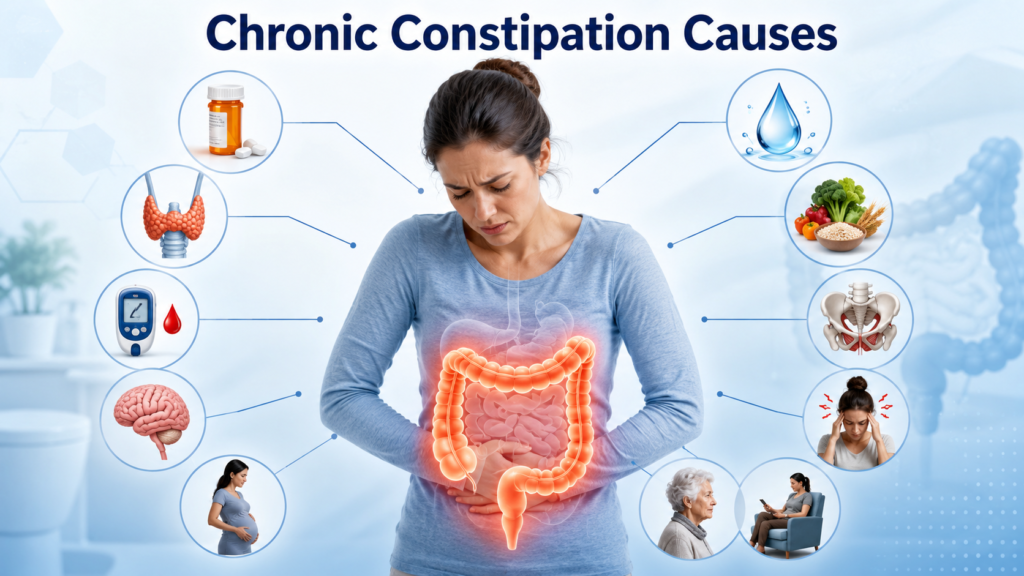
Chronic Constipation Causes: 25+ Reasons Why You’re Always Backed Up
What Counts as “Chronic” Constipation?
Medical Definition
According to Rome IV criteria (the diagnostic standard for functional GI disorders), chronic constipation requires:
At least 2 of these symptoms for 3+ months:
- Straining during more than 25% of bowel movements
- Lumpy or hard stools (Bristol Type 1-2) more than 25% of the time
- Sensation of incomplete evacuation more than 25% of the time
- Sensation of anorectal obstruction/blockage more than 25% of the time
- Manual maneuvers needed to facilitate bowel movements (digital evacuation, pelvic floor support)
- Fewer than 3 spontaneous bowel movements per week
AND:
- Loose stools are rarely present without laxatives
- Symptoms don’t meet criteria for IBS
Chronic vs. Occasional Constipation
| Occasional Constipation | Chronic Constipation |
|---|---|
| Lasts a few days to a week | Persists for 3+ months |
| Usually has obvious trigger (travel, diet change, stress) | Persists despite lifestyle changes |
| Responds to simple remedies | Often resistant to standard treatments |
| Doesn’t significantly impact quality of life | Affects daily functioning, mood, quality of life |
Key distinction: If you’ve had ongoing constipation for 3+ months despite adequate fiber, fluids, and movement, you likely have an underlying cause that needs identification.
The 4 Types of Chronic Constipation (and Their Causes)
Identifying your type is crucial because treatments that work for one type may worsen another.
Type 1: Normal Transit Constipation
What it is: Stool moves through the colon at a normal speed, but you perceive yourself as constipated.
Prevalence: Most common type, especially in young women.
Key characteristics:
- Stool may appear normal (Bristol Type 3-4)
- May feel incomplete evacuation despite normal frequency
- Often associated with abdominal discomfort or bloating
- Frequently overlaps with IBS-C
- Psychological factors (anxiety, depression, somatization) more common
Common causes:
- Visceral hypersensitivity (heightened gut sensation)
- Psychological stress
- History of abdominal/pelvic trauma
- Disordered eating patterns
- Medications (especially antidepressants, antianxiety medications)
Diagnostic clues:
- Normal colonic transit on transit studies
- Normal defecation on anorectal manometry
- Symptoms disproportionate to physical findings
Treatment approach: Stress management, gut-directed psychotherapy, low-dose antidepressants (for visceral pain), soluble fiber, peppermint oil.
Type 2: Slow Transit Constipation
What it is: Stool moves too slowly through the colon, allowing excessive water absorption and resulting in hard, dry stools.
Prevalence: Affects ~15% of constipated patients; more common in women.
Key characteristics:
- Infrequent bowel movements (often less than 1-2 per week)
- Hard, dry stools (Bristol Type 1-2)
- Little to no urge to defecate
- Bloating and abdominal discomfort
- Often begins in childhood or adolescence
- Poor response to fiber (may worsen symptoms)
Common causes:
| Cause | Mechanism |
|---|---|
| Idiopathic (unknown) | Intrinsic colonic inertia; loss of interstitial cells of Cajal (pacemaker cells) |
| Neurological conditions | Parkinson’s, multiple sclerosis, spinal cord injury |
| Endocrine disorders | Hypothyroidism, diabetes, hypercalcemia |
| Connective tissue disorders | Scleroderma, lupus |
| Aging | Natural decline in colonic motility |
| Long-term stimulant laxative use | Potential “lazy bowel” (controversial) |
Diagnostic clues:
- Delayed transit on colonic transit study (Sitz marker study)
- Normal anorectal manometry (pelvic floor works normally)
- Often reports “never feeling the urge”
Treatment approach: Osmotic laxatives (Miralax), prokinetic agents (prucalopride), scheduled toileting, magnesium. Fiber often makes symptoms worse.
Type 3: Defecatory Disorders (Pelvic Floor Dysfunction)
What it is: Pelvic floor muscles don’t coordinate properly during defecation, creating a functional “outlet obstruction.”
Prevalence: Affects ~30-50% of patients with chronic constipation.
Key characteristics:
- Excessive straining (often 10+ minutes on toilet)
- Sensation of blockage or obstruction
- Feeling of incomplete evacuation
- May need to manually assist (press on perineum, use finger to evacuate)
- May have associated pelvic pain or dyspareunia
- Often develops after childbirth, pelvic surgery, or chronic straining
Common causes:
| Cause | Mechanism |
|---|---|
| Childbirth trauma | Nerve damage, muscle tears, rectocele |
| Chronic straining | Paradoxical muscle memory |
| Pelvic surgery | Scar tissue, nerve damage |
| Sexual/physical abuse | Protective muscle guarding |
| High stress/anxiety | Chronic pelvic floor tension |
| Aging | Muscle weakness, nerve degeneration |
What happens: Instead of relaxing the puborectalis muscle during defecation, the patient paradoxically contracts it, creating a kink in the rectum that blocks stool passage.
Diagnostic clues:
- Normal or borderline transit on transit studies
- Abnormal anorectal manometry (paradoxical contraction)
- Delayed balloon expulsion
- May have rectocele on exam
Treatment approach: Pelvic floor physical therapy with biofeedback (gold standard), bowel retraining, relaxation techniques. Fiber often worsens symptoms by increasing bulk that can’t pass.
Type 4: Secondary Constipation
What it is: Constipation caused by identifiable external factors (medications, medical conditions, structural problems).
Prevalence: Increasingly common with age and medication use.
Key characteristics:
- Temporal relationship to starting medication or developing condition
- Improves when underlying cause is addressed
- May have features of any of the above types
Common causes: See detailed list below.
Diagnostic clues:
- Clear timeline correlating with medication/condition
- Resolution or improvement when cause is removed
- Other constipation types may co-exist
Treatment approach: Address underlying cause when possible; symptomatic management if cause can’t be removed.
25+ Specific Causes of Chronic Constipation
Category 1: Medications (Most Common Reversible Cause)
Up to 30% of chronic constipation cases are medication-induced.
Opioid Pain Medications
Medications: Oxycodone, hydrocodone, morphine, codeine, tramadol, fentanyl, methadone
How common: Constipation affects 40-80% of patients on chronic opioids.
Mechanism: Opioids bind to receptors in the gut, slowing peristalsis, increasing fluid absorption, and tightening the anal sphincter.
Key features:
- Doesn’t improve with time (tolerance doesn’t develop for GI effects)
- Often severe and refractory to standard treatments
- Doesn’t respond well to fiber (may worsen)
Treatment: Stool softener + stimulant laxative (senna) is first-line. Prescription medications (methylnaltrexone, naloxegol) for opioid-induced constipation.
Anticholinergic Medications
Medications:
- Overactive bladder: Oxybutynin, tolterodine, solifenacin
- Antihistamines: Diphenhydramine, chlorpheniramine
- Antidepressants: Amitriptyline, nortriptyline, paroxetine
- Antispasmodics: Dicyclomine, hyoscyamine
- Parkinson’s medications: Benztropine, trihexyphenidyl
Mechanism: Block acetylcholine, reducing intestinal contractions and secretions.
Key features:
- Dry mouth, dry eyes, urinary retention often present
- Constipation develops within days to weeks of starting
Calcium Channel Blockers
Medications: Verapamil, diltiazem, nifedipine, amlodipine
How common: Constipation in 15-25% of users (verapamil highest risk).
Mechanism: Reduce smooth muscle contraction in the colon.
Key features:
- Verapamil has highest risk (most effect on gut)
- May improve with dose reduction or switching agents
Antidepressants
Medications:
- TCAs: Amitriptyline, nortriptyline, imipramine (highest risk)
- SSRIs: Paroxetine, fluoxetine (variable risk)
- SNRIs: Venlafaxine, duloxetine
Mechanism: Anticholinergic effects (TCAs), serotonin effects on gut motility.
Key features:
- TCAs have highest constipation risk
- SSRIs can cause either constipation OR diarrhea
- May take weeks to develop after starting medication
Iron Supplements
Forms: Ferrous sulfate, ferrous fumarate, ferrous gluconate
How common: Constipation in 20-50% of users.
Mechanism: Unabsorbed iron irritates gut lining, alters microbiome.
Key features:
- Dark/black stools (normal with iron)
- Nausea common
- Risk varies by formulation
Management: Try different formulation (ferrous gluconate gentler), take with food, add stool softener, consider IV iron if severe.
Antacids
Medications: Calcium carbonate (Tums), aluminum hydroxide, magnesium-free formulations
Mechanism: Calcium and aluminum slow intestinal motility.
Key features:
- Often used for GERD (which itself can affect motility)
- Magnesium-containing antacids actually cause diarrhea
Other Medications That Cause Constipation
| Medication Class | Examples | Risk Level |
|---|---|---|
| Anti-nausea | Ondansetron (Zofran), granisetron | High |
| Antipsychotics | Clozapine, olanzapine, risperidone | High (especially clozapine) |
| Diuretics | Furosemide, hydrochlorothiazide | Moderate (via dehydration) |
| Anticonvulsants | Gabapentin, pregabalin, carbamazepine | Moderate |
| Muscle relaxants | Cyclobenzaprine, baclofen | Moderate |
| Bile acid sequestrants | Cholestyramine, colesevelam | Moderate |
| Calcium supplements | Calcium carbonate, calcium citrate | Moderate |
| Clonidine | Blood pressure medication | Moderate |
| 5-HT3 antagonists | Alosetron (for IBS-D) | High |
Category 2: Endocrine and Metabolic Conditions
Hypothyroidism
How common: Constipation in 10-15% of hypothyroid patients; often one of the first symptoms.
Mechanism: Reduced thyroid hormone slows all metabolism, including gut motility.
Key features:
- Fatigue, weight gain, cold intolerance, dry skin, hair loss
- Elevated TSH, low free T4 on labs
- Constipation often improves with thyroid replacement
Diabetes
How common: Constipation in 30-60% of diabetics (especially long-standing or poorly controlled).
Mechanism: Autonomic neuropathy damages nerves controlling the gut.
Key features:
- Often have other neuropathy (numbness, tingling)
- May alternate with diarrhea (diabetic diarrhea)
- Gastroparesis (delayed stomach emptying) often co-exists
- Better glucose control may improve symptoms
Hypercalcemia
Causes: Hyperparathyroidism, cancer, excessive calcium/vitamin D
Mechanism: High calcium reduces smooth muscle excitability.
Key features:
- “Stones, bones, groans” (kidney stones, bone pain, abdominal pain)
- Fatigue, confusion, excessive urination
- Elevated calcium on blood tests
Hypokalemia (Low Potassium)
Causes: Diuretic use, vomiting, diarrhea, eating disorders
Mechanism: Potassium required for smooth muscle contraction.
Key features:
- Muscle weakness, cramps, palpitations
- Low potassium on blood tests
Category 3: Neurological Conditions
Parkinson’s Disease
How common: Constipation in 60-80% of patients; often precedes motor symptoms by years.
Mechanism: Alpha-synuclein deposits in enteric nervous system; dopamine deficiency.
Key features:
- Slow transit constipation
- May precede tremor by 10-20 years
- Also have swallowing difficulties, drooling
Multiple Sclerosis
How common: Constipation in 50% of MS patients.
Mechanism: Demyelination affects nerve signals to colon and pelvic floor.
Key features:
- May have both slow transit AND pelvic floor dysfunction
- Fecal incontinence can alternate with constipation
- Other neurological symptoms present
Spinal Cord Injury
How common: Constipation in nearly all patients with SCI.
Mechanism: Disrupted nerve pathways between brain and colon.
Key features:
- Requires structured bowel program
- Digital stimulation often needed
- High risk of fecal impaction
Stroke
How common: Constipation in 30-60% post-stroke.
Mechanism: Brain damage affects autonomic control; immobility contributes.
Key features:
- Often multifactorial (medications, immobility, neurological damage)
- Dysphagia may limit fluid/fiber intake
Category 4: Structural and Mechanical Causes
Colorectal Cancer
How common: New-onset constipation in 10-15% of colorectal cancer cases.
Key features:
- New constipation after age 50 is a red flag
- May alternate with diarrhea
- Blood in stool (bright red or dark)
- Unintentional weight loss
- Iron deficiency anemia
- Family history increases risk
Important: This is why new constipation after 50 warrants colonoscopy.
Rectocele
What it is: Bulging of rectum into vagina (in women) due to weakened pelvic floor.
How common: Present in 30-40% of women; symptomatic in ~20%.
Mechanism: Stool gets trapped in the pouch, preventing complete evacuation.
Key features:
- Sensation of blockage
- Need to press on vagina or perineum to evacuate
- Often after childbirth
- Seen on defecography or exam
Rectal Prolapse
What it is: Rectum protrudes through anus.
Key features:
- Sensation of something “falling out”
- May see or feel tissue protruding
- Often requires surgical repair
Strictures
Causes: Prior surgery, radiation, IBD, ischemia
Mechanism: Narrowing physically blocks stool passage.
Key features:
- Narrow (“pencil”) stools
- Pain with bowel movements
- Often requires dilation or surgery
Category 5: Gastrointestinal Conditions
Irritable Bowel Syndrome with Constipation (IBS-C)
How common: Affects 5-10% of population; constipation-predominant in ~1/3.
Key features:
- Abdominal pain REQUIRED for diagnosis (different from functional constipation)
- Pain improves with bowel movement
- Bloating prominent
- Normal transit or slow transit
- Often associated with anxiety/depression
Rome IV criteria: Recurrent abdominal pain at least 1 day/week for 3 months, associated with defecation AND change in stool frequency/form.
Inflammatory Bowel Disease (IBD)
Conditions: Crohn’s disease, ulcerative colitis
How constipation occurs:
- Strictures (narrowing from inflammation/scarring)
- Pelvic floor dysfunction
- Medication side effects (opioids, anticholinergics)
- Paradoxical constipation can occur even with active inflammation
Key features:
- Blood in stool more common
- Weight loss, fever, fatigue
- Elevated inflammatory markers
- Diarrhea more typical but constipation possible
Celiac Disease
How common: Constipation in 15-30% of celiac patients (diarrhea more common but constipation well-recognized).
Mechanism: Intestinal damage affects motility; dietary changes may contribute.
Key features:
- Bloating, gas prominent
- Iron deficiency, other nutrient deficiencies
- Rash (dermatitis herpetiformis)
- Family history
- Positive celiac antibodies
SIBO (Small Intestinal Bacterial Overgrowth)
How common: Present in 30-50% of patients with IBS-C.
Mechanism: Excess bacteria in small intestine produce methane, which slows transit.
Key features:
- Bloating (often worse as day progresses)
- Excessive gas
- May have diarrhea or alternating pattern
- Positive on breath testing
Important: Methane-predominant SIBO specifically associated with constipation.
Pelvic Masses
Causes: Large ovarian cysts, uterine fibroids, tumors
Mechanism: Physical compression of rectum/colon.
Key features:
- Pelvic pain or pressure
- Early satiety
- Urinary frequency
- Seen on imaging
Category 6: Lifestyle and Behavioral Factors
Chronic Ignoring of Urges
How it happens:
- Busy schedules, lack of bathroom access
- Avoiding public restrooms
- Ignoring morning gastrocolic reflex
Mechanism: Rectum accommodates to stool; urge diminishes; stool becomes harder as more water absorbed.
Key features:
- Often starts in childhood (school bathroom avoidance)
- Common in healthcare workers, teachers, truck drivers
- Can lead to loss of normal urge sensation
Inadequate Fluid Intake
How common: Especially common in elderly (reduced thirst sensation).
Mechanism: Colon absorbs more water when dehydrated, leaving stool hard and dry.
Key features:
- Dark urine, dry mouth, fatigue
- Often combined with low fiber intake
- More common in hot climates, with diuretic use
Low-Fiber Diet
How common: Most Americans get only 15g fiber daily (recommended: 25-38g).
Mechanism: Fiber adds bulk and speeds transit; low fiber = slower transit.
Key features:
- Diet high in processed foods, low in plants
- May not cause constipation alone but contributes
Important: Some constipation types (slow transit, pelvic floor) don’t respond to fiber and may worsen.
Immobility/Lack of Exercise
How common: Bedbound patients, elderly, sedentary individuals.
Mechanism: Movement stimulates peristalsis; immobility slows it.
Key features:
- Obvious lack of physical activity
- Often combined with other factors (medications, dehydration)
Category 7: Life Stage and Hormonal Factors
Pregnancy
How common: Constipation in 25-40% of pregnancies.
Mechanism: Progesterone relaxes smooth muscle (slows transit); uterus compresses rectum; iron supplements contribute.
Key features:
- Often begins in first trimester
- May persist throughout pregnancy
- Usually resolves postpartum
Aging
How common: Constipation in 30-40% of adults over 65.
Mechanism: Multiple factors—slower metabolism, medications, reduced mobility, weakened pelvic floor, reduced thirst, comorbidities.
Key features:
- Usually multifactorial
- Polypharmacy common
- May have both slow transit and evacuation disorders
Menopause
How common: Increased constipation risk post-menopause.
Mechanism: Hormonal changes affect gut motility; aging contributes.
Key features:
- Often begins during perimenopause
- May have other GI symptoms (bloating, gas)
Category 8: Psychological Factors
Depression
How common: Constipation in 20-40% of depressed patients.
Mechanism: Gut-brain axis dysfunction; reduced activity; poor diet; medications.
Key features:
- May precede mood symptoms improvement
- Often improves with depression treatment
Anxiety
How common: High rates of constipation in anxiety disorders.
Mechanism: Stress hormones affect gut motility; pelvic floor tension.
Key features:
- Symptoms often worse during stress
- May have overlapping IBS
Eating Disorders
How common: Constipation very common in anorexia, bulimia.
Mechanism: Inadequate intake, laxative abuse (rebound constipation), electrolyte disturbances.
Key features:
- Weight loss, food restriction
- Electrolyte abnormalities
- Requires specialized treatment
Diagnostic Approach: Finding YOUR Cause
Step 1: History and Physical Exam
Your doctor should ask about:
- Symptom duration, frequency, stool consistency
- Associated symptoms (pain, bleeding, weight loss)
- Medication list (including OTC, supplements)
- Dietary habits, fluid intake, exercise
- Toileting habits (ignoring urges, time on toilet)
- Obstetric history (for women—childbirth trauma)
- Family history of colon cancer, IBD, celiac
Red flags requiring prompt evaluation:
- New constipation after age 50
- Blood in stool
- Unintentional weight loss
- Family history of colorectal cancer
- Iron deficiency anemia
- Severe, worsening pain
- Fever
Step 2: Basic Laboratory Tests
Recommended initial tests:
| Test | What It Screens For |
|---|---|
| CBC | Anemia (could indicate bleeding) |
| TSH | Hypothyroidism |
| Comprehensive metabolic panel | Calcium, potassium, kidney function |
| Fasting glucose or HbA1c | Diabetes |
| Celiac antibodies (tTG-IgA) | Celiac disease |
| Fecal occult blood | Hidden blood in stool |
Step 3: Specialized Testing (if initial approach fails)
Colonoscopy
When recommended:
- Age 45+ (routine screening)
- Any age with red flags
- New-onset constipation after 50
- Family history of colon cancer
What it shows: Cancer, polyps, strictures, IBD, melanosis coli (from chronic stimulant use)
Colonic Transit Study (Sitz Marker Study)
How it works:
- Swallow capsule containing radiopaque markers
- X-rays taken at intervals (usually days 3 and 5)
- Count retained markers
What it shows:
- Normal transit: Most markers passed by day 3
- Slow transit: Markers spread throughout colon
- Outlet obstruction: Markers accumulate in rectum
Anorectal Manometry
How it works:
- Small catheter with pressure sensors inserted into rectum
- Measures resting and squeezing pressures
- Tests rectal sensation
- Tests ability to expel balloon
What it shows:
- Pelvic floor coordination
- Rectal sensation (hyposensitivity or hypersensitivity)
- Sphincter strength
Balloon Expulsion Test
How it works:
- Small balloon inserted into rectum
- Filled with water (typically 50ml)
- Patient asked to expel it (in private bathroom)
What it shows:
- Inability to expel within 1-2 minutes suggests defecatory disorder
- Simple, highly predictive of pelvic floor dysfunction
Defecography
How it works:
- X-ray or MRI video during defecation
- Barium paste inserted into rectum
- Patient sits on special toilet and evacuates
What it shows:
- Rectocele, rectal prolapse
- Incomplete evacuation
- Pelvic floor descent
Matching Treatment to Cause
Medication-Induced Constipation
Approach:
- Review if medication can be stopped or reduced
- Switch to alternative with lower constipation risk
- Start prophylactic bowel regimen (stool softener + stimulant)
- For opioids: consider prescription agents (methylnaltrexone, naloxegol)
Slow Transit Constipation
Approach:
- First-line: Osmotic laxatives (polyethylene glycol/Miralax) daily
- Second-line: Magnesium, vitamin C
- Third-line: Prokinetic agents (prucalopride)
- Avoid: Excessive fiber (often worsens)
Pelvic Floor Dysfunction
Approach:
- Gold standard: Pelvic floor physical therapy with biofeedback (70-80% success rate)
- Bowel retraining (scheduled toileting)
- Relaxation techniques
- Avoid: Excessive fiber (increases bulk that can’t pass)
IBS-C
Approach:
- Dietary: Low FODMAP diet trial, soluble fiber (psyllium)
- Medications: Linaclotide, plecanatide, lubiprostone
- For pain: Low-dose antidepressants (for visceral hypersensitivity)
- Stress management: CBT, gut-directed hypnotherapy
Opioid-Induced Constipation
Approach:
- First-line: Stimulant laxative (senna) + stool softener
- Second-line: Prescription PAMORAs (methylnaltrexone, naloxegol)
- Avoid: Bulk-forming agents (ineffective, may worsen)
When to See a Specialist
See Your Primary Care Doctor First If:
- No red flags present
- Symptoms are mild to moderate
- You haven’t tried basic interventions
See a Gastroenterologist If:
- Symptoms persist after 4-6 weeks of primary care treatment
- Red flags are present
- You need specialized testing
- You have multiple GI symptoms
See a Pelvic Floor Physical Therapist If:
- You have sensation of blockage
- You need to manually assist evacuation
- You have pelvic pain
- Manometry shows dyssynergia
See a Colorectal Surgeon If:
- Structural problems (large rectocele, rectal prolapse)
- Cancer or polyps found
- Refractory cases may benefit from surgical options
Frequently Asked Questions
Can constipation cause serious problems if left untreated?
Yes. Chronic untreated constipation can lead to:
- Hemorrhoids (from straining)
- Anal fissures (tears from hard stool)
- Fecal impaction (stool stuck in rectum)
- Rectal prolapse (rectum protrudes from anus)
- Megacolon (severe, rare—colon becomes massively dilated)
- Urinary problems (full rectum presses on bladder)
Can anxiety cause chronic constipation?
Yes. The gut-brain axis is bidirectional—anxiety affects gut motility through:
- Stress hormones (cortisol, adrenaline) slowing transit
- Chronic pelvic floor tension
- Changes in gut microbiome
- Altered pain perception (visceral hypersensitivity)
Treating anxiety often improves constipation.
Why am I constipated even though I eat healthy?
Common reasons:
- Wrong type of fiber for your constipation type
- Pelvic floor dysfunction (mechanical problem, not dietary)
- Medications causing constipation
- Slow transit (not responsive to diet alone)
- Not enough fluid with fiber
- SIBO (methane-producing bacteria)
- Hypothyroidism or other medical conditions
Healthy diet alone doesn’t fix all causes.
Can probiotics help with chronic constipation?
Some strains show modest benefit:
- Bifidobacterium lactis HN019
- Bifidobacterium lactis BB-12
- Lactobacillus casei Shirota
Effect size: About 1 additional bowel movement per week. Best used as adjunct to other treatments, not standalone.
Is it bad to use laxatives long-term?
Depends on the type:
- Osmotic (Miralax): Generally safe for long-term use
- Stool softeners: Safe but limited efficacy
- Bulk-forming (fiber): Safe if tolerated
- Stimulant (senna, bisacodyl): Traditionally cautioned against, but newer data suggests may be safe for some patients under medical supervision
Key point: If you need laxatives regularly, you should be evaluated for underlying causes.
Can chronic constipation be cured?
Depends on the cause:
- Medication-induced: Often resolves when medication stopped
- Hypothyroidism: Improves with thyroid replacement
- Pelvic floor dysfunction: 70-80% success with biofeedback
- Slow transit: Usually manageable but may require ongoing treatment
- Idiopathic: May be chronic but typically manageable
Goal: Not necessarily “cure” but achieving comfortable, regular bowel movements.
Key Takeaways
- Chronic constipation has MANY possible causes—medications, medical conditions, pelvic floor dysfunction, slow transit, lifestyle factors
- The 4 types require different treatments—what helps one type may worsen another
- Medications are the most common reversible cause—review your list with your doctor
- Pelvic floor dysfunction affects 30-50% of chronic constipation patients—biofeedback is highly effective
- Red flags warrant prompt evaluation—new onset after 50, blood in stool, weight loss
- Fiber doesn’t help everyone—may worsen slow transit and pelvic floor dysfunction
- Multiple factors often combine—treating all contributors works better than focusing on one
- Specialized testing exists if basic approaches fail—transit studies, manometry, defecography
- New treatments are available—prescription options for IBS-C, opioid-induced constipation
- Don’t suffer in silence—chronic constipation is common, treatable, and you deserve relief
Medical Disclaimer: This article provides educational information only and does not replace professional medical advice, diagnosis, or treatment. If you have chronic constipation, especially with red flag symptoms, consult a qualified healthcare provider for proper evaluation and personalized recommendations.
Sources:
- American Gastroenterological Association – Clinical Practice Update on Chronic Constipation – 2023
- Rome Foundation – Rome IV Criteria for Functional Constipation – 2025
- NIDDK – Constipation: Definition, Facts, and Causes – 2025
- Mayo Clinic – Chronic Constipation: Symptoms, Causes, Treatment – 2025
- Gastroenterology – Epidemiology and Pathophysiology of Chronic Constipation – 2024
- American Journal of Gastroenterology – ACG Clinical Guidelines: Management of Chronic Constipation – 2025
- Cleveland Clinic – Chronic Constipation: When to Worry – 2025
- Neurogastroenterology and Motility – Pelvic Floor Disorders and Constipation – 2024
Last Updated: March 9, 2026