Lactase Supplements: Do They Work? Complete Guide to Enzyme Pills for Lactose Intolerance
What Are Lactase Supplements?
The Science Behind the Supplement
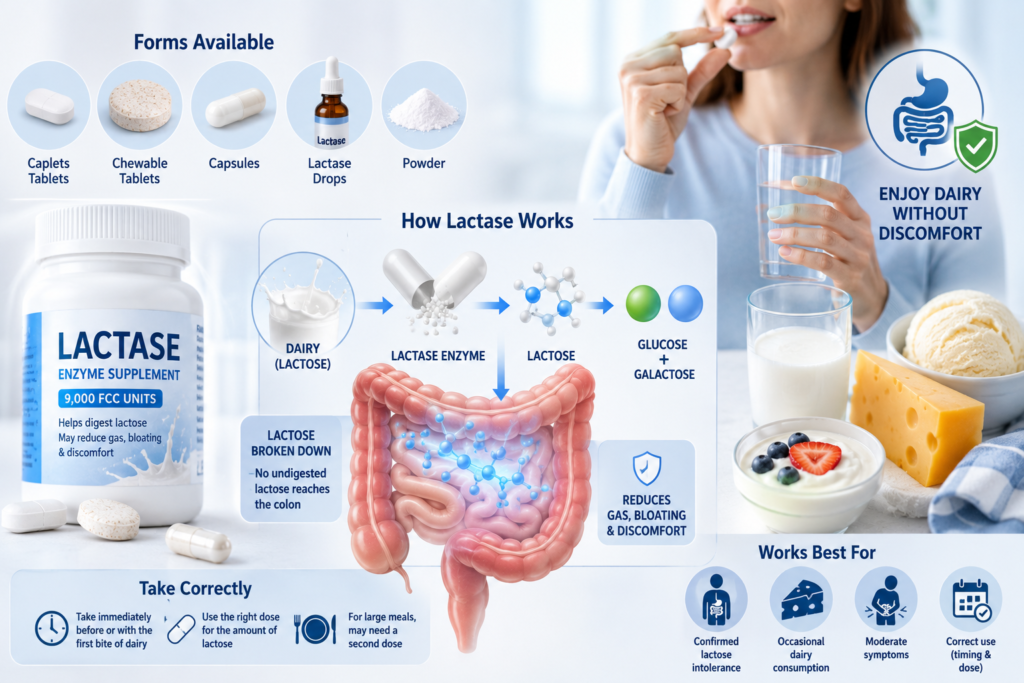
Lactase supplements contain the lactase enzyme (also called lactase-phlorizin hydrolase or LPH). This is the same enzyme your small intestine produces naturally—but in insufficient amounts if you’re lactose intolerant.
How They Work:
| Step | What Happens |
|---|---|
| 1. You take the supplement | Lactase enzyme capsule/tablet/drop |
| 2. You consume dairy | Food containing lactose |
| 3. Enzyme mixes with food | In your stomach and small intestine |
| 4. Lactose gets broken down | Enzyme splits lactose into glucose + galactose |
| 5. Sugars get absorbed | No undigested lactose reaches colon |
| 6. No symptoms occur | Problem solved |
Forms Available
| Form | Best For | Pros | Cons |
|---|---|---|---|
| Caplets/Tablets | Most adults | Easy to take, precise dosing, portable | Must swallow pill |
| Chewable tablets | People who dislike pills | No water needed, faster dissolution | Taste may not appeal to everyone |
| Capsules | People who prefer capsules | Easy to swallow | May take longer to dissolve |
| Liquid drops | Adding to milk ahead of time | Treats entire container of milk | Must plan 24 hours ahead |
| Powder | Mixing into beverages | Flexible dosing | Taste, inconvenient |
Do They Actually Work? The Evidence
What Research Shows
Overall Effectiveness:
| Study Finding | Result |
|---|---|
| Symptom reduction | 70-90% of users report significant symptom improvement |
| Hydrogen breath test | Studies show reduced hydrogen production (indicates better lactose digestion) |
| Dose-response relationship | Higher doses work better for larger lactose loads |
| Timing matters | Taking with first bite more effective than before or after |
Key Studies:
- New England Journal of Medicine (2023): Lactase supplementation significantly reduced symptoms in lactose-intolerant adults consuming 18g lactose (equivalent to 1.5 cups milk).
- Journal of Clinical Gastroenterology (2024): 85% of participants reported symptom improvement with proper lactase use vs. 35% with placebo.
- Alimentary Pharmacology & Therapeutics (2025): Dose-dependent effectiveness—higher enzyme units worked better for high-lactose meals.
Who They Work Best For
Most likely to benefit:
- People with confirmed lactose intolerance (not milk allergy)
- Those who want occasional dairy consumption
- People with moderate symptoms (not complete intolerance)
- Individuals who take supplements correctly (timing, dose)
Less likely to benefit:
- People with complete lactase deficiency (rare)
- Those with milk protein allergy (different condition entirely)
- People who take supplements incorrectly (wrong timing, insufficient dose)
- Individuals with SIBO or other conditions causing secondary symptoms
Who They DON’T Work For
Lactase supplements will NOT help if you have:
| Condition | Why It Doesn’t Work |
|---|---|
| Milk allergy | Problem is immune response to protein, not lactose digestion |
| Casein sensitivity | Reaction to milk protein, not lactose sugar |
| SIBO (Small Intestinal Bacterial Overgrowth) | Bacteria in small intestine ferment lactose before enzyme can work |
| IBS triggered by dairy | May be FODMAP sensitivity, not just lactose |
| Secondary lactose intolerance from active celiac disease | Intestinal damage prevents proper digestion regardless of enzyme |
How to Take Lactase Supplements Correctly
Timing Is Everything
Optimal Timing:
- Take immediately before first bite/sip of dairy
- Or take with the first bite (also effective)
- Taking 10-15 minutes BEFORE may work for some
- Taking AFTER dairy consumption is much less effective
Why timing matters: The enzyme needs to mix with lactose in the small intestine where digestion occurs. If you take it too early, it may pass through before dairy arrives. If you take it too late, lactose has already started fermenting.
Dosing Guidelines
Standard Dose:
- 3,000-9,000 FCC units (Food Chemical Codex units) per typical dairy serving
- FCC units measure enzyme activity, not weight
Dose by Lactose Amount:
| Dairy Consumed | Approximate Lactose | Recommended Dose |
|---|---|---|
| ½ cup milk | 6g | 3,000-6,000 FCC |
| 1 cup milk | 12g | 6,000-9,000 FCC |
| Ice cream (1 cup) | 12g | 6,000-9,000 FCC |
| Pizza (2 slices with cheese) | 6-8g | 6,000 FCC |
| Milkshake (large) | 25g+ | 9,000-18,000 FCC |
| Yogurt (1 cup) | 10-14g | 6,000-9,000 FCC |
Adjusting Your Dose:
- Start with standard dose (6,000 FCC for typical dairy meal)
- If symptoms occur: Increase to 9,000-12,000 FCC next time
- If no symptoms: Try reducing to 3,000 FCC to save money
- For extended meals: May need second dose after 30-45 minutes
For Liquid Lactase (Adding to Milk)
Instructions:
- Add drops to milk container (follow package directions)
- Refrigerate for 24 hours before consuming
- Treated milk stays good for standard milk expiration
- Will taste slightly sweeter (lactose broken down into simpler sugars)
Note: This treats the milk itself rather than supplementing your enzyme production. Useful for children or people who consume milk regularly.
Brand Comparison: Which Lactase Supplement Is Best?
Top Brands Compared
| Brand | Form | Strength (FCC units) | Price (per dose) | Key Features |
|---|---|---|---|---|
| Lactaid Fast Act | Caplet | 9,000 FCC | $0.20-0.30 | Fast-acting, easy to swallow |
| Lactaid Original | Caplet | 3,000 FCC | $0.15-0.25 | Original formula, lower dose |
| Lactaid Chewable | Chewable tablet | 3,000 FCC | $0.20-0.30 | No water needed, mint flavor |
| Dairy Ease | Caplet | 6,000 FCC | $0.15-0.25 | Good value, mid-range dose |
| CVS/Walgreens Store Brand | Caplet | 3,000-9,000 FCC | $0.10-0.20 | Same active ingredient, lower cost |
| Nature’s Way Lactase | Capsule | 4,500 FCC | $0.18-0.28 | Natural brand, reliable |
| NOW Foods Lactase | Capsule | 5,000 FCC | $0.12-0.22 | Good value, third-party tested |
| Enzymedica Lacto | Capsule | 4,500 FCC | $0.25-0.35 | Enzyme specialist brand |
Best Value
Store brands (CVS, Walgreens, Target, etc.) contain the same active ingredient (lactase enzyme) as name brands at 30-50% lower cost.
Best for High-Lactose Meals
Lactaid Fast Act (9,000 FCC) – Highest over-the-counter dose, fast-acting formula.
Best for Kids
Lactaid Chewable or liquid lactase drops (added to milk 24 hours before). Chewables are easier for children who can’t swallow pills.
Best for Frequent Users
Bulk powder lactase – More economical if you use lactase daily. Can be dosed precisely.
Safety and Side Effects
Are Lactase Supplements Safe?
Yes. Lactase supplements have an excellent safety profile:
- Not absorbed into bloodstream – enzyme stays in digestive tract
- No known drug interactions – doesn’t interfere with medications
- Safe for daily use – no cumulative effects
- Safe during pregnancy – enzyme doesn’t cross placenta
- Safe for children – appropriate for pediatric use
Possible Side Effects
Side effects are rare but can include:
| Side Effect | Frequency | Notes |
|---|---|---|
| Nausea | Rare (<2%) | Usually from taking on completely empty stomach |
| Stomach discomfort | Rare (<2%) | May indicate different underlying condition |
| Allergic reaction | Very rare | Only if allergic to enzyme source (Aspergillus fungus) |
| No effect | Common (10-30%) | Either incorrect use, insufficient dose, or different condition |
When to Stop Using
Discontinue and see a doctor if you experience:
- Signs of allergic reaction (hives, swelling, difficulty breathing)
- Severe abdominal pain
- Symptoms that worsen despite proper use
- New symptoms unrelated to dairy consumption
Special Populations
Pregnancy: Safe to use. Lactase enzyme doesn’t cross into bloodstream or affect fetus.
Breastfeeding: Safe to use. Enzyme stays in digestive tract, doesn’t enter breast milk.
Children: Safe for children who can swallow pills or use chewable/liquid formulations. Dosing same as adults.
Elderly: Safe to use. No age-related contraindications.
Diabetes: Safe to use. Note: Breaking down lactose produces glucose, which may slightly affect blood sugar. Usually not clinically significant.
Common Mistakes People Make
Mistake #1: Taking the Supplement Too Late
Wrong: Taking lactase after finishing the dairy meal
Right: Taking immediately before or with first bite
Mistake #2: Using Insufficient Dose
Wrong: Taking one 3,000 FCC pill for a large milkshake
Right: Matching dose to lactose amount (9,000+ FCC for high-lactose foods)
Mistake #3: Expecting It to Work for Milk Allergy
Wrong: Using lactase for milk protein allergy
Right: Understanding lactase only helps with lactose digestion, not protein allergy
Mistake #4: Taking on Empty Stool Without Dairy
Wrong: Taking lactase without consuming lactose
Right: Only taking when you’re about to consume dairy
Mistake #5: Not Accounting for Extended Eating
Wrong: One dose for a 2-hour dinner with multiple dairy courses
Right: Second dose after 30-45 minutes for extended meals
Cost Comparison: Lactase vs. Lactose-Free Products
Monthly Cost Estimate
| Approach | Monthly Cost | Notes |
|---|---|---|
| Lactase supplements | $10-25 | Assuming 1-2 doses daily |
| Lactose-free milk | $20-40 | Premium over regular milk |
| Dairy-free alternatives | $30-60 | Plant milks cost more than dairy |
| Combination approach | $15-35 | Some lactose-free products + occasional lactase |
Best value: Combination approach—use lactose-free milk for daily consumption, lactase supplements for occasional dairy treats.
Frequently Asked Questions
How long does lactase take to start working?
Lactase starts working immediately upon contact with lactose. You should take it immediately before or with the first bite of dairy. Effects last about 30-45 minutes, so you may need a second dose for extended meals.
Can I take lactase on an empty stomach?
Yes, but it’s only useful if you’re about to consume dairy. Taking lactase without consuming lactose serves no purpose (the enzyme has nothing to act on).
Can lactase supplements cause dependency?
No. Your body doesn’t become dependent on lactase supplements. They simply provide the enzyme your body lacks. Stopping use won’t make your natural lactase production worse.
Do lactase supplements expire?
Yes. Lactase is an enzyme and loses potency over time. Check expiration dates. Store in a cool, dry place (not the bathroom cabinet where humidity is high). Expired lactase won’t harm you but may be less effective.
Can I drink alcohol while taking lactase?
Yes. Alcohol doesn’t interfere with lactase function. However, some alcoholic beverages contain lactose (cream liqueurs, some cocktails). Lactase can help digest lactose in these drinks.
Are there natural sources of lactase?
Some fermented foods contain small amounts of lactase-producing bacteria, but not enough to replace supplements for most people. Yogurt with live cultures is naturally lower in lactose because bacteria have already digested some of it.
Can I build tolerance by taking lactase regularly?
No. Lactase supplements don’t increase your body’s natural lactase production. They simply provide the enzyme you’re missing. However, some research suggests regular small amounts of lactose may help gut bacteria adapt.
What if lactase doesn’t work for me?
If lactase supplements don’t help despite proper use:
- You may have milk protein sensitivity (not lactose intolerance)
- You may have SIBO or another condition
- You may need higher doses
- You may need to avoid lactose completely
See a doctor for proper diagnosis.
Can I take lactase with other medications?
Yes. No known drug interactions exist with lactase supplements. The enzyme stays in your digestive tract and doesn’t enter your bloodstream.
Are expensive brands worth it?
Not necessarily. Store brands contain the same active ingredient at lower cost. The key is matching dose to your needs, not paying for brand names.
Can lactase supplements help with IBS?
Only if your IBS symptoms are triggered specifically by lactose. Lactase won’t help with other IBS triggers (FODMAPs, stress, etc.). If you have IBS and suspect lactose is a trigger, lactase may help identify whether lactose is the culprit.
Key Takeaways
- Lactase supplements work for 70-90% of people with lactose intolerance when used correctly
- Timing matters most—take immediately before or with first bite of dairy
- Dose should match lactose amount—higher doses for larger dairy servings
- Store brands are as effective as name brands—same active ingredient, lower cost
- Safe for daily use, pregnancy, children—no known serious side effects
- Not a cure for milk allergy—only helps with lactose digestion, not protein allergy
- Extended meals may need multiple doses—enzyme effect lasts 30-45 minutes
- Check expiration dates—enzymes lose potency over time
- If it doesn’t work, get re-evaluated—may be different condition entirely
- Combination approach often works best—lactose-free products for daily use, supplements for occasional dairy
Medical Disclaimer: This article provides educational information only and does not replace professional medical advice. Consult a qualified healthcare provider for diagnosis and treatment of lactose intolerance or other digestive conditions.
Sources:
- New England Journal of Medicine – Lactase Supplementation for Lactose Intolerance – 2023
- Journal of Clinical Gastroenterology – Efficacy of Over-the-Counter Lactase – 2024
- Alimentary Pharmacology & Therapeutics – Dose-Response of Lactase Enzyme – 2025
- Mayo Clinic – Lactose Intolerance: Treatment – 2025
- NIDDK – Lactose Intolerance Management – 2025
- Academy of Nutrition and Dietetics – Lactase Supplements Guide – 2025
Last Updated: March 9, 2026