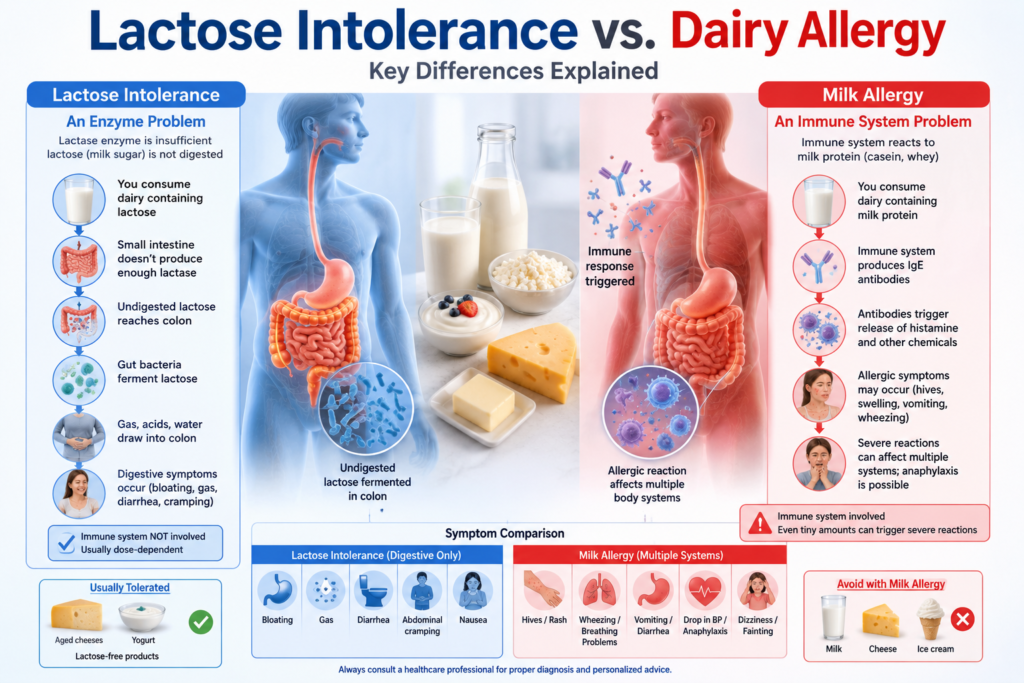
Lactose Intolerance vs. Dairy Allergy: Key Differences Explained
The Fundamental Difference
Lactose Intolerance: An Enzyme Problem
What it is: Inability to digest lactose (milk sugar) due to insufficient lactase enzyme
What happens:
- You consume dairy containing lactose
- Your small intestine doesn’t produce enough lactase enzyme
- Undigested lactose travels to the colon
- Gut bacteria ferment the lactose
- This produces gas, acids, and draws water into the colon
- Result: Digestive symptoms (bloating, gas, diarrhea)
Key point: The immune system is NOT involved. This is purely a digestive/enzymatic issue.
Milk Allergy: An Immune System Problem
What it is: Immune system mistakenly identifies milk protein as a threat and mounts an attack
What happens:
- You consume dairy containing milk protein (casein or whey)
- Immune system produces IgE antibodies against milk protein
- Antibodies trigger release of histamine and other chemicals
- Result: Allergic reaction affecting multiple body systems
Key point: This is an immune-mediated response that can affect skin, respiratory system, cardiovascular system, AND digestive system. Anaphylaxis is possible.
Side-by-Side Comparison
| Feature | Lactose Intolerance | Milk Allergy |
|---|---|---|
| What triggers it | Lactose (milk sugar) | Milk protein (casein, whey) |
| Body system involved | Digestive system only | Immune system (multiple organs) |
| Onset of symptoms | 30 minutes to 2 hours | Minutes to 2 hours (usually faster) |
| Digestive symptoms | Bloating, gas, diarrhea, cramping, nausea | Vomiting, diarrhea, abdominal pain |
| Skin symptoms | None | Hives, itching, swelling, eczema |
| Respiratory symptoms | None | Wheezing, coughing, runny nose, trouble breathing |
| Cardiovascular symptoms | None | Drop in blood pressure, rapid heartbeat, anaphylaxis |
| Severity | Uncomfortable but not dangerous | Potentially life-threatening |
| Amount needed to trigger | Usually dose-dependent (more lactose = worse symptoms) | Tiny amounts can trigger severe reaction |
| Age of onset | Usually after age 5 (often adolescence/adulthood) | Usually in infancy or early childhood |
| Outgrown? | No (but tolerance can vary) | Often outgrown by age 3-5 (80% by adolescence) |
| Prevalence | ~68% of global population | ~2-3% of infants; ~0.4% of adults |
| Treatment | Limit lactose; lactase supplements | Complete milk protein avoidance; epinephrine |
| Safe dairy options | Aged cheeses, yogurt, lactose-free products | NONE (all milk proteins must be avoided) |
Symptom Comparison
Lactose Intolerance Symptoms
Digestive Only:
| Symptom | Typical Timing | Severity |
|---|---|---|
| Bloating | 30 min – 2 hours | Mild to moderate |
| Abdominal cramping | 30 min – 2 hours | Mild to severe |
| Gas (flatulence) | 1-3 hours | Mild to moderate |
| Diarrhea | 30 min – 2 hours | Mild to moderate |
| Nausea | 30 min – 2 hours | Mild to moderate |
| Stomach gurgling | During digestion | Mild |
NOT seen in lactose intolerance:
- Hives or rash
- Swelling of lips, tongue, or throat
- Wheezing or difficulty breathing
- Drop in blood pressure
- Anaphylaxis
Milk Allergy Symptoms
Can Affect Multiple Systems:
| System | Symptoms | Typical Timing |
|---|---|---|
| Skin | Hives, itching, redness, swelling of lips/face, eczema flare | Minutes to 2 hours |
| Respiratory | Wheezing, coughing, runny nose, sneezing, trouble breathing, throat tightness | Minutes to 2 hours |
| Digestive | Vomiting (often prominent), diarrhea, abdominal pain, nausea | Minutes to 2 hours |
| Cardiovascular | Drop in blood pressure, rapid heartbeat, dizziness, fainting, anaphylaxis | Minutes to 2 hours |
| Neurological | Confusion, sense of doom, loss of consciousness (in anaphylaxis) | Minutes to 2 hours |
Anaphylaxis Signs (Medical Emergency):
- Difficulty breathing or swallowing
- Swelling of tongue or throat
- Wheezing or stridor (high-pitched breathing sound)
- Drop in blood pressure
- Rapid, weak pulse
- Dizziness or fainting
- Confusion or loss of consciousness
- Blue or pale skin
Call 911 immediately if anaphylaxis is suspected.
Why the Confusion?
Overlapping Digestive Symptoms
Both conditions can cause:
- Abdominal pain
- Diarrhea
- Nausea
- Vomiting (more common in allergy)
When digestive symptoms occur in isolation (without skin or respiratory symptoms), distinguishing between the two becomes challenging.
Similar Triggers
Both conditions are triggered by consuming dairy products. However:
- Lactose intolerance: Triggered by lactose-containing products
- Milk allergy: Triggered by milk protein (which is in all dairy)
Both Can Develop in Childhood
- Lactose intolerance: Typically develops after age 5 (as lactase production naturally decreases)
- Milk allergy: Typically develops in infancy or toddlerhood
Diagnostic Approaches
Lactose Intolerance Testing
| Test | What It Measures | Accuracy |
|---|---|---|
| Hydrogen Breath Test | Hydrogen in breath after lactose consumption (indicates undigested lactose) | 90-95% |
| Lactose Tolerance Test (Blood) | Blood glucose rise after lactose consumption | 75-85% |
| Stool Acidity Test | Acid in stool (from fermented lactose) | 70-80% (for infants) |
| Elimination Diet + Challenge | Symptom improvement with lactose avoidance | 70-80% |
| Genetic Testing | LCT gene variants associated with lactase deficiency | 85-90% (primary only) |
Milk Allergy Testing
| Test | What It Measures | Accuracy |
|---|---|---|
| Skin Prick Test | Immediate allergic reaction to milk protein on skin | 60-70% (good negative predictive value) |
| Specific IgE Blood Test | Milk-specific IgE antibodies in blood | 60-70% |
| Component Testing (Casein, Whey) | IgE to specific milk proteins | Better predictor of severity |
| Oral Food Challenge | Supervised consumption of milk under medical observation | Gold standard (100%) |
| Elimination Diet + Challenge | Symptom improvement with milk avoidance | 70-80% |
Key Diagnostic Differences
| Aspect | Lactose Intolerance | Milk Allergy |
|---|---|---|
| Test type | Breath test, blood glucose, stool test | Skin test, IgE blood test, food challenge |
| Specialist | Gastroenterologist | Allergist/Immunologist |
| Urgency | Routine evaluation | May need urgent evaluation if severe reactions |
| At-home testing | Elimination diet reasonably reliable | NOT recommended (risk of severe reaction) |
Treatment and Management
Lactose Intolerance Management
Dietary Approach:
- Reduce or eliminate lactose-containing foods
- Most people can tolerate SOME lactose (find your threshold)
- Aged cheeses and yogurt often tolerated
- Lactose-free dairy products available
Enzyme Replacement:
- Lactase supplements (Lactaid, Dairy Ease)
- Take immediately before consuming dairy
- Effective for 70-90% of people
Nutritional Considerations:
- Ensure adequate calcium and vitamin D
- Many non-dairy calcium sources available
- Supplements may be helpful
Long-term Outlook:
- Permanent condition (if primary/genetic)
- Tolerance may vary over time
- Not dangerous, just uncomfortable
Milk Allergy Management
Dietary Approach:
- COMPLETE avoidance of all milk protein
- No safe threshold (even trace amounts can trigger reaction)
- Read all labels carefully
- Avoid cross-contact (shared equipment, surfaces)
Emergency Preparedness:
- Epinephrine auto-injector (EpiPen, Auvi-Q) always available
- Allergy action plan
- Medical alert bracelet
- Family, school, caregivers trained on emergency response
Hidden Sources of Milk Protein:
- Casein, caseinates, whey
- Lactoglobulin, lactalbumin
- Ghee, butter (contains protein even if low lactose)
- Some “non-dairy” products contain casein
- Some medications and supplements
Cross-Contact Prevention:
- Separate cooking utensils and surfaces
- Careful when dining out
- Beware of shared fryers, grills, preparation areas
Long-term Outlook:
- 80% of children outgrow by adolescence
- Adult-onset milk allergy is less likely to resolve
- Regular re-evaluation with allergist
- Oral immunotherapy (OIT) available at specialized centers
Safe and Unsafe Foods
Lactose Intolerance
| Category | Usually Safe | Use Caution | Avoid |
|---|---|---|---|
| Milk | Lactose-free milk, plant milks | Regular milk (small amounts may be OK) | Large servings of milk |
| Cheese | Aged cheeses (cheddar, Swiss, parmesan) | Mozzarella, fresh cheeses | Processed cheese products |
| Yogurt | Yogurt with live cultures, lactose-free yogurt | Regular yogurt | Large servings of regular yogurt |
| Ice Cream | Dairy-free ice cream, lactose-free ice cream | Regular ice cream (small amounts) | Large servings of ice cream |
| Butter | Butter (low lactose), ghee | — | Cream, half-and-half |
| Baked Goods | Dairy-free baked goods | Products with aged cheese | Products with milk, whey, milk solids |
Milk Allergy
| Category | Safe | Unsafe |
|---|---|---|
| Milk | Plant milks (soy, almond, oat, etc.) | ALL animal milks (cow, goat, sheep, etc.) |
| Cheese | Dairy-free cheese alternatives | ALL dairy cheese |
| Yogurt | Dairy-free yogurt | ALL dairy yogurt |
| Ice Cream | Dairy-free ice cream | ALL dairy ice cream |
| Butter | Dairy-free spreads, oils | Butter, ghee, margarine with milk |
| Baked Goods | Confirmed dairy-free | Any product with milk ingredients |
| Protein | Meat, fish, poultry, eggs, legumes | Whey protein, casein protein |
Label Reading for Milk Allergy:
ALWAYS avoid these ingredients:
- Milk, milk solids, milk powder
- Casein, caseinates (calcium caseinate, sodium caseinate)
- Whey, whey protein, whey hydrolysate
- Lactoglobulin, lactalbumin, lactoferrin
- Curds, rennet casein
- Ghee, butter, cream
- Yogurt, kefir
- “May contain milk” warnings
“Non-dairy” doesn’t always mean milk-free:
- Non-dairy creamers often contain casein
- Check ingredient list carefully
Special Considerations
Breastfeeding
Lactose Intolerance:
- Breast milk contains lactose
- True lactose intolerance is rare in infants
- Secondary lactose intolerance can occur after gastroenteritis
- Usually temporary
Milk Allergy:
- Cow’s milk protein can pass through breast milk
- Breastfeeding mothers may need to eliminate dairy from their diet
- Symptoms in infant should improve within 2-4 weeks of maternal elimination
- Work with pediatrician and allergist
Formula Feeding
Lactose Intolerance:
- Lactose-free formula available
- Soy-based formula is lactose-free
- Usually temporary in infants
Milk Allergy:
- Extensively hydrolyzed formula (protein broken down)
- Amino acid-based formula (no intact protein)
- Soy formula may work for some (but some react to soy too)
- Goat milk formula NOT safe (proteins are similar)
Vaccines and Medications
Lactose Intolerance:
- Some medications contain lactose as filler
- Usually tolerated (amounts are small)
- Check with pharmacist if concerned
Milk Allergy:
- Some vaccines contain milk protein
- Influenza vaccine: Some formulations safe, some not
- MMR vaccine: Generally safe (despite previous concerns)
- Always inform healthcare providers of allergy
- Some medications may contain milk derivatives
Dining Out
Lactose Intolerance:
- Ask about butter, cream, cheese in dishes
- Most restaurants can accommodate
- Lactase enzyme can be taken before eating
Milk Allergy:
- Inform restaurant of allergy (not just preference)
- Ask about cross-contact prevention
- Some cuisines higher risk (Italian, French, Indian)
- Carry epinephrine when dining out
When to See a Specialist
See a Gastroenterologist If:
- You suspect lactose intolerance
- Elimination diet doesn’t improve symptoms
- Symptoms persist despite lactose avoidance
- You need breath testing or other diagnostic evaluation
See an Allergist/Immunologist If:
- You suspect milk allergy
- You’ve had any reaction beyond digestive symptoms
- You need skin testing or IgE testing
- You need an epinephrine prescription
- You want to discuss oral immunotherapy
- You’re wondering if your child has outgrown the allergy
Frequently Asked Questions
Can you have both lactose intolerance and milk allergy?
Yes, though it’s uncommon. Someone with milk allergy could also develop lactose intolerance (especially if intestinal damage occurred from allergic reactions). Management would require avoiding both milk protein AND lactose.
Can lactose intolerance turn into a milk allergy?
No. These are fundamentally different conditions. However, someone might develop a milk allergy independently, or what was thought to be lactose intolerance might actually be milk allergy (misdiagnosis).
If I’m lactose intolerant, can I eat butter?
Butter contains very little lactose (about 0.1g per tablespoon). Most lactose-intolerant people tolerate butter well. Ghee (clarified butter) has virtually no lactose.
If I have a milk allergy, can I eat lactose-free products?
NO. Lactose-free products contain milk protein (that’s what causes allergic reactions). Lactose-free milk is still cow’s milk—it just has lactase enzyme added. People with milk allergy must avoid ALL dairy, including lactose-free products.
Can milk allergy develop in adulthood?
Yes, though it’s less common. Adult-onset milk allergy tends to be persistent (less likely to resolve than childhood-onset). Any new allergic reaction to dairy in adulthood warrants medical evaluation.
Is goat milk safe if I’m allergic to cow milk?
Generally NO. Goat milk proteins are similar enough to cow milk proteins that most people with cow milk allergy will also react to goat milk. Some people tolerate it, but attempting this should only be done under medical supervision.
Can I outgrow lactose intolerance?
Primary (genetic) lactose intolerance is permanent. However, tolerance can vary—some people find they can tolerate small amounts regularly. Secondary lactose intolerance (after illness) often resolves when the intestine heals.
Can I outgrow milk allergy?
Yes. Approximately 80% of children outgrow milk allergy by adolescence. Regular follow-up with an allergist can determine when it’s safe to reintroduce milk. Adult-onset milk allergy is less likely to resolve.
What’s the difference between milk allergy and dairy sensitivity?
“Dairy sensitivity” is a vague, non-medical term. It could refer to lactose intolerance, milk allergy, or non-IgE mediated reactions. Get proper testing to determine the specific condition.
Are home allergy tests reliable?
At-home IgG food sensitivity tests are NOT reliable for diagnosing milk allergy. They measure IgG antibodies, which indicate exposure to foods, not allergy. Proper diagnosis requires skin prick testing, IgE blood testing, or oral food challenge supervised by an allergist.
Key Takeaways
- Lactose intolerance is an enzyme problem; milk allergy is an immune system problem
- Lactose intolerance causes digestive symptoms only; milk allergy can cause anaphylaxis
- Lactose intolerance is dose-dependent; milk allergy can be triggered by trace amounts
- Lactose-free products are NOT safe for milk allergy (they still contain milk protein)
- Aged cheeses are often tolerated in lactose intolerance; NONE are safe in milk allergy
- Lactose intolerance is usually permanent; milk allergy is often outgrown
- Different specialists: Gastroenterologist for lactose intolerance; Allergist for milk allergy
- Different tests: Breath test for lactose intolerance; Skin/IgE tests for milk allergy
- Emergency preparedness matters: Epinephrine required for milk allergy, not for lactose intolerance
- When in doubt, get tested: Self-diagnosis can lead to unnecessary restrictions or dangerous situations
Emergency Warning: When to Seek Immediate Help
Call 911 immediately if someone experiences ANY of these after consuming dairy:
- Difficulty breathing or swallowing
- Swelling of tongue, lips, or throat
- Wheezing or high-pitched breathing sounds
- Widespread hives or rash
- Drop in blood pressure (dizziness, fainting)
- Rapid, weak pulse
- Confusion or loss of consciousness
- Blue or pale skin
- Sense of doom
These are signs of anaphylaxis—a life-threatening emergency requiring immediate epinephrine and emergency medical care.
Medical Disclaimer: This article provides educational information only and does not replace professional medical advice, diagnosis, or treatment. If you suspect lactose intolerance or milk allergy, consult qualified healthcare providers (gastroenterologist for lactose intolerance; allergist/immunologist for milk allergy).
Medical Review: This content has been reviewed for accuracy against current guidelines from the American Academy of Allergy, Asthma & Immunology (AAAAI), American College of Gastroenterology, and National Institute of Allergy and Infectious Diseases (NIAID).
Sources:
- American Academy of Allergy, Asthma & Immunology – Milk Allergy Guidelines – 2025
- NIAID – Food Allergy Guidelines – 2025
- American College of Gastroenterology – Lactose Intolerance Guidelines – 2025
- Mayo Clinic – Lactose Intolerance vs. Milk Allergy – 2025
- Cleveland Clinic – Milk Allergy in Children – 2025
- Journal of Allergy and Clinical Immunology – Milk Allergy Diagnosis and Management – 2025
Last Updated: March 9, 2026